Playable Books
Hector Berlioz · section 42 of 67
Voices
Read and hear this section in the playable edition →Voices are naturally divided into two great categories: the male (or low) and the female (or high) voices; the latter comprise not only women's voices but also those of children of both sexes and the voices of artificial sopranos and altos (castrati). Each of these two categories is subdivided into two classes, which, according to the generally accepted theory, have the same range but different pitch, The assumption customary in all Italian and German singing schools is that the low male voice—the bass—reaches from F under the stave of the F-clef to D and E® above the stave; and that the high male voice—the tenor—is a fifth above the bass and goes from C under the stave of the tenor-clef to A and Bb above it. Women's and children’s voices range in the same order, exactly an octave above the two men’s voices: contralto (corresponding to the bass) and soprauo (corresponding to the tenor). Hence the contralto can go (like the bass) from the low F to the high E> {almost two octaves), and the soprano (like the tenor) from low C to high Bo,
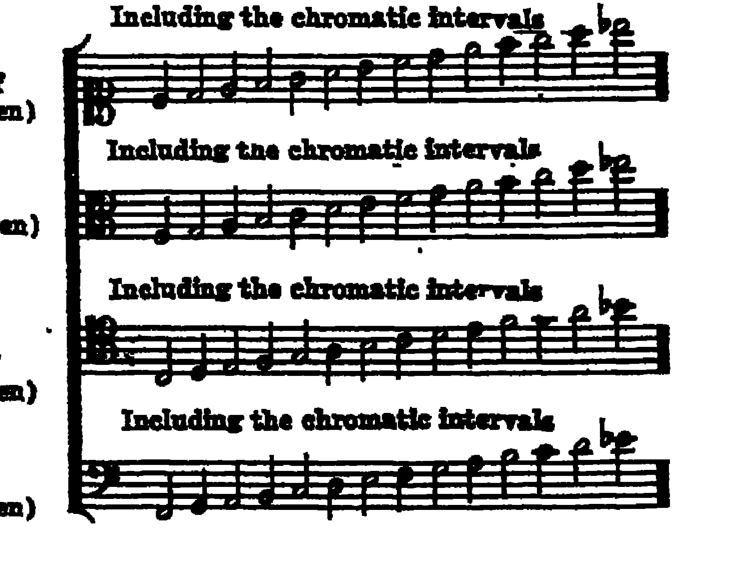
(high voice of men)
(low voice of women & children)
Glow voice of men)
Doubtless this regular division of the four most easily distinguishable human voices is very tempting. But close examination shows that it is in many respects insufficient and harmful, since its rigid observance would deprive the choral composer of many precious voices. In reality nature does not proceed the same way in all climates.
While it is true that it produces many contralto voices in Italy, it cannot be denied that it is very sparing with them in France. Tenors who can easily reach high A and B? are plentiful in Italy and France; but they are rare in Germany, where—as a compensation—their low tones are more sonorous than in the other countries. Therefore, it appears to me very unwise to write choruses always in four real parts in accordance with the classical division into soprano, contralto, tenor and bass. In Paris, at any rate, the contralto in such a chorus (especially if it is numerous) would be so weak in relation to the other voices that the effect planned by the composer would be distorted. It is equally certain that the majority of tenors in Germany, and even in Italy and France, if kept within the traditions] limits (that is, a fifth higher than the bass) would break down in passages where the composer them to go up to the high A or BD; or else they would produce false, forced or ngly sounds. The case is exactly the opposite with the basses; most of them lose much of their sonority below C or B, It is therefore useless to write G and F for them, Since nature
sider it more prudent, more practical and even more musical—if one wants to give each voice the same importance—to write either for six parts: first and second soprano, first and second tenor, baritone and bass (or first and second bass); or for three parts, taking care to divide each part as the voice approaches the limits of its range: the first bass then takes the notes too low for the second bass, but a third, a fifth or an octave higher; notes too high for the first soprano or first tenor are given to the medium range of the second soprano or second tenor. It is less important to separate the first sopranos from the second if a phrase goes very low than in the opposite instance. It is true that high voices lose all their power and their peculiar character if forced to sing tones properly belonging to the contralto or to the second soprano; but at least they are not in danger of producing ugly sounds such as the second sopranos do when forced to go up too high. It is
scend much lower; the first basses do not resch as low as the second and at the same time can scarcely go higher. In a chorus written—as I propose—in six parts, the real contraltos { a large chorus always includes a greater or smalier number of them) must necessarily sing the second-soprano part; where the part goes above the high F, they must be divided once more lest the lower, true contraltos be forced to scream notes too high for them.
$ (All this is very worthy of note.)
The following list shows the range of the most sonorous tones of the seven different voices found in most large choruses. Not included are the extremely high or low tones arailable only to a few singers. These should therefore be used only in exceptional cases.
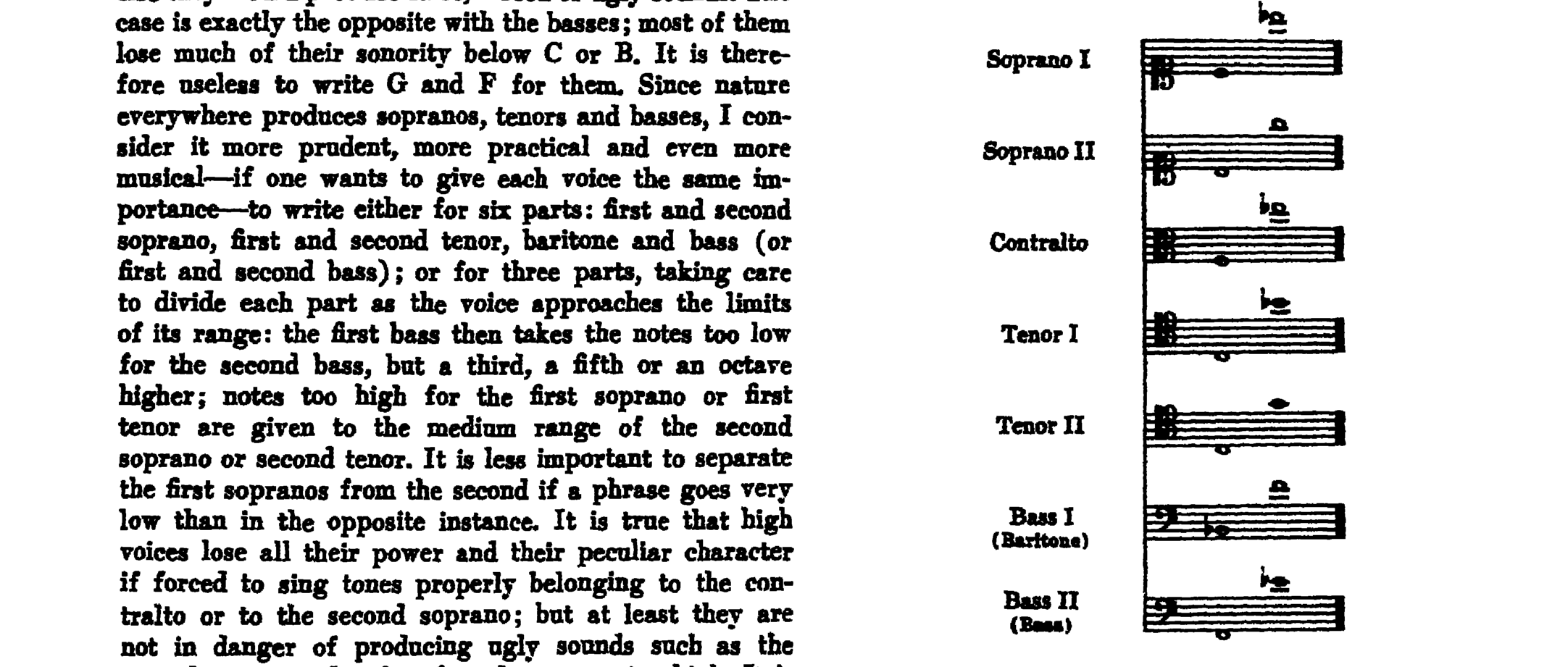
the same with the two other voices. The second soprano and the second tenor are usually a fourth below, and the first bass the same distance above the main voice whose name they bear, and they have almost the same range; this, however, applies more to the second soprano than to the second tenor and first bass, If the second soprano is sasigned @ range of an octave and a sixth, from B to G:

all the tones will sound well. It will not be quite the same with the second tenor if it is given a scale of the same length; its low D, C and B would have scarcely any sonority. Unless a special effect is intended, it is better to avoid these notes and to give them to the first or second basses, who can sing them with perfect ease. The opposite is found regarding the first basses or baritones: suppose they were a third above the second basses and their scale would consequently extend from the low A to the high G, then, the low A would be dull weak, the high G forced. Hence it follows that the ond tenors and first basses have the smallest range:
second tenors can neither go as high as the first nor de-
Three-part women’s choruses have an enchanting effect in compositions of a religious or tender character. They are divided into the voices just mentioned: first and second soprano and contralto, Sometimes a tenor part is added as a bass to these three women’s voices. Weber has done so with success in his chorns of elves in “Oberon”. But this is only advisable if a soft and quiet effect is intended, since such a choras can obviously not have much power, On the other hand, choruses com-
only of men’s voices are very powerful, particularly when the voices are lower and less divided. Dividing the basses into first and second (to avoid high notes) is not so necessary if rough and wild effects are intended; for the forced tones (such as the high F and F*) are better suited because of their peculiar character than the natural tones of the tenors on the same notes. But these tones should be skillfully prepared; one must not jump abruptly from the medium or even the low range to the extreme upper register. Gluck, in his terrible choras of Scythians in the second act of “Iphigénie en Tauride”,
and
lets all the basses, joined with the tenors, sing the high
sec-
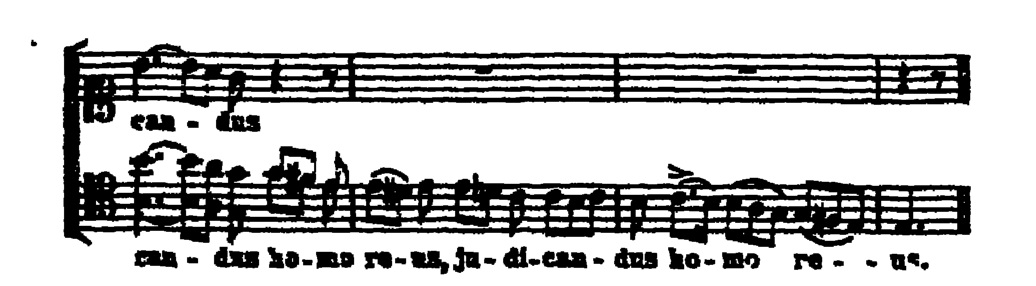
F# with the words, “Ys nous aménent des victimes”;
the
but this F¥# is twice preceded by a D, and by binding the two notes on the syilable “nous” the voice is easily carried from the D to the F=.


Tis sous a - - ma-nent des vie.ti- - mes.
The sudden unison of the tenors and basses gives the phrase so much sonority and emphasis that it is impossible to hear it withont shuddering. Here we have anether of those toucles of genius that are to be found on almost every page in the scores of this giant of dramatic music.
Aside from a particular idea of expression which was apparently decisive in this ease, simple considerations of yeeal scoring may frequently necessitate such choral anisons. For instance. if a certain melody leads the first tenors up to the B {2 dangerous tone. which should better be avoided’, one can let the second soprano and contralto join the tenor just for this passage: they can sing easily in unison with the tenors, blending with them and supporting their intonation.
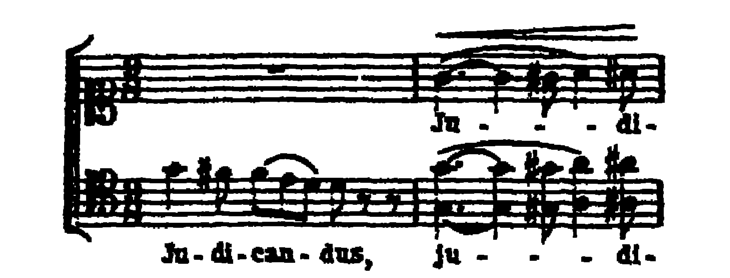
Tenor I & If
On the other hand, if the tenors are forced by the design of a melody to descend too low, the first basses serve to support and reinforce them, without changing the character of the sound conspicuously. It would be different, of course, if the tenors or—still worse—the basses were to support the contralto and second soprano voices; for the female voices would be overshadowed and their sound would be suddenly changed by the entry of the male voices so as to destroy completely the unity of such a passage. This method of supporting one voice by another must therefore not be employed indiscriminately for all voices if one wants to preserve the peculiar character of the voice carrying the melody and of the voice taking it over. For, I repeat, just as the contraltos in their middle register become lost when sustaining in unison the high register of the tenors, so, on the other hand. would the middle range of the tenors—joining the low register of the second sopranos—cover them so that the sopranos would be almost completely inaudible. If the composer simply wants to add the range of one voice to that of another in a descending melodic line, he must not let a mass of heavy timbres suddenly follow one of lighter quality because the joining-point would be too apparent. In such cases it is better to let the upper half of the high voices cease first and then to replace it by the upper half of the low voices, whereas the lower half enters a little later. For instance, let us assume a descending scale of considerable extent, beginning with the
_high G sung by the combined first and second sopranos;
when the scale reaches E, a tenth below the initial G, the first sopranos stop and the first tenors enter on D (a tone below the last E of the high sopranos); the second sopranos continue the descending movement unisono with the first tenors, stopping only on the low B, whereupon the second tenors enter on A, in unison with the first tenors; then these cease on F, to be replaced by the first basses; the junction of the second basses with the second tenors takes place on the low D or C; and finally the two groups of basses descend together to the low G. The result for the hearer will be a descending scale of three octaves, during which the voices follow each other in such a way that the transitions are scarcely noticeable.
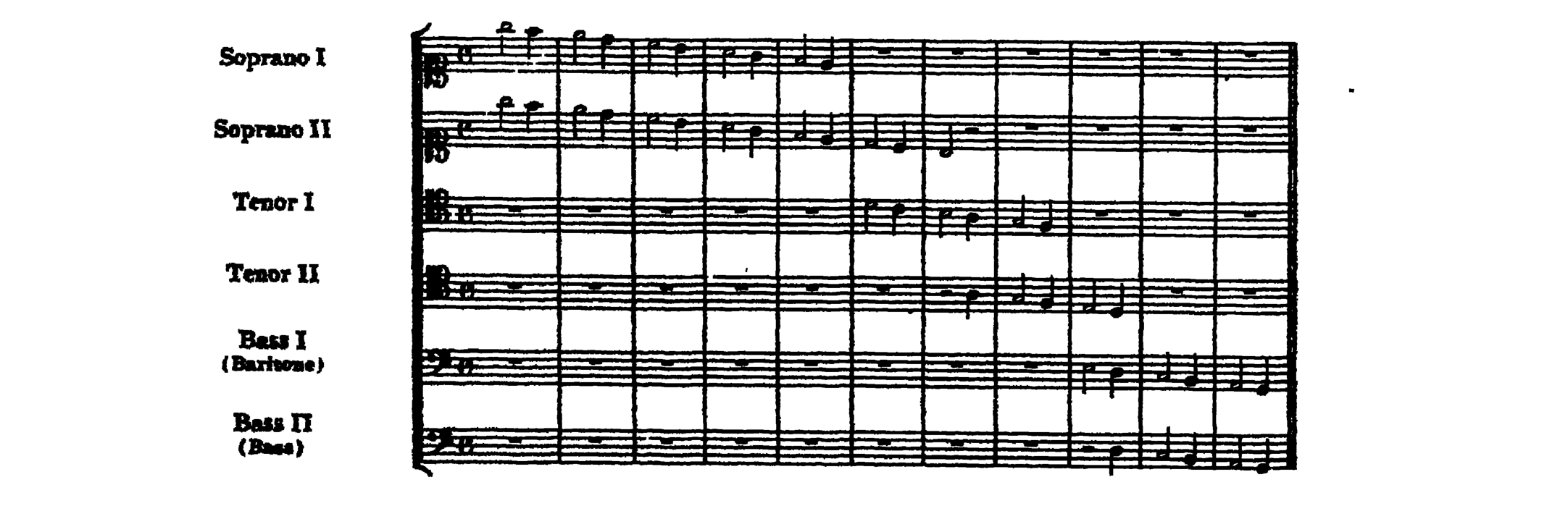
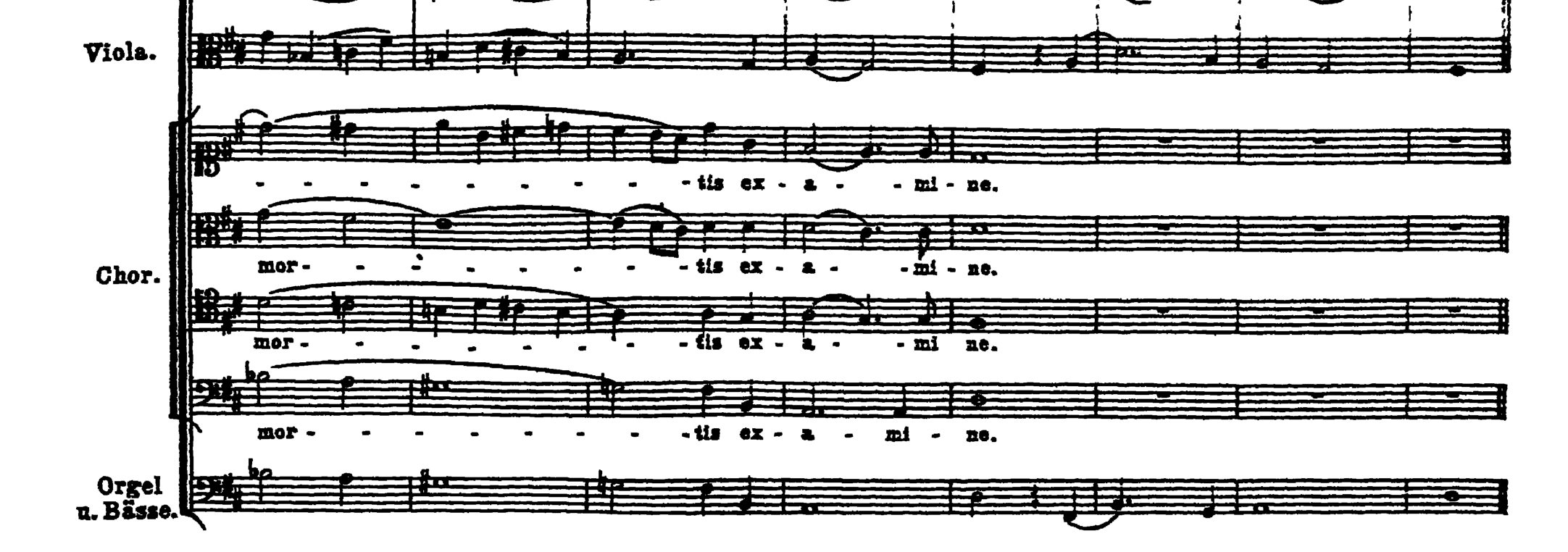
After these remarks the reader will easily understand that the composer has to adapt the choice of vocal registers to the character of the composition. For an Andaute in sustained and soft tones he would employ only the tones of the medium register; they alone have the suit-
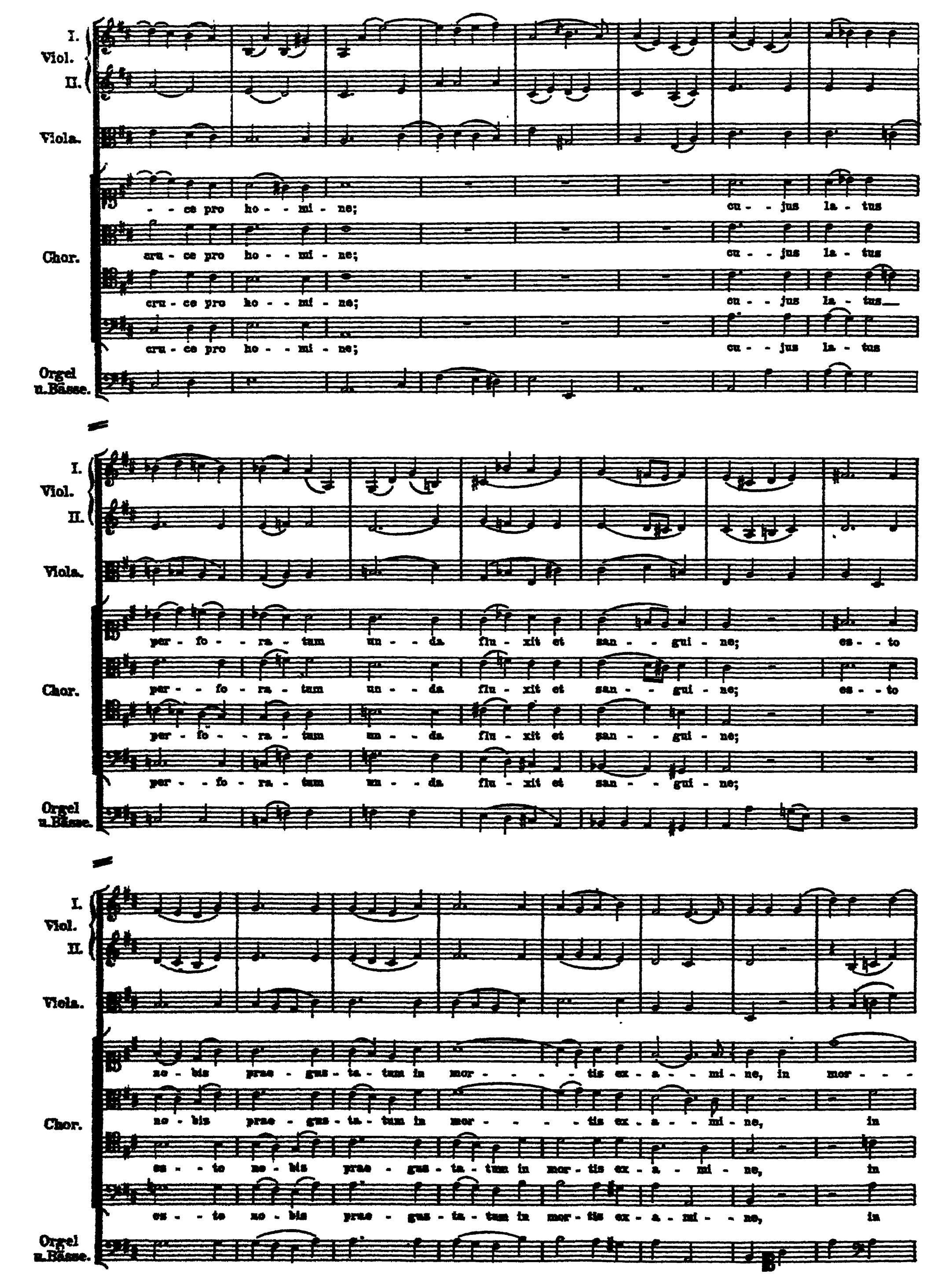
able timbre, they move with calmness and precision and can be sustained pianissimo without without the slightest effort. This is what Moxart did in his sublime prayer “Ave verum corpus” (Example 186).
136. ave verum corpus
Chor. ao Ma-ri-a vir. - gi - ne, ve- - re pas - sem, m- - mo- le- tm in
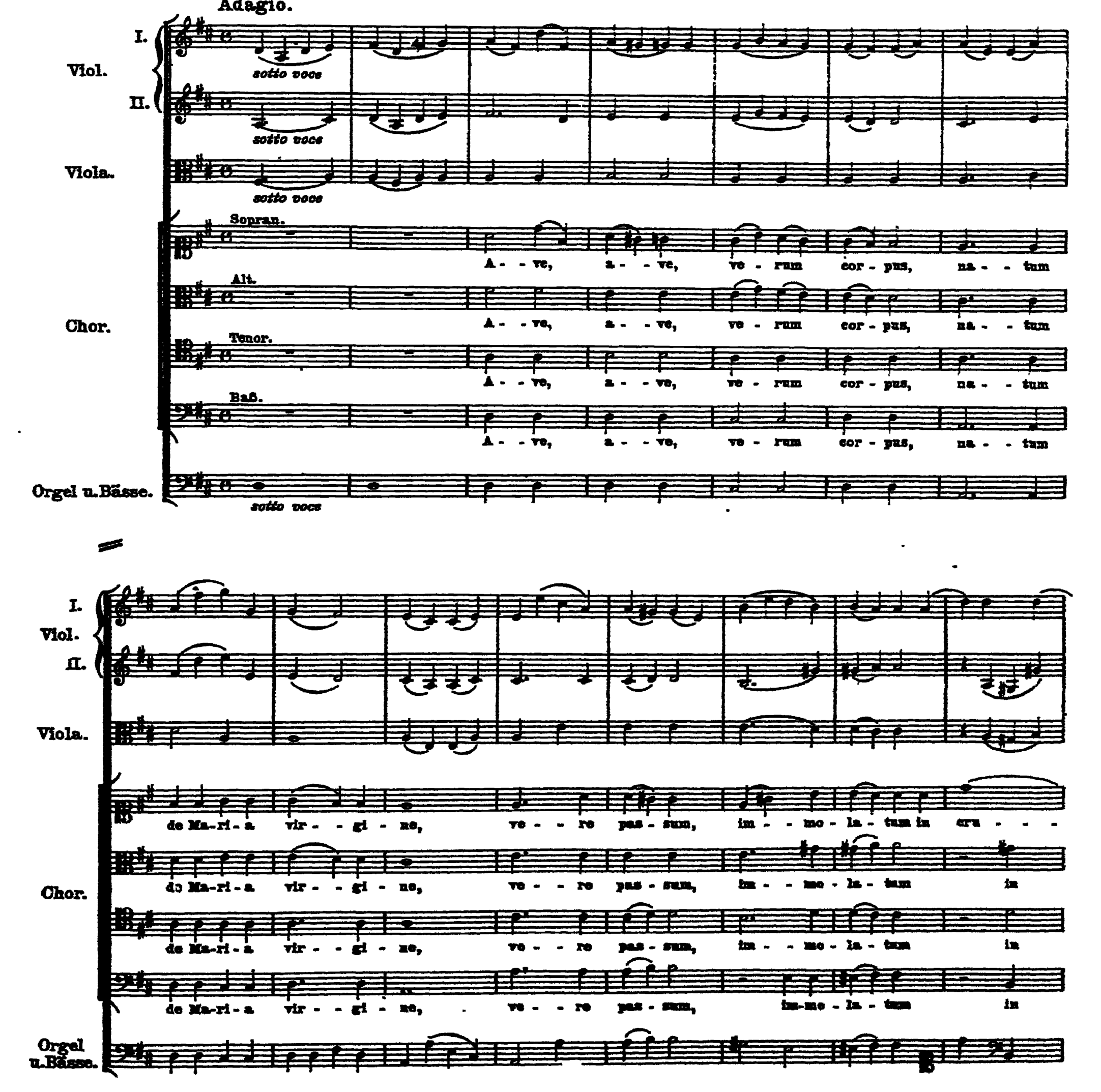
de Ma-ri-s vir - - gi - ue, wa- - To pee - sam, im- « mo-~ ia - Gun in
de Ma-ri-a vir- - gi - me,. vwe- - re ypas- Sum, im-me - In - tom in ac. dis pree - gus-ta- tam in mor- - - - Hs e-a- - mi-ne, in mor - - -
no - bis prae - gus - ta- tam te mor - - - -ts xca- - mi - ne, in
es - -to ne- ts yee - gus- ta- tem in mor. tis ex-a - mi - ne, in



Excellent effects can be obtained from the lowest tones f the bass—such as the E> and even the D under the tave. Many voices can produce them easily if they have ime to take them (i.e. if they are preceded by a rest for reathing) and if they coincide with sonorous syllables. Yn the other hand, choral pieces of brilliant, pompous or iolent character should be written somewhat higher; ut the high tones must not predominate continually or must the singers be forced to pronounce a great numer of words rapidly. The resulting fatigue would soon npair the execution; and such a succession of high tones n different gyllables is also rather unpleasant from the stener’s point of view.
Beethoven, in his inspired impetuosity, unfortunately did not avoid this mistake in his choral works (i.e. Ninth Symphony, Missa Solemnis). On the other hand, because of the recklessness of his magnificent choral polyphony, the great Johann Sebastian Bach often makes the voices (tenor, contralto and especially second soprano) descend so low that the most important fugue subjects can be imagined by the reader of the score, but not heard with clarity by the listener. For the sake of the polyphonic clarity of these wonderful creations it would almost be advisable to arrange Bach’s great choral works according to Berlioz’ ideas, bringing in a few tenors for important passages to support excessively low phrases of the sopranos, or & few basses (or bafitones) for the support of alto or tenor melodies descending too low. The general imitation of this method is warmly recommended. A good example of beautiful treatment of the chorus is the a-capella prayer in the third act of “La Muette de Portici”, where the anisono of the medium range of sopranos and contraltes produces an excellent effect.
We have not as yet spoken of the very high tones which are called head tones or falsetto, Those of the tenors are of great beauty and extend the normal range considerably; with the head voice some can reach E® or even F above the stave without effort. These tones might be used more frequently and successfully in choruses if choral singers were more proficient in the art of singing. The head voice of -basses and baritones is tolerable only in an extremely light style of music—such as the French comic operas; these high, feminine-sounding tones, so different from the natural tones of the low voices—the so-called chesi-coice—have actually something repulsive about them, except in the case of musical jokes. There has never been any attempt to employ them in a chorus or vocal piece of noble style.
The point where the chest voice ends and the head voice starts cannot be determined exactly. Skillfal tenors are able to produce certain high tones such as A, B and even C in forte with the chest or head voice, as they choose; but I believe that the high B> should generally be considered the extreme limit of the chest voice of the first tenor. This again proves that the tenor voice is not strictly a fifth above the bass, as is stated in most school theories; for among twenty basses selected at random at least ten will be able to sing the high F# in chest voice after due preparation, whereas one cannet find among an equal number of tenors a single voice able to sing a tolerably good high C* in chest voice.
The old masters of French opera, who never employed the head voice. wrote for a voice which they called hoxte-contre, and which foreigners, deceived by the meaning of the Italian word coxtratto, often mistake for the low women’s voice. However, this uame indicates a male voice trained to sing almost exclusively the five bigh tenes (inciuding B} of the first tenor's compass in chest voice. It is generally assumed that the normal pitck was at that time a tone lower than at present; but this assumption dues not seem to me to be irrefutable anc entirely certain. If a high B occurs in a chorus nowsdays, most tenors take it in head voice; only the very high tenors (the hautes-contre) use the chest voice withott hesitation.
Children’s voices are of excellent effect in large choirs. Boys’ sopranos have something incisive and crystalline about them which is lacking in the timbre of women’s sopranos. However, in soft, dignified and calm compositions the Iatter appear to me preferable because of their faller and less strident sound. As ‘for artificial sopranos and contraltos—to judge from those I have heard in Rome—it does not seem that their almost complete disappearance is to be regretted.
In northern Germany and in Russia there are besses of such low range that composers are not afraid to let them sustain the low D and C under the stave even without any preparation. These precious low voices contribate considerably to the wonderful effect of the choir in the Imperial Chapel in St. Petersburg—the foremost choir in the world according to the judgment of all who have beard it. In the high registers. however, these very low bass voices can scarcely reach B or C above the stave.
To employ the lowest tones of the bass voices appropriately, one must guard against giving them rapid successions of tones with too many words. Vocalizing (i.e. holding one vowel or syllable during several notes) o choruses in the low part of the scale is of extremely poor effect; it is not much better in the medium range.
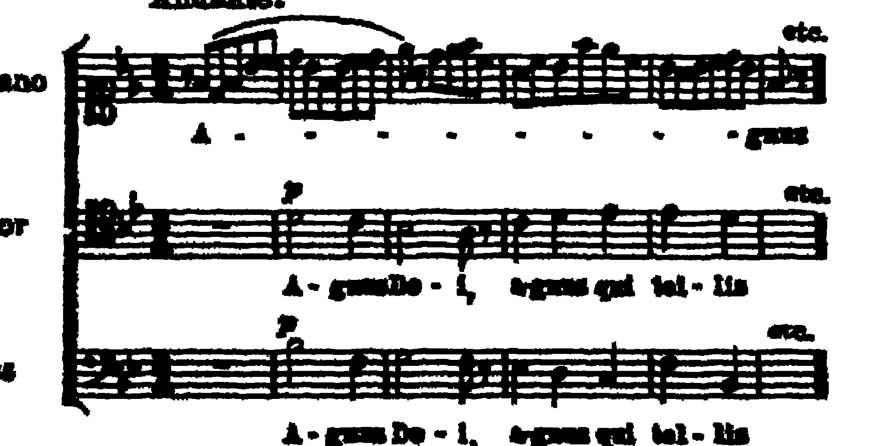
In spite of the example set by most of the famous masters, let us hope that those ridiculous tonal roulades on the words “Kyrie eleison” or “‘Amen”, which contribute toward making vocal fugues in church music an indecent and abominable tomfoolery, will be banned from any sacred composition aspiring to be worthy of its purpose, However, slow and soft vocalizations of sopranos secompanying « melody of lower voices have a pious and seraphic expression. One must not forget to intersperse them with short rests to give the singers time for breathing.
In performing a phrase which cannot be sang in one breath, a large chorus (e.g. a hundred sopranos) is divided so that four groups of twenty-five sopranos each breathe in four different places in the phrase. This is exactly the same method as that used in extended violin melodies where only one stroke of the 2 how is indicated.
The special kinds of voice production in men’s voices called mired and dark voice are very valuable and lend a peculiar character to solo as well as choral singing. The mixed roice combines, to a certain degree, the sound of the chest voice and the head voice. As with the latter, it is impossible to determine fixed upper and lower limits for the mixed voice. One voice can produce very high mixed tones; others cannot go so high. The dark voice— whose character is indicated by its name—depends not only on the manner of production, but also on the degree of force and on the expression of the singer. A chorus in not too fast tempo, which is to be sung softly (sotto voce), can very easily be executed in dark voice, pro-
vided that the singers possess a feeling for expression as well as experience in singing. This kind of execution always produces a great effect if contrasted with the powerful and brilliant tones of a forte in the high range.
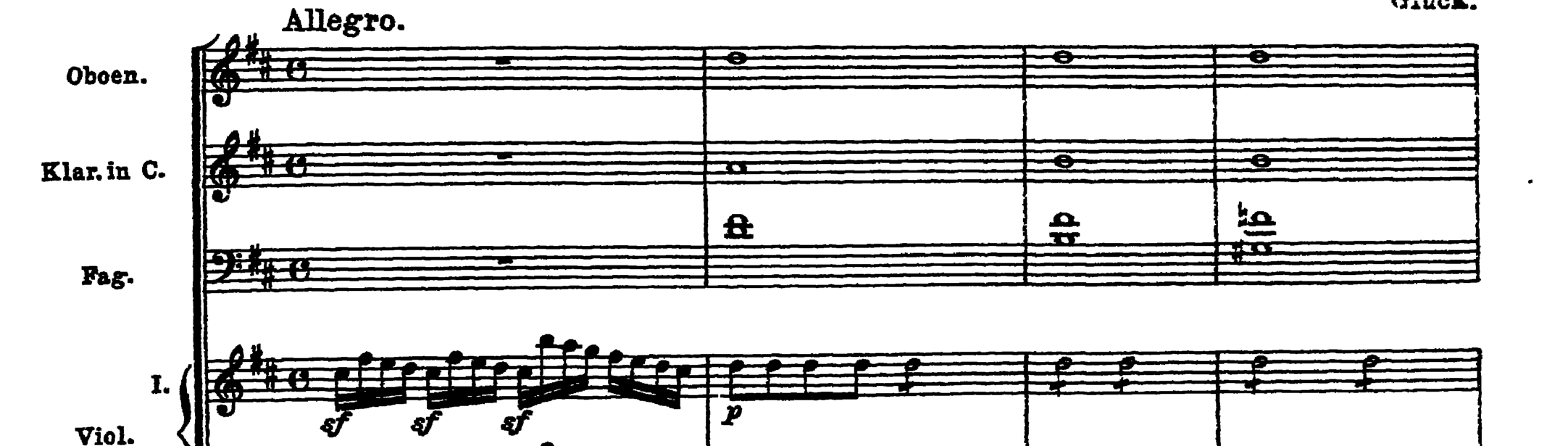
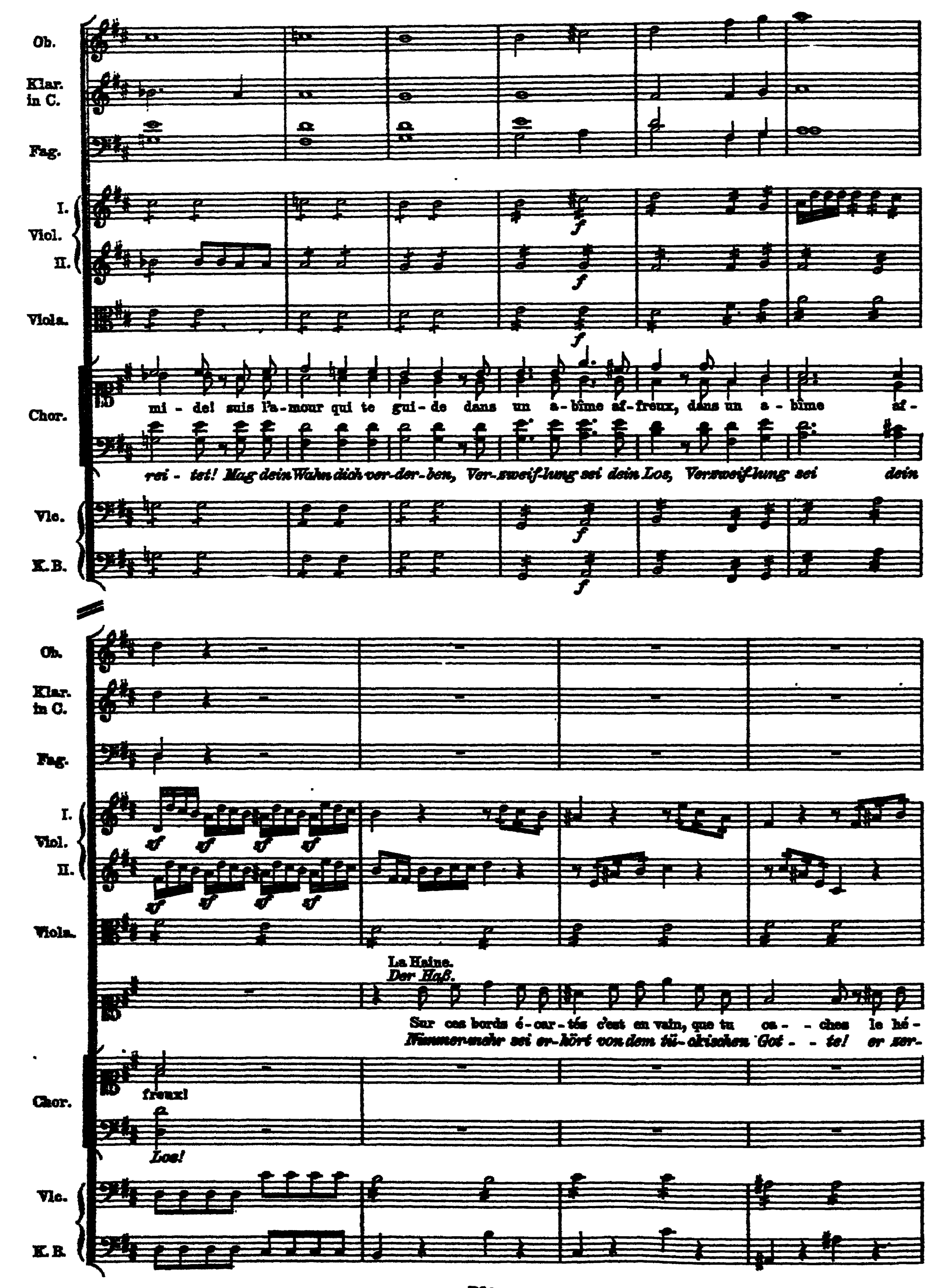
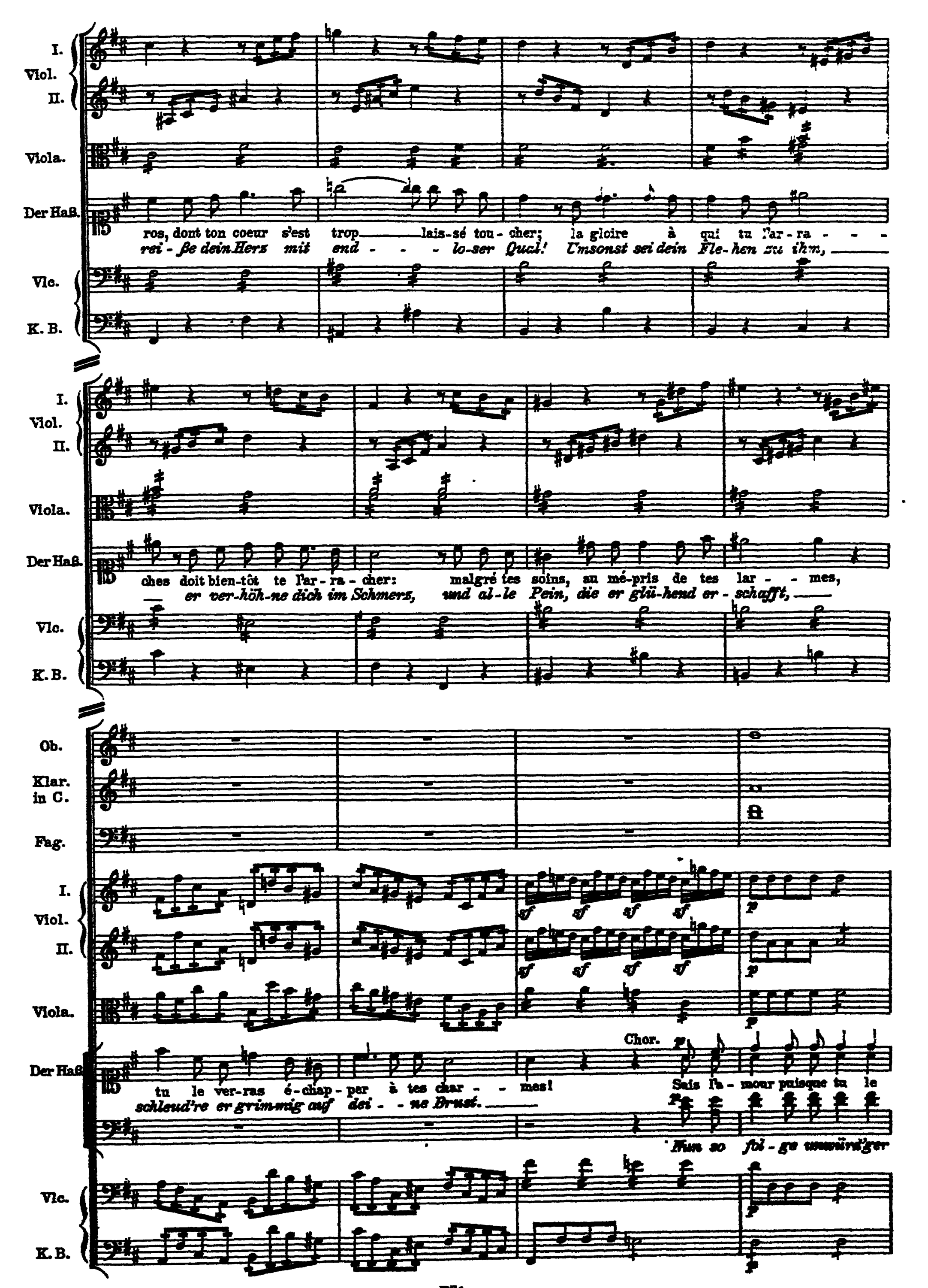
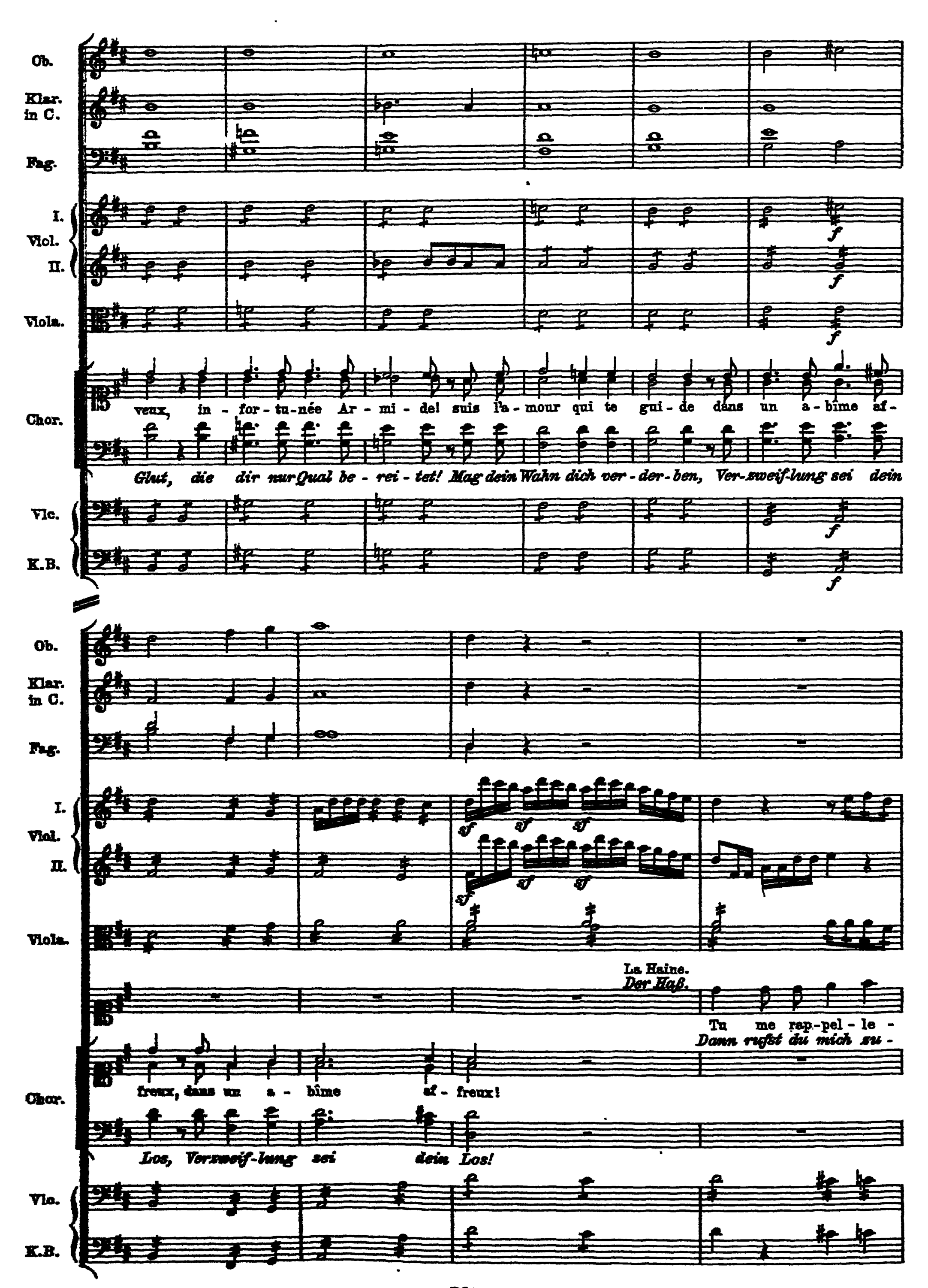
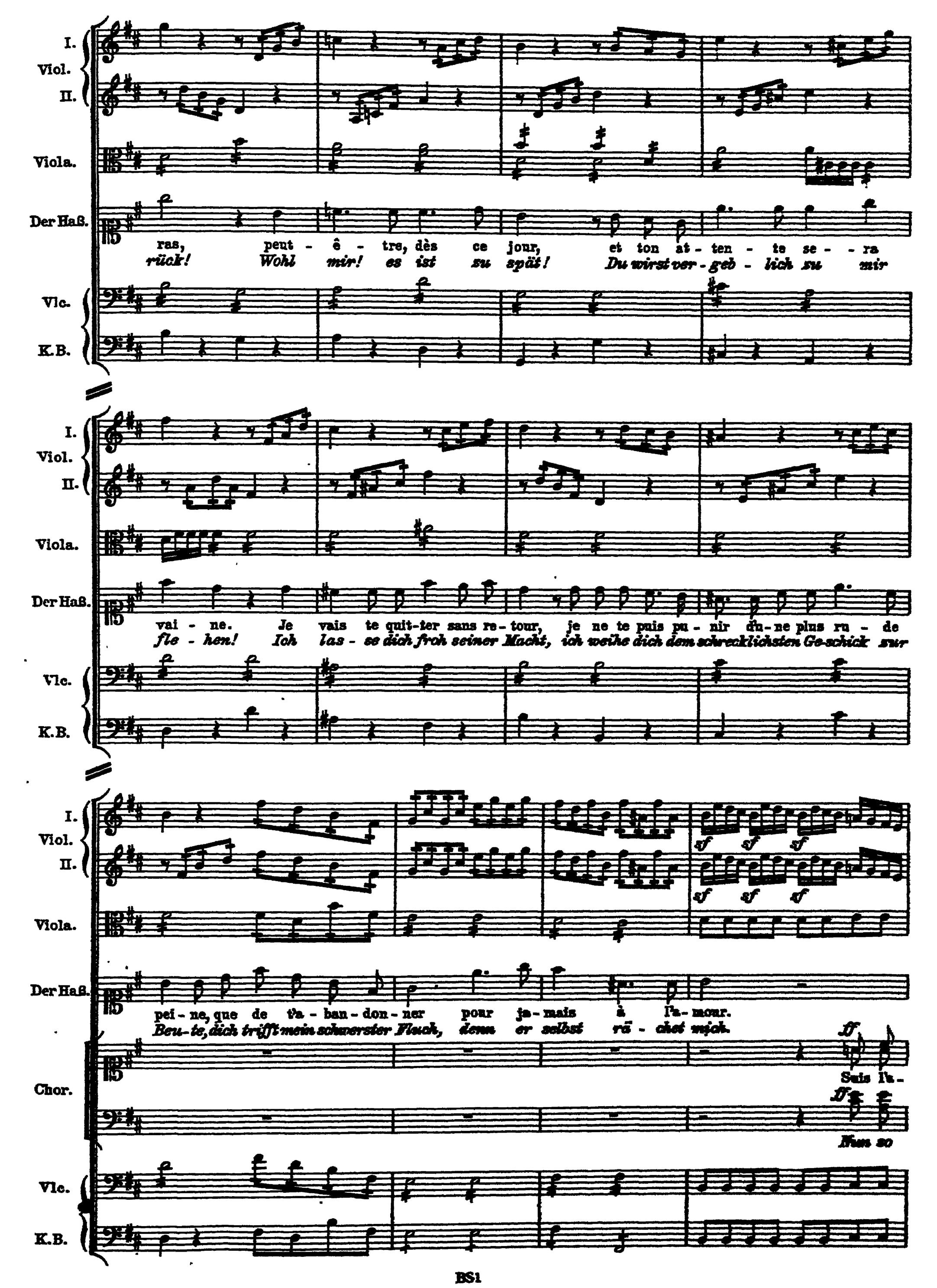
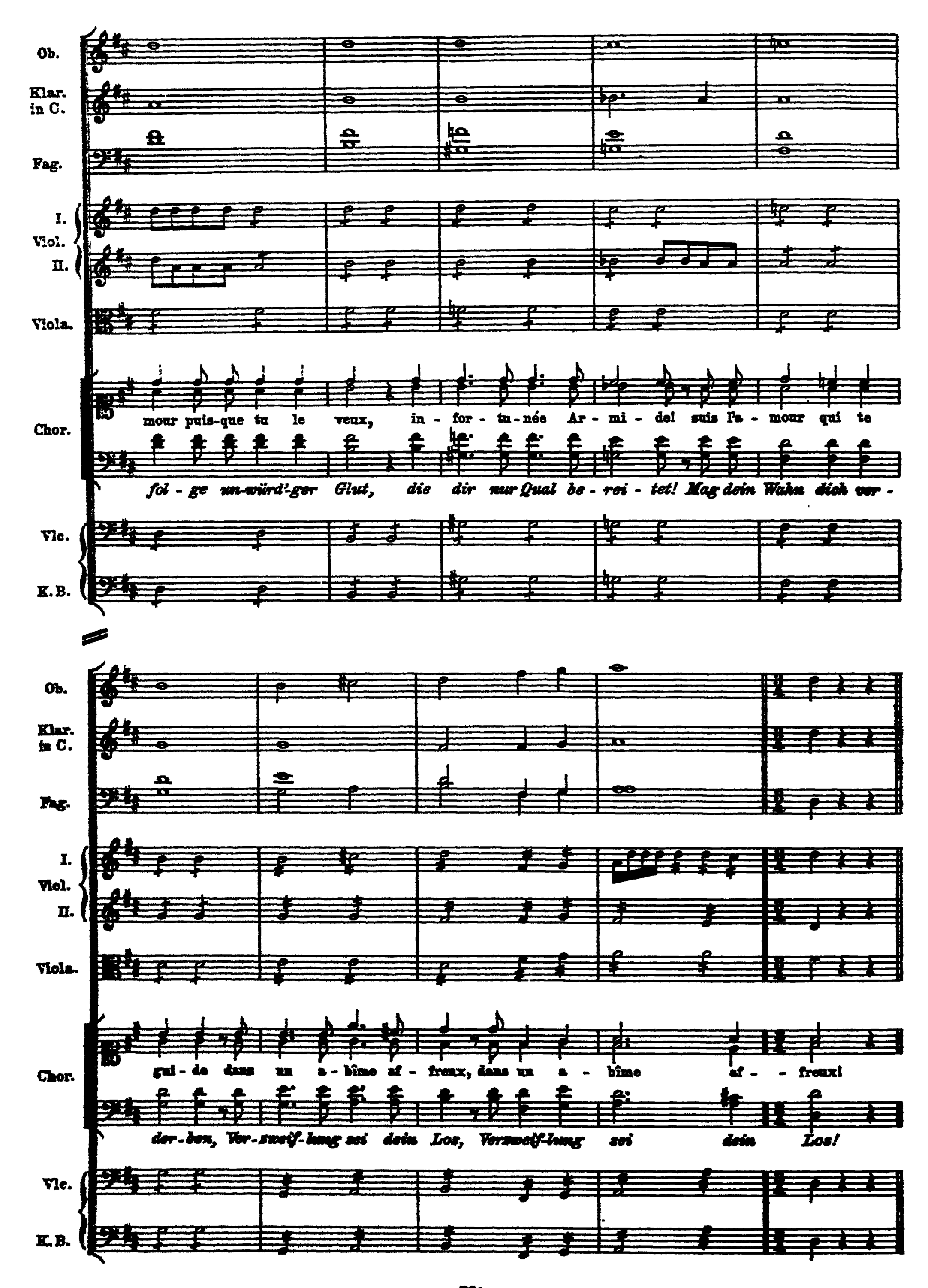
As @ magnificent example of this effect we can cite the chorus “Suis l’amour puisque tu le veux” in Gluck’s “Armide”. Its first two stanzas, sung in dark voice, lend even more power to the conclusion, sung in full voice and fortissimo on the repetition of the words “Suis |’amour”. It is impossible to characterize any better the suppressed menace and the sudden outburst of wrath. Indeed, this is the way the spirits of hate and fury must sing! (Example 187.)
137. ARMIDE, ACT Hl
iI. SSS SS s
ae a ee 7 iam
_y Sopran. P : H i je ‘


ees Eee 2 2 Se oe eee ee Oe eS ee on ot eee ee as eS ee eee a
So far we have only dealt with the voice as used in choral bodies. The art of writing for solo voices requires the consideration of so many varied points that it is difficult to enumerate them all; they vary with the pecaliarities of each individual singer. One could show hew it is best to write for Rubini, for Dubrez. for Haitzinger (three well-known tenors), but not how to write a tenor part equally suitable for all three.
Of all the voices the solo tenor is the one hardest to write for because of his three registers—chest voice, mixed voice and head voice—whose range and facility. as I have already stated, vary with the individual singer. One performer is particularly skilled in using the head voice and can give much sonority even to his mixed voice: another sings with ease high and sustained phrases in all dynamic shadings and in all degrees of rapidity, preferably on the vowels E and I: a third one produces head tones with difficulty and prefers to sing all the time in full and vibrant chest tones; a fourth one excels in passionate pieces, but because of a voice which is somewhat slow in responding, he requires moderate tempos; he will prefer open syllables and sonorous vowels like A, he will dread sustained high tones and consider a high G held for several bars difficult and risky. Thanks to the flexibility of his mixed voice, the first will be able to strike a high and lond tone without preparation; on the other hand, the second needs to have such a tone prepared gradually because he employs his chest voice for it, reserving the mixed and head tones exclusively for the mezzoforte effects and tender accents. Another, whose tenor belongs to the voices formerly called haute-contre in France. will not be afraid of high notes at all because he can take them with a full chest voice, without preparation and without danger.
The first soprano is less difficult to treat than the first tenor; its head tones are scarcely different from the rest of the voice. Still, in view of the inequalities in soprano voices, one should know exactly the singer for whcm one writes. Some sopranos sound weak and pale in the medium or low register; the composer has to consider this in selecting the registers for the main notes of a melody.
The mezzo-soprano (second soprano) and contralto voices are generally more homogenous, and therefore easier to treat. However, these two voices should not be required to sing many words on high phrases, since this makes the pronounciation of syllables very difficult if not impossible.
he moat comventent volee is thr hass, because of its simplicity. Since head tones ure not used, ome need net worry about changes of timbre, The choive of syllables is also less important. Every singer possessing a troe hass volver must be able to sing a reasonahiy written bass part ranging from the low G t> E” above the stave. Some voiers descend much lower. ay for instance that of Levasseur, wlio can sing iew El and even D; some. like Alizard, rise to F= and even G without the slightest toss in purity of sound: but these are the exceptions. On the other hand, there are veices which without being able to go higher than E", have no sonority below C within the stave;; these are fragmentary voices, dificult to use—however great their power and beauty. Baritones in particular are frequently of this type; they have voices of very small range. moving almost always within a single octave.from medium E” to the higher E5)}. which wakes it very difficult for the composer to avoid 4 certain monotony.
The excellence or mediocrity of » vocal performance— choral as well as solo—depends not only on the art of using the registers. on the careful designation of breathing points and on the choice of words to be sung, but above all on the manner in which the composer arranges the instrumental aceompaniment. Some accompaniments overwhelm the voices by an instrumental uproar which might be excellent before and after the vocal passage. but not while the singers are trying to make it heard. Others again. without unduly overloading the orchestra, take delight in displaying some single tmstrument by letting it play runs and unnecessarily complicated figures during an aria; thus they detract the listener's attention from the main subject and confound and annoy the singer instead of aiding and supporting him. This does not mean that the simplicity of accompaniments should be exaggerated and all expressive and musically interesting figures should be banned from the orchestra, They are very appropriate, particularly if interspersed with short rests which give the voeal movements a certain amount of rhythmic freedom and do not compress the measures with metronomic exactitude. Thus the sighing motive of the violoncellos in the pathetic aria in the last act of Rossini's “Guillaume Tell” (“Sois immobile”)— whatever some great artists may say against it—has a touching and admirable effect. It expresses the idea of this complicated piece clearly without impeding the voice in the least, and enhances the affecting and sublime expression of the aria. (Example 188.)
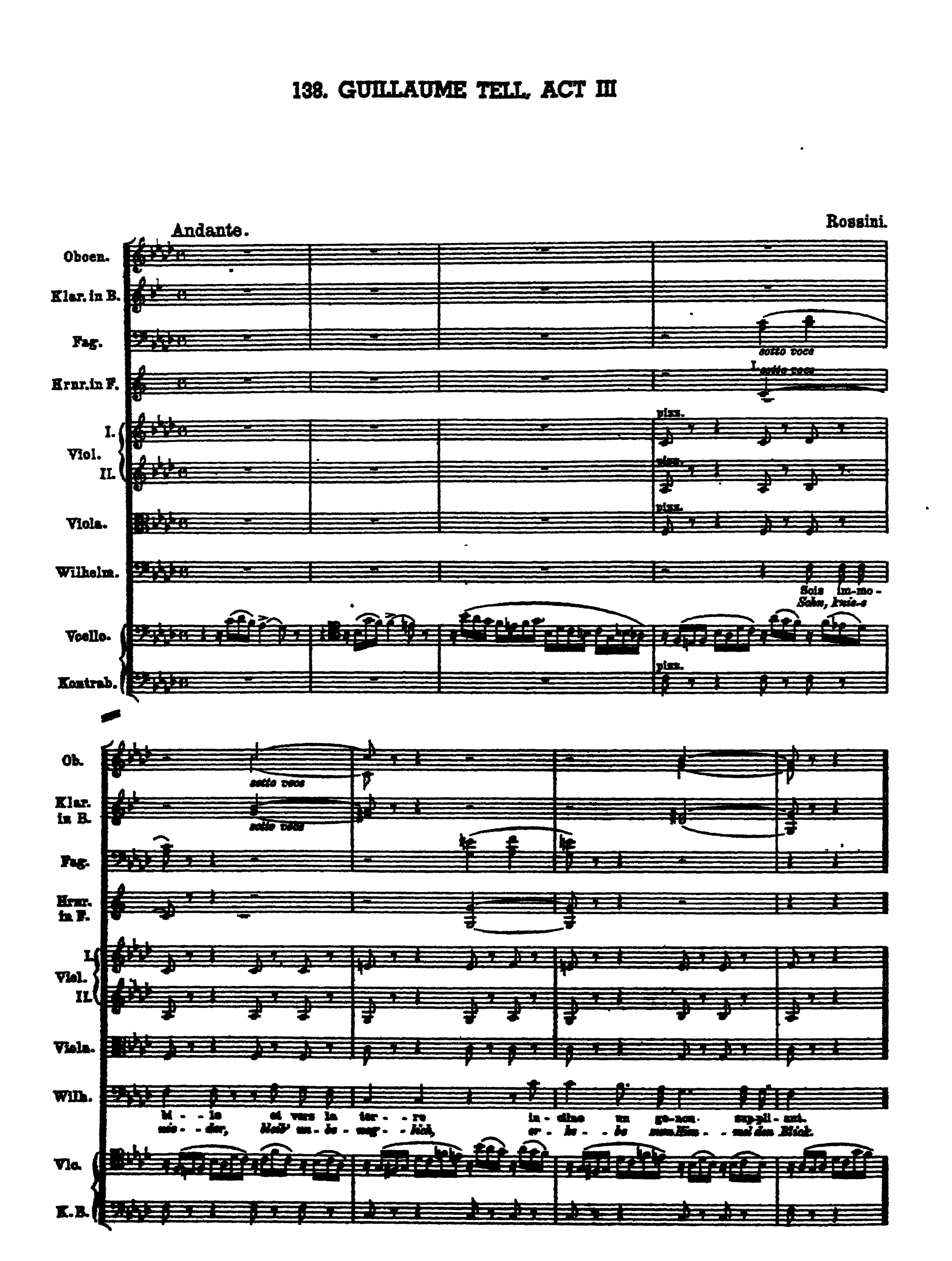
A solo instrument playing a cantilena in the orchestra used more ingenicusiy and mare dramatiealir, (Example corresponding with the vocal melody and thus forming 189).. _ : a kind of duet with the voice is also frequently of exce!- Another example ‘s Recha’s cavatina in the second act lent effect. The horn solo in the second act of Spontini’s of Halévy's “La Juive’, accompanied by a solo of the “La Vestale”, which joins Julia’s voice in her sorrowful English horn. The weak and touching voice of this inand passionate aria “Tois que j’implore”, gives added strument joins in this scene most aifectingly with the intensity to the vocal part. Never has the mysterious, supplicating voice of the young girl..
veiled and somewhat painful tone of the horn in F been
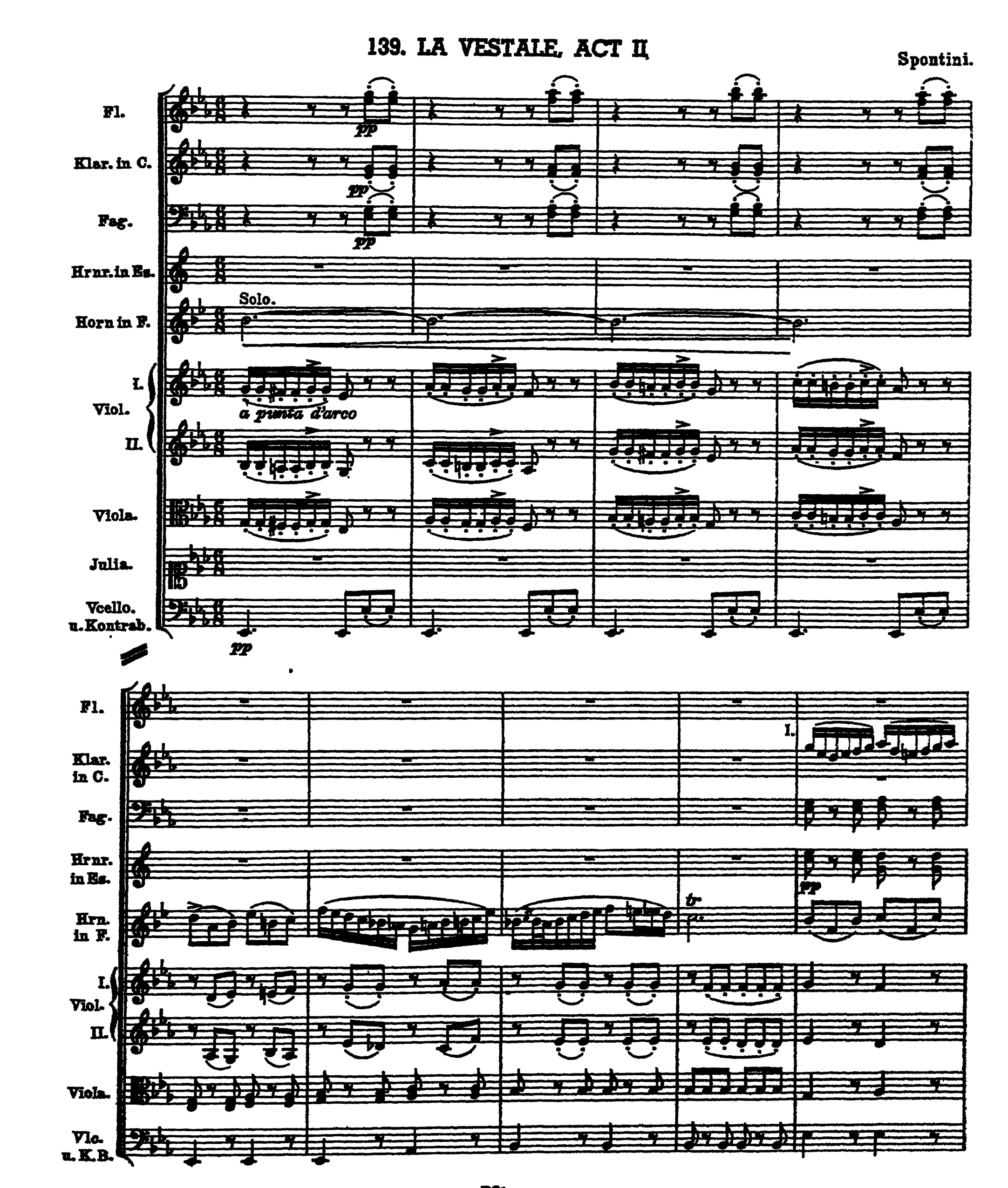
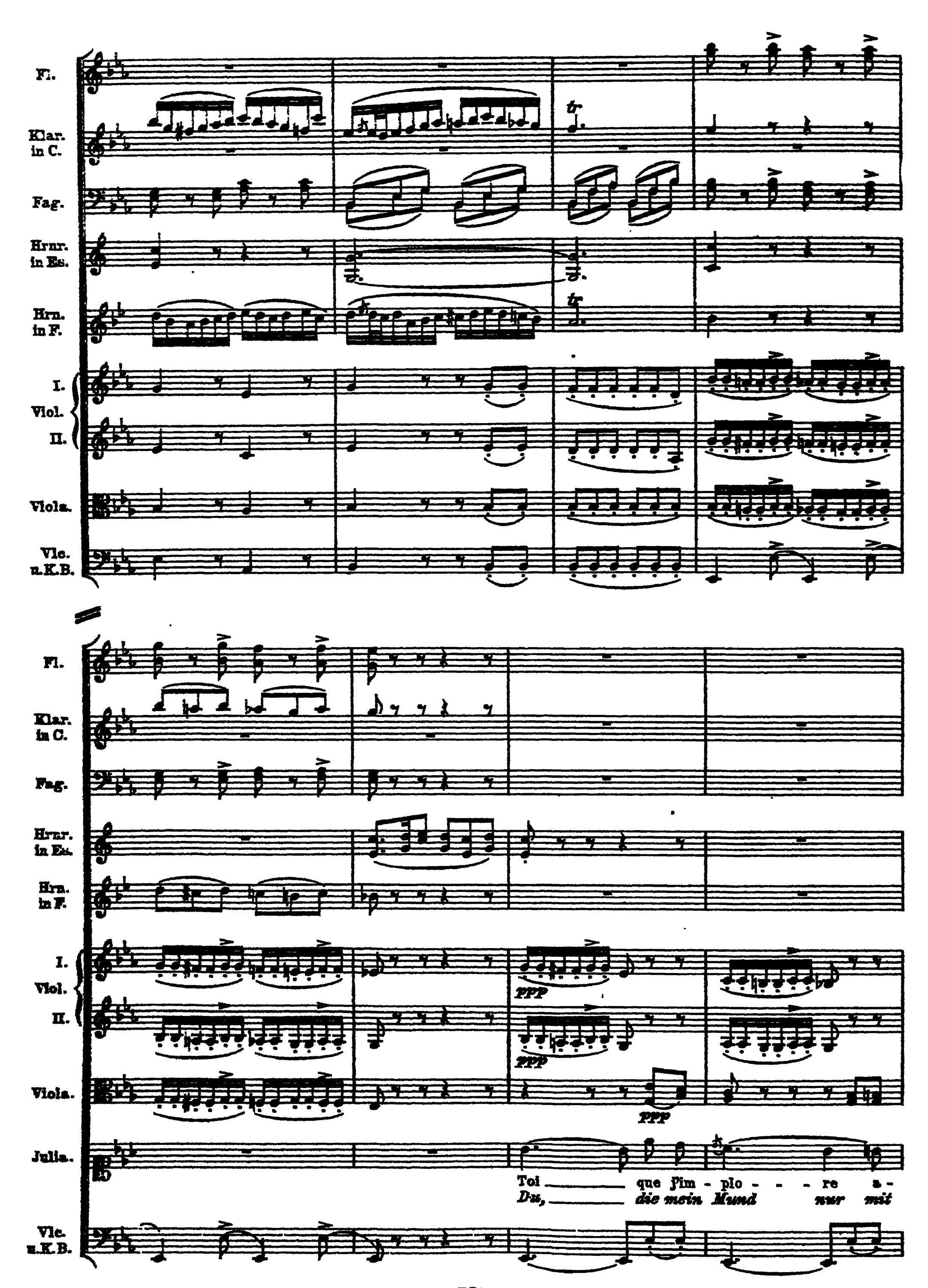
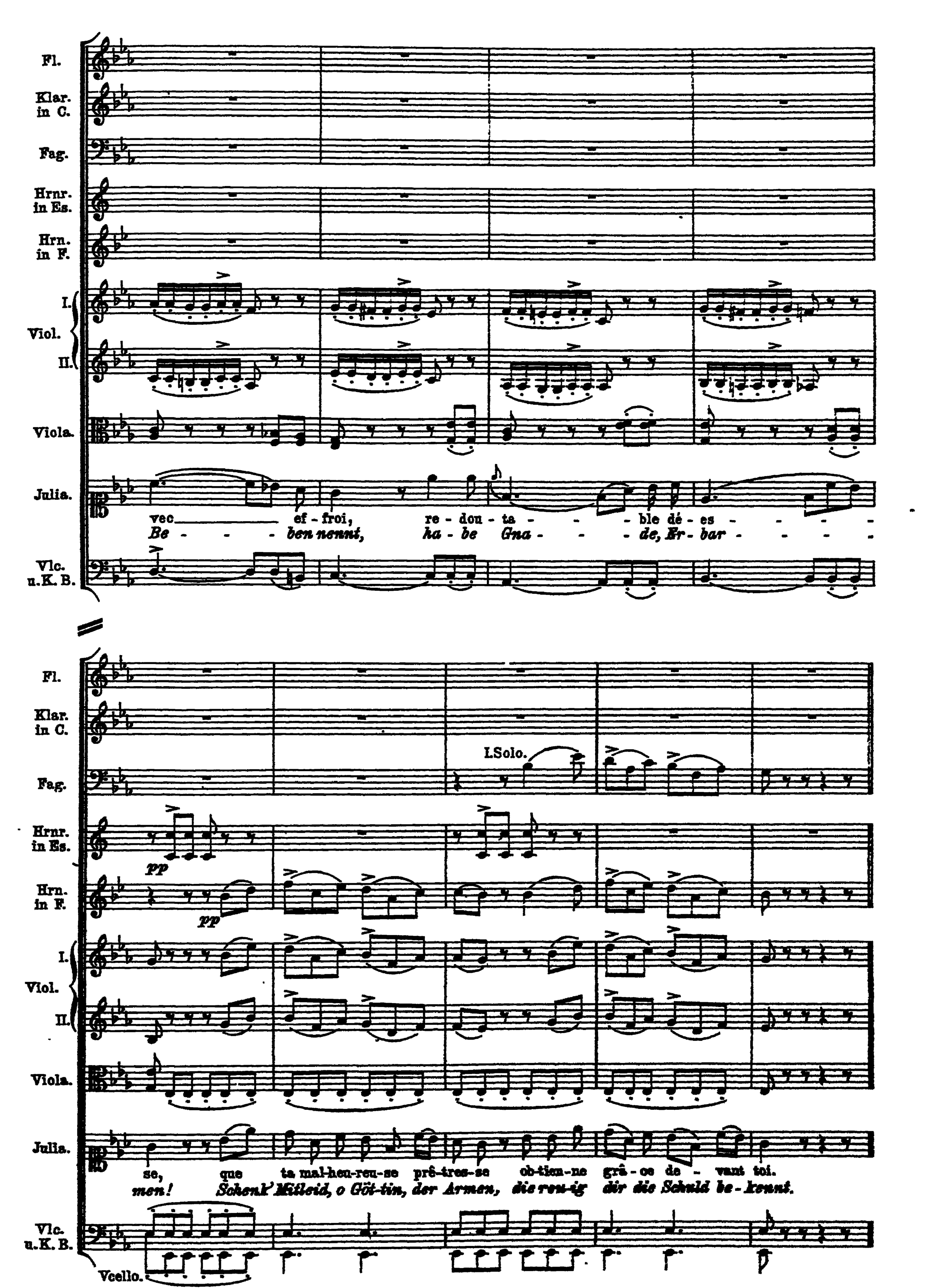
Runs, arpeggios and variations of a solo instrument during « vocal piece arc, I repeat. so disturbing for the singer as well as fer the hearers that it requires great art and a cogent reason to make them acceptable. At any rate, I must admit that I always find them insufferable —with the sole exception of the solo viola in Aennchen’s aria in the third act of “Freischuetz”. Notwithstanding tie example set by Mozart, Gluck and the majority of ancient masters as well as some modern compusers, it is seldom good to double the vocal part with an instrument, especially in an Andante. This is almest always superflanus. the voice being sufficient for the enunciation of a mtiody. Moreover. it is rarely agreeable; the inflections
of the voice, its expressive nuances and subtle shadings would be merelt burdened and weakened by the addition of a second melodie part. Finally, it is wearisome to the skilled singer, who will doubtless perform a fine melody better if the execution is left to him alone.
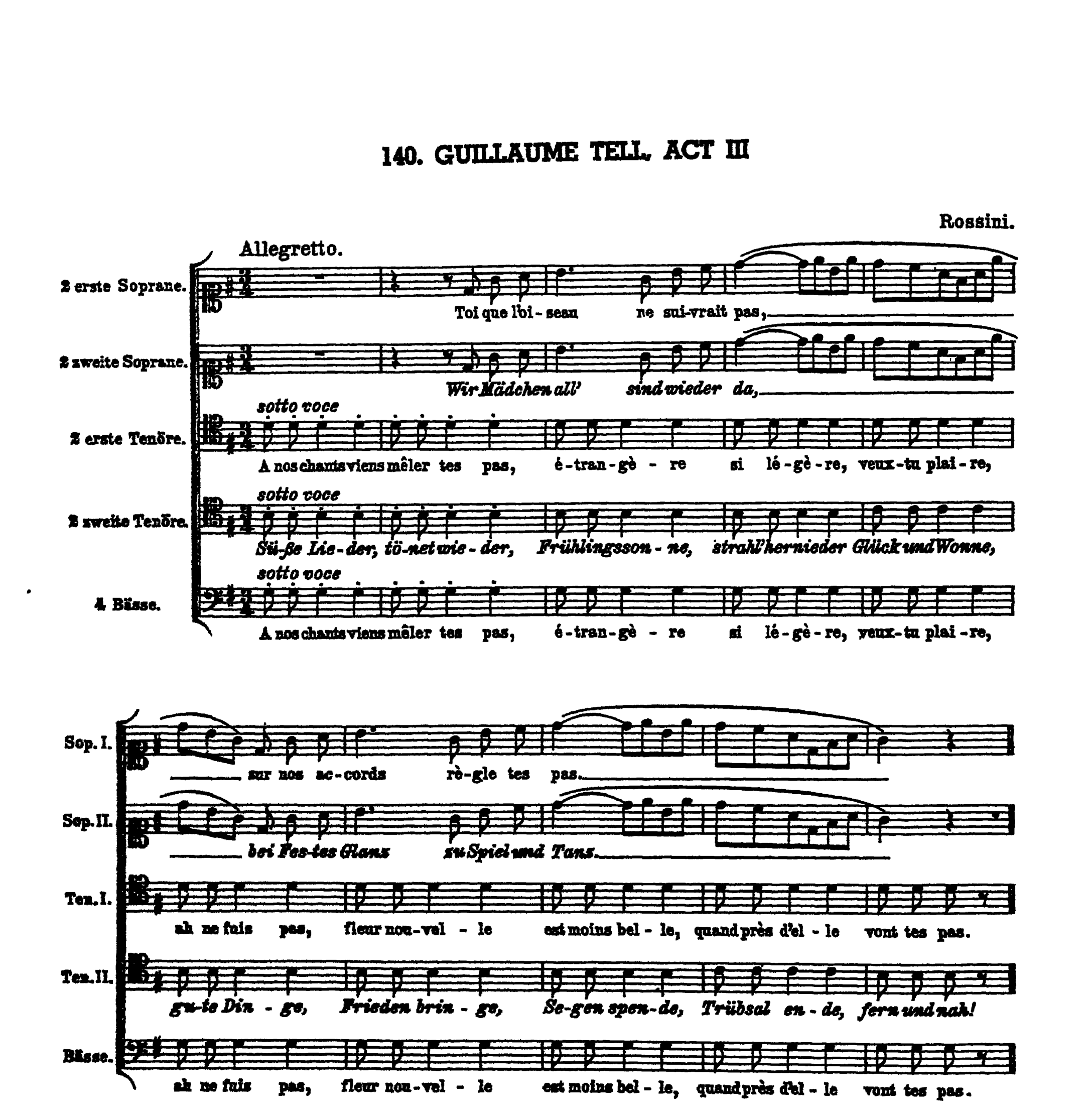
Sometimes a kind of vocal orchestra is formed in choruses or in large ensemble pieces; one part of the voices adopts an instrumental style and sings, beneath the melody, accompaniments of various forms and rhythms, This almost always results in the most charming effects; cf. the chorus during the ballet in the third act of “Guillaume Tell” by Rossini, “Toi que l'oiseau ne suivrait pas” (Example 140).
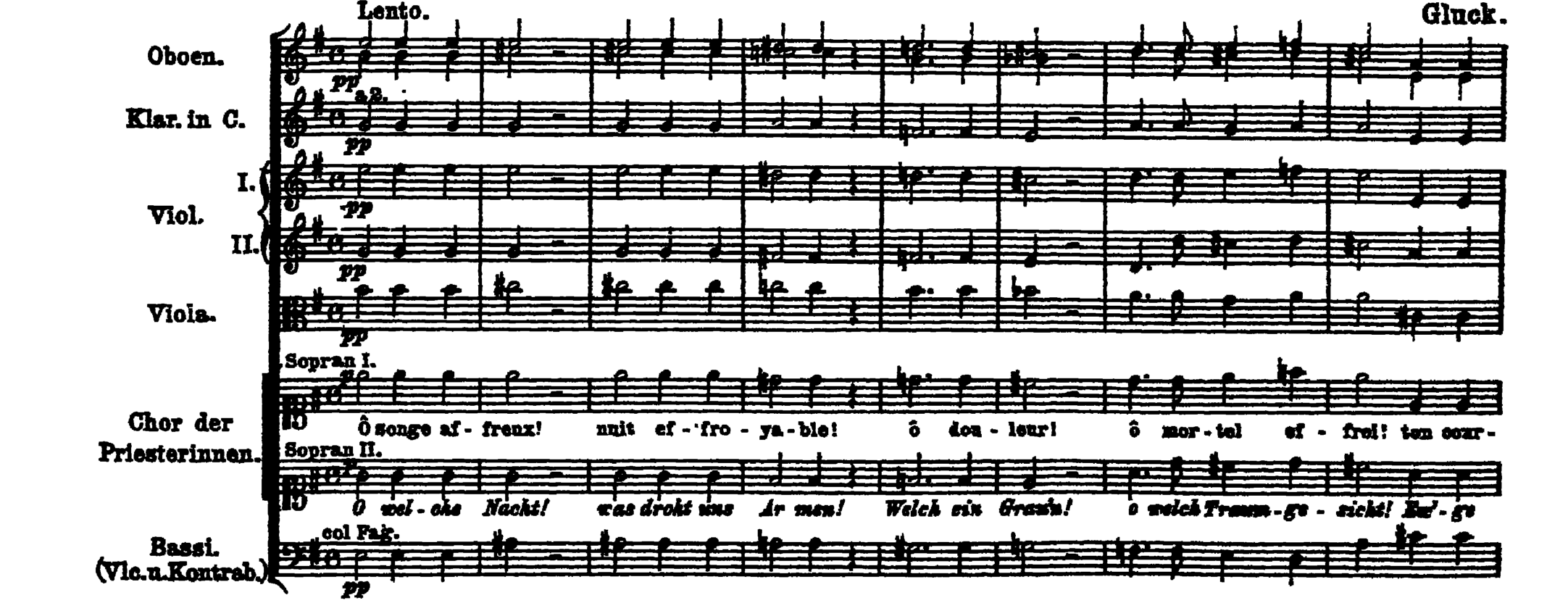
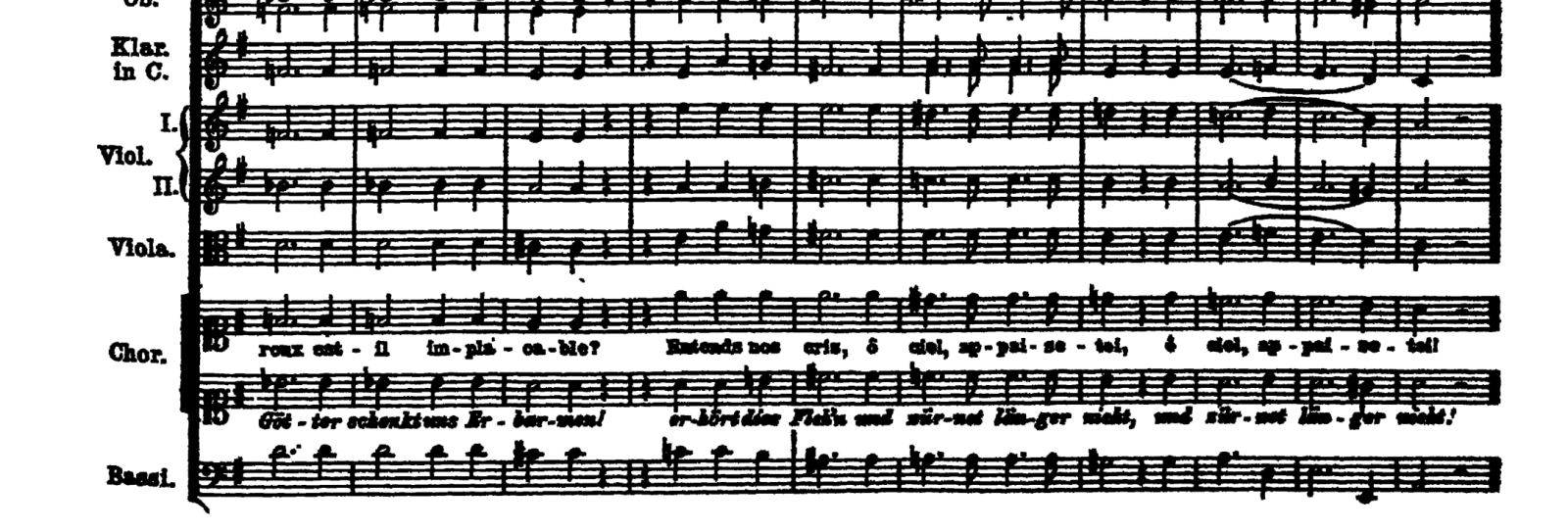
It remains to point out to composers that in pieces accompanied by instruments the vocal harmony should be complete, as if there were no accompaniment. The various timbres of the instruments are too dissimilar from those of the voices to supply basses for them, without which certain chord successions would appear defective. Gluck, in whose works many sixth chords are to be found, used them also in his priestess chorases in “Iphigénie en Tauride”; these are written for two soprano parts only. In these harmonic successions the second part is a fourth beneath the upper part; the effect of these series of fourths is softened only by the basses, which are a third below the medium part and a sixth below the upper part. Now, in these choruses by Gluck the sopranos execute the two upper parts and are written in series of fourths. The lower part, which completes the chords and renders them harmonious, is given to the instrumental] basses, whose tone is entirely differ-
ent from thut uf the s:pranos, This differences is -nhanced by their extreme depth ind their distance from the singers, Consegentiy, these suecessions of fourths sung on the stage sound ike dissonance, (ar ore. at least, extremely harsh’, because of the apparentiv missing complementary sixth,
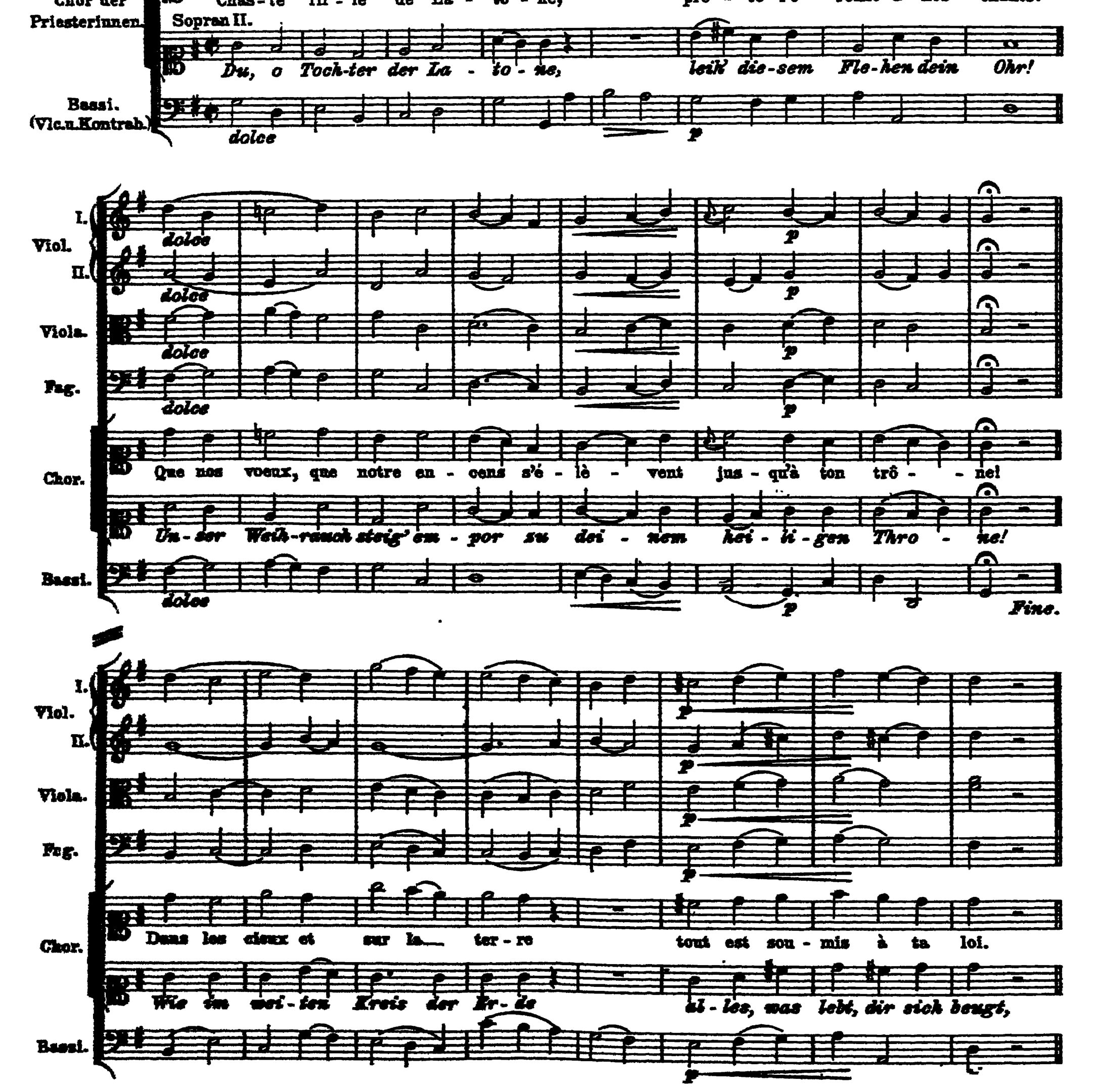
In the chorus “O songe affreux” in the first act of the same opera these chord successions serve tu increase the dramatic effect: but this is not the vase in the fourth act. when the priestesses of Diana sing the hymn “Chaste file de Latone” with its ancient and yet so beautiful color. Here, purity of harmony is absolutely indispensable. The series of clearly audible fourths in the vccu! part is a mistake on Gluck’s part—a mistake which could have been avoided by adding a third vocal part under the second one, an octave above the orchestral basses. (Examples 141 and 142.°
141. iphigenie
En tauride. act I
142. iphigenie en tauride, act IV

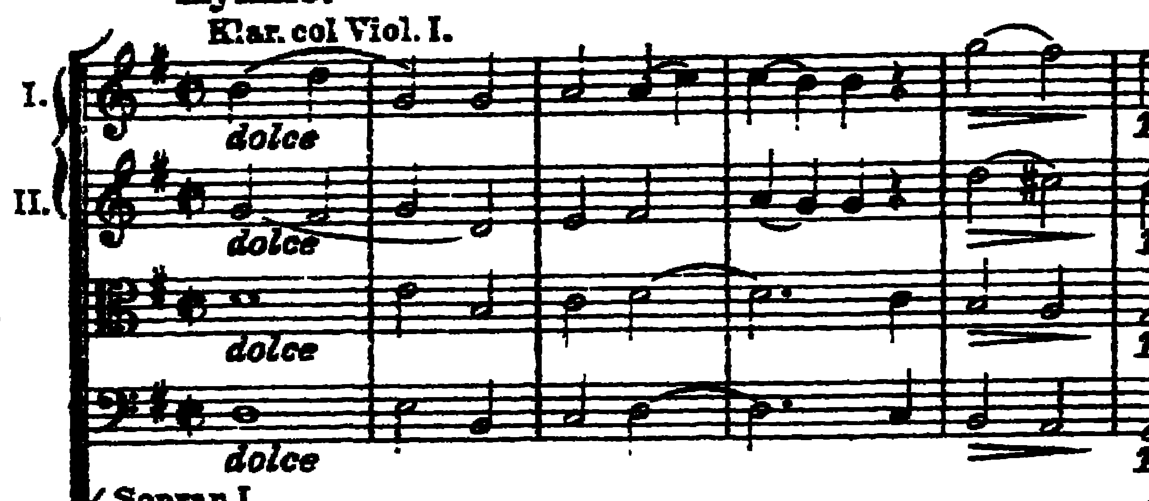



1 a. we eee —- i ca ~ +t he a — t apr gtiemre-snare] aes | eee a 3 ms in me mas 6 i ya ia i. 4 i. ‘om ire. I. i. a1 i. Ls a i = y Wes 2 i oo am a ne ze
H r * ae ade odie a a wes & mf ~ i L. i. = » om mo §
a “dei-nes Tem-pole Schwol-le staunt dies Volk und be. tet cm.