 Playable Books
Hector Berlioz · section 63 of 67
Pianofortes and Melodiums with Prolonged Sounds
Read and hear this section in the playable edition →(By Alexandre)
The prolongation of sound is the most important invention by which keyboard instruments have been improved in recent times. It can be applied to the pianoforte as well as to the melodium and enables the player to prolong at will a tone, a chord or an arpeggio—within the entire range of the keyboard — after the hands have ceased pressing the keys. During this prolongation of a number of tones the performer can not only play with his free hands other tones which do not, belong to the - sustained chord, but can even replay the same sustained tones again. It is obvious how many different and charming combinations have been made possible by this invention on the melodium and pianoforte. These are real orchestral effects, similar in character to those produced by string instruments playing four or five different voices within a harmony sustained by wind instruments (flutes, oboes and clarinets) or, still better, like wind instruments playing a phrase in several voices during a sustained harmony of the divided violins, or finally like harmony and melody moving above or below a pedal point.
This prolongation of tones can take place in varying dynamic degrees, according to the register employed.
Under the keyboard of instruments furnished with this innovation two knee levers are attached so that they can be moved by slight pressure of the performer's‘ knees; one, on the right side, effects the prolongation of tones on the right half of the keyboard; the other acts similarly on the left side. The motion of the knee must take place simultaneously with the pressing down of the keys whose tones are to be sustained, e.g.
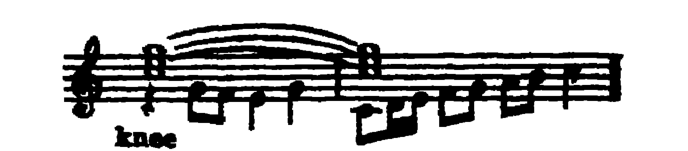
A second pressure of the knee instantaneously stops the
. sustained tones:
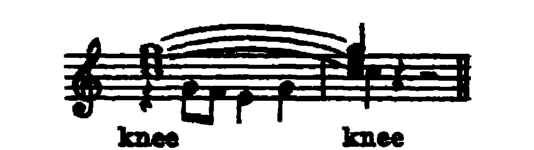
Although the second pressure stops the prolongation produced by the first, it can at the same time start a new
prolongation if one or several new keys are struck simultaneously.

If a single tone of a short chord is to be prolonged, the knee motion takes place only after the fingers have released the keys of the tones which are not to be sustained, while still holding for a moment the key of the tone to be sustained; only then the entire hand becomes free. To change the sustained tones, a series of these movements is necessary in addition to the supplementary movement for stopping the tones whose prolongation is not desired, which takes place while the key of the tone to be sustained is still pressed down.

This applies equally to both halves of the keyboard (by means of the left-hand and right-hand mechanism), and to the pianoforte as well as to the melodium.
When writing sustained tones for the pianoforte or for the melodium organ one must use at least three staves, sometimes even four. In the latter case, the upper stave is reserved for the high and medium sustained tones
and the lowest stave for the low ones. The two middle staves serve for the parts executed by both hands.


