 Playable Books
Percy Goetschius · section 2 of 29
Introduction
Read and hear this section in the playable edition →Music, theoretically considered, consists altogether of Lines of tone. It more nearly resembles a picture, or an architectural drawing, than any other art-creation; the difference being that in the drawing the lines are visible and constant, while in music they are audible and in motion. The separate tones are the points through which the lines are drawn; and the impression which is intended, and which is apprehended by the intelligent listener, is not that of single tones, but of continuous Lines of tones, describing movements, curves and angles, rising, falling, poising, — directly analogous to the linear impressions conveyed by a picture or drawing. The popular name for such a tone-line is " Melody." As several tone-lines are usually being traced simultaneously, it follows that several corresponding melodies may, and generally do, appear together. The term Melody, however, is applied specifically to the principal, or most prominent line.
When a number of tone-lines are intonated together, it is evident that they should agree, or harmonize with each other. The process by which this agreement is assured is commonly known as " Harmony."
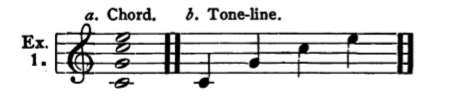
Tones are associated in two different ways: First, in vertical columns, or simultaneously, in solid bodies of tone, usually known as Chords; and second, in lateral order, or successively, in strands of tone which we shall call Tone-lines, or melodies. For example, the tones c-e-g, arranged vertically, give a chord-body, or harmony, each separate tone of which may be a point in some tone-line (Ex. 1, a). The same tones, arranged successively, give a tone-line or melody (Ex. 1, b):
Ex.1
It is of the utmost importance that the music student should adopt and cultivate the habit of apprehending music according to this definition, as a System of Lines. The beginner, and the ordinary hearer, are inclined to regard music merely as a series of chords, a succession of tone-groups, and to associate mentally only those tones that are sounded together (simultaneously, as Ex. 1, a). This is surely a natural view, and correct as far as it goes, for the harmonic basis of all music is unquestionably the chord. But it is an imperfect view. The object of the chords is, simply, to fix (approximately) the points through which the lines run; and unless these lines are grasped and traced, — unless the hearer can associate mentally the tones that follow each other, the true purpose and significance of the whole tone-association is missed. This must be so, because the only evidence of Life in music lies in the motions which interlink the tones in flowing lines; and these lines are, therefore, the only tangible element in the art of tone.
The real musical picture then, is a delineation; an image of sounding and moving lines. Quite aside, for the present, from the numerous qualities which enter into these lines, — their directions, their speed, their rhythm (freedom and variety of changing motions), their spaces, and even their indefinable sensuous or spiritual attributes, — the fundamental fact must be grasped that it is these lines which create the musical impression. The " music " lies in its melodies. Music is " tone-lines "; and the quality of the several lines determines the quality of the composition; the vitality of the lines equals the life in the music; and the degree of harmony which governs the association of the lines fixes the euphonious standard of the composition, — its pleasurable effect upon the natural sense of harmony or concord.
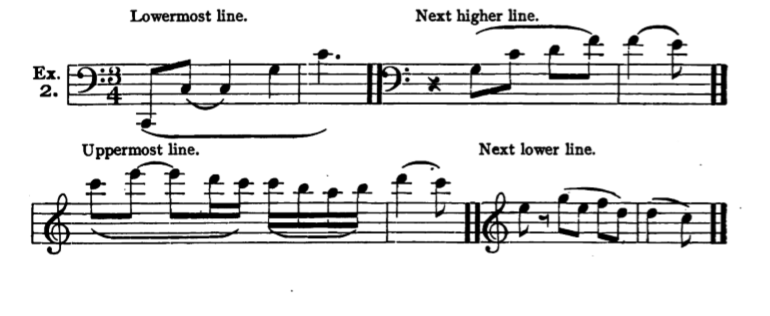
To illustrate more fully what is meant by apprehending music as a fabric of tone-strands, tone-lines, or associated melodies, traced, not vertically through the separate chord-forms, but continuously (laterally) from chord to chord, — let us take a passage, at random, from a Beethoven Sonata. In this passage, the master, though certainly guided by his vertical chords, was quite as surely impelled to trace a good, distinctly melodious, effective tone-line in each separate part or register: —
Ex.2
The total result, obtained by weaving these four different strands of tone into one compact body (as it came from Beethoven's hand) is as follows: —
Ex.3
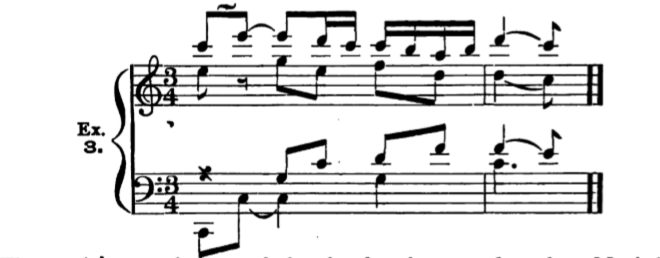
The music proceeded out of the chords, of course, but the " Music " itself manifests its finished beauty and life and meaning in the Lines of tone. The chords were the means, the lines were the object, of the musical thought. The above musical image (Ex. 3 ) should therefore appeal to the finer sense of the listener in the forms noted in Ex. 2. He should apprehend each line separately, first of all; and the total sensuous impression should be gained by mentally combining these lines.
The tone-lines differ greatly in their length, and in the manner of their presentation. Some lines are long, others are often very brief. Sometimes the line is continuous in sound (legato), and again it may be intermittent (staccato). In the latter case, which is very common, the inner ear of the listener traces the complete line across the silent gaps, just as the eye traces a dotted line as readily as an unbroken one.
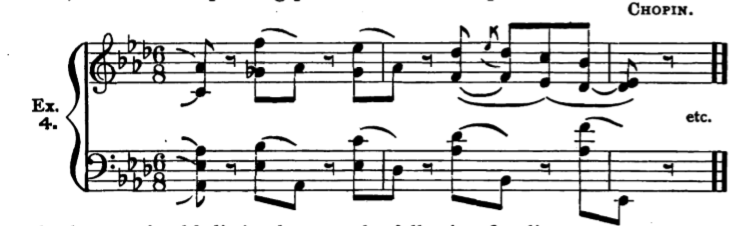
Through the following convenient (and customary) method of notation, and its corresponding performance on the pianoforte: —
Ex.4
Ex.5

the hearer should distinctly trace the following five lines:
The student should carefully examine brief passages from the masterworks, with a view to resolving the given bulk into its component lines, as shown in the above examples. In many cases, only one single prominent line (the " tune " proper, in the uppermost part) seems to be distinctly melodious, — as for instance, in No. 37 of Mendelssohn's " Songs without Words." In others, at least two independent lines are discernible; in a few, the entire bulk may be divided into distinct melodies, — as in the Inventions and Fugues of Bach, and many passages in stringquartets, or symphonic scores (where the lines are written separately, of necessity, on independent staves). In many, finally, the bulk is very uneven, as if, here and there, single extra tones, or brief little lines, had been inserted among the more important, longer melodies.
To some extent, this principle of simultaneous melodies is present in every grade, even the simplest, of music. It is impossible to connect chords, as, for example, in a hymn-tune, or in the earliest harmony exercises, without tracing such tone-lines.
In four-voice harmony there are four, — known in vocal writing, and familiar to the student (in church choirs or choral societies) as the soprano, alto, tenor and bass. As a rule, so much preference is given to the uppermost of these (the soprano), that the other singers scarcely realize, themselves, that they too are intoning " melodies " quite as surely as
Counterpoint is one of the technical processes of music writing. The object of contrapuntal practice is to enable the student to add melody to melody, — or to obtain an association of two, three, or more tone-lines that agree with each other harmonically and yet are sufficiently independent of each other to present really different melodic lines. Briefly defined:
Melody is a succession, or continuous line, of single tones. Harmony is a succession of chords or vertical columns of tones which harmonize in their simultaneous presentation. Counterpoint is the harmonious association of individually perfect, but independent, melodies.