Playable Books
Percy Goetschius · section 3 of 29
Chapter I. The Single Melodic Line
Read and hear this section in the playable edition →

1. Counterpoint is associated melodies. In good counterpoint, the association is, in a general sense, harmonious, — that is, reasonably accordant, and each melody is good, by itself.
2. Probably the latter condition is the most important. The first consideration, for the beginner, is the correctness of each separate melodic line, independently of the other, or others. Each line, sung or played alone, must produce a satisfactory melodic impression.
3. Therefore, the first point to be mastered by the student of harmony, or counterpoint, is the fundamental principle of good melodic movement. He must acquire the ability to judge the quality of a melodic line, and to avoid any tone-progression which is unnatural,—that is, which violates the natural conditions of Melody (smooth, rational, congruous, well-balanced and interesting tone-succession).
4. Should the student harbor any doubt of the existence of laws that govern Melody, or of the possibility of distinguishing good melodies from inferior ones with scientific accuracy, let him compare the following:
Ex.6

with those shown in Ex. 2, or with any other examples in this book that are given as specimens of correct, sensible melody.
5. It is not possible, in this necessarily condensed form, to state all of the conditions which enter into the process of perfect melodic formation, a process which is ultimately subtle, and no doubt partly incalculable. But a few general rules may be given, and these the beginner must carefully observe and follow, until his instinct and experience shall enable him to control the finer and finest movements.
6. Probably the most vital law of melody is that which is grounded in the relations and interactions of the primary harmonies of the key, and which determines the direction of certain Scale-steps.
Rule 1. The natural or inherent bent of certain Scale-steps must be respected, as far as is possible without monotony. These tendencies are as follows:
The 7th step of the scale moves (naturally) upward.
The 6th and 4th steps of the scale both move (naturally) downward.
7. These are called the Active scale-steps. Their movement extends, generally, only one step; that is: Step 7 moves to step 8, Step 6 moves to step 5, and Step 4 moves to step 3, as a rule, though wider movements in the proper direction are possible. For example, in C major:
Ex.7

The other scale-steps (1, 3, 5 and 2) have no such tendencies, and are free to move in any direction, — that is, free as far as direction is concerned.
8. When the active tones of the scale move one step, as here shown, they are " resolved "; that is, their active tendencies are gratified, and their movement is finished. But it is always correct, when less decisive movement is desired, for each active step to move two steps at once, or, in other words, to leap a third, — in the proper direction, of course. Thus (C major):
Ex.8

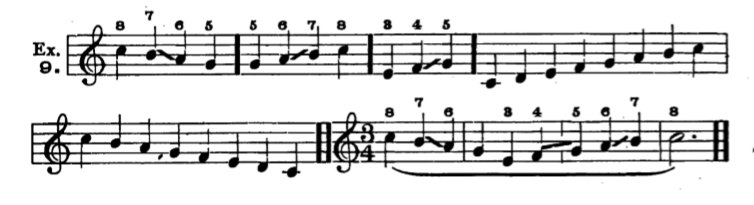
9. To this fundamental rule there is one important exception: Rule 2. The natural tendency of each active step may be overcome, so that it will move along the scale in the opposite direction, by approaching it (so to speak, by "pushing" it) from the other side, along the scale. Thus, step 7, if preceded by step 8, may pass on down to step 6; step 6, preceded by 5, may pass on up to step 7; and step 4, preceded by 3, may pass on up to step 5.
In other words, the progressions 8-7-6-5, 5-6-7-8 and 3-4-5 are good. Thus (C major):
Ex.9
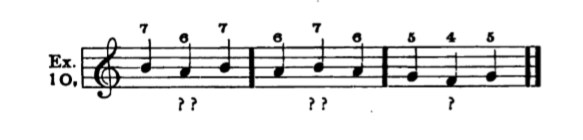
10. Observe that the successions 7-6-7, 6-7-6, and 5-4-5, cannot be justified in this manner, and should therefore be avoided, for the present. Thus (C major):
Ex.10
Exercise 1
The Scale-line, and Narrow Leaps.
The aim of this first lesson is to impress these fundamental melodic movements upon the student's mind, and habituate him to them (in case his studies, hitherto, have left this most important work unaccomplished). Therefore, he is required to write a very large number of original melodies, in all the major keys, strictly according to the following directions:
1. At present, only in major.
2. Use chiefly the regular resolutions of the active steps, as shown in Exs. 7 and 8. But do not neglect the irregular movements (Ex. 9).
3. At no point should the melody leap more than a third. All wider skips must be deferred until the next lesson.
4. Any tone may be repeated, anywhere. See par. 20.
5. Use all the simpler kinds of measure.(from 2/4 to 9/8). The notes may be of uniform rhythmic value, or of different lengths. See pars. 21, 22 and 23.
6. The length of the melodies is optional, but it is advisable to write in the regular forms of four or eight measures, closing with the keynote.
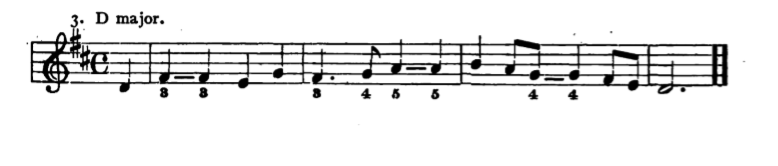
For illustration:
Ex.11a
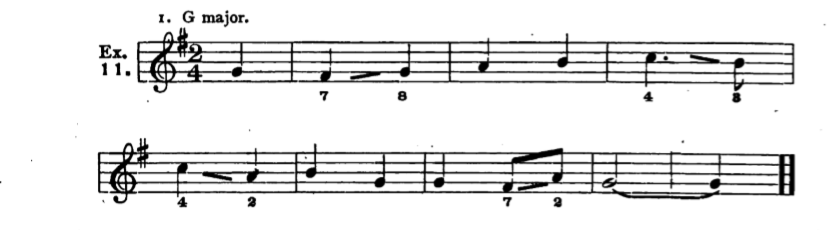
Ex.11b

Ex.11c