Fedele Fenaroli · section 10 of 26
or the Suspension of the Fourth Read and hear this section in the playable edition →
The fourth can be prepared by all four consonances, that is by the 8ve, 3rd, 5th, and 6th.
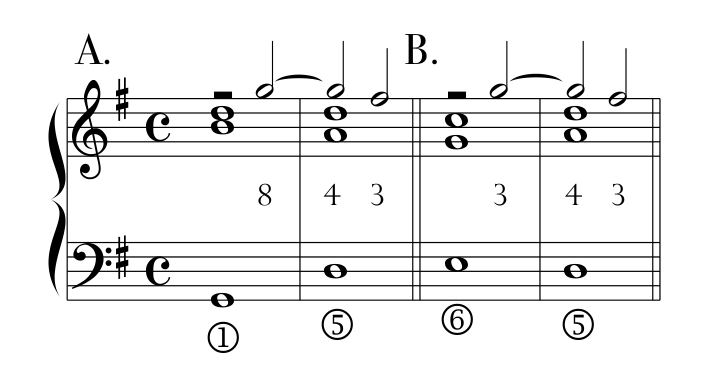
Fig. 59 · Play this example in the reader ▶ To prepare the 4th by the 8ve, the partimento should rise a 5th or descend a 4th, that is, from ① to ⑤. See the example in the manuscript at letter A.
To prepare the 4th by the 3rd, the partimento should descend by step, that is, from ⑥ to ⑤, or from ② to ①. See letter B.
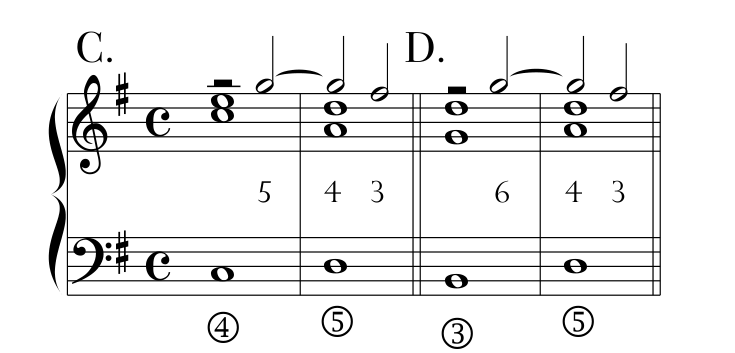
Fig. 60 · Play this example in the reader ▶ To prepare the 4th by the 5th, the partimento should rise by step, that is, from ④ to ⑤, or from ① to ②. See letter C.
To prepare the 4th by the 6th, the partimento should rise a 3rd, that is, from ③ to ⑤. See letter D.
Note that the 4th can also be prepared by the minor 7th and by the diminished 5th.
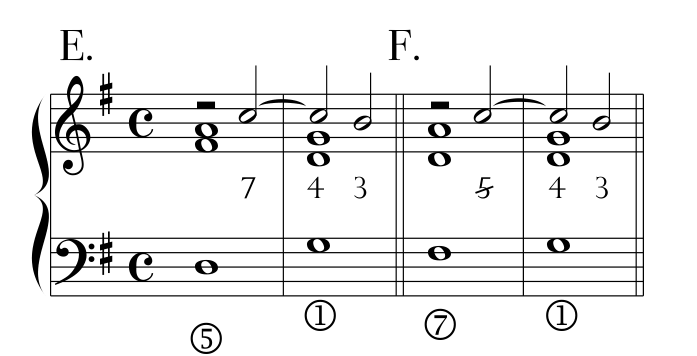
Fig. 61 · Play this example in the reader ▶ To prepare the 4th by the minor 7th, the partimento should rise a 4th, that is, from ⑤ to ①. See letter E.
To prepare the 4th by the diminished 5th, the partimento should rise by a semitone. See letter F.
Observe that the dissonance of a 4th should always be accompanied by the consonance of the 5th. That is because the aforementioned dissonance can never have a place above a note that, by its nature, does not take the 5th.
Concerning Dissonances,
← Concerning Scales All sections or the Suspension of the Seventh → More Playable Books Reger, Modulation Explore Reger’s modulation method with 100 analyses and 102 playable examples. Fux, Counterpoint Learn how independent voices work together, one species at a time. Goetschius, Exercises in Elementary Counterpoint Build independent melodies through graded exercises, with 471 recorded examples. Goetschius, Counterpoint Applied Study imitation, canon, and fugue with 393 recorded examples. Prout, Bach’s Forty-Eight Fugues Follow Prout through all 48 fugues of the Well-Tempered Clavier, every example playable. Rameau, Treatise on Harmony Explore the foundations of harmony, composition, and accompaniment. Rimsky-Korsakov, Practical Manual of Harmony The classic harmony course, newly translated from the 1910 French edition, with all 640 examples playable. Tchaikovsky, Practical Study of Harmony Tchaikovsky’s Moscow Conservatory harmony course, with playable examples. Schoenberg, Theory of Harmony Read all 22 chapters, with the original German beside a new English translation. Rimsky-Korsakov, Principles of Orchestration Discover instrumental colors through scores and orchestral recordings. Forsyth, Orchestration A witty, thorough guide to every orchestral instrument, with the original pages. Berlioz, Treatise on Instrumentation Berlioz’s treatise on the orchestra, revised by Richard Strauss, with the original pages. Sanganeria, Arrival Build jazz lines that land, with 30 original playable examples. Bona, Rhythmical Articulation Practice rhythm through 120 graded studies, with playable notation and original scans. ← All Playable Books  Playable Books