 Playable Books
Fedele Fenaroli · section 15 of 26
Concerning a Partimento that Descends in Ties
Read and hear this section in the playable edition →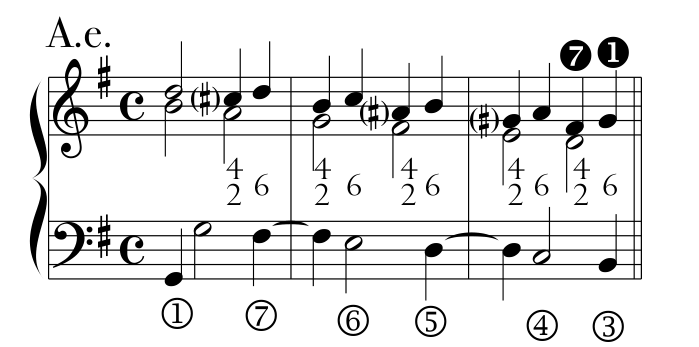
The tied note of the said partimento could have a perfect 4th or even an augmented 4th at the choice of the composer. One should not descend in this way beyond the ④. And above this last tied note of the partimento the 4th should definitely be augmented to rise to a 6th above the subsequent note of the partimento on which this motion ends. That [final] note of the partimento comes to be ③ in the key in which the composition has been proceeding. See A.e.
Among the prerequisites of a partimento that begins to descend from ⑤ and proceeds descending by step, at least as far as ③, one must observe whether that partimento is in the major or the minor mode.
If it is in the major mode, it can be accompanied as follows:
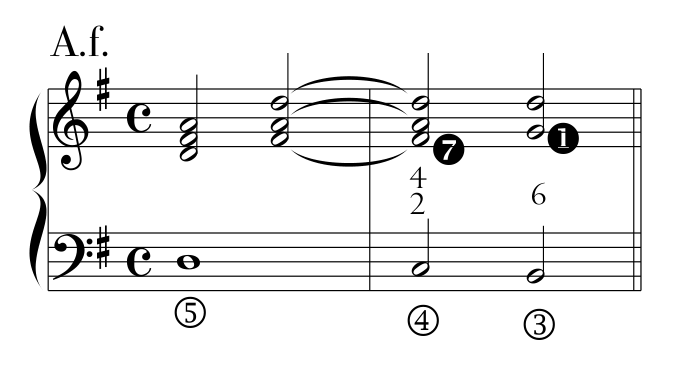
Above the ⑤ there will be a major 3rd and an 8ve. On the subsequent note descending stepwise, which comes to be the ④, the same accompaniment will hold firm causing the major 3rd to become an augmented 4th, the 5th to become a major 6th, and the 8ve to become a 2nd. Above the next note of the partimenti, which comes to be ③, the augmented 4th in the accompaniment [❼] procedes to rise a step to form the 6th [❶]. See A.f.
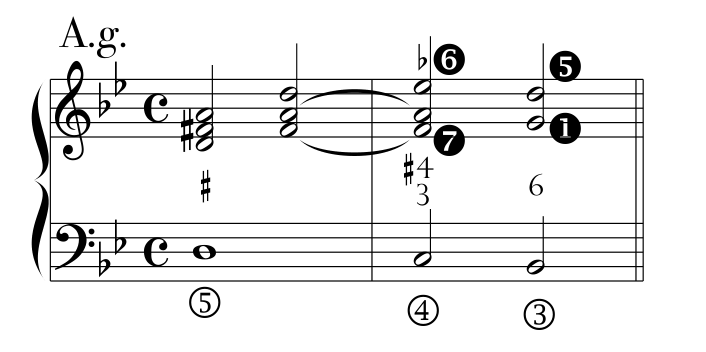
But if the partimento will be in the minor mode, it will follow in whole the proceding rule of accompaniment concerning the major mode, with this sole difference, that above the second note of the partimento descending stepwise, which comes to be ④, the composer has the choice of adding the minor 3rd to his accompaniment [♭❻], replacing the 2nd [❺]. See A.g.
If the partimento is in the minor mode, it can also descend semitone by semitone [from ①] down to ⑤ inclusively. And this motion can accept various accompaniments.
First, on the first half of its time value the first note of the partimento [①] will be given an accompaniment of a 3rd and 5th. On the second half of its time value the 3rd will hold fast and the 5th will move to the 6th.
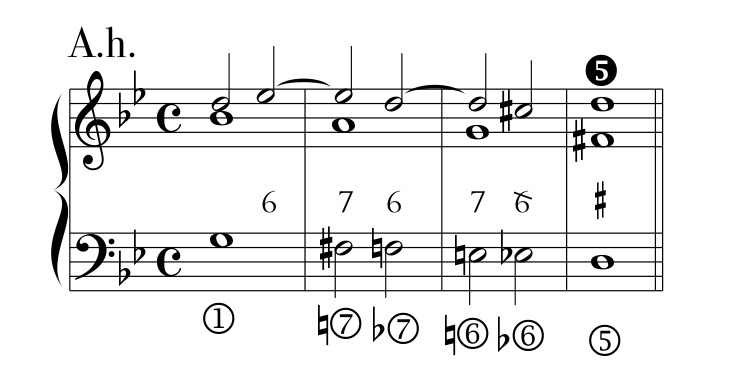
Then, above the semitone to which the partimento will descend [⑦], the previous 6th will form a suspended 7th. The partimento will then descend again by semitone, and above this note [♭⑦] the preceding 7th will resolve to a 6th, and thus descending by semitone successively down to the penultimate note of the partimento [♭⑥].
Descending thus, the penultimate note of the partimento will be ♭⑥. And the resolution of the accompaniment that will be above it should move to an augmented 6th, which will then rise to the 8ve [❺] of the subsequent note of the partimento [⑤]. See A.h.
Observe that each one of the notes of this partimento, descending by semitone, should be accompanied by its 3rd.
Second, a partimento descending by semitone, can be accompanied in contrary motion, that is:
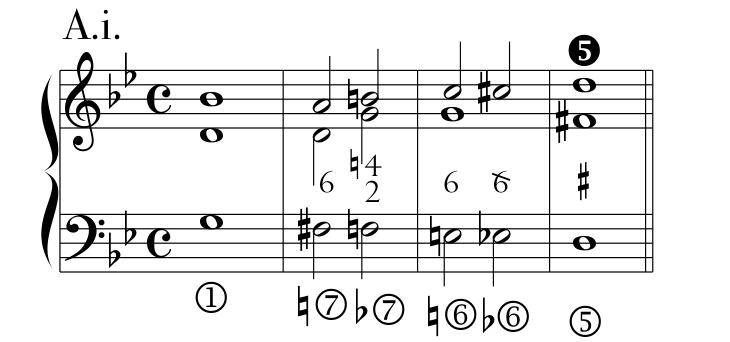
To the first and second notes of the partimento [①,⑦] one should give a 3rd. To the third note [♭⑦] one should give an augmented 4th. To the fourth note [♮⑥] one should give a 6th. And to the fifth note of the partimento, which will be ♭⑥, one should give the augmented 6th, and thence to finish it all just as was described in the preceding article. See A.i.