 Playable Books
Fedele Fenaroli · section 16 of 26
Concerning a Partimento that Rises by a Third and Falls by a Step
Read and hear this section in the playable edition →When the partimento rises by a third and falls by a step, it can accept various accompaniments.
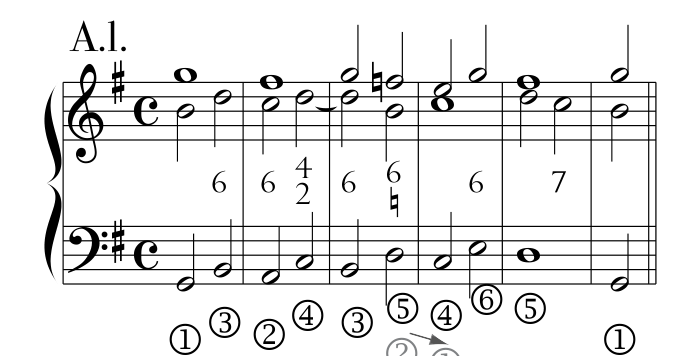
I. To the first note of the partimento, which one supposes to be ①, one will give the 3rd and 5th. To the note of the partimento that rises by third, and will be ③, one will give the 3rd and 6th. To the note of the partimento that descends by step, and will be ②, one will give the 3rd and major 6th. To the next note of the partimento that rises by third, and will be ④, one will give the 2nd, augmented 4th, and 6th. To the next note of the partimento that descends by step, and will be ③, one will give the 3rd and 6th. The next note of the partimento that rises by third, which is ⑤ in the key in which the motion began, should have received a major 3rd and a 5th by virtue of the scale of the said ①. The motion we treat here, however, has other requirements and obliges one to consider the above mentioned note of the partimento no longer as ⑤, but rather as ② of the next note of the partimento [④] descending by step. And as such one will give it [⑤] a minor 3rd and major 6th. To the next note of the partimento [④] descending by step, which one regards as a ①, will be given a 3rd and 5th. To the next note of the partimento that rises by third [⑥], one will give the 3rd and 6th. To the next note of the partimento that descends by step [⑤], one will give the 3rd and 5th so as to make a cadence to the note [①] from which the partimento began. See A.l.
II. The first note of the partimento, which will also be ①, will have as such the accompaniment of 3rd and 5th. In the first half of its time value, one considers the second note of the partimento ascending by 3rd as ③, which it effectively is, and as such will have the accompaniment of a 3rd and 6th. One will consider the same note of the partimento [③], in the second half of its time value, as a ② in respect of the following note to which it will descend by step. Whence
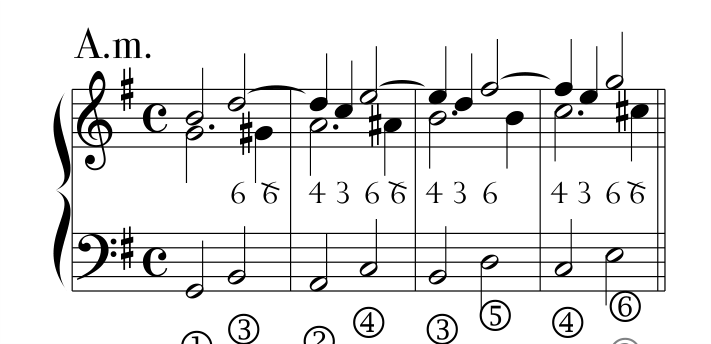
in the said second half of its time value it will have, according to the key [of the note below] a 3rd and major 6th. The third note of the partimento descending by step [②], will then be considered as a ①. Whence in its accompaniment, the note which in the preceding accompaniment had formed a 6th, will rise directly by semitone and will form an 8ve. The other note, which had formed the consonance of a 3rd in the preceding accompaniment, will hold over in the first half of the time value of this accompaniment, and it will form a suspended 4th that will resolve to a 3rd in the second half of the time value of the note of the partimento. And so on until the end of the said motion. See A.m.
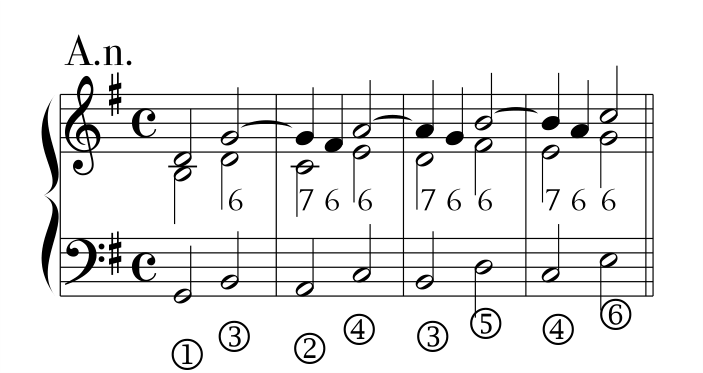
III. The first note of the partimento [①] will be accompanied by a 3rd and 5th. The second note [③] ascending by 3rd, will have a 3rd and 6th. On the third note of the partimento [②] descending by step, the 6th above the previous note will form a suspended 7th which will resolve to a 6th above the same note of the partimento. The fourth note of the partimento [④] ascending by 3rd will have a 3rd and a 6th. [The ensuing 7th] will be resolved as above, following the same accompaniment until the end of the motion. See A.n.