Playable Books
Fedele Fenaroli · section 17 of 26
Concerning a Partimento that Falls by Third and Rises by Step
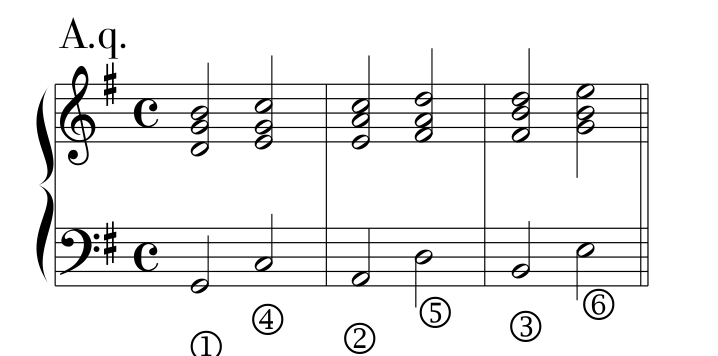
Read and hear this section in the playable edition →This motion can accept various accompaniments according to the diverse interpretations that one may have of the notes of the partimento that form it.
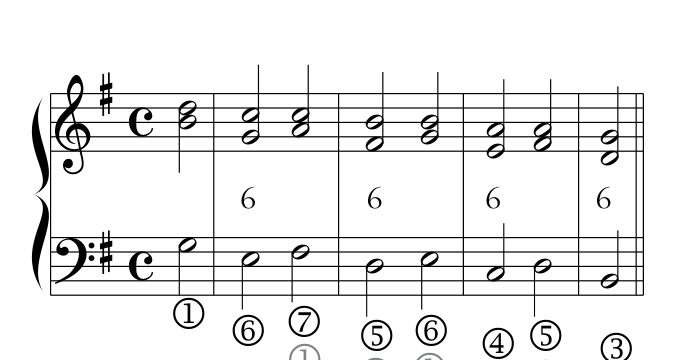
I. The first note of the partimento, considered as ①, will be accompanied with a 3rd and 5th. And the second note of the partimento, having descended a 3rd, considered as ⑥, will be accompanied with a 3rd and 6th. The third note of the partimento [⑦] having ascended a step, considered now as ①, will be accompanied with a 3rd and 5th. And thus one successively alternates the accompaniments until the end of the motion,
whether that of a 3rd and 5th for the notes of the partimento ascending by step, or of a 3rd and 6th for the notes of the partimento descending a 3rd.
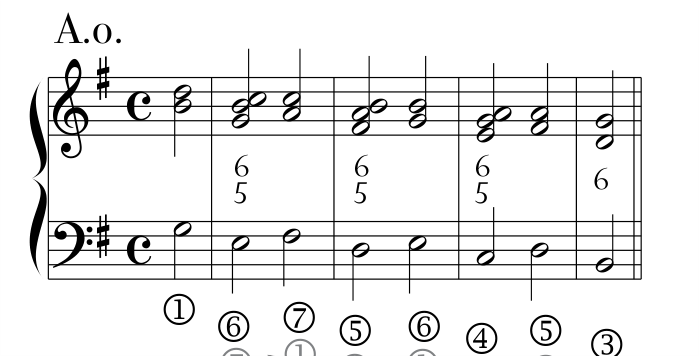
II. The first note of the partimento, considered as ①, will be accompanied with a 3rd and 5th. And the second note of the partimento [⑥] descending by 3rd, will be considered as ⑦ in relation to the following note to which it will rise by step. And like a ④ (as has been said) it will be accompanied with a 3rd, 5th, and 6th. The third note of the partimento [⑦] having ascended a step, will now be considered as ①, whence it will be accompanied with a 3rd and 5th. And thus the aforementioned two accompaniments, that is, of a 3rd, 5th, and 6th for the notes of the partimento descending a 3rd, and of a 3rd and 5th for the notes of the partimento ascending by step, will proceed alternately the one to the other until the conclusion of the motion. See A.o.
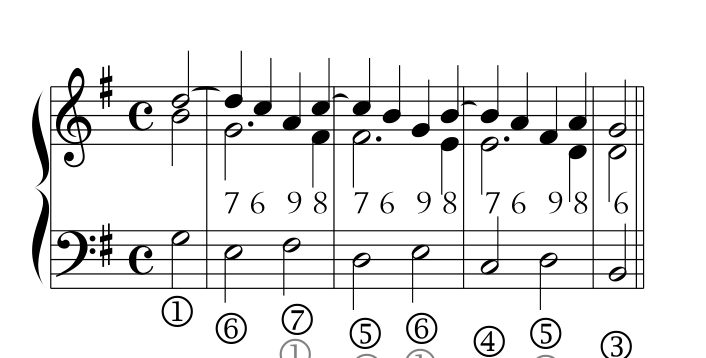
III. The notes of the partimento that form the above mentioned motion can also be considered as follows. On the note of the partimento that descends by 3rd, if one considers it as ⑥, one makes a suspension of a 7th prepared by the 5th of the preceding note of the partimento [①] in order to resolve it to a 6th on the second half of its time value. And thus one [progresses] successively until the conclusion of the motion. On the note that ascends a step [⑦], if one considers it as ①, one makes a suspension of a 9th prepared by the 3rd of the preceding note [❶] in order to resolve it to an 8ve on the second half of its time value [❼].