Playable Books
Cecil Forsyth · section 6 of 39
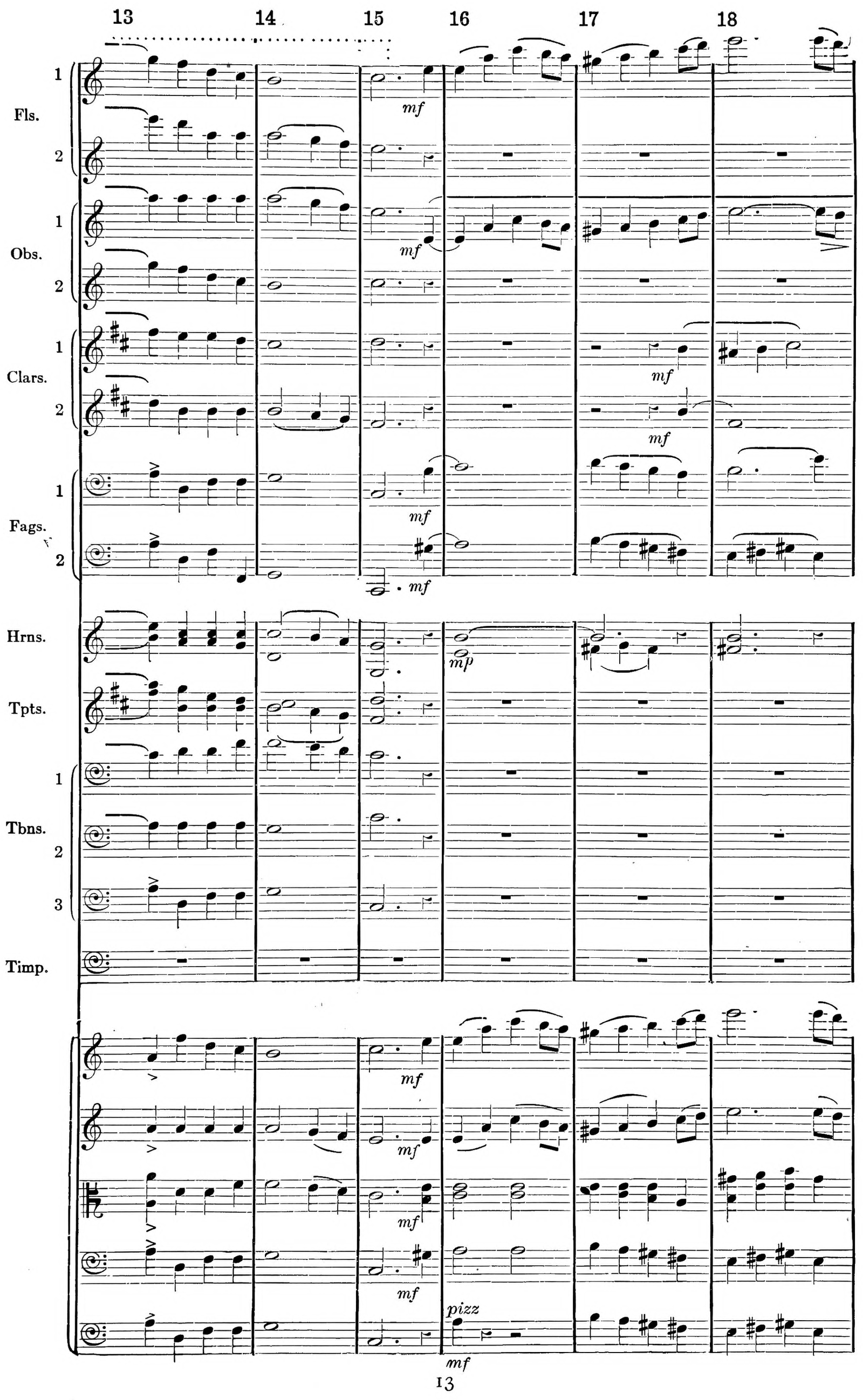
[Bars 13–18]
Read and hear this section in the playable edition →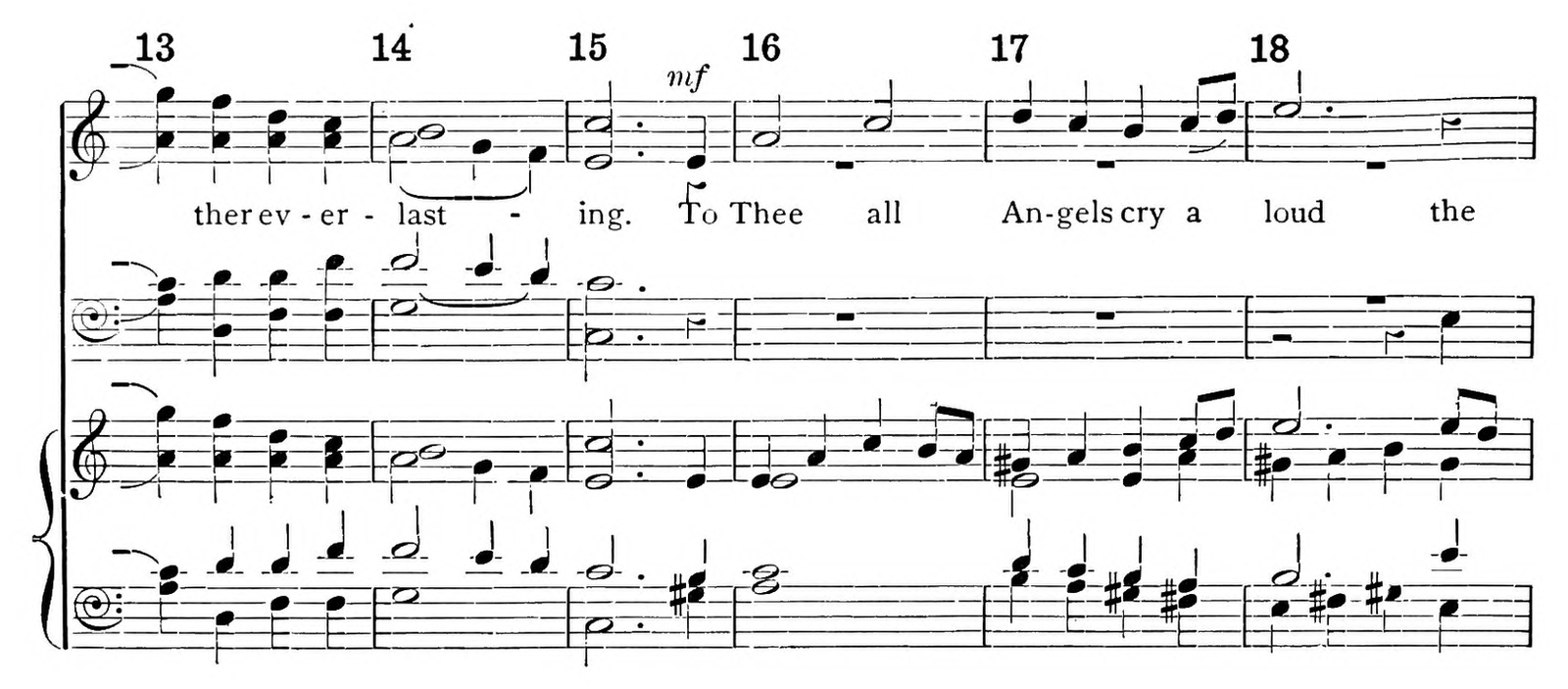
We now come to the little A minor tune beginning on the last beat of bar 15. The brass stops playing; and the whole orchestra, hitherto forte, is now marked down to mezzoforte. The horns are marked still one step lower, mezzopiano. The basses change to pizzicato, which will be distinctly heard and yet will materially lighten the ensemble. The bassoons are kept up fairly high and in pretty close harmony. Finally, whereas up to bar 15 practically every note in the orchestra is detached, after bar 15 almost every note—especially in the wind—is slurred. These technical methods of making the orchestra sound lighter and sweeter may be set out in a little table thus:
Up to bar 15 After bar 15 forte mezzoforte Heavy brass No heavy brass Detached notes Slurred notes Heavy bottom-octave Bottom oct. pizz. basses only
But let us examine the scoring of this passage, bars 16 to 26, a little more closely. The main melody is an octave-combination of first and second violins, and we rely on that to make a beautiful soaring commentary on the vocal parts. If these parts had been sung by solo voices, the first violins would probably have been written in the lower octave, more particularly as their present part is solidified by the addition of the first flute. We should then have used the second violins to play the upper notes of the easy double-stopping in the viola-part. However, in present circumstances, the octave-combination sounds very well. Its lower octave is treated with a little more freedom. The second violins play the whole tune. But in the wood-wind department it is looked on roughly as broken up into two parts. The oboe begins, and is then joined and replaced by the clarinets: then the oboe begins again, and is again joined by the clarinets.

This sort of goldsmith's work, though not especially effective when the chorus is singing, is almost a matter of orchestral routine. It lends variety to the sound, and gives the player an interest in his part and the opportunity of an occasional rest. Before leaving this passage, a word must be said as to the phrasing. It is all legato, but legato of different sorts to suit the various instruments. In the melodic line the oboe has the longest slurs. Then comes the first clarinet. Then, still more broken up to the eye, come the violins and flutes. But it is all legato, in contradistinction to the detached style of the first fifteen bars, and will sound so. In the horn parts the object is to make the sound as unobtrusive as possible. And, as they are marked mp, it is feasible to use fairly long slurs right down to the crescendo bar 26. The harmony of these ten bars (16 to 26) need not detain us long. It is the same throughout, a mixture of bassoons, horns, and violas. Even if we had four horns at our disposal, we should probably use only two here.