Playable Books
Cecil Forsyth · section 10 of 39
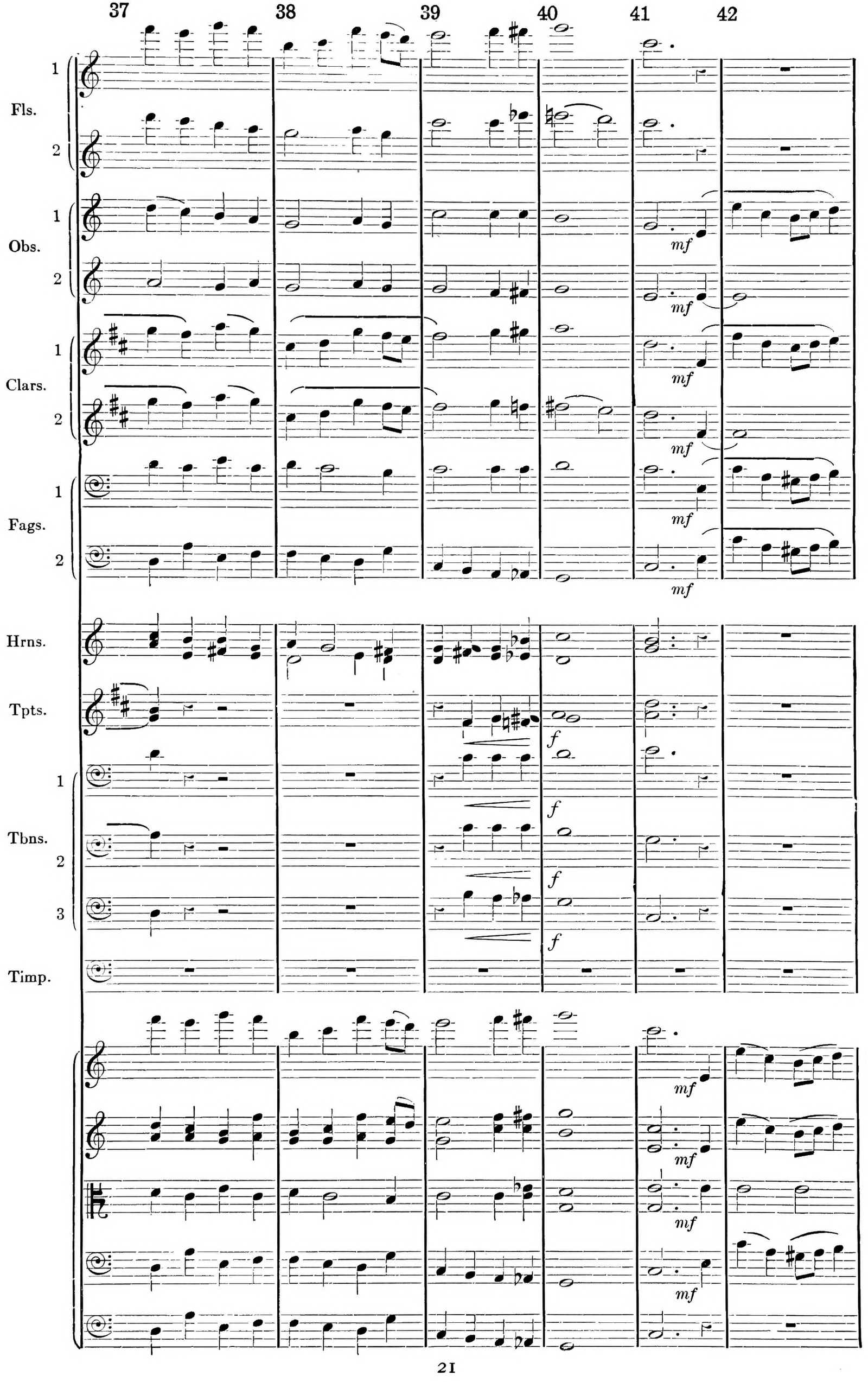
[Bars 37–42]
Read and hear this section in the playable edition →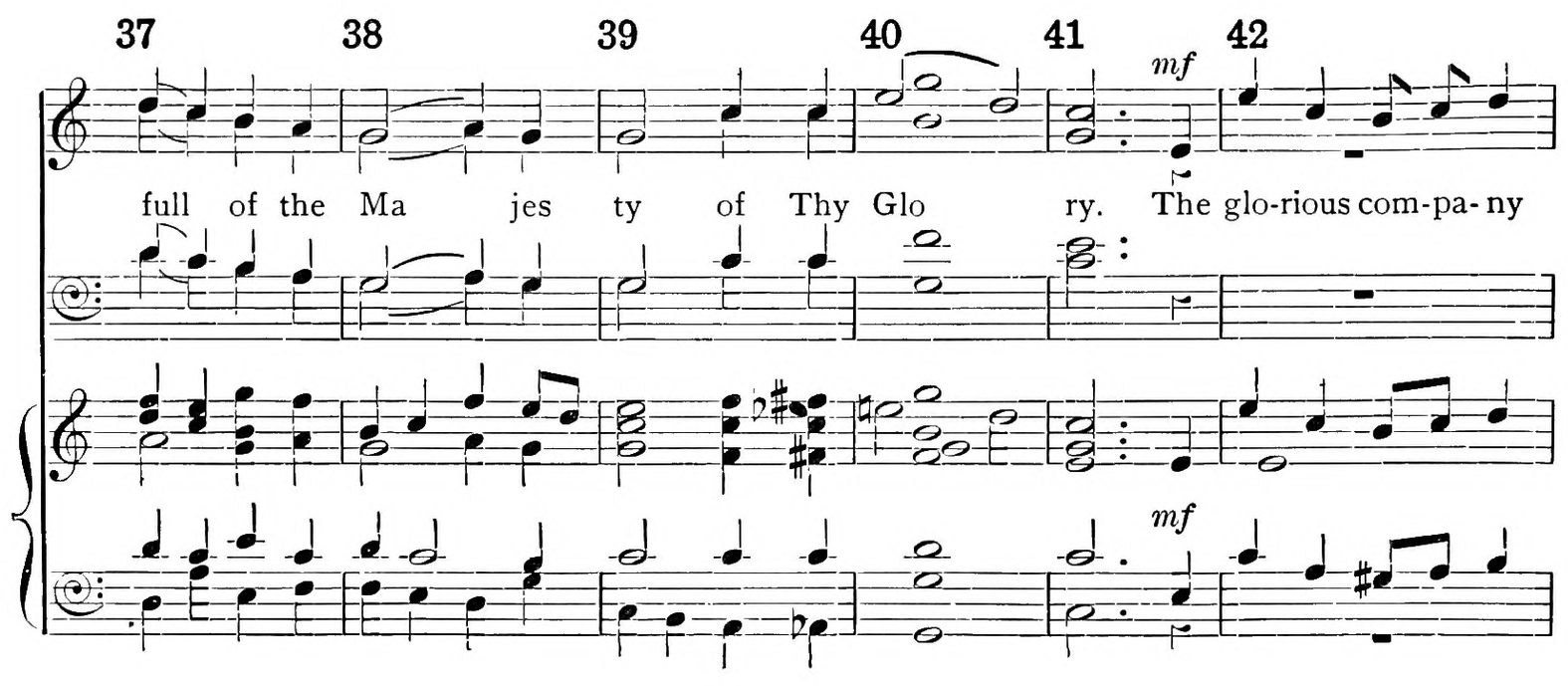
The whole of this passage calls for careful consideration. And we shall have to use a good deal of nice judgment. It will certainly not do orchestrally merely to transliterate the composer's “ff Gt.” each time by a tutti ff. In the first place, where is the real high-light of the whole passage? I do not think there can be any doubt about that. It is on the last beat of bar 59, and continues down to bar 67. But there are the three “Holy's” to be considered. They are undoubtedly meant to be loud by the composer. They must therefore be supported, but without any blaring in the orchestra. The best way to do this will be to replace the horns by the heavy brass in bar 27; to give them as little movement as possible, using them in close harmony as a sort of harmonic background. The trumpets must certainly be kept as low in pitch as possible. Here are the complete chords at the beginning of their entry, bars 27 to 30:
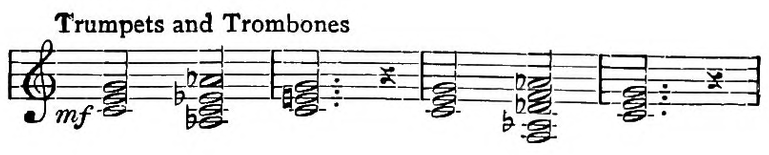
Observe here that we have taken the liberty of making the general orchestral crescendo in bar 26, not from mf to ff, but from mf to f. This enables us to mark the brass mf; and the fact that they are five heavy instruments replacing two lighter will make all the effect we require. Furthermore it gives us something up our sleeve for the high-light that is coming.
On the last beat of bar 41 begins the first of the built-up phrases lettered (b) and (c) in the table on page 18. However we score these phrases, it is obvious that we must contrive three (b's) corresponding orchestrally to each other, and three (c's) similarly corresponding. There must also be a marked contrast between the small smooth things, the (b's), and the loud jubilant upsoaring things, the (c's). How vivid that contrast is to be must be a matter of personal taste. But, having regard to all the circumstances of the composition I should say that we might make it as vivid as our orchestral conditions will permit, always remembering that we are never to employ a ff in our heavy brass. That is to be reserved for our high-light in bar 59. My suggestion would be this:
(b) Strings (no basses) in unison with wood-wind (no flutes); all mf, and playing only the actual written notes of the organ-part. (c) Tune on 3 octaves of strings plus flute and clar. Block-chords on the rest of the orchestra. Brass f, strings and wood-wind ff.