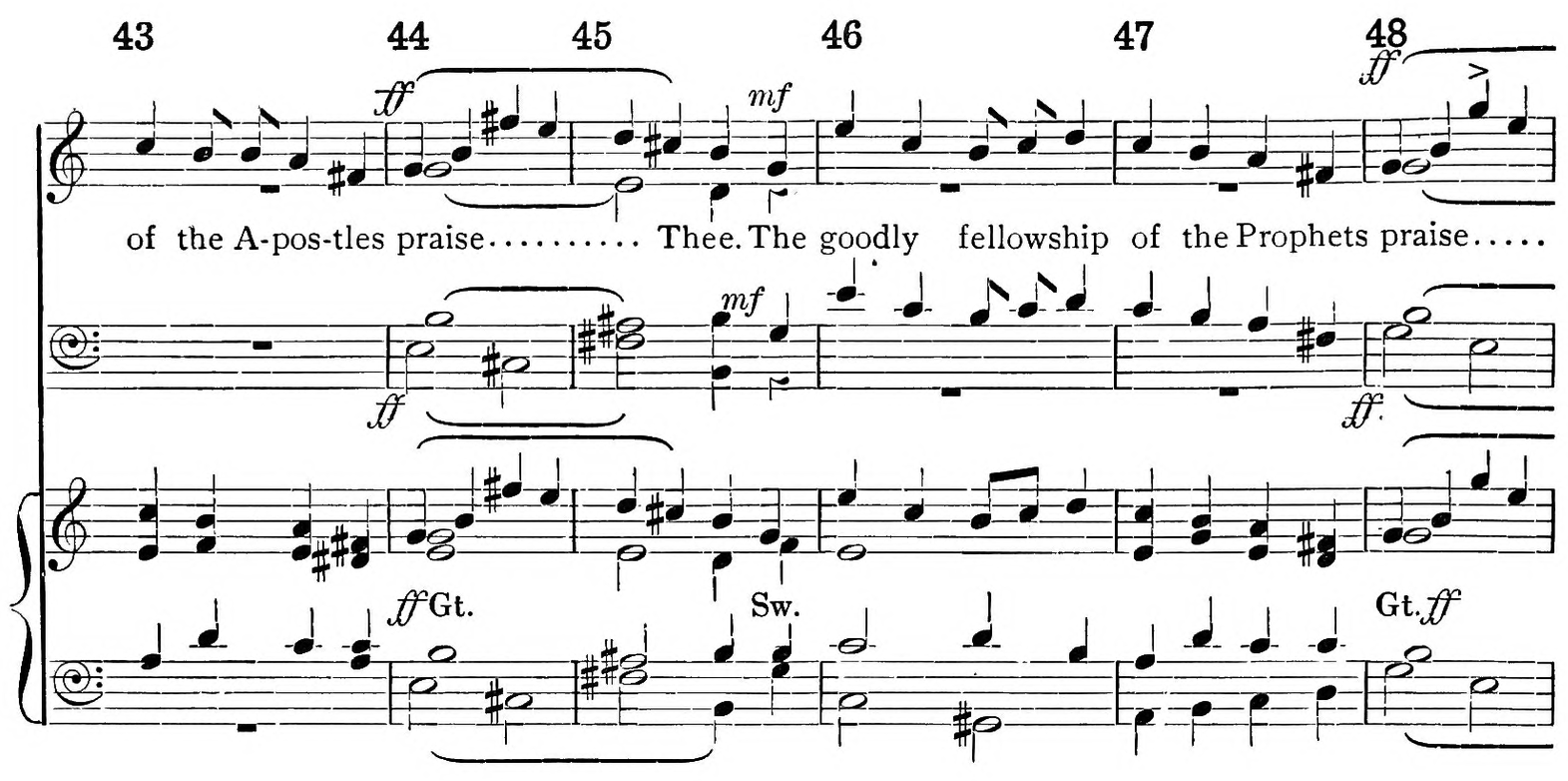
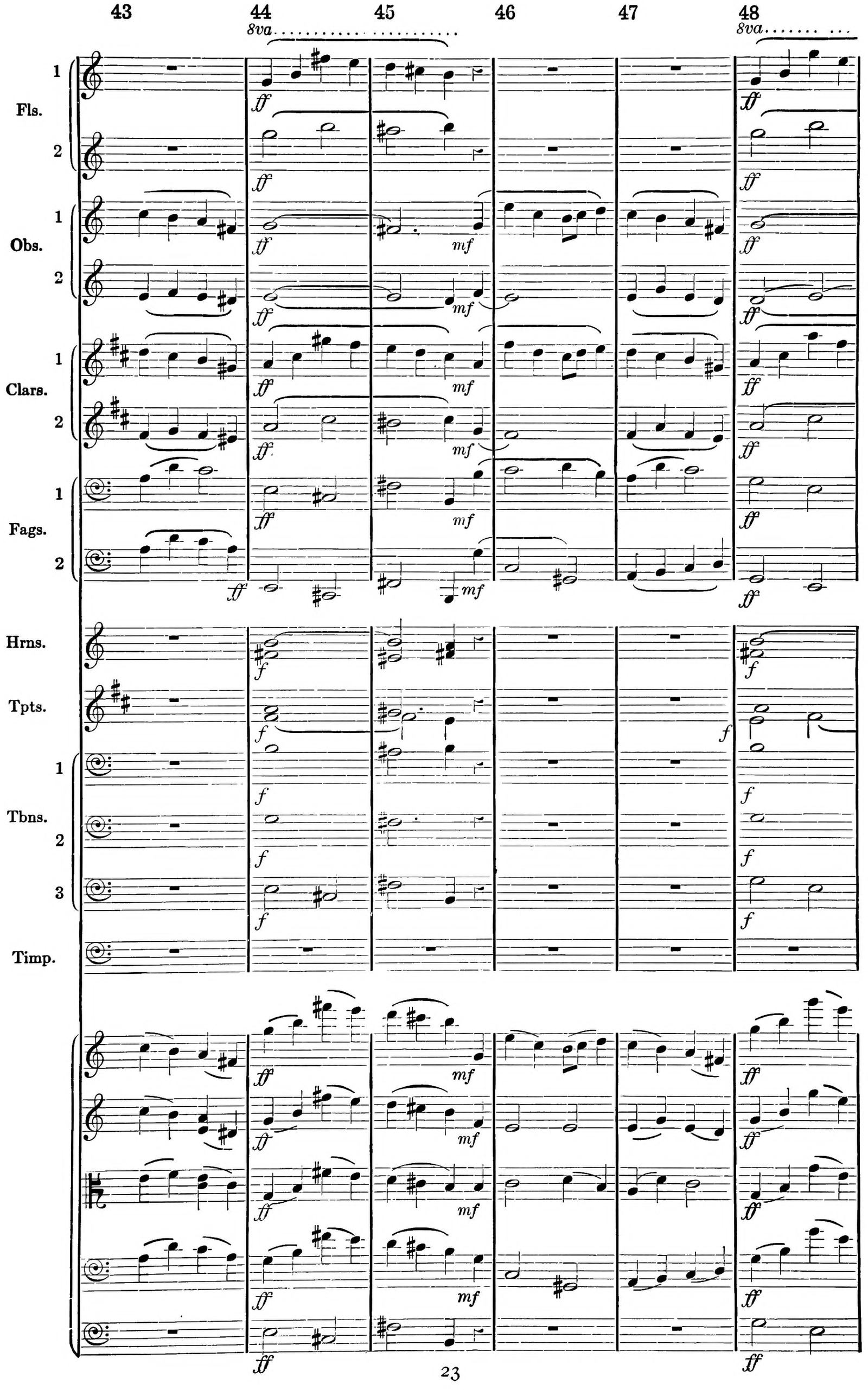
Of course this is by no means the only way in which these passages might be scored. As an example, we might reduce the whole dynamic level by putting (b) on the wood-wind and horns alone, and (c) on strings in two octaves, and mf brass. There are other ways too, in finding which the reader can exercise his ingenuity. But here are two small points both favouring our first suggestion. So far we have had 41 bars, and not one without brass of some sort. It will therefore be a distinct relief if we omit the brass in our (b) section here. Furthermore the actual unison of wood-wind and strings in this particular kind of smooth simple passage is delightful. The wood-wind gives the strings a deliciously reedy—sometimes almost steely—quality. It must not be continued for too long. But during a few bars, as here, it is quite welcome to the ear, especially as it is a pleasant relief after the brass. Naturally there is to be no octave-doubling: that would spoil the effect entirely. So we double the first and second oboes with the first and second clarinets, these two parts being simply the two upper string-parts with a difference of phrasing. The two bassoons, where there are three string-parts, double the lowest string-part in unison, and, where there are four string-parts, they play divisi with the violas and cellos. The reader should verify these statements by analyzing bars 42, 43, 46, 47, 50, 51.
The “lay out” of the (c) bars (44, 45, 48, 49, 52, 53) is simplicity itself. The only change that could be made in this orchestration, granted the original scheme, would be to confine all the wood-wind instruments to the block-chords. This is not an important point. Note, however, that it would be ridiculously ineffective to turn the tables, and give the tune to an octave-combination of wood-wind, while the strings played solid chords with the brass.
 Playable Books