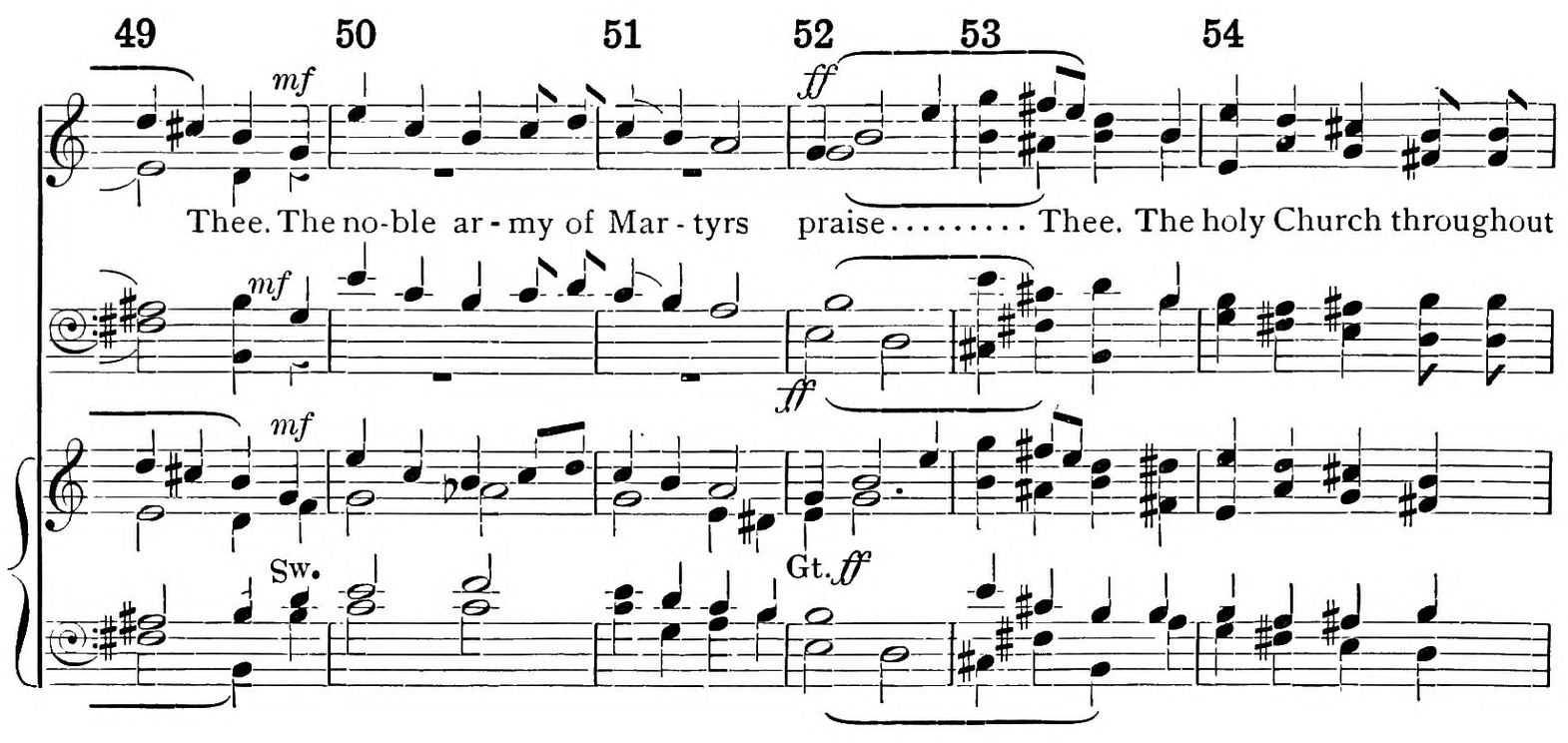
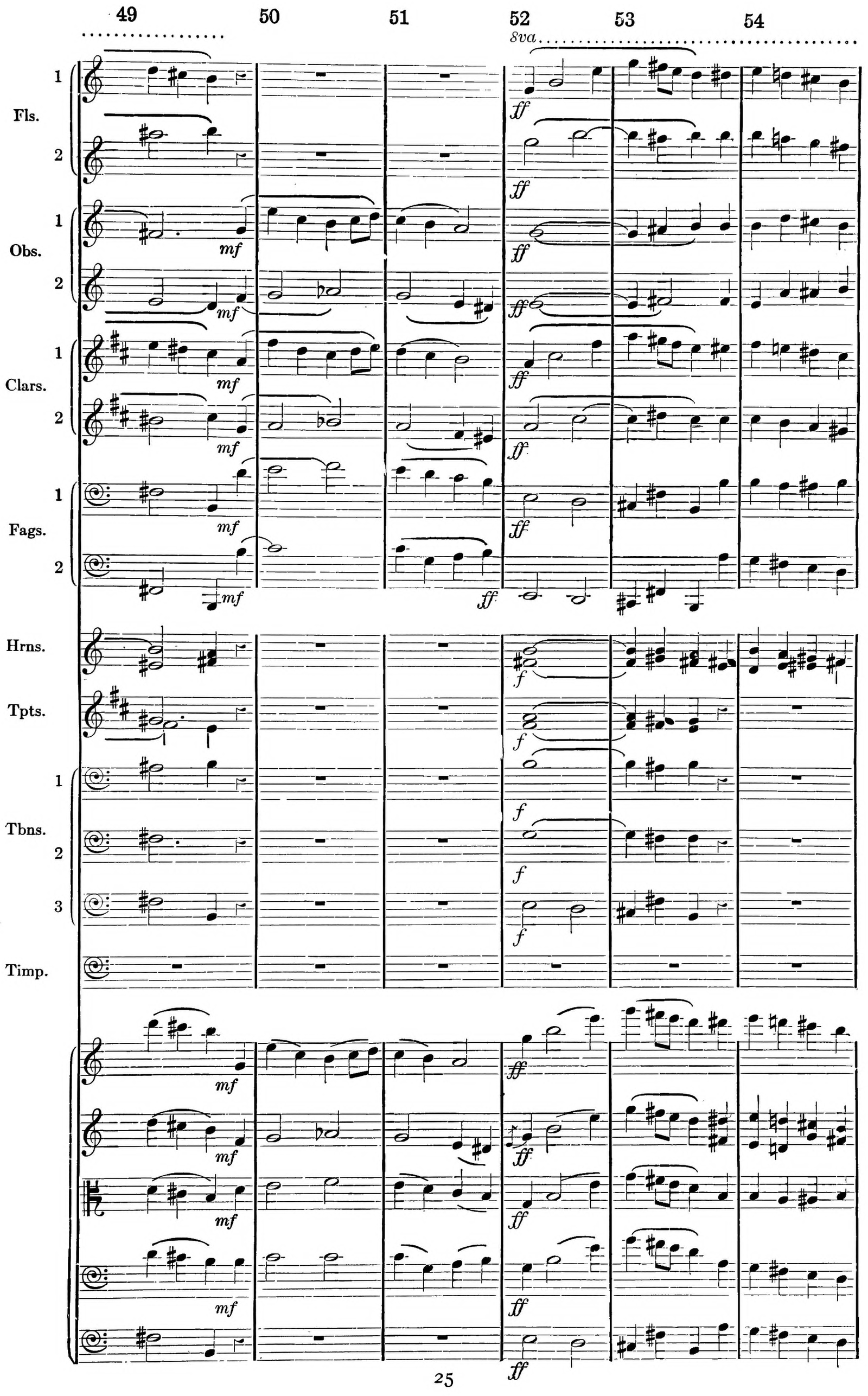
We have now almost disposed of the three “Holy's.” There is practically nothing to notice about the string-parts, except the very important fact that the violins are down again in the lower octave and playing in harmony with each other and with the rest of the strings—the violas doing a sort of double duty with the violins and the basses in bars 28 and 30. Simultaneously with this lowering in the pitch of the first violins the converse plan is put into operation with the wood-wind. They all enter on bar 27, and all play in the upper part of their compass, three of them above the string-limits. Owing to the marking of the brass (mf only) and the low pitch of the string-parts, the wood-wind here are liable to “tell” and to give, as it were, a tutti effect to the whole ensemble.
There are only two further points to be noticed in the scoring of this passage; one of them a matter of taste, the other of discretion. On the word “Heaven” (bar 35) the character of the melody in the accompaniment seems to call for something more brilliant and searching than the fiddles can give it in their middle register. The first violins are therefore put into the upper octave with the first flute, and the melody is doubled in the lower octave by two clarinets in unison. At the same time, as we wish to help the chorus with what we may call their semi-climax at bar 40, we introduce the horns at bar 35 to avoid any thinness, give the heavy brass momentary rests, and then allow them to crescendo through bar 39 to f, the dynamic level of the rest of the orchestra.
We have now got as far dynamically as this: seven full beats of tutti f. But it will be observed that, though the wood-wind (and latterly the first violins for six bars) have been playing in their upper register, the trumpet-parts have all been kept as low as the exigencies of the music would allow.
 Playable Books