Playable Books
Cecil Forsyth · section 17 of 39
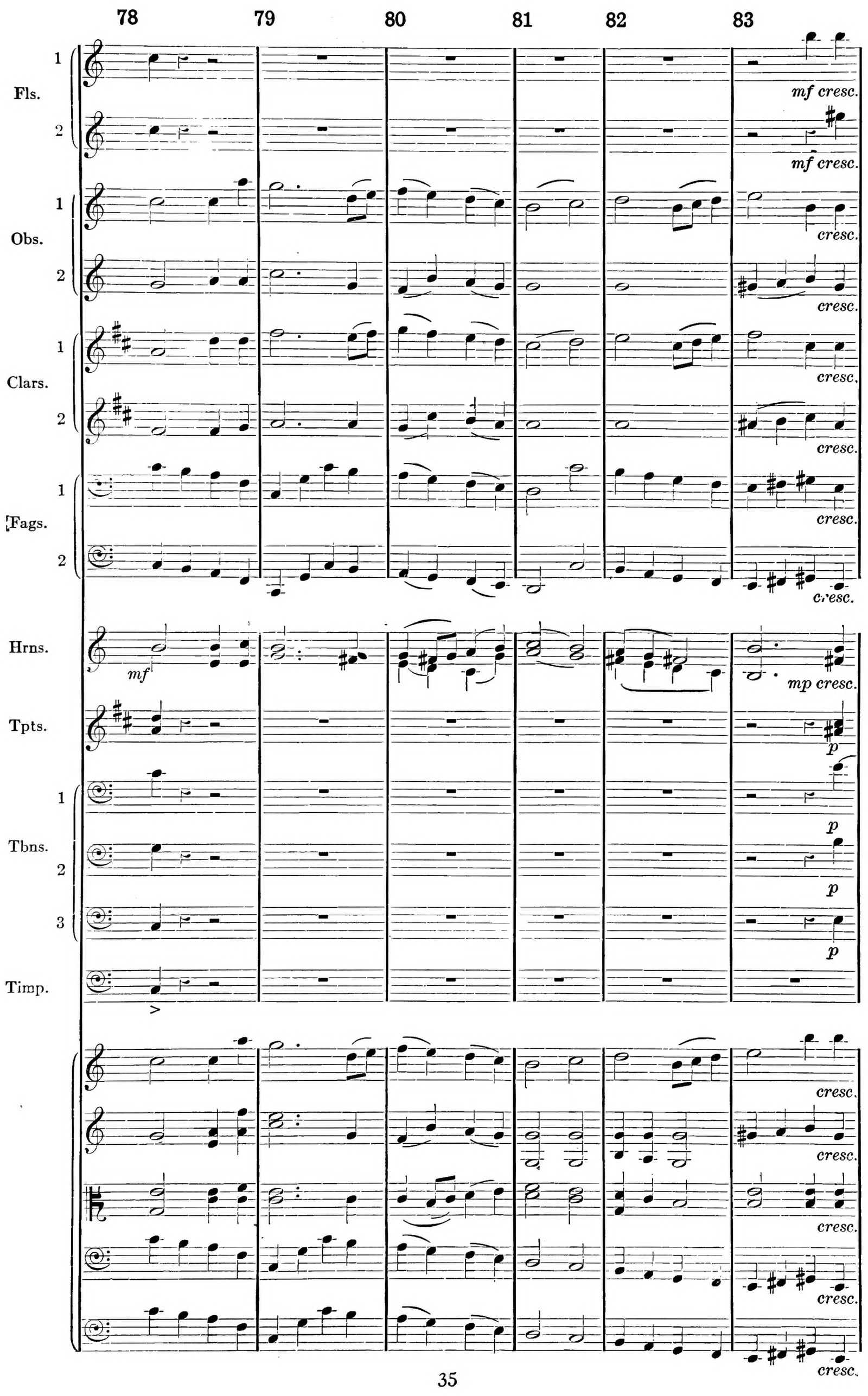
[Bars 78–83]
Read and hear this section in the playable edition →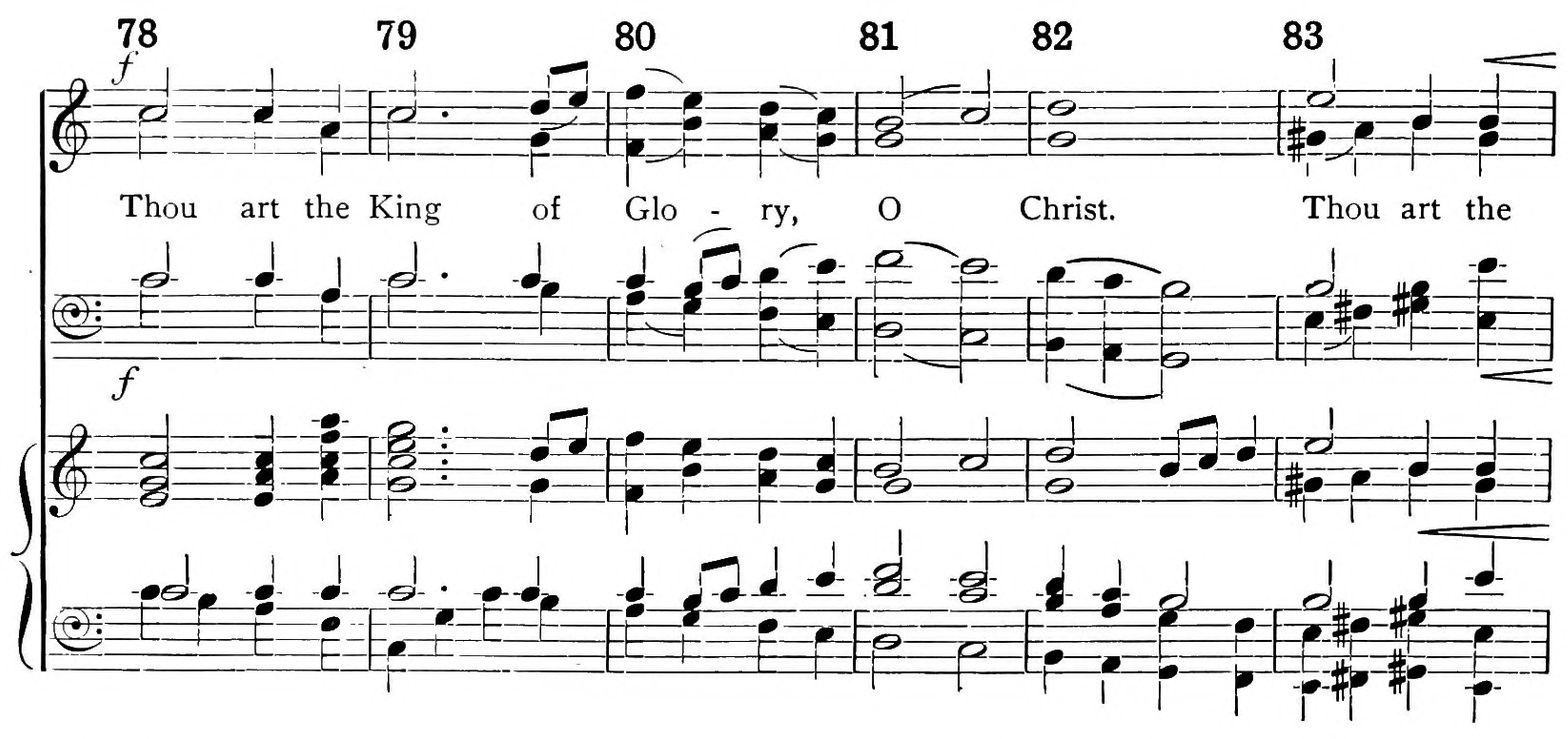
But there is another and stronger reason against this procedure. And that reason is to be found in bars 200 to 207. In this Festival Ending the moving pedal-bass is consciously used, with full knowledge of the pedal-board-compass, to make its massive appeal. And it is used there with much more direction and prevision than it is in bars 78 to 88. If, then, we make our big splurge in the earlier bars with our brass and three-octave string-combination, we shall be compelled to do something the same only bigger when we come to the Festival Ending. And that is an orchestral impossibility. Probably in this particular work we shall not be able to use our three-octaves of strings at all. At any rate it is quite certain that musical common-sense demands the lowering and not the raising of our dynamic scheme at bar 78. Should the reader wish, he may re-score these ten bars according to the prescription that I have suggested above. If he does so, he may be sure that, for these ten bars, his score is the more effective of the two; but equally sure that from the viewpoint of the general orchestral prosperity of the Te Deum, this effectivenesss is inadvisable in this particular place.
I have not hesitated to devote some space to the discussion of what may not appear to be a very important question, because it is just these preliminary considerations that are so vital in scoring choral music. The reader can now turn to the details of their execution: (1) The combination of strings, wood-wind (without flutes), and horns at bar 78. (2) The moving bass, in two octaves only, on bassoons, cellos, and basses. (3) The piano entry of the heavy brass at the end of bar 83, with the simultaneous addition of the flutes, and the jumping of the first violins into their upper octave. (4) The addition of the drums piano for the first time while the chorus is singing. (5) The dynamic marking of the brass, and particularly of the drums with regard to the rest of the orchestra. (6) The fact that, though the tone-scheme of bar 78 is considerably lowered as compared with that of bar 5, we arrive in bar 85 at an appreciably larger sound-mass than that in its corresponding bar, 12. These two latter bars, 12 and 85, should be carefully compared.