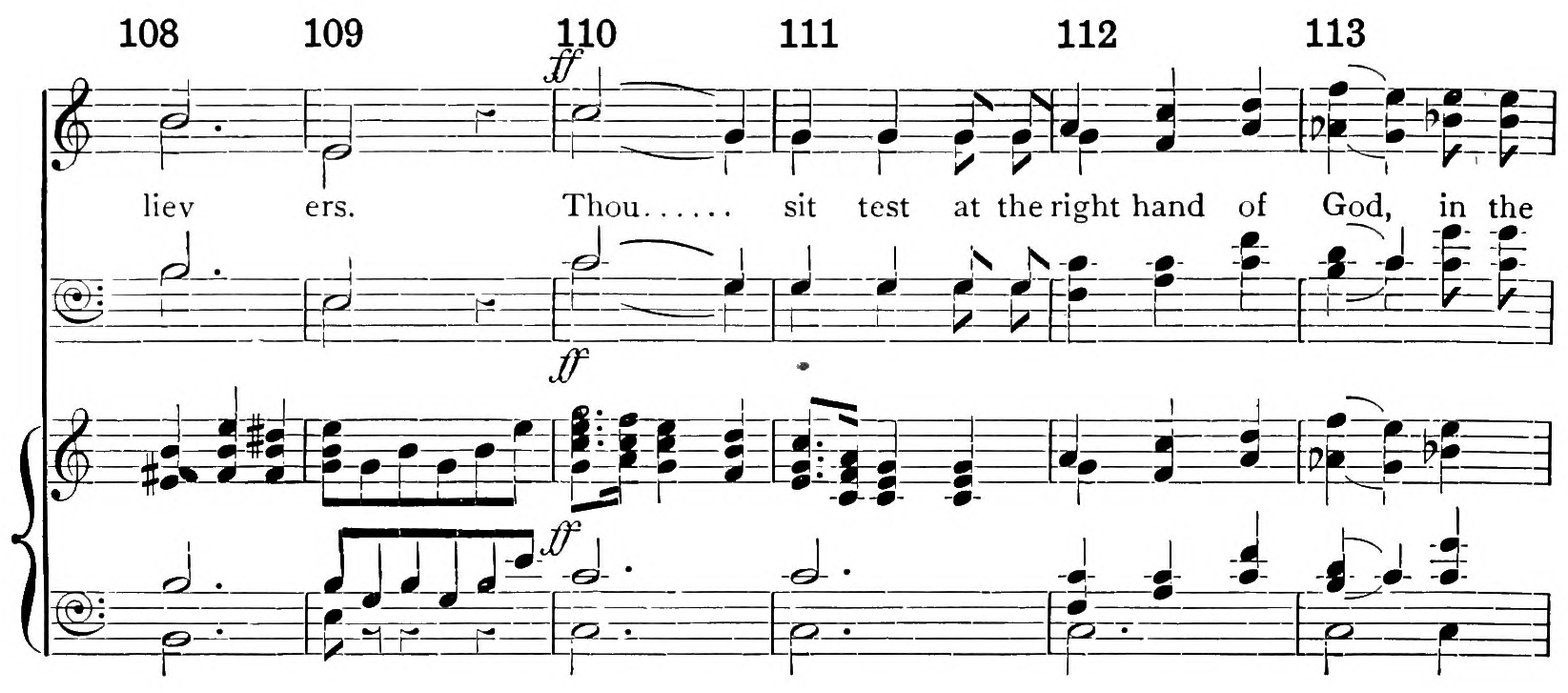
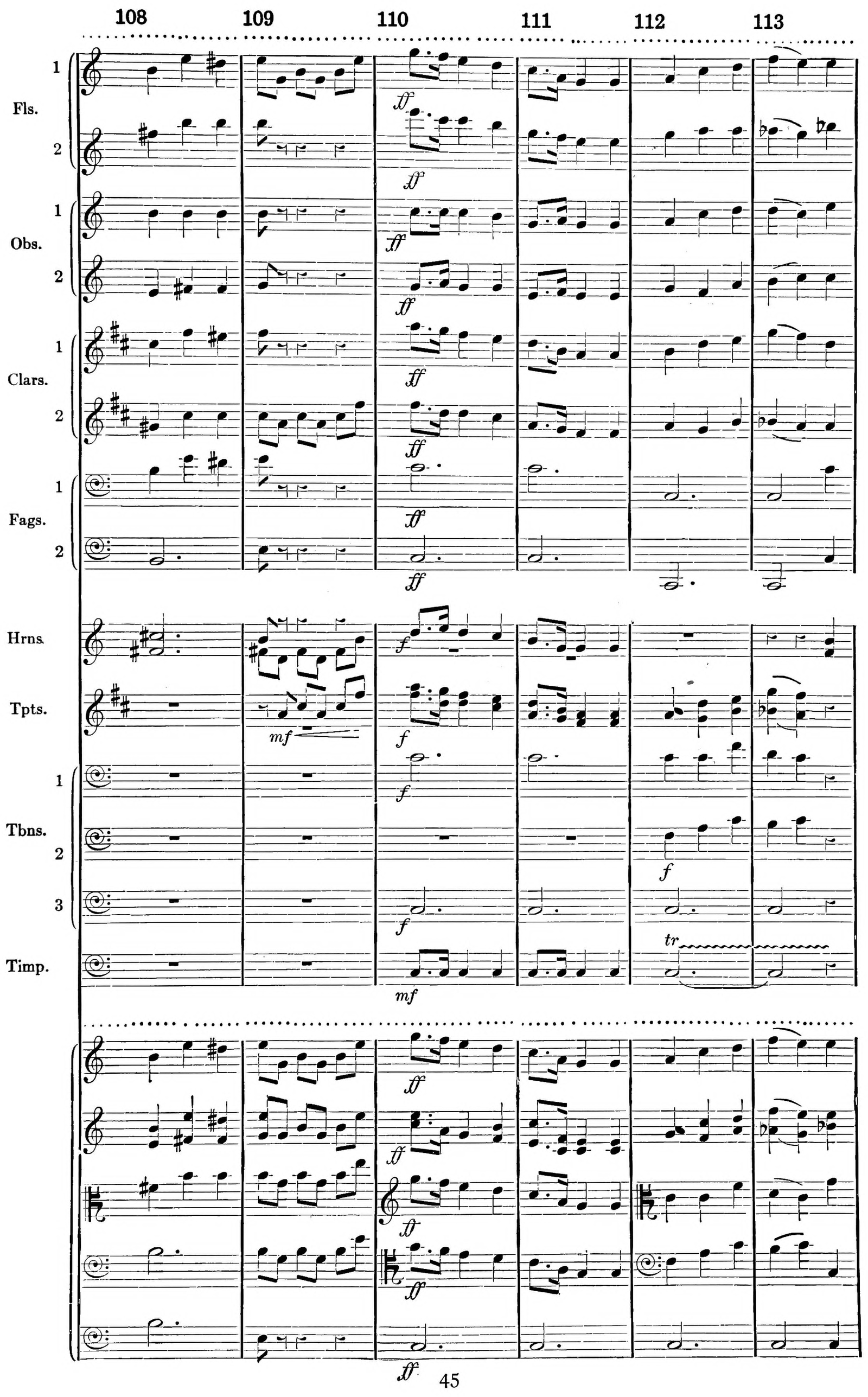
We now come to a passage that is rather awkward to deal with successfully. Of all the passages in the work its orchestral interpretation is the least obvious. It begins at bar 110, and continues to the first beat of bar 119. Let us first notice that is is marked ff, and that therefore it would probably be played on the organ with a considerable increase in the registration. On the other hand, in view of what has gone before and what is coming, we do not want to attack the passage immediately with six- or seven-part chords in the brass. The first two bars of this passage can be made a three-part affair for the two trumpets and the first horn, while two of the trombones, assisted by the basses and bassoons, play the octave C's. But, if we adopt this somewhat “up in the air” treatment, it will be as well to make a virtue of our difficulties, and rise still higher into the orchestral atmosphere, attacking the phrase in the strings with a three-octave combination pitched as high as circumstances will allow. This, in fact, we have done. The three-octave combination includes the first violins, the violas, and the cellos; but excludes the second violins, which play a harmonic part. The rest of the score is subsidiary. The first flute plays with the first violins: the clarinets with the trumpets. The second flute and the oboes, like the second violins, fill in the harmony. Observe the drum, which counts for something here. In the next two bars (112 and 113) the scoring is more normal. The heavy brass gives the horns time to fill their lungs; and the horns repay the courtesy at the end of the phrase (bar 113). The second violins lead a double life, as mentioned above.
 Playable Books