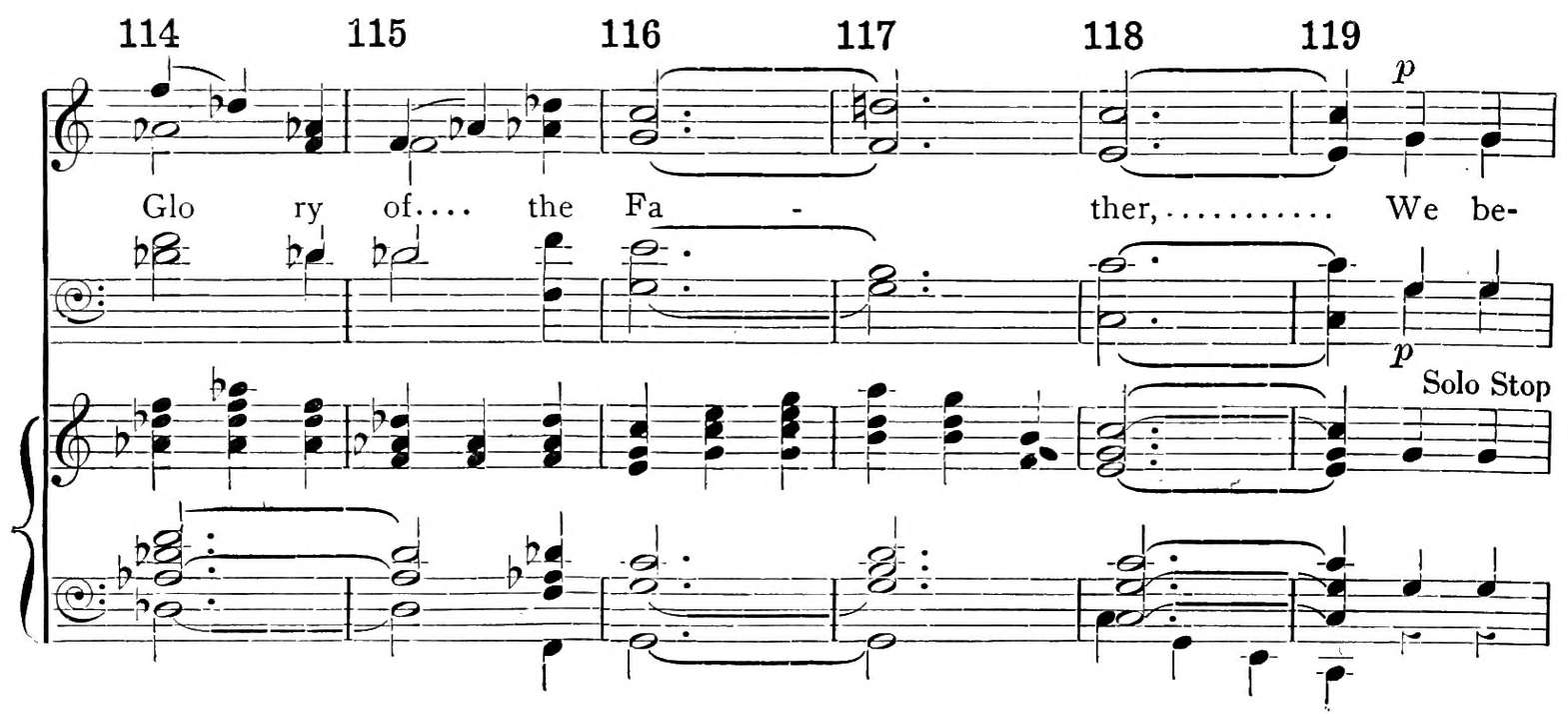
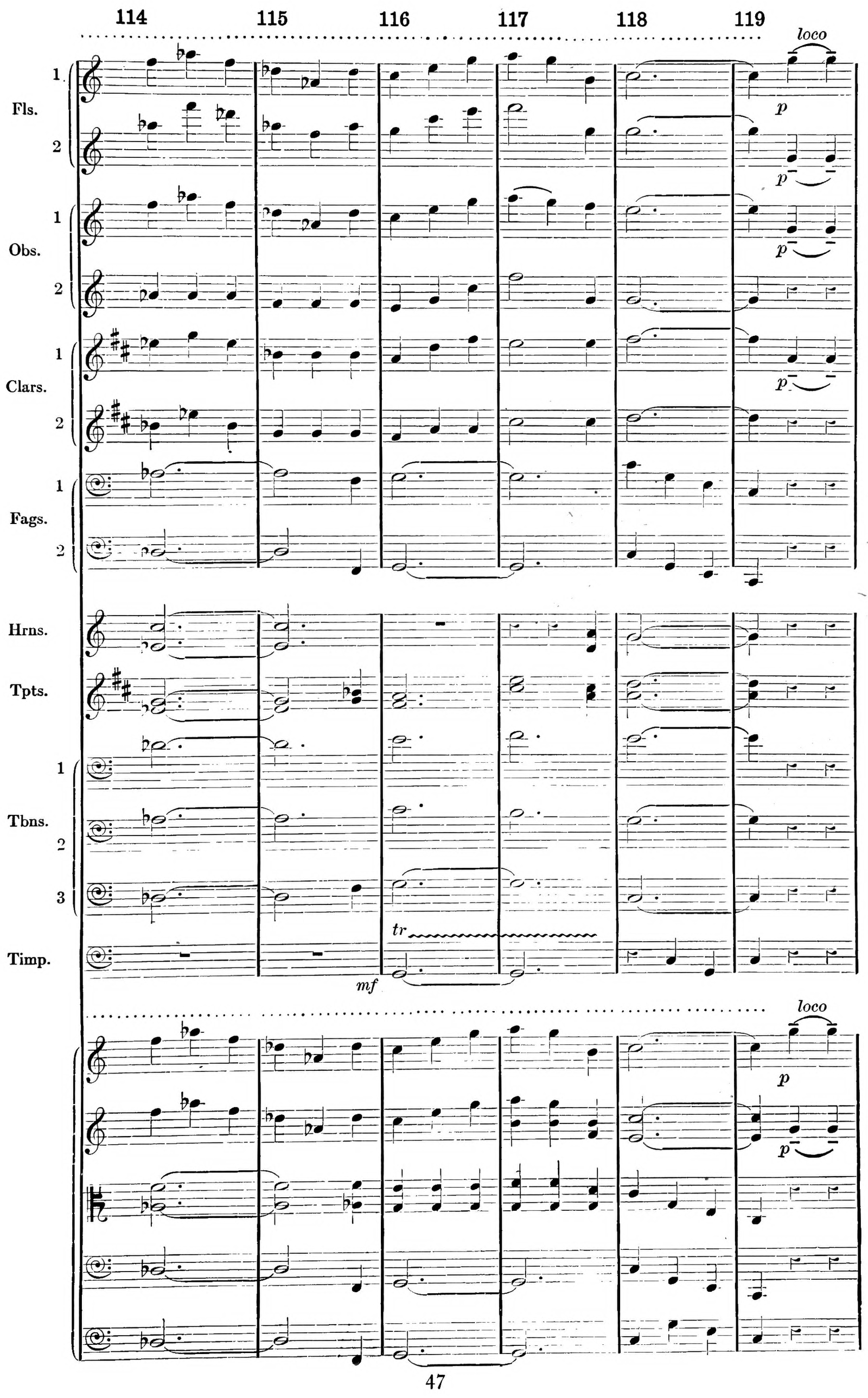
It will be noticed that, at bar 110, the first trumpet attacks the tune in unison with the first clarinet and the violas; and continues it as far as the second beat of bar 113. There it stops. It might proceed in any one of three ways:
1. By playing the secondary tune; that is, the movement, as given in the right hand of the organ-part. If it did that, it would necessarily have to play the upper series of notes. As the latter are written, they lie too high for the trumpet, and would be liable to sound too prominent. In order to keep them subsidiary to the main theme in the chorus, we should have to put them down an octave, so that the first trumpet part from bar 114 to bar 119 would be a suboctave-reduplication of the first oboe part. This passage does not lie well at all. In the upper octave it is far too high; in the lower it is too low, and would be lost among the trombone notes.
2. The trumpet might play in unison with the sopranos, continuing the tune in fact for the whole eight bars, instead of for only four.
3. It might play the lowish tenuto part, as printed on the opposite page.
No. 1, is practically out of the question. The choice is between Nos. 2 and 3. And as No. 3 gives the secondary tune a somewhat better chance of standing-out, it is adopted here. The subordinate movement is then entrusted to the first and second violins in octaves, reduplicated and supplemented harmonically by the flutes, oboes, and clarinets.
 Playable Books