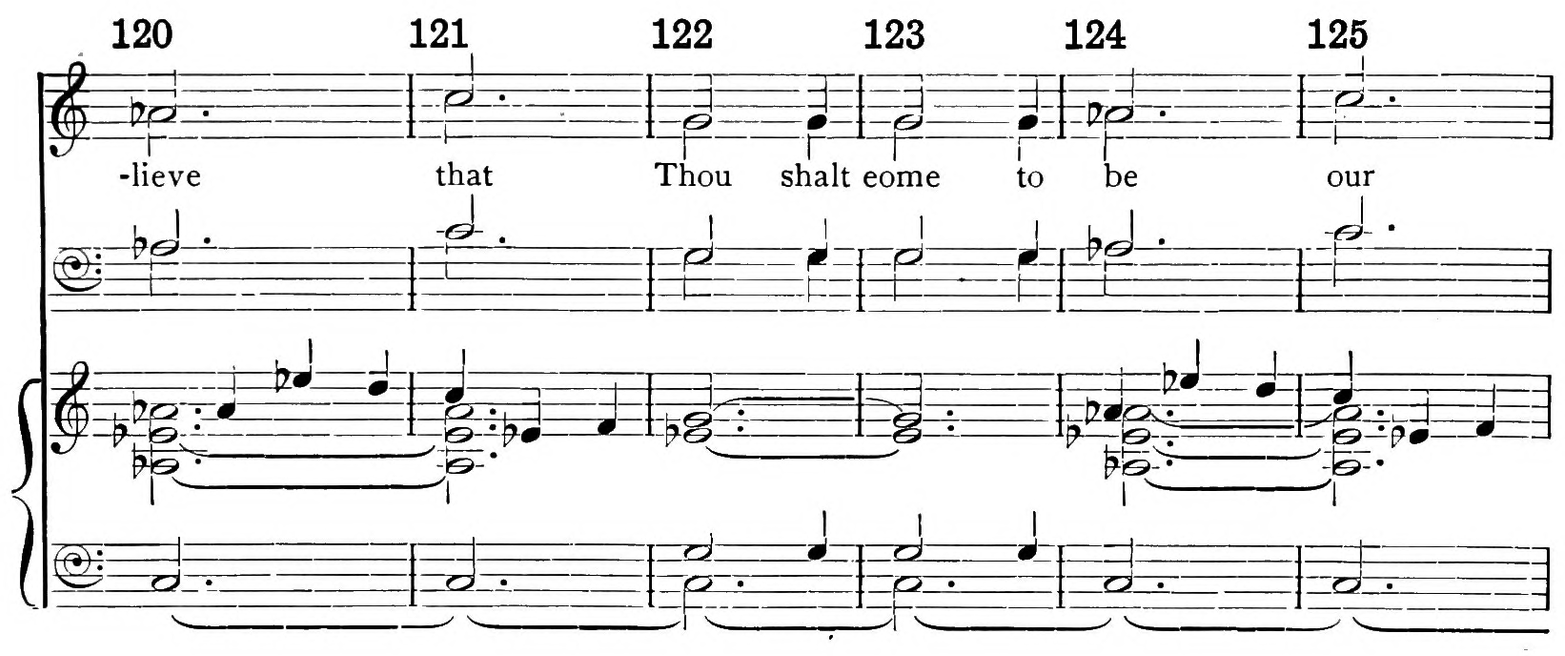
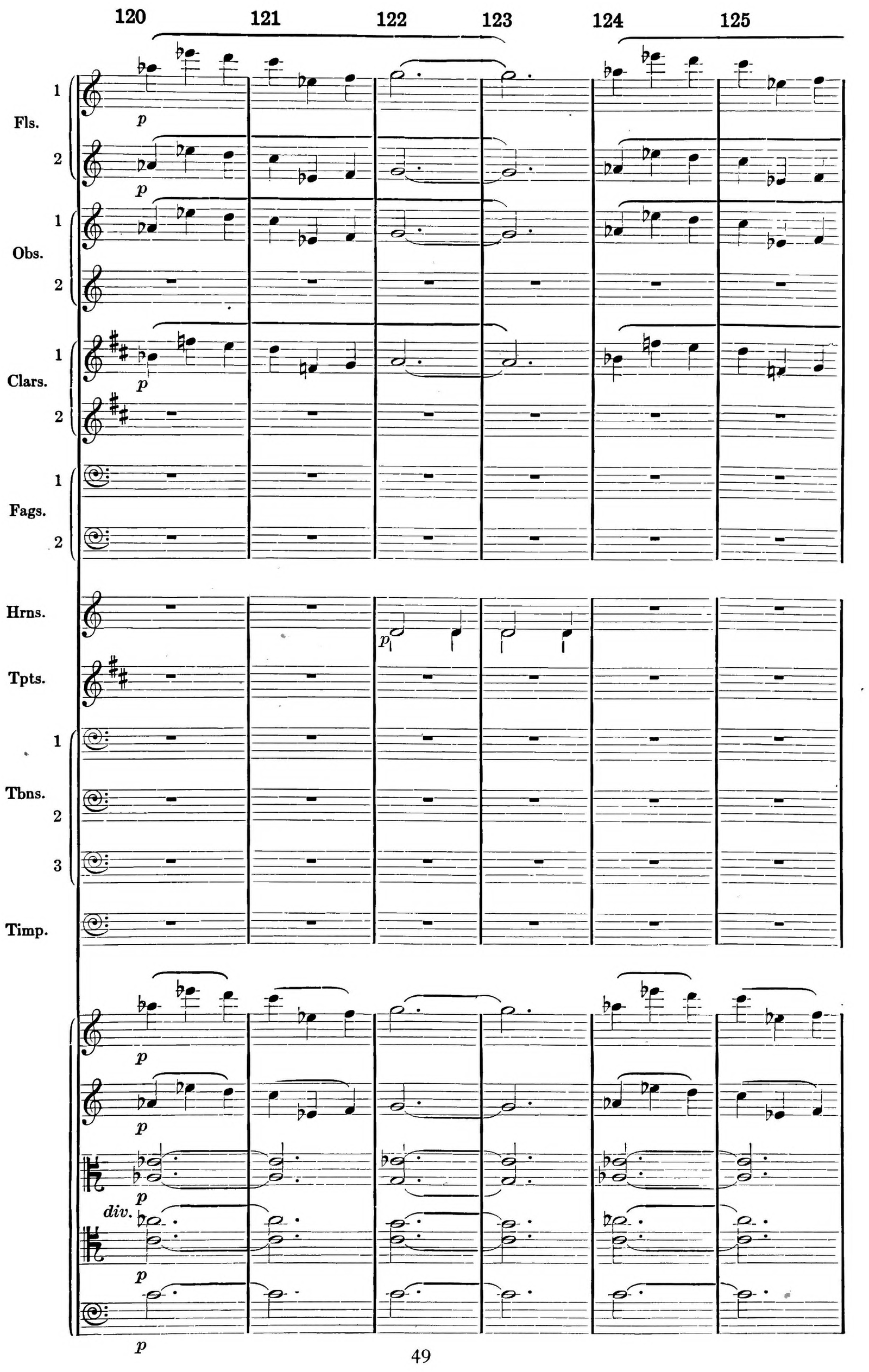
At bar 119 we reach a modulatory passage which is technically no more than a preparation for the E-flat unaccompanied chorus to come. The extreme solemnity of the words, however, and the character of the music make a change in the orchestration imperative. What are we to give the composer in exchange for his direction “Solo stop”? If the chorus were not singing, we might carry out his wishes almost literally by using a solo oboe accompanied by the string-quartet, or by giving the actual written notes of his melody to first and second violins in unison, with clarinets, bassoons, and horns to support them. However, neither of these plans would be quite satisfactory here. What we need for our harmony is a tone-colour sufficiently warm and vibrant to add interest to a rather simple choral unison, and at the same time moderate enough in quality not to obscure the smooth melody above. Perhaps the best way to get this is to write the harmony on violas and cellos divisi, keeping the latter well up on their top strings. If we give the violas the second and fourth parts of this four-part ensemble, they will be able to play the whole passage easily in double-stopping. The treatment of the melody—flutes and violins, both in octaves, with one oboe and one clarinet added to the lower part—speaks for itself. It might be a possible improvement to omit the first flute and the first violins entirely from bars 124 to 127. The four notes for horns in bars 122 and 123 will not, of course, come out very clearly against the same notes in the choral tenors and basses. Nevertheless their solemn warning character exactly suits the mood of the passage. So we shall retain them, and even repeat them two bars later. Finally, before leaving these eight bars, the reader should examine their phrasing, as it happens to exhibit, with almost mathematical regularity, the instrumental differences which are common on nearly every page of a full-score.
 Playable Books