Playable Books
Cecil Forsyth · section 25 of 39
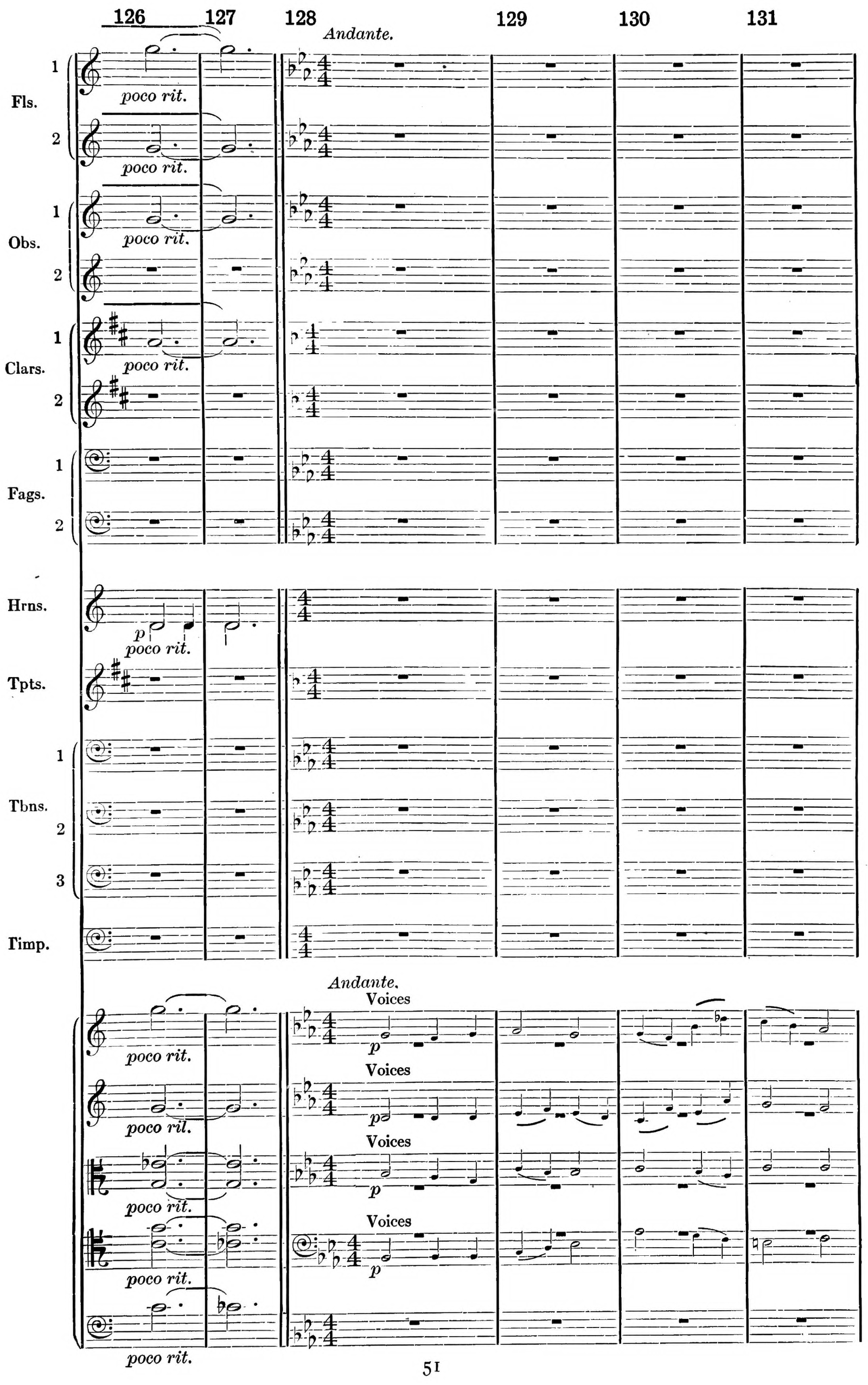
[Bars 126–131]
Read and hear this section in the playable edition →![Bars 126–131: voices and organ, as in the original copy. Bar 126: poco rit.; bar 128: Semi-Chours [sic], Andante. (not too slow.), 4–4, p; Organ ad lib.](/forsyth-choral-orchestration/assets/reflow/org-126.png)
The chorus now (bar 128) is singing unaccompanied, with an organ-part marked “ad lib.” All we have to do therefore is to put rests in our string-parts, and “cue” the S. A. T. B. into the violins, violas, and cellos. We write small pin-head notes, and leave the vocal phrasing as it is.
This matter of “cueing” was mentioned before, when we were discussing the musical merits and demerits of the lead-pencil (page 6). The business of cueing, however, has been developed into an elaborate orchestral technique, far beyond anything in these very simple choral pages. A little more space, therefore, may be devoted to the subject.
Cucing, then, is a system beloved by the publisher and much practised by the professional orchestrator. Its object is to provide instrumental alternatives to any and every bit of melody and accompaniment. And this provision has to be made, not because the orchestrator cannot make up his mind, but because the instrument of his choice may not be on hand, and the purchaser of the parts demands the assurance that the work will sound well, whatever his instrumental forces may be. In fact, he asks for perfection—and at a very low price. For example, the orchestrator may have assigned a fragment of melody to that almost unheard-of instrument, the oboe. But there may be no oboe present. The part has to be cued-in to the clarinet. But there may be no clarinet present. The part has to be cued-in to the violin. What happens if there is no violin I do not know. I presume that then the word “orchestra” becomes interchangeable with the word “pianist.” This happily illustrates the schoolboy's definition of an optimist as “a man who looks on the bright side of things, while one who looks on the dark side is called a pianist.”
Bad as this system is fundamentally from the artistic point of view, its results are often surprisingly good. But it needs, for its successful operation, long experience, a cunning hand, and an amount of patience that, in any other walk of life, would seat its owner high up on the pinnacles of prosperity. Its painful feature is to be found in the tonal callousness which it sometimes produces in the mind of the orchestrator, forced as he is to regard all sounds of equal pitch as having equal orchestral value. The result of these accumulated uncertainties is often a stereotyped style that regards music chiefly from the chinese puzzle point of view.