Playable Books
Cecil Forsyth · section 32 of 39
[Bars 168–173]
Read and hear this section in the playable edition →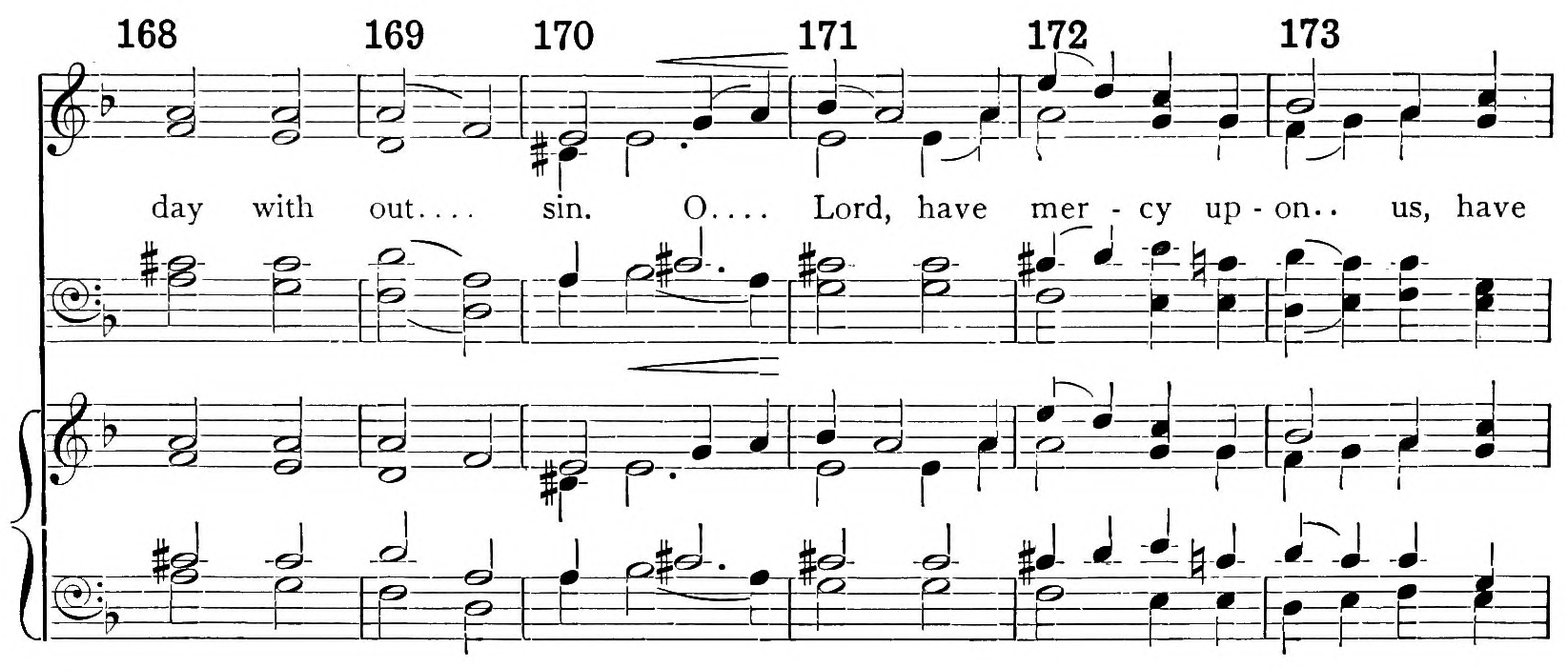
It is not, however, in the brass that the beginner will probably find his chief difficulties, but in the wood-wind. This question has often been asked: The oboes can be placed either above or below the clarinets; which is the correct way of writing them? Well, there are six ways of spacing, let us say, the ordinary chord of G major for oboes and clarinets, not two:
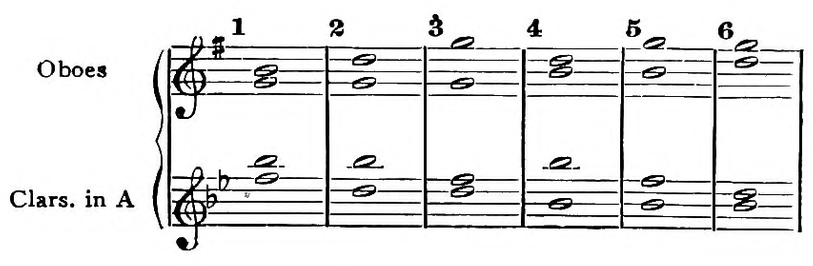
and each of these six sounds different from the rest. In most cases it is a matter of complete indifference orchestrally how they happen to be placed at any given moment. As a routine in filling up tutti chords the dovetailing system may be adopted (nos. 2 and 5). But this must be interpreted liberally. If no special effect is intended, the two arrangements (2 and 5) can be interchanged occasionally for the sake of interesting the players, who naturally see the music as a strictly horizontal affair at their own level. Next in order of usefulness come the two placings (nos. 3 and 4) where one of the pairs plays the outside parts. Nos. 1 and 6 are less used, but it would be absurd to say that they are not quite common. No. 6 in particular often has to be written in low-pitched chords, owing to the over-reedy quality and the limited compass of the oboes. The employment of one oboe to play a fragment of tune supported harmonically by two clarinets underneath is an orchestral commonplace. However, it is always charming, owing to its woody homogeneity and its pointed melodic appeal. Before leaving this subject let me repeat the statement that the six arrangements given above all sound different if they can be heard. A nice discrimination in their use is therefore a weapon in the hands of the orchestrator. The question of routine in a tutti is quite another matter. It may be added—though this is not altogether germane to the topic—that wood-wind unisons and octave-combinations are much more frequent in orchestration than in orchestration-books. In the latter, too, there is a hoary mediæval legend that perfect fourths on one tone-colour (nos. 1 and 6 above) plunge an audience into deep mental distress. I confess that, though I have often tried, I have never been able to feel unhappy on this subject. It seems to me to be a Hucbaldian hallucination which might well be allowed to perish.