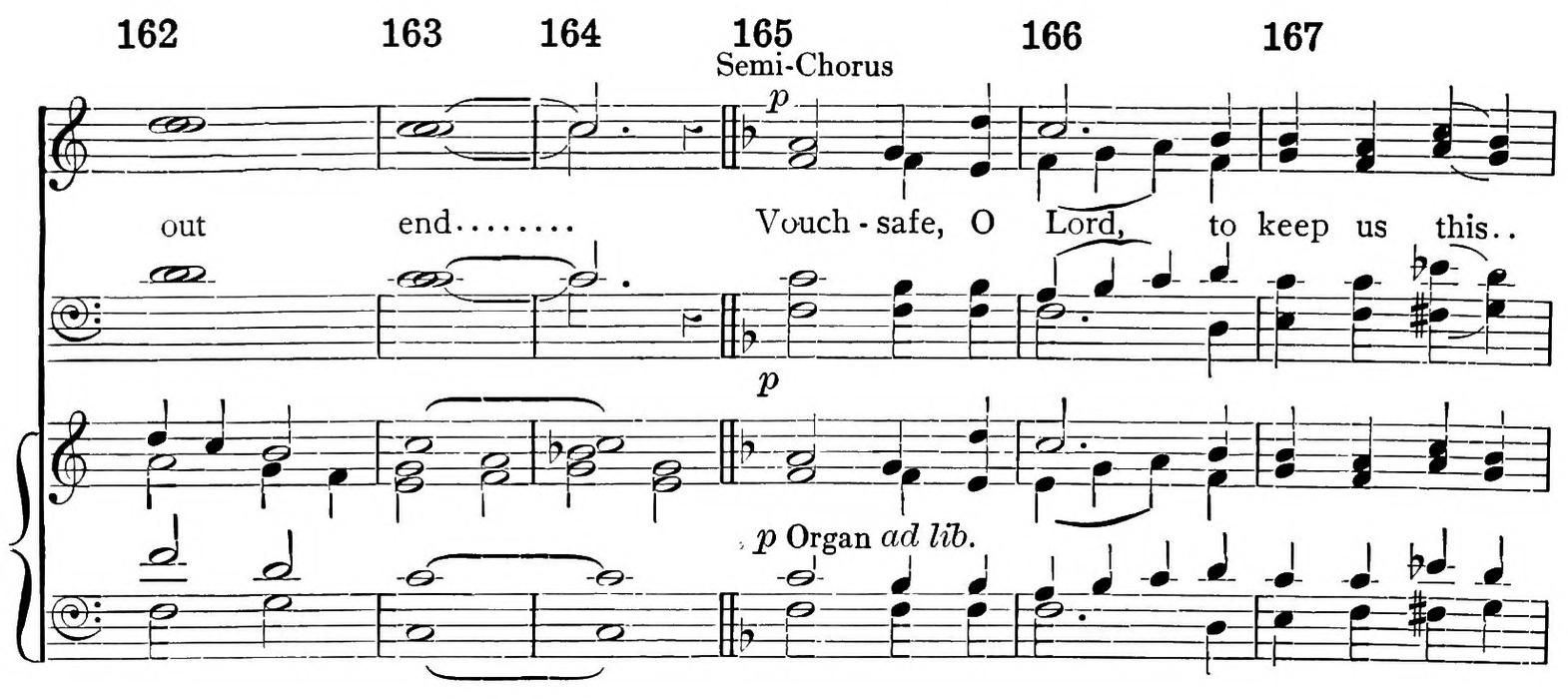
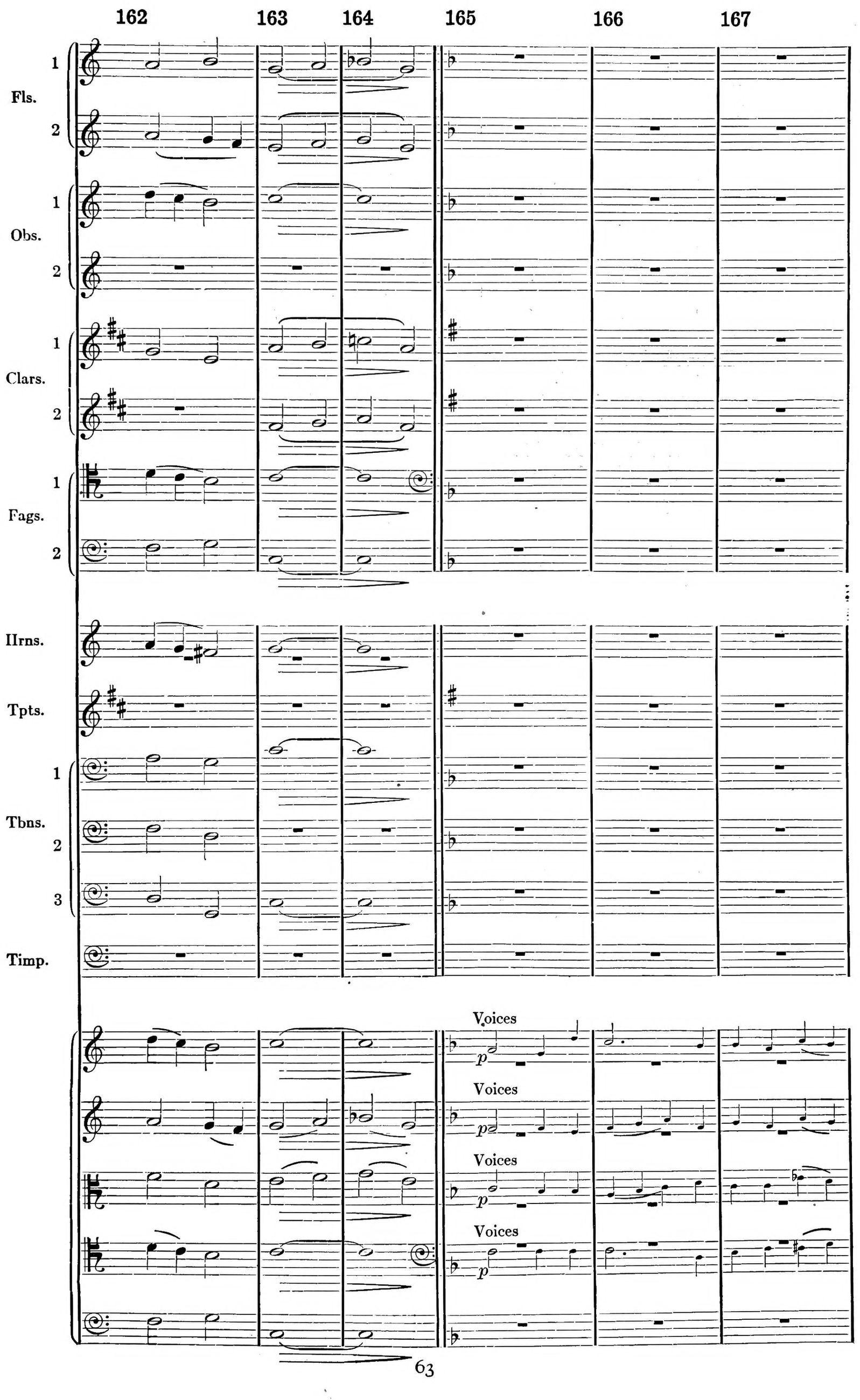
We now arrive at our diminuendo bars (163 and 164), followed by our second cued-in chorus, bars 165 to 178. And here we may pause for a minute to consider a little question, simple enough in itself: but often the source of anxiety to beginners—the relative “placing” of the various instruments. I need scarcely say that with four horns (or trumpets, for that matter) the parts are always written dovetailed or interlocked. The third horn plays the harmony-note immediately under that of the first horn; then come the second and fourth horns, in that order downwards. In modern music this is an absolute necessity, as it specializes the leading players of each pair of horns to the accurate production of the difficult upper harmonics. On the rare occasions when one has four trumpets at one's disposal, the same general scheme holds good. But it often happens that, even with four trumpets in the score, the upward spread of the trombones makes a three-part trumpetchord more desirable. In this case either a trumpet is omitted or one of the parts is doubled. If a part is doubled, more often than not it will be the top part; so that the three parts downwards in the chord will be played by first and third trumpets in unison, second trumpet, fourth trumpet. But every chord must be looked at searchingly to determine exactly what is needed. Nothing upsets things so much in the orchestra as too much or too little sound in the trumpet department. Of course, at a big orchestral climax there is nothing to compare with four-part trumpet-chords in the top register. But a little of this goes a long way; and an audience is soon blinded musically.
 Playable Books