 Playable Books
Cecil Forsyth · section 4 of 60
Percussion instruments
Read and hear this section in the playable edition →Preliminary
A NUMBER of instruments with different mechanical methods of toneproduction and of widely varying musical effect must be grouped together under the heading "Percussion" or "Struck" Instruments. They all have this in common however, that, in playing them, the performer sets up vibrations by beating elastic and semi-elastic surfaces which are in contact with the air.
Gevaert subdivides these Percussion Instruments into
(1) Autophonic Instruments.
(2) Membrane Instruments.
In the former he says "the tone is produced by the vibration of solid (metallic or wooden) bodies, of a nature sufficiently elastic to be capable of keeping up the vibratory motion imparted to them, usually by pereussion. They include
(a) Instruments of definite pitch, such as Bells, Glockenspiel, and
Celesta.
(b) Instruments of indefinite pitch, such as Triangle, Cymbals,
Gong, Castanets, and so on.
The Membrane Instruments are, in a word, the Drums. They include
(a) Instruments of definite pitch, such as the Kettle-Drums.
(b) Instruments of indemnite pitch, such as the Side-Drum, Bass-
This subdivision of the "Percussion" into "Autophonic" and "Membrane" Instruments depends for its logic solely on the degree of elasticity in the struck surface. It seems to be based rather on musical than on scientific considerations. We shall therefore content ourselves by classing all the elastic and semi-elastic beaten surfaces together as "Percussion Instruments." However, a musical subdivision of the whole group must be made. This is not difficult. In some of these instruments the vibrations in the elastic material set up irregular vibrations in the air. These are the "Unmusical Percussion Instruments." Others set up regular vibrations. These are the "Musical Percussion Instruments." The former produce noise, but not soundal i deinite musical pitch. The latter produco sounds of
Unmusical percussion instruments
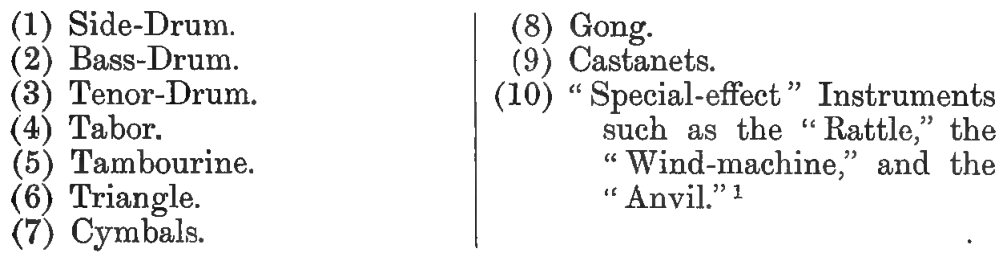
Musical percussion instruments

NOTE.—In two other instruments-the Hungarian Cimbalom (or Dulcimer) and the Pianoforte-the sound is produced by means of the percussion of stretched strings by hammers. In the Cimbalom the hammers are directly under the control of the player. In the Pianoforte there is an intervening mechanism between the player's nanand aestrings instructs rese instruments belong both to the " Musical Percussion" group and to the "String" group. However, our present rough orchestral classification is one of "Per- " "Brass," "Wood and "Strings." It will therefore be more cussion, convenient and more satisfactory from the musical point of view if these two instruments are excluded from the list of "Percussion Instruments" and dealt with under the heading "Stringed Instruments."
We shall now briefly describe the 16 instruments in the above list. Sufficient detail will be given to furnish the student with an adequate knowledge of their mechanism and their compass,-it any. Very few musical examples, however, will be included in this section. There is .,no very great urgency for special quotations to illustrate the use of Percussion Instruments. But references will be found under each instrument to such examples of its use as are scattered through the book.