Playable Books
Cecil Forsyth · section 10 of 60
No. 6. The Triangle
Read and hear this section in the playable edition →
Fr. Triangle; It. Triangolo; Ger. Triangel.
This instrument is a small bar of steel bent into the shape of a triangle. It is struck with a beater of the same metal. It should be moderate in size, not so small as to sound "tinkley" nor so large as to acquire a distinct musical note. In tone it should be as clear as crystal.
Simple rhythms, isolated notes and little groups of notes are all possible and effective on the instrument. When a succession of rapid notes are grouped together on a beat thus
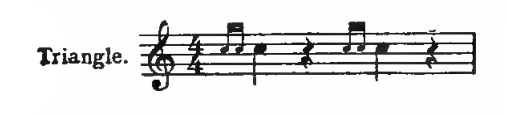
it is better to use an odd number of strokes. This enables the player to pertorm the first and last notes of the series in the same direction, right to lett. With an even number of strokes he has to reverse the direction for his accent. As a rule the simpler the rhythms and one might also say the fewer the bars played the more effective will the part be. In this connection the student should look through the whole of the Triangle part in the Merstersinger Overture. It is the acme of good taste. Another effective triangle part of precisely the same length-namely one note-is to be found at the end of the 2nd Act of Siegfried, page 280 of the Full Score.
The tremolo or "roll" is made by beating rapidly to and fro between two sides of the Triangle. Widor picturesquely remarks that "at the climax of a crescendo, when the orchestra would seem to have reached its maximum intensity, it suffices to add the Triangle, in order to convert red-heat into white-heat."1 This type of effect with the Triangle beating either a roll or a strong rhythm is well-known and much practised. In such places the instrument has little difficulty in asserting its tone-quality even in the tutti ff. On the other hand its pr when used with soft Strings and light Wood-Wind is charming. Single soft strokes mixed with the octave-unison of a Flute, an Oboe, and a Harp (playing in Harmonies) sound delightiul. An excellent example of the Triangle ppp in combination with the Wood-Wind and the upper Strings is quoted below from Lalo's Rapsodie. See Ex. 115.
Another and characteristic use of the Triangle is in starting or, as it were, setting free a new phrase in the orchestra, either at a change of harmony, of melody, or of tone-colour. Of this the passage referred to in the Meistersinger Overture is a happy example. But the student must resist the temptation of repeating the stroke on the other firstbeats of his succeeding melodic sentences. The notation of the Trangle is either on a single line or conventionally on a stave in the trebleclef. The usual notation for the " roll" is employed? Care should be taken with the p's and f's as the Triangle has considerable powers in
1 The Technique of the Modern Orchestra, translated by Edward Suddard. 2 See page 24.
this direction. As a rule it is well to keep the marking of the Triangle part below the level of the instruments with which it is playing.
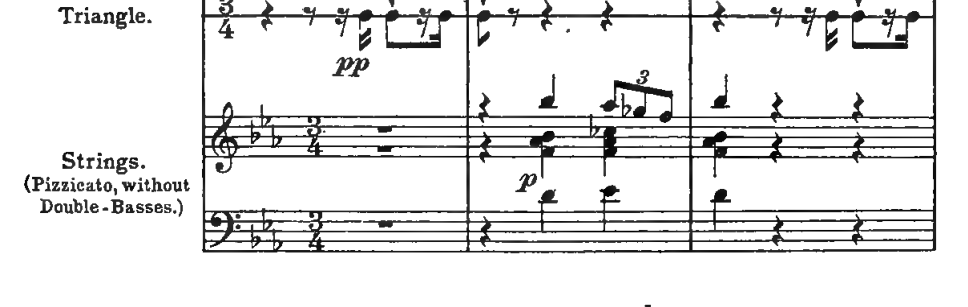
Liszt, in his pranoforte Concerto in ED, has raised the Triangle to the symphonic level of a Solo instrument:
EXAMPLE 6. Allegretto Vivace. Liszt. Pianoforte Concerto in Eb.