 Playable Books
Cecil Forsyth · section 11 of 60
No. 7. The Cymbals."
Read and hear this section in the playable edition →

Fr. Cymbales; It. Piatti or Cinelli; Ger. Becken.?
These are two large circular brass plates of equal size. In the centre of each is a saucer-shaped depression, to the outer side of which a strap is attached. The plates are made, not flat, so that their whole surfaces would touch each other, but slightly tapered so as to secure a contact at the edges only. Their tone varies greatly according to size, weight, and the particular alloy used in • their manufacture. When large enough, and of the proper metal, their quality is martia and brilliant in the extreme. But it is to be regretted that makers often turn them out so small in size, and poor in quality, that they add and little to the orchestral tone-colour, but a sense of vulgarity discomfort.
The tone of the Cymbals is produced in four ways:
(1) By clashing them edge-to-edge with a sort of side-ways or brushing movement. This, the two-plate-stroke, is the ordinary method of playing single notes.
(2) By striking a single plate either with a hard Side-Drum stick or with a soft Kettle-Drum stick. The former method can only be satisfactory when used fortissimo at moments of wild excitement.
1 Or Clashpans. The English word Cymbal, though as old as the 9th century, did not become specialized to its present meaning till the introduction of the "Batterie " in the 18th century. Before that time it was only occasionally used in its modern sense. For instance, "Cymbales be instruments of musick, & be smit together & soundeth & ringeth" (Batman upon Bartholome, But the student would do well to remember that in old English the word Cymbal or Cimball is more commonly used for either "Bell," "Dulcimer," or "Psaltery." It is also found as the name of a stop on the Organ or Regal. The bell-imitation on the former instrument was usually effected Cy mad 3 eatres and diapay eye anton or as we should say are flage as tae The early 17th century Keyed Carillon (or, as we should say, the Glockenspiel) was known as the Clavicymbalum.
"The full word is Schallbecken. Each plate is known as Schale or Teller.
3 But see Ex. 20, where it is used piano to reproduce the hard metallic tap of the clapper on the bell.
In the pit Ths atter gam bleed it degre of ene of ct it is customary to write the words "with hard stick" or " with soft stick" above the part.
is the Baiting the edget i the plates adas sach oft can be varied from a rather commonplace and ineffective pianissimo to a fortissimo of some violence.
(4) By hanging up a single plate and performing a roll on it with two soft Kettle-Drum sticks. This is the "two-stick-roll." It should be written in the ordinary way, and the words " Soft Drum-sticks" or
The left is engaged in holding up the plate by its strap. The two-stick-roll, however, when made by an accomplished player, is vastly more effective. In fact, there is no other sound in the orchestra quite so exciting as a long crescendo finely performed with two Kettle- The plate should never be held in the hand. Drum sticks. penter can easily make a projecting wooden "arm" to hold the plate. This arm can be fastened to the back of a chair or any other convenient object. The player should then make the roll by beating with the two sticks at opposite sides of the circumference of the plate. In this way the aggravating oscillation that spoils so many cymbal-rolls is prevented. A rapid diminuendo can, if necessary, be made by means of the finger-tips without any sticks whatever.
The Cymbals and Bass-Drum are continually associated, though there is no good reason why they should be. In some Comic Opera music, their continual zim-boom in the tutti destroys all chance of bearing either the harmony or the melody. This is distressing and inartistic. Furthermore, it defeats its own end, which should be the addition of weight to the music, not the substitution of noise for the musIc.
The parts for Bass-Drum and Cymbals may, however, be conveniently put on one stave, conventionally in the bass-clef, or even on one line. In fact this is usually done. Iwo sets of tails are used, and B.D. aed "Om parts are clearly marked with the abbreviations or "G.C." (Grosse Caisse) and "Piatti."
Do not, however, imagine that because the instruments are on one stave that they must be used together for safety's sake. They quite distinct in quality and etfect. It is only an unfortunate accident chat allows some players to tasten a Cymbal-plate to the shell of the Bass-Drum-incidentally destroying its tone-and to bang away at both instruments with his two hands.
With the exception mentioned above, viz. the stroke with the hard stick, the dynamic range of the Cymbals is anything trom po to fff. The combination, however, of the soft two-plate-stroke with p notes of the Bass-Drum is, despite Berlioz's liking for it,' rather poor and stupid. However, on occasion this sort of bizarrerie can be made 1 See the Sanctus of his Requiem, and elsewhere.
effective. Meyerbeer employs it in his weird accompaniment Marcel's "War-song."1 _ The Full Score of the opening contains nothing but 1 Piccolo, 2 Bassoons in octaves, pizzicato Double-Basses without Cellos, and the soft strokes of the Bass-Drum and Cymbals every third beat.
Example 7
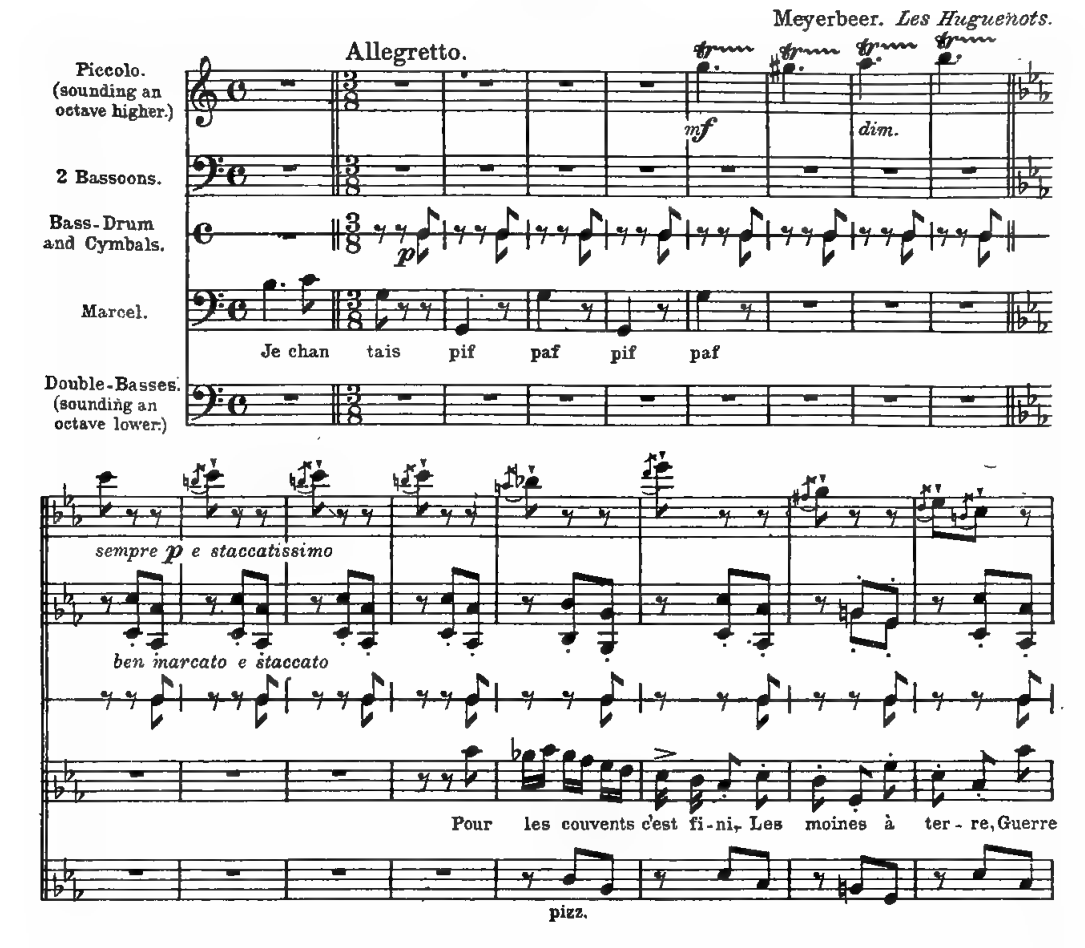
In writing a Cymbal part, remember that whether in the twoplate-roll, the two-plate-stroke, or the drum-stick-roll, the vibration continues so long that it is necessary to set down accurately the length of sound required. If you want a minim of sound write a mınım and leave it to the player to carry out his instructions. If this is done regularly, and with care, there is no necessity for writing "secco,"2 "vibrato," and so on. Finally, remember that the effect of the Cymbais is in inverse proportion to their use.
A word must be said as to the Ancient Cymbals. These were in common use by the ancient Egyptians, Greeks and Romans. They were, however, much smaller than our modern instruments, and seem
' Act I. of Les Huguenots. Beethoven has a passage for Kettle-Drums and Piccolo in illustration of the words "Die Trommel gerühret, Das Pfeifchen gespielt" (Egmont).
"See Ex. 79.
to have been used only by dancing girls. Specimens of Egyptian Cymbals are still in existence. They were made either of brass or of mixed brass and silver, and varied in diameter from 5} to 7 inches. In shape they closely resembled our modern Cymbals, even to the saucer-shaped depression in the middle. The plates, however, were flat, not tapered as in the modern instruments. There are several sets of Greek Cymbals in the British Museum. One sweet little pair, 3g inches in diameter, is complete with its tiny chains and rings. gives out a clear F7 in alt. Round the rim in dots run the words, SATAL EIMI, "I belong to Oata."
Serioz reintroduced one showed nis sound antiquarian taste by und homec having them tuned to a definite pitch—one pair in Bb and the other
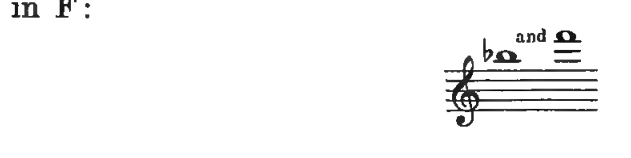
Their effect is charming, but they are better when used in the classical manner, that is to say, played in rhythm by a large number oi dancers, than when employed singly in the orchestra.