 Playable Books
Cecil Forsyth · section 15 of 60
No. 11. The Kettle-Drums
Read and hear this section in the playable edition →

Er. Timbales; It. Timpani; ' Ger. Pauken.
These Drums are of Arabian origin. They were originally quite small—a half-gourd covered with a dressed skin—and could be conveniently held in one hand and played with the other. Introduceo into Europe towards the close of the thirteenth century, they were commonly known in England as Nakers? In a list of Edward I's musicians (1310-11) we have the names of "Rogero le Troumpour, Janíno le Nakerer, Menestrallis Regis." 3 The large-sized instrument was first brought to England by that musical enthusiast, Henry VIII., and it is interesting to note that, even at that date, the Kettle-Drums were preeminently at home in the sphere where they still cut such an imposing figure—the cavalry regiment. In a word, Henry VIII. sent
' Often mis-spelt with a "y" thus, "Tympani"; but there is no "y" in the Italian alphabet.
"From the Arabic Naggareh. The word is still in common use in Hindostan for the state-drums of the Indian Rajahs. "In English the word," i.e. Naker, "seems to have had real currency only in the fourteenth century" (Murray). In that century, how-

ever, it is continually to be met with. For instance, in an Alliterative Poem of the early fourteenth century we read: "Ay be nakeryn noyse, notes of pipes, Tymbres in the reign of ed and til weave, in the Count at menarehorasion of ; again, in one of Laurence Minot's poems
"De princes pat war riche on raw Gert nakers strike and trumpes blaw" (before 1352); and, in the last quarter of the century, Chaucer writes: «Pypes, trompes, nakers, and clariounes" (Knight's Tale, 1386).
3 MS. Cott. Nero, c. viii. If. 87b.
to Hungary for specimens of their cavalry Kettle-Drums' and equipped his own mounted drummers with these improved instruments.
The modern Kettle-Drum is the most important of the Percussion Instruments which produce definite musical sounds as opposed to mere noise. It consists of a basin-shaped shell ot copper or alloy across which a circular sheet of parchment—the "head"—is stretched. Various skins, such as those of the ass, goat, dog, sheep, and calt, have but on the whole calf been used for making this parchment Is tound to be the most suitable. Unly good skins tree trom cracki and of an even thickness can be employed, and these have to be pre- The head is first lapped over a wooden hoop pared with great care. called the "flesh-hoop." That is held in its place by a circular iror ring, which can be slightly raised or lowered by means of screws with T-heads. In this way the player can, within certain narrow limits adjust the tension of the head so as to produce a succession of definite musical notes. The mechanical action of the screws and the iron ring can be clearly seen in the illustration on Plate I. At the bottom of the shell a hole is pierced in order to lessen the violence of the airconcussion, and so prevent the splitting of the parchment in fortissimo passages.
The instrument is played with two sticks. These, in instrumentation books, are made of whale-bone with sponge ends. In real life they are of malacca-tips and have their ends padded with two sorts of pianoforte felting, a hard layer inside and a soft outside. As a rule the Drummer strikes the head at a point about halfway between the rim and the centre. This is, however, varied according to the quality and amount of tone that he wishes to produce.
Drums have always been made in two sizes—a small Drum for the upper series of notes, and a large for the lower. To these a third Drum of intermediate size has now been added, and forms a regular part of every Symphonic and Opera Orchestra. For the present, however, we will leave this third Drum out of account, and describe the size and tunings of the largest and smallest Drums.
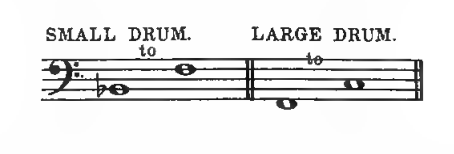
Down to and including Beethoven's day two Drums only were used. The smaller of these had a chromatic compass of a pertect fiftl rom Bo to l; the larger had a similar chromatie compass trom # to C
1 The earliest occurrence of the word appears to be in a letter from Sir T. Seymour to Henry VIII. (1548): "The captaynes that your Heynes wolde retayne, the dromes and Drom with his boye and a nother Drome with a fyffe." There is an early example of the word in the interesting Diary of Henry Machyn, Undertaker and Citizen of It occurs, under date xxy day of November, 1554, in his account of what we may, without indiscretion, call a royal spree : " The sam day... the Kyngs grace and my lord Fuwater and dyvers Spaneards... with targets and canes in ther hand... and thrumpets... and drumes mad of ketylles."
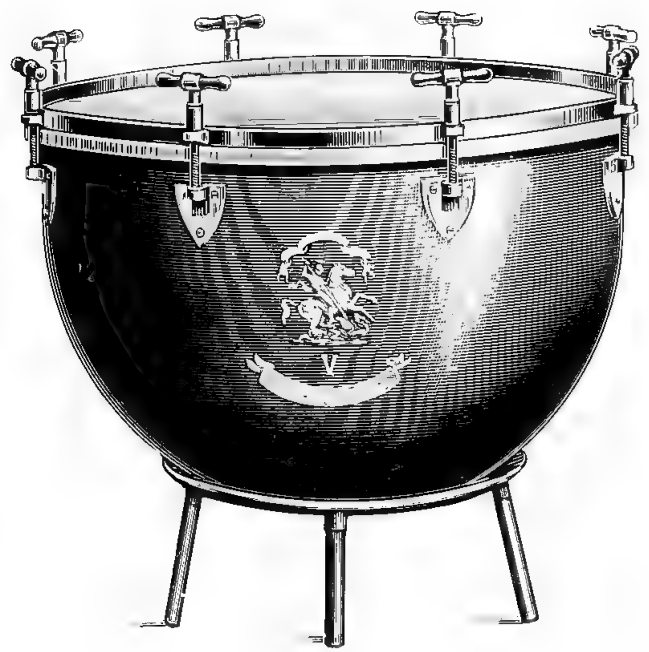
Facing p. 42.
By kind permission of Messrs, Boosey it Co.
It will be noticed that the compasses of the two instruments overlap for three semitones. However, as we shall see later, the lowest notes of the small Drum and the highest notes of the large Drum have never been much employed.
Before Beethoven's time the tuning of the Drums was invariable. The small Drum played the tonic, and the large Drum played the dominant a pertect fourth lower. The Drums were therefore limited to those keys which lie chromatically upwards between Bo and E
Beethoven did not alter the mechanism, pitch, or compass of the Drums. But he enlarged their scheme of tuning. In the first place, he put the tonic at the bottom whenever he so wished. The Drums were now in a perfect fifth, and this gave him access to various new keys. In the keys of Bo and t, where it was possible to arrange the Drums either in fourths or fifths, he suited his fancy. He first employed the tuning of a minor sixth (A-F) in the Scherzo of the rth Symphony. Finally he invented the octave-tuning F-F of the 8th
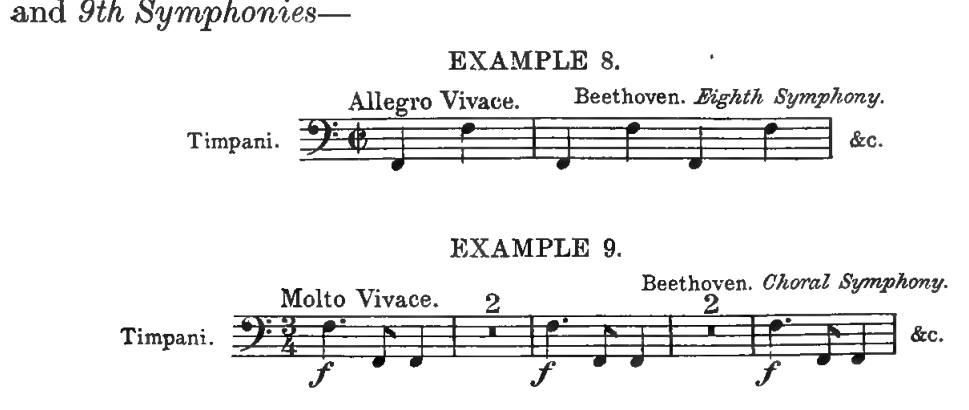
Allegro Vivace. Beethoven. Eighth Symphony.
and the diminished fifth tuning of Fidelio-
Example 10
Beethoven. Fidelio.
Grave.
The following is the complete list of Drum-tunings as Beethoven left it. As we have already mentioned, none but the tunings in perfect fourths was in use before his day. Even in his time those tunings marked with a t were rarely or never employed. They belong to the extreme keys, Do, Bi, and F♯.

The Middle Drum, which is now a regular member of the orchestra, is reckoned to have a compass either from A to E or from G to D:
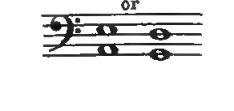
This would give us a theoretical compass for the Three Druns of

Small Drum. Middle Drum. Large Drum.
The tendeney, however, is all in the direction of pushing the playing-register of the Smallest Drum upwards. High Ef's and even G's are often met with in modern music. By a proper adaptation in the size of the shell and a careful selection of the parehment these notes can be produced. Furthermore, as the composer now has three Drums at his disposal, he rarely needs the wide compass of a perfect fifth. He can keep all his instruments much more in the most useful parts of their register. In fact, he need scarcely go outside the limits of a fourth for any one Drum. It is rather difficult to lay down any law for the student's guidance on this point. But, if he will remember that the two highest semitones on the Small Drum are by no means pleasing to all ears, he may take the following intervals as roughly representative of their modern compass:
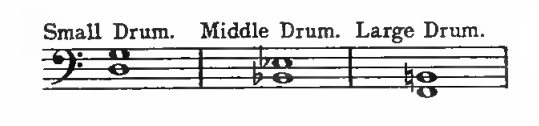
mal Drum Middle Drum. Large Drum.
With a little tactful arrangement all Drum-parts can be kept within these limits. The low El, however, below the deep F of the Large Drum is fairly often called for.
It may be mentioned in passing that with a suthciently large shell and a proper "head" Drums can be made to give the deep Cello C.
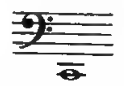
This is, however, only a matter of manufacture, and does not affect the general average of pitch employed in the Orchestra
l'he student will see that in forcing the Small Drum upwards the composer has obtained access to two other octave-tunings, F♯-FF and G-G. 'The latter of these has been used by Elgar in his rumbustious Variation Troyte. This Variation (No. VII.) is Presto, and the three Drums are tuned to G, C, and G.
Example 11

1 In a current (1913) Drum-maker's catalogue Drums are advertised and guaranteed

Before Beethoven's day it was the general but not invariable custom to mark the correct tuning of the Drums at the beginning of the piece and then to write only C's and G's in the part itself. In other words, the Drums were treated as "transposing-instruments." T'his plan has long since been abandoned, and the universal custom is o indicate the tuning required at the beginning of the Score and ther write the actual notes. In the case of notes which have a f or a b it would be correct to mark the # or b every time the note is written. But in practice this is omitted, or at most the acidenta. is written once only, at its tirst occurrence. The most logica and satistactory way is, of course, to give the Drums a key-signature. They deserve as In order to prevent any possible doubt as to the tuning of the extreme notes, it is customary not only to name the notes required at the heginning of the Score, but to add the actual notes tenselves in

Except for the fact that the part is always written on a five-line stave, all that was said above about the actual noting-down of the Bass-Drum-part, the clearest way of writing the roll, and the necessity of accuracy with regard to the length of note written, applies equally to the Kettle-Drums. Of the last point it is necessary to be constantly watchful, as the sostenuto is quite observable even in a mf.
A chord of two notes can of course be taken by one player. Nothing of this sort, however, is of much practical value, except perfect fifths,' and, for special effects, diminished fifths. In the case of the smaller intervals, such as major and minor thirds, the two notes, owing to the confusion of their upper partials, only seem to get in each other's way. The minor sixth, unless very accurately tuned and defined in the rest of the orchestra, has a tendency to sound like a fifth gone wrong. The octaves F-F, F♯-F♯, and even G-G, are quite good. Simultaneous octaves, however, never give the heavy "drummy" effect of simultaneous fifths. As both sticks are necessary to the making of a proper roll, simultaneous rolls on two notes can only be satistactory when pertormed by two Drummers.
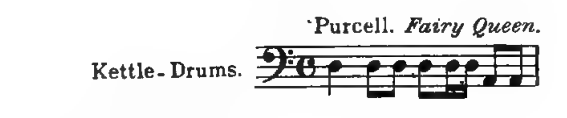
There has been considerable discussion as to the earliest date at which a "Drum solo,", in the modern sense of the words, occurs. honour is generally claimed on behalf of an Opera called Dido, produced by its composer Graupner at Hamburg in 1707. Ihıs ıs probably very far from the truth. At any rate one has no ditlicuity in putting the date back fifteen years to furcell's Solo Drums at the opening oi the Symphony to Act IV. of the Fairy Queen:
Example 12
1 For an instance of this, see below, Ex. 134.
From their earliest introduction the Drums were always used in a conventional manner to play flourishes with the fanfares of the Brass. This style of writing was universal down to the death of Mozart. As we have already mentioned the great innovator in the Drum department was Beethoven. He found the instrument, so to speak, in the kitchen and elevated it to the clouds. With a delicate and truthful perception of its "fundamental" nature he built up its rhythmicmusical sounds into the very substance of his works. It was for this purpose that he enlarged its scope and removed its former restrictions.
With three Drums at his disposal and the concrete example of Beethoven betore him the modern composer's only difficulty is to decide to what notes of more than a complete chromatic octave it is best to tune his instruments. No rigid law can be laid down on this point. But speaking generally and without reference to special eflects one may say that it is as true now as it was before Beethoven's innovations that two of the Drums should be tuned to the main harmonic notes of the passage in which they are taking part. These notes may be tonic and dominant or they may not.
It the music is so chromatic as to dety every attempt to bring the Drums into its harmonic scheme, it will be better, ninety-nine times out of a hundred, to leave them out altogether. In fact, their character a so vivil noble sed to the eldemo bading does the are in t that this difficulty scarcely ever arises. Be it noted, however, that even with three Drums, each with a compass extension of a perfect fifth, a tuning can be arranged that gives a harmony note to each of 18 triads (major and minor) out of a possible 24.
"But," the student may say, "if I want chromatic notes, the Drums can alter their tuning." That is so. And in many modern works the Drummer has to be a particularly quick-change artist. But there are some considerations here. First, we must remember that if the Drummer is continually screwing his parchment up and down, the tension of the head is liable to become uneven and the intonation faulty. Next, no parchment capable of producing a fine Drum-tone will stand this constant racket. The player is therefore likely to save his drum-head at the expense of the intonation. Try therefore to arrange your part so that your Drummer has
(1) Two or three bars at least of 4/4 Moderato time in which to make an accurate change of a whole-tone, and consequently a proportionately longer time for a bigger change;
(2) New tunings that involve as small alterations as possible.
The latter point generally admits of a very simple solution. If we omit the two top semitones of the Small Drum altogether, and take the compass of the Middle Drum as from A to E, we shall see that in the thirteen chromatic notes of the normal Drum-stave five are duplicated and three triplicated, thus:
' Ey. in the opening bars of Brahms's C minor Symphony.
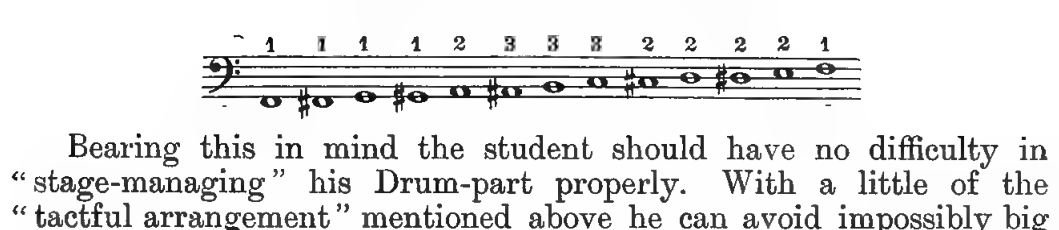
skips, and keep his three instruments mostly midway between their extreme notes.
There may be some few places, especially at a climax where the Drums are to take part in a two- or three-note fragment of a melodie figure. This is no more than an extension of Beethoven's practice. Such a phrase, whether hammered out ff or just touched in the pp, is equally effective. It may, however, involve some odd tuning and, consequently, a big skip in the alteration. But this limitation of the instrument must be fairly and squarely faced. It is useless to adopt the shabby and unpractical method of writing any notes you fancy and leaving the Drummer to "find out a way" of playing them. Keep in mind the fact that you have got a man standing up in front of three Drums and that, at any given moment, they are tuned to three definite A Drummer can make a rapid change of a semitone, or even a tone, but beyond that it is much more satisfactory for him, for yourself, and, be it said, for the audience, to give him time.
When you wish to alter your tuning, mark it clearly in your score ," or, in Italian, "Muta F in C, thus: "Change F to E, C to C♯, G to A, C'in C♯, G in A." This particularizing of the note you wish altered as well as the note to which you wish it altered is the more necessary if you are changing the tuning of only one or two of your Drums.
The question is sure to arise in practice as to how far it is possible to write the Drums on notes that are foreign to the harmony in which they are taking part. Here again no definite answer is possible. It depends on the taste of the writer. Occasionally a Drum can sustain a roll or rhythm with fine effect in a passage which starts "at home," modulates to a distance, and then returns. This does not refer to the some pase idiot migh det a will has its pedal-age witten one whole orchestra except the Drums moves away from the original harmony. Sometimes too, in a continuous passage where the Drums are playing, it is of greater artistic value to hear the Drum-tap on a note foreign to the harmony than to miss the rhythm altogether. But however this special problem is presented, it is necessary to write with a consciousness of the fact that you are introducing a foreign harmony-note. You cannot treat the Drum in the way that you would the Triangle,-as a "neutral element" in the orchestra. always has harmonic value. It you want dissonances, you can get these the tote noes to out yous opend, it dos sod pety do that, "neutral" in quality:
The peculiar felicity of the Drum is that it is a wholly rhythmical instrument, and yet has a pure and beautiful tone. A good artist can play and make effective practically any rhythm that a composer can think. Nevertheless, one should not lose sight of the fact that the other bass-instruments can also do the rhythm and something besides. are ry fundage, therefore ok me berto is waderd, on d ht be the heavy much.
Do not be afraid of putting continual p's and f's into your Drumparts. Mark every entry carefully, and never write a crescendo or a diminuendo without clearly stating from what level you mean it to come, and to what level you mean it to go. In the following passage
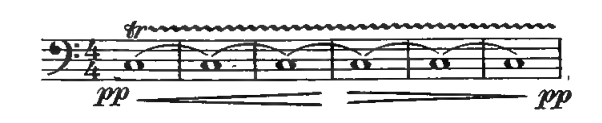
the omitted mark between the - and the = may be anything from p to fff. Do not think it "fussy " if the part looks like this: "

The Drummer has only a few elemental things to do, but they depend for their success on the accuracy of the directions which he receives. One continually comes across passages like this

which appears to be only a crescendo from p to mp, but which is intended by the composer to be a four-bar crescendo from p to for mf (omitted in the fourth bar) and then a dynamic drop down to a slightly higher level than that of the first bar. This means a stoppage at rehearsal or a careless performance.
In this connection the student may be recommended to accept the tact candidly, that, in a long crescendo, there is a limit to the powers of gradation of even a Drummer. It is useless to begin with peppo, go on to prpp, and scatter the rest of the expression-marks up to fff at mathematical distances along the line of action. In practice, about eight bars of moderato time at the end of the roll is the limit within which the effect of a crescendo or diminuendo can be made appreciable to the audience. As a simple example, see the 25-bar roll on Bb in the Allegro Vivace of Beethoven's 4th Symphony. The first 14 bars are marked "sempre pp" then comes an 8-bar crescendo to 3 ff bars. A similar instance, but on a smaller scale, is to be found at the beginning of the Allegro con brio in the Egmont Overture.
Do not get into the habit of regarding the Drums as only forte instruments. Nothing but the Bass-Drum and Cymbals swamps the
-See the Drum-part from letter R onwards to the Andante Mosso in the Ist movement of Ischalkowsky's Pathetz Symphony.
whole orchestra-melody and harmony-so easily. Write the part often p when the rest, even the Brass, are playing mp and mf. In performance note the effect
(1) ot steady, persistent rhythms such as the thirty bars of crotchet Us that precede the crescendo quavers in the C minor Symphony of

or → in such rhythms. See, for instance, the pedal D's in Tschaikowsky's Pathetic Symphony (letter D of the {movement);
(3) of detached Drum-notes, especially when they form part of a pedal-bass. See the examples quoted below from Bizet's Carmen and Wagner's Flying Dutchman. (Exs. 43, 14);
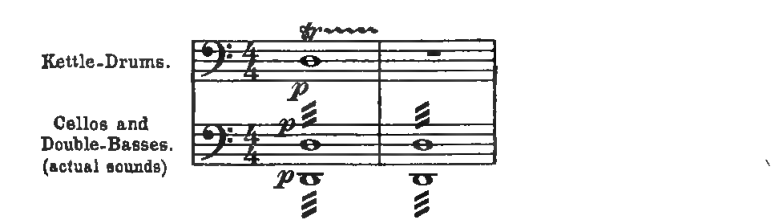
(4) of a deep roll when the Basses cease playing a tremolo and, as it were, uncover the Drum-roll-
Kettle-Drums.
ouble-Bass (actual Bounds)
(5) of the precisely opposite arrangement—
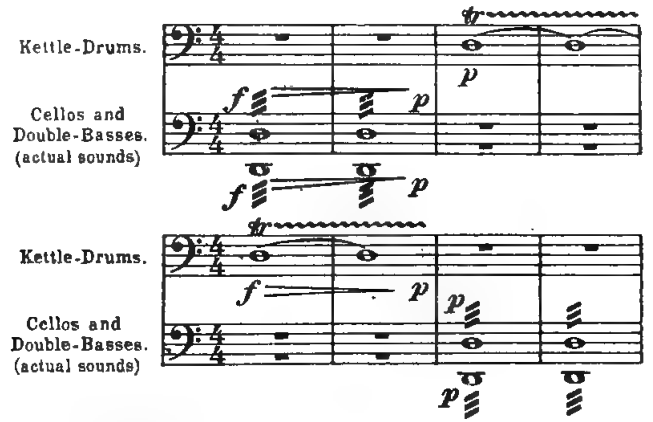
(6) of the Basses and Drums handing on a roll to each other either way without overlapping-
(7) of the Brass with or without Drums, the force of the former and the brightness of the latter;
(8) of a single interpolated note or phrase solo, whether p or f;
(9) of the Drum's piano solo notes, the curious feeling which they Phe Drun solo at the first entrance of the Dutch san for naganc,
(10) of suddenly bringing the Drums and the whole of the orchestra into one simple rhythmical pattern.
For very special effects the Kettle-Drums are occasionally playea with Side-Drum sticks or in various "trick" ways, such as with a couple of coins, and so on. The student can find an example of a long prp roll on middle C played with the Side-Drum-sticks in the Romanza of Elgar's Enigma Variations.
The Kettle-Drums can be reduced to almost the exact quality of the Side-Drum by simply placing three heavy non-vibrating bodies (such as the T-heads of the screws) on three equidistant points of a circle lying half-way between the outer rim and the centre. This is worth remembering when scoring for a very small band.
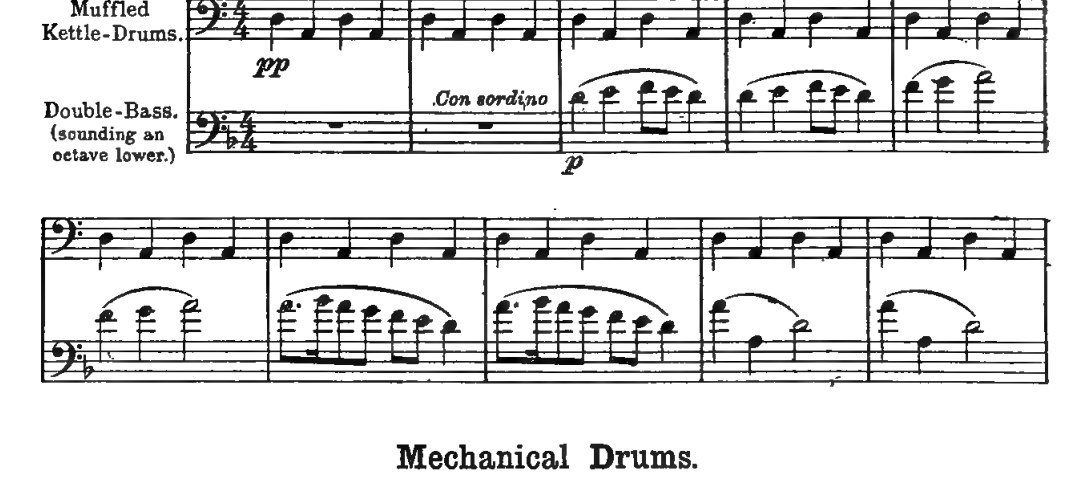
Like the other Drums, the Kettle-Drums can be muted or muffled. This is generally done by laying a strip of cloth or some suen material on the head. Examples of this are rare in symphonic music. Mahler has used the effect in the 3rd Movement of his Ist Symphony. The movement opens with 34 bars for muted Drums. After 2 bars a solo Double-Bass, also muted, enters with the subject.
The following are the first few bars:
Example 13
Mahler. Symphony No.1
Feierlich und gemessen, ohne zu schleppen. *
Several mechanisms have recently been invented with the idea of dispensing altogether with the old hand-tuning. Their object is to enable the Drum-head to be retuned instantaneously and accurately to any note required. As a rule they are more instantaneous than accurate. It must be remembered, however, that slight adjustments rendered necessary by the inequalities or imperfections of the head
1 Solemn and measured, without dragging.
can be made by hand. These systems are generally worked by means of pedals and levers. Against all of them it is urged that both the tone quality and the portability of the Drum suffer owing to the aecessary heaviness of the frame. The latter objection—the want of portability—is not of much account, as a set of three ordinary Drums always needs a cart or trolley for its transport. The pair of Mechanical Drums weighs very little more. The other objection-the deterioration of the tone-quality-is more serious. It must be allowed that in most Mechanical Drums the tone is notably "tubbier" and less resonant The difference is most perceptible in the mf and the f. One needs to get accustomed to it.
There is, however, a simple apparatus known as Potter's Mechanism which has been applied to the Kettle-Drums. It is claimed that the tone of these drums is an actual improvement on that of the old handtuned variety. The mechanism consists of an arrangement of rods, screws, and chords. It has the appearance of a Maltese Cross within a circle. It is placed inside the shell of the Drum, and worked from outside by means of a screw. A 28-notched dial corresponds to the greatest possible tension and relaxation of the head, and, in the case of an overstretched parchment, it is possible to secure a still greater tension by beginning again at the first notch.
The question may be asked, "Is the Mechanical Drum wanted?" instrument is not hurt, question fairly,-"Yes, if the tone of the One may answer this It is, however, a matter for the personal consideration and convenience of Drummers. There may be a few places where the mechanism would offer composers an easy way out of a difficulty, especially at the ends and beginnings of consecutive movements in the Theatre. In so far as it helps to solve these and similar difficulties, it is to be welcorned. On the other hand, we must remember that the function of the Drums is not to play scales, portamentos, and melodies.! Its elemental nature should never be disregarded.
As we have now dealt with all the more commonly-used Percussion Instruments we may, for the sake of completeness, give a single example of their forte combination in the peroration of a Movement. The example selected is from the end of Ischaikowsky's Symphonie Poem, Francesca da Rimini. The Percussion Instruments employed are the Kettle-Drums (timpanz), Cymbals (prattr), Bass-Drum (grosse caisse), and Gong (tamtam). Of these the first and thira play a consita Bangles o thie tinuous tremolo, while the second and fourth are in rhythmical pattern with the rest of the orchestra. Examples of this sort are, of course, common at the end of many concert and operatic works.
1 According to Strauss, Von Bülow put Beethoven's
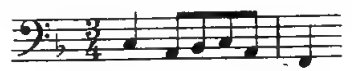
on the Mechanical Drums.
Example 14
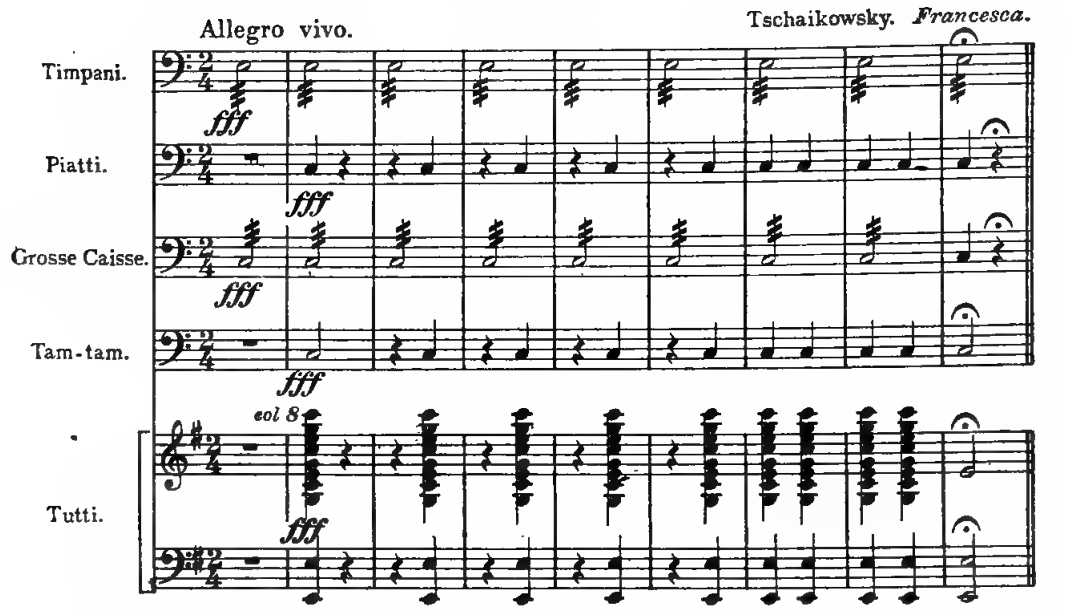
Another example of a Percussion ending is quoted below trom Dvorak's Carneval Overture. The instruments employed are Kettle- Drums, Cymbals, Side-Drum, and Triangle. (See Ex. 79.)
Betore leaving this subject the student should look caretully at all the examples in this book which include a Kettle-Drum part. Without very lengthy quotation it is quite impossible to show the relative value of the Drum-parts to the general orchestral texture of a movement. The quotations, however, have been selected when possible to include some illustration of the commonest Drum-effects. They may be found in Exs. 43, 73, 74, 79, 91, 93, 112, 134, 176, 182, 214, 259, 267, 278.