 Playable Books
Cecil Forsyth · section 21 of 60
No. 17. The Valve-Trumpet
Read and hear this section in the playable edition →

Fr. Trompette à pistons ; It. Tromba ventile; Ger. Ventiltrompete.
This instrument has replaced the old natural Trumpet. Its bore Is. mainly narrow and cylindrical. The "bell-joint," however, which
1 No connection with the modern Tuba.
* The hybrid Saxophones and Sarrusophones belong to this group. See pages 166, 170- 3 The Modified Horns (commonly called Wagner-Tubas) as originally planned belong to this group. Ste page 151.
* Sometimes in C. In this case it is pitched a minor seventh below the Euphonium, q.v.
forms something under a quarter of its entire length, is conical. It IS furnished with tuning-slides, and has the usual set of three valves described above. The mouthpiece is a hemispherical cup with a rim. In this, as in all other Brass-Wind instruments, the player's lips stretch across the mouthpiece and act as vibrating-reeds. A difference in the tension of the lips, commonly called the embouchure, and in the pressure of the breath, serves to produce the various notes of the Harmonic Series.
The material of the Trumpet's tube appears to have no effect whatever on its brilliant incisive quality. This, as far as is known,

which is bored at the bottom of the cup. The sharper the angle of entry, the more pungent and steely the tone.! (2) To the proportion between the bore (or calibre) of the tube and the length of the aircolumn.
Both the Trumpet and the Horn, though now valve instruments, are played with a crook of some sort. In the case of the Horn the F-crook has supplanted all the others. On the other hand, there is no such unitormity with regard to the Trumpet. In our own orchestras a few players use the F-Trumpet, while the majority use a Trumpet crooked either in C, Bo, or A. The transpositions of all these instruments of course remain the same as they were in the days of the old Natural Trumpet. See page 78 for the full list.
Before we proceed to describe the modern Valve Trumpet in F, the student may be reminded that the ancient Natural Trumpet with its apparatus of crooks is really a totally different instrument from the tiny modern Trumpet in C, Bb, or A. More will be said on this point later. The student should, however, fix firmly in his mind the fact that these differences are not simply differences of external mechanism. The mere addition of the valve apparatus would make no great ditterence to the instrument, provided the length and bore of tube were roughly maintained. This can be seen in the case of the Horn. the Trumpet, however, the continual desire for a bright and at the same time less obtrusive tone-colour, and the call for greater flexibility and ease of execution, especially in the top octave, have caused a complete change in the length and bore of the tube itself. It is not merely that the instrument has become chromatic. It has also become, except in name, a ditferent instrument
The old Natural Trumpet was first employed experimentally by Monteverde. He wrote for five Trumpets-under the names Clarino, Quinto, Alto e Basso, Vulgano, Basso-in his Opera Orfeo (1607). The experiment was not successful. During the greater part of the seventeenth century the Operatic Orchestra consisted mainly of
1 See the Encyc. Britt., xi. Ed., sub Trumpet, for an interesting account of the effect produced by using a shallow "clarino" mouthpiece in which the "passage at the bottom ot the cup inaugurated by the sharp angle (known as the grain in French) is prolonged in cylindrical instead of conical bore for a distance of about 10 cm. (4 inches) right into the main tube." I'nis may, perhaps, help to explain the method that was adopted in Bach's day for attacking and overcoming the difficulties of his high Trumpet parts
Harpsichord and Strings. In the last quarter of the century, however, the Wind began to reappear, and the Trumpet was the first instrument to "make good" under the new régime.'
From that time onwards for about a century the instrument was continually employed, chiefly as a Solo instrument, to play all sorts of bravura passages, principally in its top register. For this purpose only two crooks were used by Händel and Bach, those in C and D.
About the middle of the eighteenth century something happened to the Trumpet. Nobody knows exactly what it was. Gevaert says: "About 1750 the brilliant technique of the Trumpet suddenly declined; pertormers lost the habit of playing in the higher octave, the only one which has a continuous scale, and that is, therefore, able to furnish ¿antilenas and melodie figures." It is much more likely that the growing discrimination in matters of orchestral taste developed a horror in the minds of composers for these terrible vocal caricatures. They ceased to write them, and the players therefore lost whatever power they ever had of playing them. It was probably never very great."
The Trumpet now became a much more subservient instrument. It was used much less frequently and much less prominently. It was "warned off. the obbligato ground altogether, and dethroned from the ridiculously false orchestral position which it had hitherto occupied This was all to the good in the cause of music. Indeed one may say that without this step the development of the Symphony would have been an impossibility. So long as the Trumpet-the most aggressive of all instruments-was allowed to play tunes in its top octave all pleasure in the orchestral ensemble disappeared as far as the unhappy audience was concerned
New crooks now began to be added . Mozart employed the Eo as well as the Cand D. The Bb, F, and El came next. Later still came the B$ and A. The instrument thus crooked was employed by all the great Classical Masters, and continued in general use down to the middle of the nineteenth century. Iwo Trumpets were regularly used in Symphonic music, but in Operatic and even Choral works three and four were quite common.
We may mention in passing that, from time to time, attempts have been made to adapt the slide-mechanism* of the Trombone to the Trumpet. In the earliest specimens thus made the instrument was -provided with a spring which automatically threw the slide back into position. The spring was soon abandoned as a useless encumbrance, and the slide-Trumpet began to enjoyit never what precarious popularity. Outside England, however,
1 In Eteocle e Polinice, by Legrenzi (1675). See Gevaert, page 229. Down to about the middle of the 18th century the words Clarino and Principale were used for the upper and lower Trumpet parts respectively.
2 But see what is said below, page 120 (foot-note 2).
3 Haydn, The Seasons (three Trumpets in C); Weber, Euryanthe and Oberon (four Trumpets in D); Mendelssohn, Midsummer Night's Dream (three Trumpets in C).
« The slide-Trumpet of Bach (tromba di tirarsi) was simply a Soprano-Trombone, the successor of the old Treble-Sackbut.
became a recognized instrument, and whatever success it had here was effectually cut short by the advent of the valve-system. Recently some further attempts have been made to reintroduce the slide- Trumpet. These have never been successful, though the instrument is said to have a fine crisp tone.
By 1850 the valve mechanism had been sufficiently tested to enable it to assert its undoubted superiority. A few composers continued to write for the old Natural Trumpet, more as a "platonic kind of protestation "1 than from any candid examination of the new instrument's capabilities. However, the days of the Natural Instrument were numbered. The most able composers frankly recognized the enormous advantages of the valve system, and the Natural Trumpet now finds itself where it started a great many centuries ago, doing duty in camps and barracks, on the field and the parade-ground.
The Valve-Trumpet in F' is in size and build the only representative we now have of the old tamily of Trumpets, and its tonequality differs materially from that of the Trumpets in C, Bb, and A.
Theoretically its natural series of Harmonies should range from
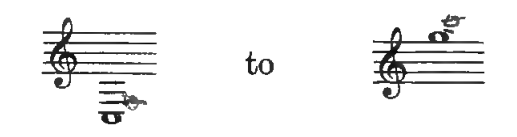
both sounding a pertect fourth higher. Its valve mechanism gives it a complete chromatic compass within these limits, but the four lowest semitones are practically useless. This leaves the instrument with a

The upper notes above written E, especially the F♯ (sounding Bl), require great certainty of lip, and cannot be taken in anything but the f. On the other hand, their effect is as striking as anything in the orchestra.
Example 35

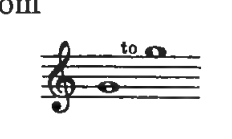
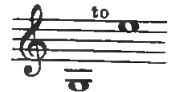
In writing for this instrument one cannot be too careful. Indeed the tessitura must be as well considered as that of a Soprano voice. Its notes, as they ascend from
« Used in the army in the key of Eb. 1 Gevaert.
In the Full Score there are three Oboes and the 2nd division of the Ist and 2n iolins in unison with the Trumpet melody
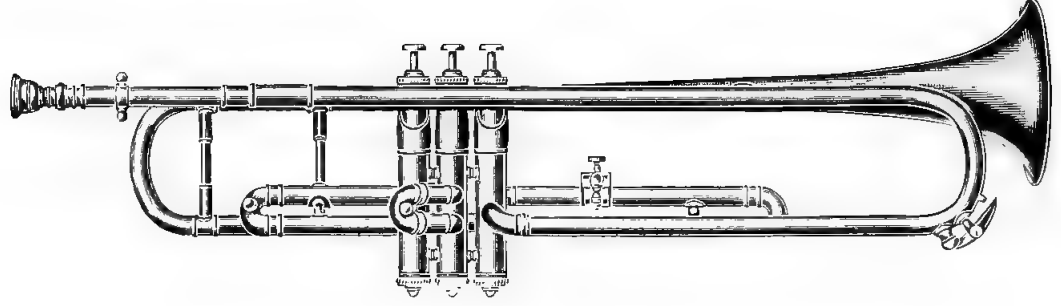
Fig. 1.—valve trumpet in f
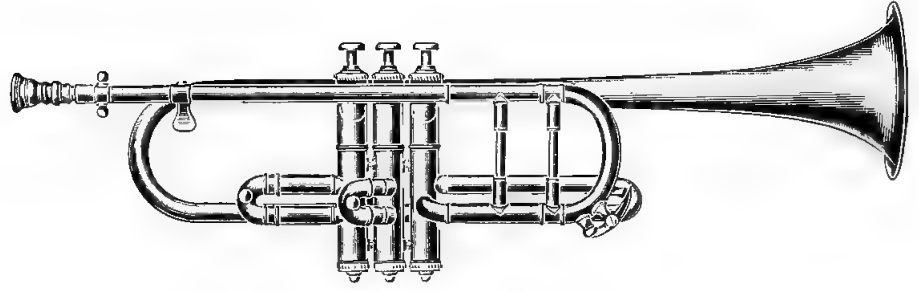
FIG. 2.-VALVE TRUMPET IN Bb.
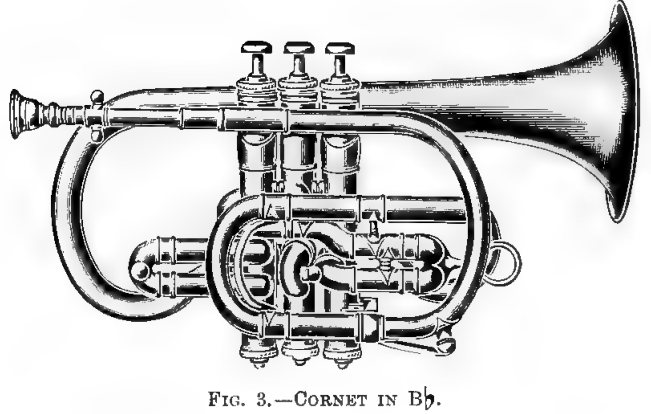
Facing p. 93.
By kind permission of Messrs. Boosey & Co.
have an alarming way of detaching themselves more and more from the rest of the orchestra.! The best part of its compass is from
An illustration of the instrument will be found on Plate IV.
The F-Trumpet has been alternately praised for its noble and powerful tone and reviled as a "razor-edged antique" and "an outdoor instrument borrowed from the military band."" One must acknowledge that in actual breadth of tone-colour, especially in its lower notes and in the p, it is without a rival. No one who has heard two of these instruments enter pp at the 346th bar of Beethoven's Violin Concerto can have any doubt on this point.
Example 36
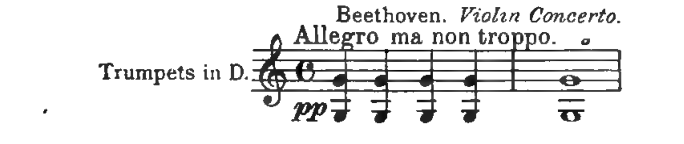
Magical passages like this lose half their intention when played on the small-bore instrument.
It is, however, rather in the f and the ff that one feels its undoubted brilliance and force to be something of a survival from the days when it was not thought necessary to assimilate the various tone-qualities of the orchestra. Even in the most unimportant passages it appears to be always playing Solos. A certain inflexibility too, due perhaps to the size of its tube, gives the audience additional cause tor anxiety.
In the old days its main business was to reiterate single notes f and to blare out somewhat conventional flourishes and fanfares "in the tutti." On these points there was never any charge against it on the score of ineffectiveness. On the contrary, the objection was then, and is now, that to all its phrases it lends a prominence that sometimes induces almost a sense of physical pain. We must remember too that the ditticulties of mastering the instrument are great. It is the undoubted heir of the classical tradition, but our regret at its restricted use is tempered by the reflection that at most one or two players in a generation can make it bearable.
The reasonable view to take on this vexed question seems to be that where the music has been specially designed for this instrument—as it was by the classical masters—-it should undoubtedly be called on to perform the parts as written. The heavy cast-iron
-The student is reminded that, in speaking of the transposing instruments, one always understands the written note without further explanation. in mind throughout the following pages.
"There seems to be no doubt that the modern Valve-Trumpet in F' is heavier and more cumbersome in tone than the old Natura. Trumpet. This is said to be due not to the valve mechanism, but to the altered proportions of its tube and mouthpiece.
trumpet parts of ancient days require a massive unyielding tonecolour. Mere weight was nine times out of ten the object of their existence. Played on the puny modern Trumpet in C they sound stupid, undignified, and trivial. On the other hand, in modern music, where the Trumpet-part is woven more cunningly into the tissue of the music, and where a certain flexibility and power of blending are essential, the older instrument might well be dispensed with. better still, perhaps it might be confined to a single Solo part written so as to turn its qualities to good account.
Very little can be said as to the uses of this instrument in the orchestra, for though it is so dazzlingly effective, its gamut of expresthe Brass ensemble and to add a climax colour in the general scheme of orchestration. It need scarcely be said that any form of cantilena writing is almost insupportable on an instrument with suen a pronounced tone-quality. Certain tunes, however, which appeal either by their imposing and pompous character or by a sort of simple, dignified, direct vigour, come out well enough. Every one who has heard César Franck's Symphony in D minor will remember the Trumpet tune in the first Movement. The English Horn here plays with the. F-Trumpets, and they are reinforced in the octave above by a brilliant unison of Flutes, Oboes, Clarinets, and Ist and 2nd Violins. A two-part quaver accompaniment for Violas and Cellos, held chords for the Horns, and detached chords for Cornets, Trombones, and Tuba complete the score. The tune with its introductory bars is as follows:
Example 37
Cesar Franck. Sympiony in Uminor.
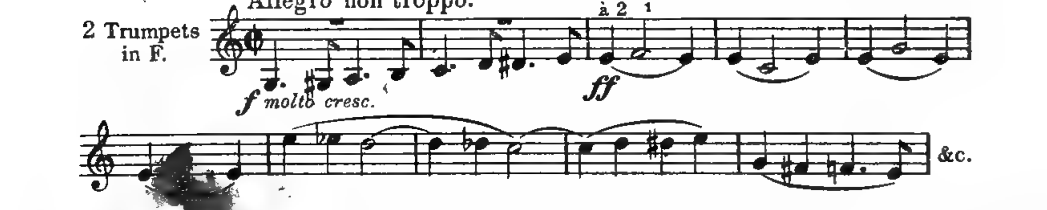
Another mage to which the Trumpet octaves lend a peculiarly poignant colour can be found just before the 2nd Act curtain in
Iristan.
Example 38

1 The mark "à 2" (Italian à due, i.e. in the manner of two) has two precisely opposite meanings in orchestral scores. When placed over a Wood-Wind or Brassstave, which is usually devoted to two separate parts, it means that both players are to perform the same part in unison; on the other hand, when placed over a String-stave, which is usually devoted to one single part, it means that the players are to divide and perform the separate parts as written on the stave. The tendency is to confine the expression "à 2" to the Wind-staves and to use the words divisi and unisoni (abbreviated to div. and unis.) for the Strings. The Germans usually indicate the String dzus when of more than two parts by the words Dreach, Veerfach, etc.
The modern instrument which has taken or is taking the place of the old big-bore instrument is still called a Trumpet. It still remains the highest pitehed instrument of the Brass ensemble. But beyond that there is not much musical likeness between the two instruments. It seems a pity that a little of the enormous expenditure of energy in nineteenth century Brass-nomenclature was not devoted to coining a name which should clearly differentiate the new from the old instrument. For they are really not the same instrument at all. student will be able to appreciate this statement when he is told that the Trumpet for which Beethoven wrote the five notes quoted above was 7 feet 8% inches in length, while a modern Trumpet in the same key would measure 3 feet 5f inches.
The crooks used for the modern instrument are three. They are
(1) Crook in C, which sounds as written,
(2) Crook in Bb, which sounds one whole tone below the written notes, and which must therefore be written for in the key of one whole tone above the music. Its key-signature has two o's less or two i's more than the key-signature of the piece.
(3) Crook in A, which sounds one tone and a half below the written notes, and which must therefore be written for in the key of one tone and a half above that of the music. Its key-signature has three b's nore or three f's less than the key-signature ot the piece
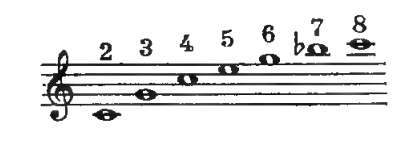
This instrument, whatever its crook, has as its bottom open not the 2nd of the Harmonic Series which, with its length of tube, 1s
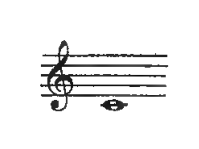
Upwards from that it can proceed to the Sth Harmonic
while downwards its three valves take it, as usual, a diminished fifth
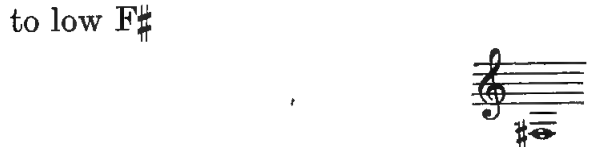
and also give it a continuous chromatic compass up to the high C. The
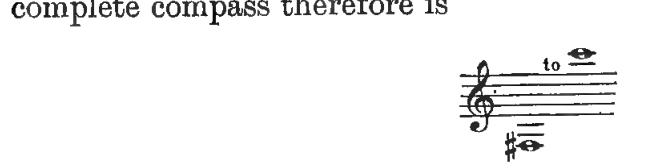
1 For an illustration of the Trumpet in Bb, see Plate IV., page 93.
and this compass, on the three crooks mentioned above, sounds
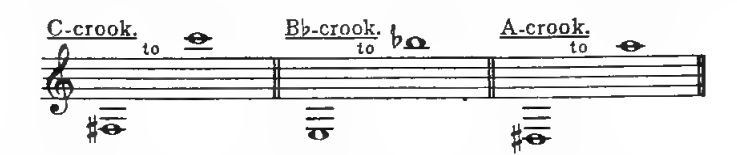
The question now arises: which crook is to be written for? And, as precisely the same question arises in the case oi some other transposing instruments, a few words may be said on the topic
In some German, English, and French orchestras-especially in the last_the C-Trumpet alone is used. It does not, however, follow that it is always written for, though the practice is common in France. If it is written for it must, of course, be treated as a nontransposa sustument, led athon in the act al key-sito day. That is to say, of the piece. For symphonic work and for work of a chromatic character this plan, which has the advantage of great simplicity, is excellent.
In Operatic work, however, and especially in Comic Opera in this players invariably use the Bb- and A-crooks. A noncoansposing part would therefore throw on the player the burden of transposition during performance. It is better to avoid this and to choose the crook which will give the player the fewer sharps or flats in the key-signature.
In a key such as E one would naturally write for A-Trumpets in the key of G, not for Bb Trumpets in the key of F♯
In a key such as Ao one would write for Bb-Trumpets in the key of Bb not for A-Trumpets in the key of Cb. This is only elementary prudence.
Note, however, that it is not worth while changing the crook for a short passage even if it gives a simpler key-signature. Nor is there much difference between one signature and another unless the part is exceptionally quick and intricate. In most cases the player ignores an interpolated change of crook and transposes the part to suit the crook which he has been using. The whole of this question is discussed in full under the heading Cornet, page 103. The student who wishes detailed information on the subject should read the remarks given there.
The student must be warned that, in going through Full Scores, he will continually find a quite different method of writing adopted Ior the Trumpets and, be it said, for the Horns. This method is to leave the player out of account altogether: to pretend that he is still furnished, as he was in the eighteenth century, with crooks A, Bo, C, D, ED, uh, and I: to crook the Trumpets as nearly as possible in the key of the piece: and then to write for him in the key of C. At a change of key in the music the name of a new crook is inserted in the part whether there is time to change it or not. The part proceeds merrily in C'as before.
This plan has the high authority of Strauss,' and he supports it with four bad reasons. They are
(1) Force of habit.
(2) The Score is easier to read if the Horns and Trumpets are all in C. Their parts detach themselves with a sort of plasticity from the Wood-Wind and String-parts, littered as the two last are with accidentals.
Trumpet-parts.
(4) Horn players prefer transposing according to the key of their instrument to reading from a proper F-Horn part full of sharps, flats
The interest of the first two reasons lies in the fact that they totally ignore the persons most concerned in the matter-the players. Clever as these artists undoubtedly are at transposition, this is surely a burden that should be laid it possible upon the composer in the quiet of his study, not on the player during rehearsal or pertormance. fourth reason is curiously unconvincing, for, however much a Hornplayer may dislike looking at the nasty sharps and flats, he has got to play them, and, with his F-Horn in his hands, be has not only got to play them but first to transpose into them from the simple key in which his part is written.
Gevaert has pointed out how dire would be the result if the player were actually to tale the composer at his word and use the crooks which he directs. "A crook, of the main tube, but in no way affects the additional tubes, whose length is calculated for a given pitch. Hence it is evident that the fitting-on of a higher or lower crook upsets the whole tuning of the instrument. True, each additional tube is provided with a little tuning slide, which allows of increasing the length of the air-column to a certain extent, but apart from the fact that such modifications suffice at most to regulate the tuning of a small number of crooks only, they require an accuracy of manipulation which cannot practically be obtained in the orchestra." He adds in a foot-note, "Wagner never takes this practical need into account: he constantly changes the tuning of the Valve-Horns."" It is not even certain, as some
1 In his Commentaries and Additions to Berlioz's Orchestration. The author commends ten mithed in winding as the Was as proCee bet, no in who ag eve Hen and Tuba parts can doubt that he is the worst possible guide to follow in matters of notation. There is more than one locus classicus of absurdity to be found in F-Tubas in Bb gests, only to ada to the mystery. rey-signature for his Brass.

2 A New Treatise on Instrumentation, English edition, page 274.
suppose, that. Wagner was always guided in these matters by the desire to employ only those crooks most suitable to the music. are plenty of examples in his works of actual unison melodies per- When formed by similar instruments playing on different crooks. one finds a passage in which the Strings are playing " in one sharp" and the Trumpets are crooked Nos. 1 and 2 in E, No. 3 in Cand the Bass Trumpet in D......!
These questions will be alluded to later when we come to deal with the standardization of the Horn. Meanwhile the student may be advised frankly to recognize the fact that players actually play nowadays either on a non-transposing instrument in C' or on a transposing instrument furnished with both Bo- and A-crooks. His part will be written with its proper key-signature.?
The modern small Trumpet substitutes execution and flexibility for the imposing tone-colour of its predecessor. All sort of figures, arpeggios, and scales diatonic and chromatic can be played witi astonishing ease and lightness. Repeated notes are both practicable and elective, but it is well to place them in the middle register of the instrument and to break them up in order to give the player time to breathe. Nothing sounds worse than a series of repeated notes during which the performer has to gasp for breath.
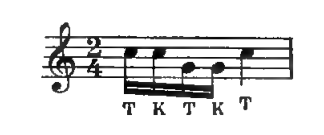
Single-, double-, and triple-tonguing—that is to say the interruption of the wind-stream by the action of the tongue-are all possible even in quick tempos.
The player when single-tonguing strikes the note by tonguing on it

In double-tonguing he makes use of the two letters T-K
while, in triple-tonguing he employs the letters T-K-T
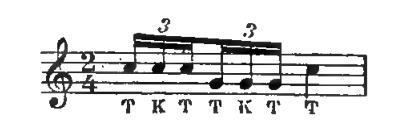
By this method a surprising degree of consonantal distinction is given to the attack.
The Trumpet, unlike the Horn, plays shakes with the pistons only. Good whole-tone shakes are to be had on the following notes:
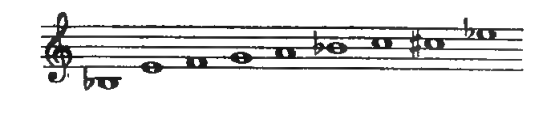
1 Sce foot-note on page 105.
and good half-tone shakes on these:

but in general, one may say that shakes are not for Brass Instruments. There is a curious passage in the last Act of Gotterdämmerung (tull score, page 432), where the ear seems to expect the Trumpet shake on the high G. The shake, however, is actually only superimposed or the Trumpet tone. At the moment when the two Oboes and two Clar nets begin their share the ear is partially deceived and appears to hea a soft Trumpet-shake. The following is the passage from which th Harp- and String-parts have been omitted.
Example 39
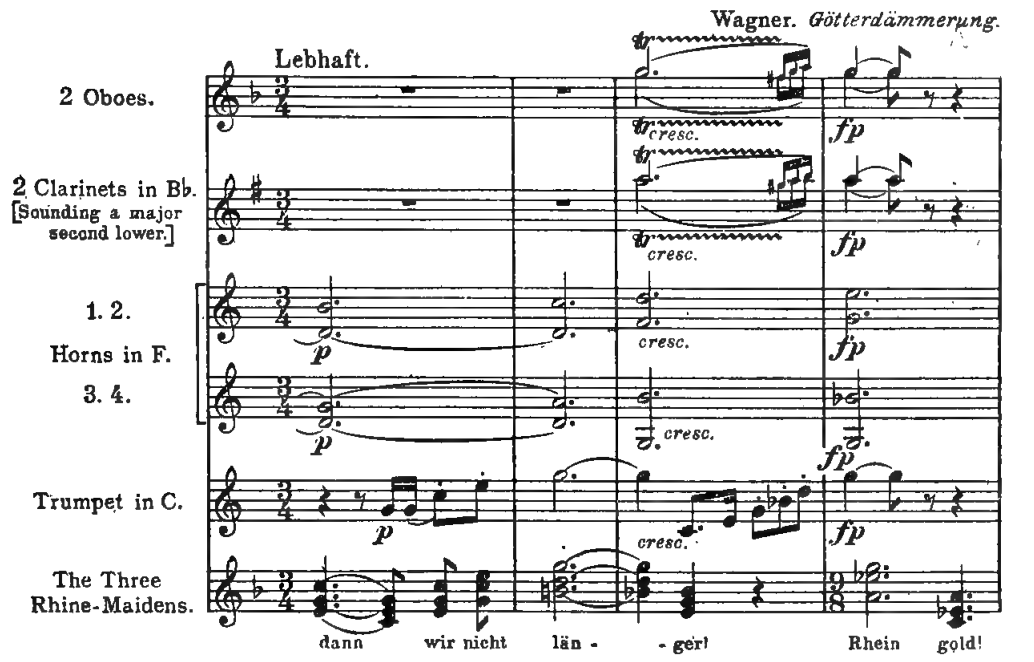
The shortness of the modern Trumpet tube and its comparative smallness of bore combine to give the player an undoubted certainty of grasp over its entire compass. The student is, however, reminded that its extreme notes are not satisfactory. Below
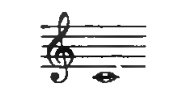
they are uninteresting and lack substance. This is of little consequence, as they can always be adequately replaced by the Trombones and Horns. On the other hand from
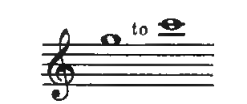
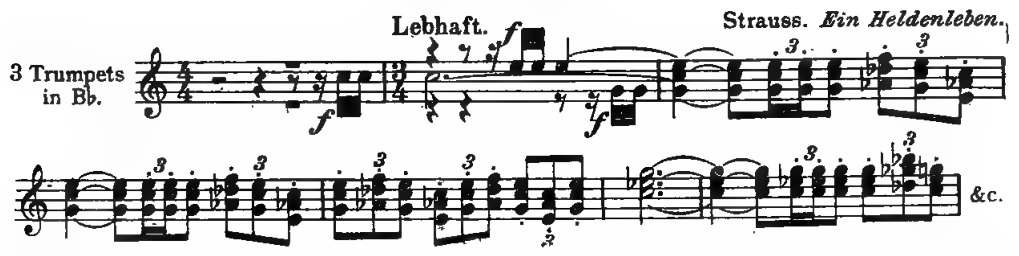
they become rather attenuated and "tinny " and, in this octave, there is no other Brass instrument to take their place. It is a good rule never to take them below low C and only for special purposes above high G. A hine example of three Trumpets playing in harmony at the top of

only other instruments are the Ist Violins, Violas, and Cellos holding an octave Bo pp.
Example 40
A word must be said here with regard to the Trumpet Mute. This is a sort of pear-shaped stopper so constructed as not to alter the pitch of the instrument. It is fitted into the "bell" and its effect, when the player blows in the natural manner, is to reduce the tone to a faint echo. On the other hand, by overblowing,' that is to say by greatly increasing the pressure of the wind-stream, he can disturb and stultify the air waves so as to produce the weird pungent tone-quality which is perhaps a little too familiar to our concert-goers. For these two effects it is only necessary to mark the part Con sordino p and Con sordino f, adding in the latter case, at discretion, the English equivalent of the French word cuivré, "brassy." One may be permitted to mention here that the Trumpet sutters the mute much more gladly than the other brass instruments. In fact it preserves under this indignity an unexpected plancy and agility. Un the other hand, the Horn, perhaps owing to its larger bore and its greater ditticulty of intonation, seems to resist partial suffocation. This is to its credit.
Some controversy exists as to the composer who first made use of muted Trumpets in his score. Mozart and Berlioz have both been cited under the First Ofenders Act. A recent critic, however, has dug up a queer passage by Scarlatti, in which two muted Trumpets play in thirds at the top of their compass and are answered by two "Trombe Marine"! This seems to settle the matter for the present, though of course there is always the possibility of an appeal from the sentence. Whatever the merits of the case, it was Richard Wagner who first found this particular brand of tone-colour where it was lying in

the instrument's compass at a higher part of its compass. This is done by means of increased lip-pressure. For instance, the Oboe is said " to overblow an octave," the Clarinet " to overblow a twelfth " This means that, with the same fingering, the natural scales ot these instruments can be reproduced by an alteration of lip-pressure at the distances, respectively, of an octave and a twelfth higher,
? In Mitridate Eupatore, 1707. See Mr. E. J. Dent's Alessandro Scarlatti, page 109.
, 3 See page 298.
the dust of the cellar, and brought it upstairs to stimulate the jaded palates of the musical world. The vinegary "tang" of this vintage is well suited to both Mime and Beckmesser.
Since Wagner's day composers have resorted to muted Trumpets on the slightest, or no, provocation. Used with discretion they are capable both in the j and the p of great effect, but the tone-quality, especially in the J, etches itselt so deeply into the mind as to become unbearable after a little while.
A striking modern example of the muted Trumpets is to be found in Strauss's Ill Eulenspiegel. The four-part harmony is arranged for two muted Trumpets and two muted Horns both playing mf. Four muted Solo Violins, omitted below, double the four Brass parts and are marked pp. They make little difference in performance, but serve to steady, and, so to speak, solidify the Brass harmony. In playing this passage over on the pianotorte the student must not overlook the fact that the transposition of the F-Trumpets is a fourth upwards, that of the F-Horns a fifth downwards.
Example 41
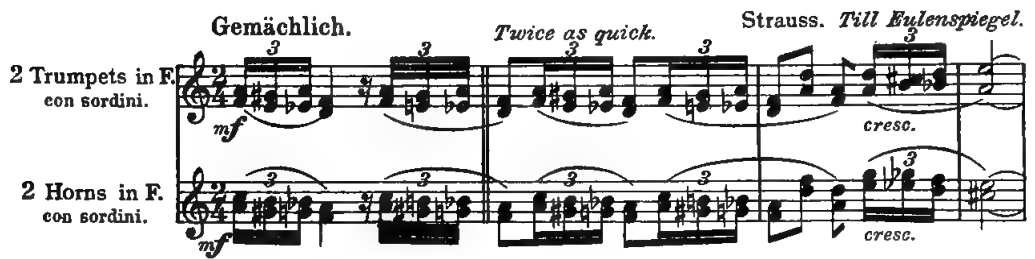
A second and much more elaborate example will be found later under the heading "The Tubas" (Ex. 95). In this quotation (from Strauss's Don Quixote Varrations) the three Muted Irumpets in D play one of the chief subjects of the work accompanied by Muted Tubas, Oboe, Double-Bassoon and Muted Strings. The stúdent should exe mine the Trumpet peso of this extrains. They give a good idea of