 Playable Books
Cecil Forsyth · section 22 of 60
No. 18. The Bass-Trumpet
Read and hear this section in the playable edition →Fr. Trompette Basse; It. Tromba Bassa; Ger. Basstrompete.
This Trumpet, as imagined by Richard Wagner for the Ring, was to be an instrument of Brobdingnagian length and Brobdingnagian

tone-colour, with a compass which extended from the bottom notes of the Tenor Trombone to the topmost notes of the French Horn. The actual notes of the Harmonic Series which it was to employ ranged from the

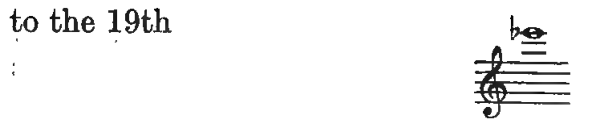
It was to be played with three crooks, C, D, and Eb, transposing downwards an octave, a minor seventh, and a major sixth respectively. chromatic compass, therefore, with these three crooks was to be

It need not be insisted on that the advantage of having three different crooks on a newly-invented valve-instrument was purely a From the player's point of view a single croo vould have been infinitely preferable. But over and above this it wa found that, with a narrow-bore instrument of such enormous length— viz. 23 ft., nearly the size of a Double-Bass-Trombone-the two lowest
Wagner's original Ideas were theretore thrown overboard Bass-Trumpet was modified into the instrument which we now possess. Its Harmonic Series has been raised an octave, and the player is now asked to produce no Harmonic lower than the 2nd or higher than
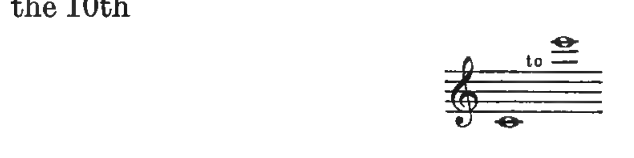
For orchestral use the instrument is built in the key of C-basso only.! It has no need of additional crooks. By means of its three valves it has a complete chromatic compass downwards through a diminished fittn to f'f, and upwards to its highest note E.

As in most other Brass Instruments, the extreme notes of its compass upwards and downwards are the most difficult to attack and the least satisfactory to listen to. Its most useful register is therefore from

The technique of the instrument is practically the same as that oi the standard Trumpet in C, Bo, and A, with this qualification, that its
1 Bass-Trumpets are also made in Bb and Eb. These are used in some military bands.
length of tube makes it less facile of execution and much more tiring to the player.
The tube of the Bass Trumpet is bent into the shape of an ordinary Valve-Trumpet, but apart from that and its name, the instrument is actually a Valve-Trombone half-way in pitch between the Tenorand the obsolete Alto-Trombone. This is satisfactory enough, as Wagner's parts for the instrument in the Ring have exactly the type of melodic outline which suits the Valve-Trombone'
The rarity of its use in this country, of course, militates against its success in pertormance. However, in the hands of a skilful Irombone. player it has an admirable tone, rich and sonorous, both in the p and the f. Like the other Valve-Trombones, it has considerable powers of legato playing.
There is no earthly reason why the Bass-Trumpet should be written for as a C-basso instrument an octave above its true pitch. The better way is to write the actual notes in the bass- and treble-clefs at convenience. Being pitched in C, it will, of course, receive the keysignature of the music. For example:
Old notation
Simpler notation
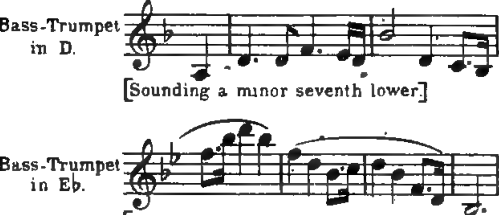
[Actual sounds in their correct clef]
Sounding a major sixth lower]
[Actual sounds in their correet clefs]