Playable Books
Cecil Forsyth · section 23 of 60
No. 19. The Cornet
Read and hear this section in the playable edition →
Er. Cornet-à-pistons; It. Cornetto (or Cornetta); Ger. Cornett.
This much-abused instrument is really a military development of the Post-Horn. Its short tube is partly cylindrical and partly conica. The bore is larger than that of the Trumpet, and a cup-shaped mouth piece is used. The illustration on Plate IV., page 93, gives a food idea of the relative proportions and the general "build" Bb-Cornet, the Bo-Trumpet, and the F-Trumpet.
The notes of the Harmonic Series employed are the same as those of the Trumpet in C, viz.:
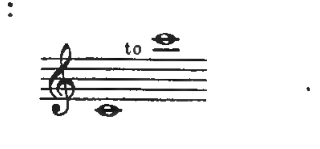
and by means of the three valves the compass is extended chromatically downwards a diminished fiith to low it, and made chromatic from that note to top U. The instrument is, however, never played
" Not to be confused with the ancient Cornetto or Cornet à bouquin., See pp. 71-2, 133. 'The French generally abbreviate the name of the modern Cornét to "Piston." With the Italians, on the other hand, the abbreviation "Pistone" means the high military Cornet in Eb.
in C, but with one of the two crooks Bb or A. The written chromatic compass, therefore,
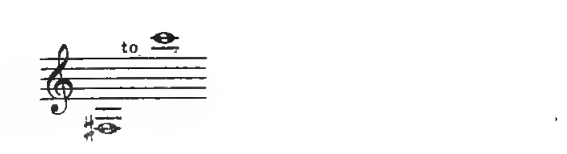
sounds, on the Bb-Cornet;
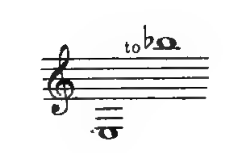
and, on the A-Cornet,
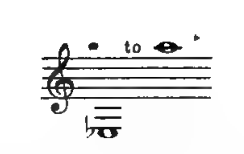
In quality the difference between the two crooks is negligible. When selecting the crook the composer must therefore be guided by the considerations given above under the heading "Trumpet." He must endeavour to give the instrument as few sharps or flats as possible in its signature. However, as the Cornet is much more used in short pieces and in light Upera than the Trumpet, a tew more words on choice of crook may not be out of place.
The student should first notice that the Bo-crook obviously necessitates a signature two degrees sharper than the signature of the piece. Similarly the A-crook necessitates a signature three degrees flatter.
In major keys, then, the general rule is to use the Bo-Cornet as a corrective to flat keys, and the A-Cornet as a corrective to sharp keys. The crook corrects the sharpness or flatness of the signature of the music.
It is, however, always necessary to use some discretion in this matter when writing for the Cornet, the Trumpet, and, be it said, the Clarinet. Even in the key of C major the choice between the two tairly simple keys, D major for the Bo-Cornet and Eb major for the A-Cornet, should really be made according as the direction of the modulations is northwards-that is, to the sharp side-—or southwards —that is, to the flat side. For instance, if the second section were in # major, the A-Cornets, now in G major, would be preferable to the Bb-Cornets, now in Ff major. On the other hand, if the second section were in Ab major, the Bb-Cornets, now in Bb major, would be preferable to the A-Cornets, now in Cb (or Bl) major.
The rule, Bo-crook for flat keys and A-crook for sharp keys, will suttice for all the simpler keys and modulations. Notice, however, that when one is dealing with the borderland keys, such as Db, Gb, F* Bi, and with the less simple modulations, it is often wise to modify inv general rule and to take advantage of the enharmonic change
Example 1.
The piece begins in Do major, and has a second section ir
1ª major The signatures of the Bb-Cornet will be Eb major and Bl
The signatures of the A-Cornet will be Ell (not I major and
C major.
Obviously in this case, though it is a flat key, the A-Cornet will be the better, more particularly if it has anything important to do in the second section, 4 accidentals with the A-crook, as opposed to (3+5)= 8 with the Bo-crook.
Example 2.
The piece begins in Do major, and has a • second section in
Fb major. The signatures of the Bb-Cornet will be Eb major and G
major. The signatures of the A-Cornet will be El (not Fb) major and
Gi (not Abb) major.
(4+1) =5 accidentals for the A-crook, as opposed to (3+ 6) = 9 for the Bo-crook. Here we have a case of extreme flat keys, but for enharmonic reasons the A-Cornet is again more advisable. These questions, however, are not to be solved by rule-oi-thumb, but by a consideration of the actual passages which the instrument has to play.
For instance, in the second of the two examples given above, if the Cornets had a really ditticult part in the ist section (Do major, and practically nothing in the 2nd section (Fo major, the balance o probability is that one would use Bb-Cornets (in Eb to begin with) rather than A-Cornets (in El to begin with). In the 2nd section it would certainly not be worth while to change the crook for a simple part. Even the signature would be better lett undisturbed for such a
If the student now reverses the supposition, and imagines the Cornets to have very little in the Ist section (Db major) and a difficult part in the 2nd section (Eb major), the chances are that he will üse the A-Cornets (in El to begin with) rather than the Bb-Cornets (in Eb to begin with). Then in the second-the difficult section he will have his instruments in one of their easiest keys—- Gi major. Finally, it the student supposes that his Cornets have got the average of key is in favour of the A-instrument. El major +

" In order to avoid many sharps and flats in the key-signatures of Wind-instruments it is often wise (1) to avoid the key-signatures of F' minor, Bb minor, Eb minor, and Ap minor altogether, and to substitute their tonic major key-signatures; (2) to avoid the key-signatures of E major, B major, and Ft major, and to substitute their tonic minor key-signatures. In both cases the additional sharps and flats should be written in where necessary as accidentals.
Minor keys are just as easy to deal with, if only one keeps an eye on the modulations and remembers that a transition to the dominant puts one four degrees to the North. In flat keys this generally brings one fairly near home (C major); but in sharp keys it lands one near The direction of the the freezing regions of By major and I# major. modulations must therefore be taken into account before settling the question of crook, and, as before, the possibilities of enharmonic modulation must not be overlooked.
Example 3.
The piece begins in A minor, and has a second section in E
major. The signatures of the Bb-Cornet will be Bi minor and F♯
major. The signatures of the A-Cornet will be C minor and G major.
The A-Cornet is, of course, the better: (2 + 6) =8 accidentals as opposed to (3+1) =4.
Example 4.
The piece begins in A minor and has a second section in The signatures of the Bb-Cornet will be Bl minor and Ab (not
G♯) major. The signatures of the A-Cornet will be C minor and Al major.
There is not much to choose between the two crooks: (2+4) =6 accidentals as opposed to (3 + 3) = 6. The selection will depend on the relative difficulties of the passages in the two sections.
Example 5.
The piece begins in A minor and has a second section in
El major. The signatures of the 4-Comet will be mir and A C major.
Obviously the Bb-instrument is the better: (2 + 1)= 3 accidentals opposed to (3+4) = 7.
In a similar way the student may deal on their merits with the other modulations, namely those from major to minor and from minor to minor keys. In a few of these cases he will find extreme modulations where a change of crook is a necessity. For example, from A major (A-crook necessary) to C minor (Bo-crook necessary); or from F minor (Bb-crook necessary) to Bi minor (A-crook necessary). The student should consider these points carefully, not only because they are of importance when writing for the high Brass-the Trumpets and Cornets-but because when he comes to deal with the more complex instrument, the Clarinet, he will find the same little problems confronting him.
All that was said above with regard to the shakes of the C-Trumpet applies equally to the Cornet. The latter instrument In perimen frer is do easier in thie or tula than say hated Bast that does not commend itself to everyone's musical tastes.
'The mute used is similar to that of the Trumpet, but not so ettectively acid in the f. Uccasionally the instrument is fitted with an "echo-attachment,"" a blind-alley mechanism which reduces its tone to a stifled whisper.
The technique of the Cornet is much easier to acquire than that of the Trumpet. The instrument "speaks" freely, and, except in its very lowest notes, maintains a good even tone-quality throughout its compass. In the hands of even a moderately good artist it is—as far as lightness and agility go-pretty well the equal of the Clarinet. Single-, double-, and triple-tonguing, slurred and detached passages, quick chromatic and diatonic scales, unprepared high notes, arpeggios, and all sorts of mixed figures founded on these various technicalities can be played with extraordinary certainty. Owing to this facility it is indispensable in the military band.
In this country there is an absurd prejudice against the instrument, a prejudice based partly on the fact that it was unknown to the ancient masters, partly on a comparison of its tone with that of the Trumpet when playing Trumpet-passages, partly on a dislike of its repertoire, and principally on ignorance.
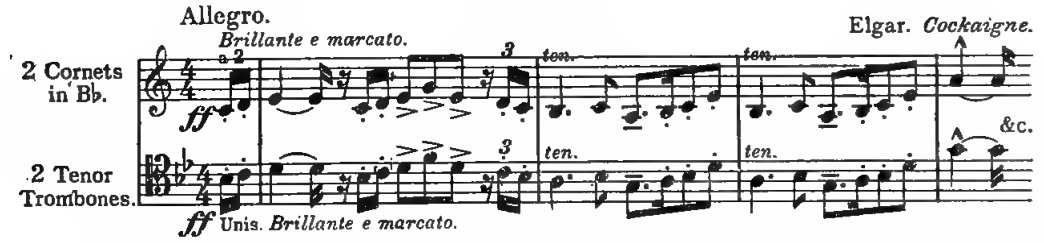
True, its tone-quality is not so heroic as that of the old, long, big bore Trumpet. Un the other hand, in nine cases out of ten it is much more pleasant to listen to. Its lowest notes alone, like those of almost all Brass Instruments, are weak and flabby. It is better not to use them at all or to use them at any rate only for helping the Horns or other instruments over a difficult place. Such is their funetion in this curious unison of low Cornets and high Trombones from Elgar's Cockaigne:
Example 42
We must not forget that the contempt which is usually bestowed on the Cornet by those who have never heard it properly played is mainly a contempt because it cannot equal or beat the Trumpet in Trumpet passages. These simple straighttorward phrases were always consciously designed by the old masters to produce their somewhat oppressive effect by the mere weight of the instrument's tone. In course of time we have come to associate that tone with that type ot passage. The Cornet, a youth not yet a hundred years old, is suddenly called on to compete with its hoary rival in the very passages that least suit its genre. Naturally it fails, and its failure is gleetully recorded as the culpable tailure of a noisy and objectionable upstart. This is hardly fair, for the instruments are quite distinct. It is as if one were to blame the Viola for not being able to characterize the first four notes of the Tristan prelude in the way that the Cellos can.
The fact is, that the Cornet when badly played is as bad as the Then play dwel bone as hend, or ate ora purpoges, as these inorse. ments are for theirs. Only it needs a totally distinct style of treatment. In the first place, no other Brass Instrument can touch it In Horid music: Its fluent tone-quality; easy diction, and flexible technique, make it the ideal instrument for all those complex passages which need the colour of high-Brass, but which would be spoilt by a too obvious sense of struggle and effort in securing that colour.
It is only in recent years that composers have begun to treat the Cornet otherwise than as a substitute for the Trumpet.' Let us accept the fact frankly that a Cornet is a Cornet, not a Trumpet. Then we shall be able to see what can be done with it. Here is one little point. The Cornet more than any other Brass instrument is able to "drop out of sight" at will. It is the only Brass Instrument capable of filling this fifth
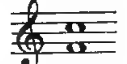
for us with quiet unobtrusive sound. This tone-quality is just above the level of the Clarinets. When played pp the effect is, in the theatre, often charming. Seconds, thirds, fourths, and fifths, can be either sustained in this quality or repeated in simple rhythms; and quiet two-part chromatic or diatonic passages can bè played with a delicacy of poise that will not disturb the vocal equilibrium of even a Comic Opera Soubrette:
Ihe Cornet is oiten charged with having a "coarse" tone. But the quality of its tone is in the main soit and placid. It lacks pungency and incisiveness. Any coarseness in the Cornet is not so much due to the instrument itself as to the mistaken efforts of injudicious players determined to make their part "stand out" at all costs. there are hundreds of Cornet players to every Trumpeter, so there must be scores of bad Cornet players to every Trumpeter. And they always remind us of their existence. Players on the F-Trumpet are not heard at street-corners.
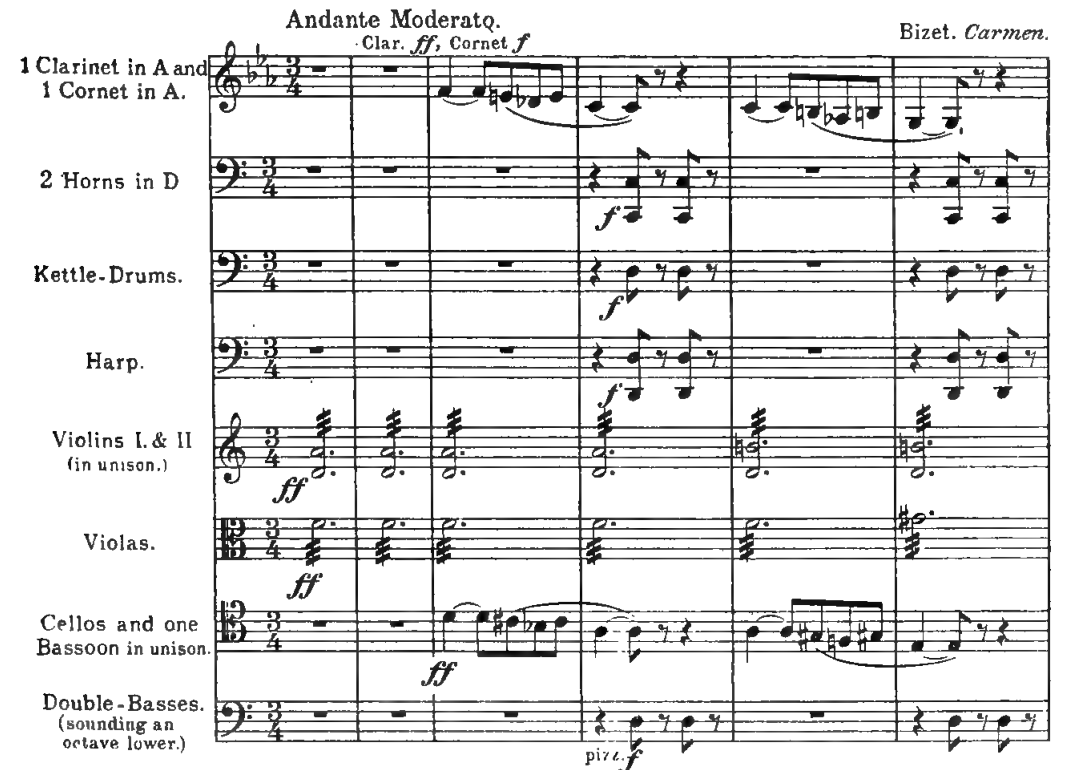
One of the most useful features of the Cornet, besides its variety, is its power of combining. Indeed, save in its topmost register, it will "hole Our men or Cobies, u the stood bris pozet, whomored the well. The tragic theme in the prelude to that opera is assigned to an impressive unison of Cornet, Clarinet, Bassoon and Cellos.
1 In France it has always had a certain musical status. It is used there regularly, not only in Comic Opera, but in Symphony and Grand Opera Orchestras.
accompaniment, above the melody, is for Violins and Violas tremolo, while the bass notes after each phrase are assigned to Horns (bassclef, transposing in the old-fashioned way up a tone, not down a seventh), Drums, Harp, and pizzicato Basses.
Example 43