 Playable Books
Cecil Forsyth · section 25 of 60
No. 21. The Tenor (or B) Trombone.'
Read and hear this section in the playable edition →

Fr. Trombone ténor; It. Trombone tenore; Ger. Tenorposaune.
This instrument is played with a cup-mouthpiece, and its peculiar acoustical properties seem to depend on the correct proportion between the lengths of its cylindrical tube and of its conical "bell-joint." The tone and quality of the instrument, however, vary considerably according to the player's method of attack.
We have already described the Slide-Mechanism by means of which the air-column is lengthened so as to produce the seven fundamental notes and their accompanying Harmonic Series. The student i advised to re-read what was said above on this subject (page 83). For the sake of clearness and completeness the whole of the notes which are obtainable in each of the seven positions are now set out in full.
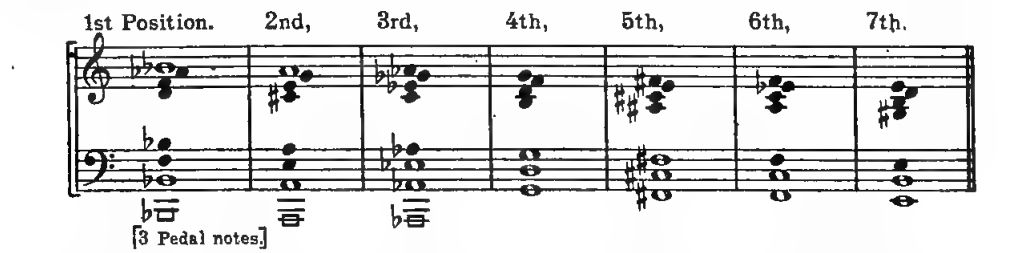
1 For Slide-Trombone the French say Tromhone à coulisse; the Italians, T'rombone a tiro or Trombone duttile; the Germans, Zugposaune.
(1) In each of the first two positions two higher notes—the 9th and 10th Harmonics-are playable by means of a strong lip. These are, in the Ist position,
and, in the 2nd position,
The compass of the instrument is therefore four semitones greater than that actually shown in the list of positions. Of course the corresponding 9th and 10th Harmonies are easier to produce in the lower than in the higher positions, but in actual practice they are not used because they merely reduplicate notes which are still more easily Betairal be for a or A Intrum ate is that the fundam of al. rate production increases with the height of the Harmonic Series. most important, however, to note that this height is not a height in pitch but in number (1, 2, 3, etc.). The notes of a Ist Horn part that les constantly between Harmonics 6 and 13 aré, quite apart from any question of pitch, much more difficult to produce accurately than those of a Ist Trombone part which lies mainly between Harmonics 2 and 8. The extreme notes of the Trombone-those above the high Bo-are really not of much use in the orchestra, and it is as well to confine the upward compass to the Bb. Downwards, the last three semitones F♯, F4, and Eh, are not of such a good quality as the same notes on the Bass-Trombone, though one need not scruple to use them if necessary. 0) in there brevery comes are vine bore retal dote 1 5s, Ah, and Ab, all playable with a very loose embouchure. In quality they are somewhat unsatisfactory, rather coarse, and wanting in substance. The highest of these three, the Bb (1st position), is by far the best, then come in order ot demerit the A (2nd position) and the Ab (3rd position). If they are wanted it is as well to approach them by a drop trom the octave above. If that is not possible the player should have a moment's rest in which to adjust his em bouchure It is not wise to skip down to them direct from 6th and music-hall comedian's Harmonics. Otherwise it may sound like a "effect." There are iew instances of these pedal-notes to be met in orchestral music. Gevaert quotes 10 bars of held pedal Bb from the Ist Act Finale of Hérold's Zampa. The pedal is allotted to three Tenor Trombones in unison. Berlioz, as every one knows, had a pedal-bee or rather a hive of pedal-bees in his bonnet. Here is a
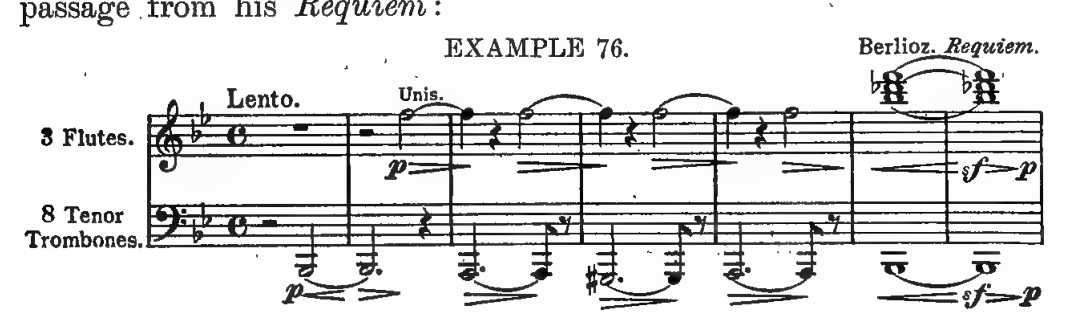
It probably sounds very nasty. Elgar, in his overture Cockaigne, has written a three-bar pedal on Bb for two Tenor-Trombones in unison with a Tuba and a Double-Basoon. He does not even hesitate, earlier in the same overture, to make his Ist Trombone jump down three octaves to the deep pedal Ab. It is true that the player has a moment's grace before his musical dive trom the chiti to the sea. gives him the opportunity of reflecting what it will feel like when he strikes the bottom:
Example 77

If the student will now refer back to the list of Trombone- Harmonies given above, he will see that the majority of them are printed in black crotchet-heads. These are the notes which are reduplicated, the notes which are producible as Harmonies of different Series-numbers from more than one fundamental note. In other words, these are the notes which can be played in more than one position. This reduplication of notes is of considerable advantage to the player, as it helps him to avoid sudden changes of position in quick passages;
The white semibreves are the notes which can be taken in one position only. A caution may be entered here as to their use. The top A and Bo do not come into the matter, as they are playable from the two closest positions of the slide, the Ist and 2nd. But with regard to the lower notes it must be observed that very rapid sequences of notes involving extreme changes of position, say from the Ist to the ith, or vice versa, are not only awkward but impossible. The slide takes an appreciable time to pass down the two "legs" of the instrument, and has to be pulled away betore the instrument has had time to "speak." The result is a sort of ghostly grunt. Imagin what a player looks like in trying to play this:
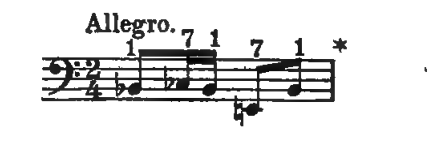
His action is very much that of an energetic cyclist pumping up his tyres against time.
It is a good general rule to avoid quick interchanges of the note
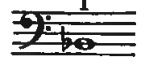
* The numbers above the notes give the positions.
with any of the following:
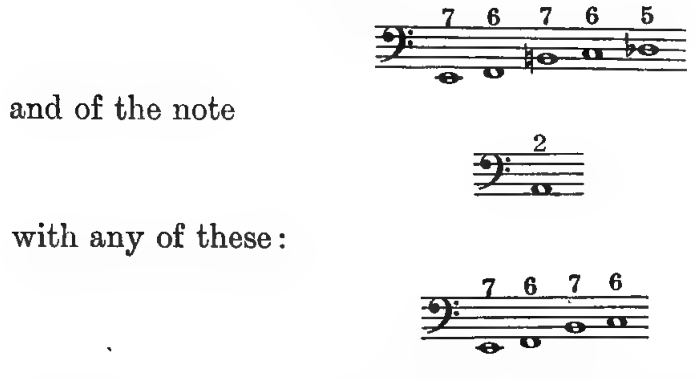
Of course, as the upper pivot note (Bb, A, etc.) becomes lower, or the loser sion ete more highe that unete are the fact not But there are two facts not to be overlooked in this connection. (1) Apart altogether from the question of pivoting one note on another, the three or four deepest semitones of the instrument take an appreciable time to "speak." (2) The actual length through which the slide has to be moved is not the same for all the positions, but increases with the depth of the position. The player therefore in the last three semitones of his ordinary compass has to struggle with a difficulty of tone-production, with a ditliculty in the extension of his arm, and with an increased distance between his positions. And finally, as has been already said, the fundamental notes in his 5th, 6th, and 7th positions are all of much better quality on the Bass-Trombone.
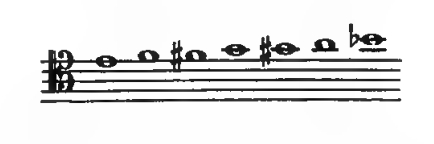
Shakes are scarcely worth considering on the Trombone. They are formed with the lips, not with the slide. They can only be made in the upper part of the register where two tones lying next to each other can be blown alternately by a difference of embouchure, but without any alteration of the fundamental note. These whole-tone shakes are possible on the following notes:
Before the Alto-Trombone became obsolete it was customary either (1) to use three staves for the Trombones with the three clefs alto, tenor, and bass; or (2) to write the first two Trombone parts on one stave with the alto- or tenor-clef, while the Bass-Trombone had a separate bass-clef stave; or (3) to write all three instruments on one line, generally with the bass-clef but occasionally (see below, Ex. 80) with the tenor-clef.
Nowadays the usual plan is to write the two first Trombone parts

the parts are very simple and similar in outline the practice of crowding three instruments on to one stave is likely to lead to confusion. All three parts have of course to be distinguished by means oi tails and rests, and, what with marks of expression, slurs, and so on, a three-part stave generally becomes a muddle. Hase of writing and reading is the object to be aimed at.
The Tenor-Trombone is the first instrument under our notice which, built in a key other than O, is yet not treated as a transposing-instrument. Crooks, though tried on the Trombones, have never "made good" with them. We are therefore in the happy position of being able to write
and not
when we want middle Bb.
The method oi tone-production and of attack varies greatly 1l ditterent countries. In England the amount of "tang" and "bite" f is extraordinary. The player starts the note with a great impetus, and "throws it out into the air." This 1s well enough in passages that demand the utmost force of delivery. Occasionally, however, the notes themselves seem to disappear and leave nothing but a nerve-splitting edge. Ine continual call for brilliance in the Brass department has caused such alterations in the instrument's construction that nowadays Tenor-Trombones are made with pretty much the same bore as that of a Cornet. The shape of the cup-mouthpiece is also determined principally with the object of securing the utmost brilliance of attack. "In France the most esteemed players have not a tithe of this bravura, but their smooth crescendo, sounding like an irresistible "head" of water, is something to be remembered. This is partly due to the fact that they usually play with instruments of a wider bore and partly to the fact that they employ a sort of modified funnel-mouthpiece. It must not be overlooked that the special drawback of the present-day Trombone Is Its aversion from a forte sostenuto. The note as a rule barks out and then dwindles down to a mezzo-prano. The noble manner of holding a note forte, but not so forte as to be oppressive, seems to be almost a This was the majestic sostenuto which Mozart and Beethoven always had in their ears when they wrote their Trombone chords. It is certainly worth all the Trombone bravura-playing in the world.
There is in general no true legato on the trombone at all. Lach note has to be articulated at the moment that the slide changes its position. There is therefore a perceptible moment between each two notes when the air-column is not in vibration. Were this not so we should get a distressing portamento between the notes. In the p and the pp a good player reduces this moment-of-silence to vanishing point, produces an effect which Widor happily compares with the sostenuto of the Violin—a sostenuto which is scarcely interrupted by he turning of the bow. When playing a succession of notes from the same fundamental, that is to say, when playing without change o1 slide-position, the Trombone, of course, enjoys the same advantages of legato-playing as any slideless Brass Instrument.
It is worth noting that the Trombone player depends solely on his ear for his correct intonation. This is true of all instrumentalists, but it is true in a special sense of the Trombone-player. He has no mechanical pistons or keys to guide him, nor is he employed, as the Bassoon-player is employed, in correcting the defects of an imperfect instrument. He makes his notes just as the String-player makes his. Thus he has the opportunity of a nice accuracy in judgment, and it 1s only necessary to hear four clever Trombone-players exercising this judgment by playing an "equale" in the pure untempered scale to be made aware how delightfully musical is the essentia. character ot the instrument.1