 Playable Books
Cecil Forsyth · section 24 of 60
No. 20. The Valve Horn' in F
Read and hear this section in the playable edition →

Er. Cor-à-pistons; It. Corno Fentile; Ger. Ventilhorn.
Our present-day Valve-Horn consists of a spirally-coiled tube of brass some 7 feet 4 inches long: The F-crook with which it is invariably played in this country adds another 4 feet 41 inches.? The total length of the instrument is therefore 11 feet 8} inches.
1 The full English name of the Horn, whether with or without valves, is "French-
« In France the instrument is often built in Bo-Alto. This is much less satisfactory than the medium-pitohed key of F. Cruoks have to be continually used and, even when the tuning-slides are pulled out, the piston-notes on the lower crooks are all far toc is a favourite key for the manufacture of Valve-Horns. sharp. German instruments have very little resemblance to our own. Their tone-quality we should regard as more suitable to the Euphonium. It is somewhat coarse, thick, and In lightness and brilliance they are inferior to the true French Horns explanation is to be found in the bore and mouthpiece of the German instruments. It Both tonal and executive control must be added that they are much easier to the Germans appear to be unaware of the seem to be acquired without much difficulty. instrument's deficiencies both in elegance and lightness. This is perhaps mainly a matter of custom, though it is surprising that in America some ot the tinest orchestras should deliberately prefer German to French or English players.
instrume valve prontel id as many extra longth of pubi begive the

and the theoretical advantage of a downward extension of compass
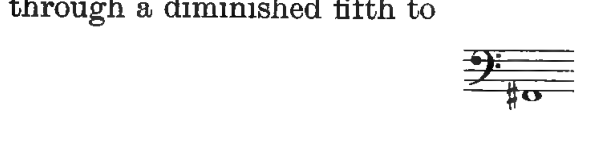
Small tuning-slides are attached to the extra lengths of tubing and ive the player the opportunity of making some necessary adjustments n pitch. " The bore of the Horn is theoretically conical, but, except i one patent valve-system," the extra lengths of tubing are actually cylındrical. The whole tube ends in a parabolically curved bell whose widest diameter is about 1 foot. Unlike most other brass instruments the Horn is played with a small funnel-shaped mouthpiece, which is in shape much like the bore of the instrument itself—a truncated cone. The size of this mouthpiece is a matter of convenience to the individual player concerned. As a rule Ist and 3rd Horn-players, being more continually called on to produce the upper Harmonics, use a somewhat shallower mouthpiece than 2nd and 4th players.
In compass the instrument is still practically what it was before the invention of valves. Even in the eighteenth century players were accustomed—or at any rate were required—not only to play the Harmonic Series from high C down through three octaves, but to descend through five further semitones to the low G. These notes were produced with a very loose lip, and were known and disliked tactitrous notes. An example of their use is to be found in the familiar 4th Horn passage in Beethoven's Ninth Symphony. The two bass-clef notes of this passage are, according to the custom oi the times, written an octave too low. But, even with that allowance, the second note is five semitones below the true first Harmonic of the Horn.
Example 44

These notes, and an additional semitone-the low FF (sounding on the F-Horn BI)—can now be produced by means of the valves. their difficulties both of intonation and emission are great, and their
• The student is again reminded that, as this is a transposing instrument, the writter notes are player's notes only. In every case their sounds are a perfect fifth lower & See page 85.

theoretically does not exist on the instrument at all.
The Horn is now a chromatic valved instrument, and every note can be taken as an open note from a fundamental. The old Horn, however, still persists in the new, and the whole series of "hand" and "stopped" notes with its accompanying variety of tone colour is still available.
The question of the "hand-notes," however, needs a little explanation, as the student will find two diametrically opposed statements on this point in instrumentation books. They are
(!) That the insertion of the hand in the bell lowers the pitch of the instrument;
(2) That the insertion of the hand raises its pitch.
Incredible as it may seem, both of these statements are right. Let us see what the facts are:
(1) If a Horn is placed in a free position, say on its side on a table, so that no lip-pressure is possible, and if the air-column inside its tube is then set in vibration by the lips a definite note is produced. If the band the is feed into thimlot gra do or ote ento gitening. of the note is heard. Practically every sound between the extreme limits of the two notes is heard successively. Now this is in essence the method of stopping which was practised before the days of the valve, a method which gave the artist, restricted though he was, a great variety of tonecolour.
(2) After the invention of the valve-system it was tound that by bringing the hand hard-up into the bell and exerting considerable lippressure a totally new series of muffled or stopped notes could be produced one true semitone above pitch. This raising of the pitch by means of a new technique differs integrally from the old hand-lowering in that any one of the raised series of notes cannot be produced as the highest point of a portamento upwards from the lower note. On the

acoustics, explains it as being a raising only to the ear. The Harmonies are really higher numbers in the Harmonic Series from a disturbed lower fundamental. The notes
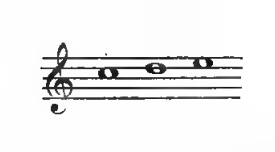
(Nos. 8, 9, 10) from a fundamental Ch do not become the notes
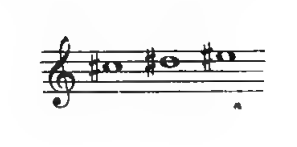
(Nos. 8, 9, 10) from a higher fundamental Cf. They become the notes
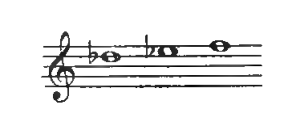
(Nos. 9, 10, 11) from the lower fundamental Cb. From the practical side the very great difference in technique between the old and the modern series of stopped notes makes this explanation appear feasible. With the new hand-technique the player has now a new series of stoppea notes, over all of which he has adequate control. As he has a complete chromatic compass in open sounds, he has—with certain reservations to be mentioned presently—a second complete chromatic He need only read his part one semitone lower than it is written, and he can reproduce any given passage in muffled notes at its correct pitch. Thus the following passage
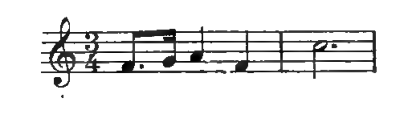
when played as hand-notes would be automatically read by the
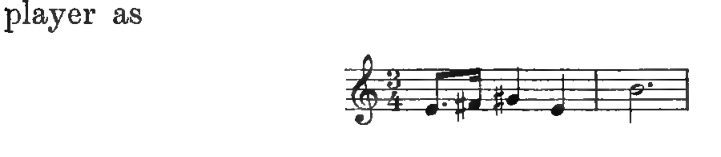
It is interesting to note that, in an art where innovation is looked on as madness or crime, a certain class of player persistently retused to recognize the necessary alteration and extension in technique. This was the more to be regretted as the modern hand-technique gives the playe he certainty of eed ha he paige in stopped notes, of modern music has always ended in failure.
If the old hand-technique had produced a different quality of stopped note from that obtained by the modern method, one could well ane edentic the reels on this dience that one method is cent ear, the other uncertain or impossible. Even a simple scale cannot be played in stopped notes by the old method. It is liable at any moment to fizzle-out in a dismal groan. A really brilliant Horn-player of the last generation has been known to hand over a simple stopped passage to a younger and less conservative rival with the remark that it was " not Horn music."
The student will now see that, without the aid of any mechanical mute, the Horn-player is already in possession oi a varied system of muffled and half-muffled tones. Their production is a matter for his judgment as an artist. At the same time, the indication of these muffled notes in a Score is nowadays a necessity. Before the invention of valves certain notes had to be played stopped. Nowadays none need be, but most can be. The composer must, therefore, mark such notes and passages in the part either stopped or con sordino. In any case when these notes are wanted as " echo-notes" they must be marked p. Both the sfe and its sign > should be avoided. if the words con sordino are used the notes will either be produced as a hand-stopped series or by means of an actual mute. With an instrument so little stereotyped as the Horn the player will use his discretion in the matter.
A mute is, of course, quite commonly used. In former days it was a cardboard or papier-maché affair, which altered the pitch of the instrument, and this alteration had to be allowed for in performance. At the present day it is usually of metal, pear-shaped, and pierced laterally so as to prevent any alteration of pitch. Its effect is to The mute can be inserted by the unemployed right hand either (1) before a passage, (2) in the break between two phrases (for an echo effect), or (3) during In the score it is usually marked con sordino. The Germans say mit dämpfer or gedämpft
In addition to this purely p series of stopped notes there is a second series of overblown notes, that is, of partially or completely handstopped notes whose tone-colour is altered by excessive lip-pressure. The quality of the notes varies from a savage bark like that of a wild animal to the dull uncertain sound with which a rout-seat scrapes over a parquet-floor. Before the invention of valves they were, of course, only available on the stopped notes of the Horn's compass. Nowadays, as every open note can be taken stopped, they are avalable everywhere. There is, however, a certain downward limit to their effectiveness, and this is generally put at
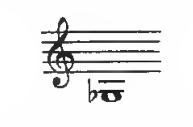
Berlioz and Wagner were the earliest composers to use this effect consciously. Many composers have misused it since.
The usual method of notation in every country is to mark the part The i with agendily out a litte over in obe, played stopped.
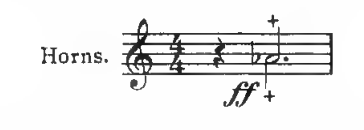
with perhaps the word gestopft (stopped).. They often add some such xpression as schmetternd (clanging, shrill) or stark anblasen (blov hard). The French either mark the note curvre or put the word sons bouchés over the passage. In this country the best way is to mark the f note with the t, and to add the word "brassy."
Complete chords limited only by the number of Horns available and by the "spread" of the notes can be played in this way. When
1 The resumption of the open notes is usually marked with the word Naturale.
not pitched too low, such chords are extremely effective. All overblown notes, however, especially single notes of low piteh, have a tendency to drop out of sight unless they are kept well uncovered by the rest of the orchestra.
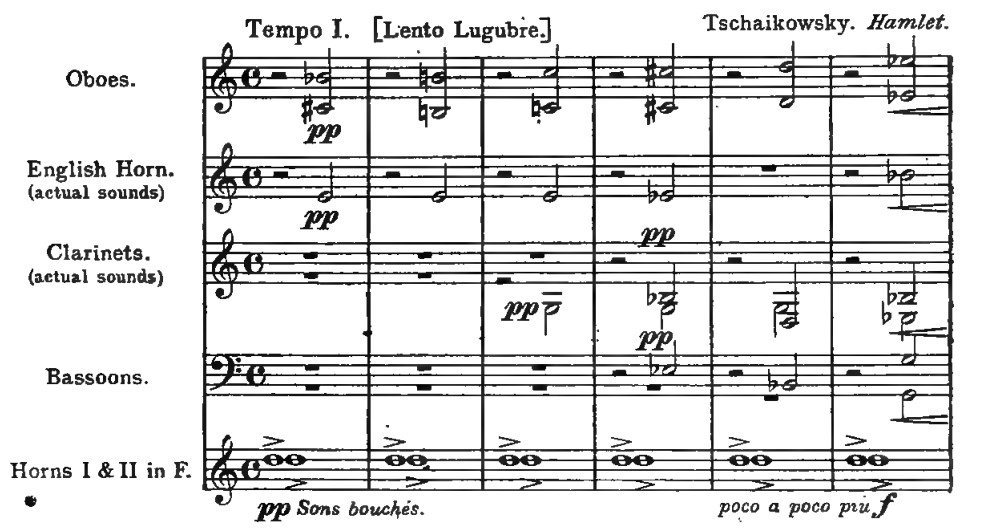
It is difficult to select instances of overblown notes from modern Scores, there are so many examples to choose from. The student will find one already quoted (Ex. 41), and, for another he may take the weirdly terrifying passage in Ischaikowsky's Fantasy-Overture Hamlet, where the clock strikes twelve on the plattorm at Elsinore. The composer evidently intends this series of twelve D's to be begun with only a slight "tang" instantly muffled into a toneless whisper. Then from the fifth D onwards each successive note is to be more and more overblown. The first six bars of the passage, with its curious Wood-Wind accompaniment, are as follows:
Example 45
All that was said above with regard to the atavistic crook-notatior f the Trumpet applies with equal force to the Horn. There is, however, a difference. Except for one special purpose, which will' be mentioned later, the instrument is crooked and played in F. Its habits are thus slightly more regular than those of the Trumpet. As with that instrument, however, composers still keep up the fiction that other crooks are used. It is a useless, even harmful, fiction, in which as is quite plain-even the composers themselves do not believe.
If the student wishes to see how this fiction works out in practice, he may take the following instance. The quotation is from the Don Quixote Variations of Strauss. The composer is writing in the key of Ff major. He marks his part "Six Horns in E" He writes them with the key-signature of O major, adding the two missine marks wherever they occur. His second section is in D minor. his part "Six Horns in F," and goes on writing them with the keysignature of C major. But what happens at the junetion of these two sections? Let us look at the first two Horn parts. The composer wishes them to produce these sounds:

Example 46

But obviously they cannot change their crooks in this bar-and-a-half. This is where the fiction comes in, for the composer knows this fact and does not expect them to make the change. What actually happens is that the players perform the whole work on the F-crook, and transpose at sight wherever the music is written for another crook.

The result, in sound, is the same.?
The student is not advised to adopt this method, but to write for he instrument on which his music will be played, the Horn in # There is also no reason nowadays why the Horns should not hav a correct key-signature. It is already regulariy done in military bands for the Ho-Horn. As we have seen already, whether the keysignature is on the paper in front of him or not, the player who is transposing is compelled to have it in his head. The brain that can master such a dificult instrument up to symphony standard is not likely to be worried by seeing the sharps and flats on the left hand top corner of his music. If you are writing in an extreme sharp key, such as Ft major-which will not be once in fity times-make an

parts, even if you are writing in accidentals for the Strings and Woodi contain a dou music bef my i madance in witure the lor. , write-in the key.

advised to adopt the plan-which is still tar trom universa —oi using the bass-clef at its proper pitch. The more the clets and key-signatures are simplitied in orchestral music the better for the progress of the art.
1 See pages 96-8.
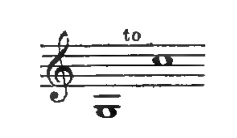
In the lower register of the Horn the tone-emission is too slow and heavy to allow of anything but single-articulation. In the medium registers, however, both double- and triple-tonguing can be used with good effect. It is as well to confine such passages within these limits :
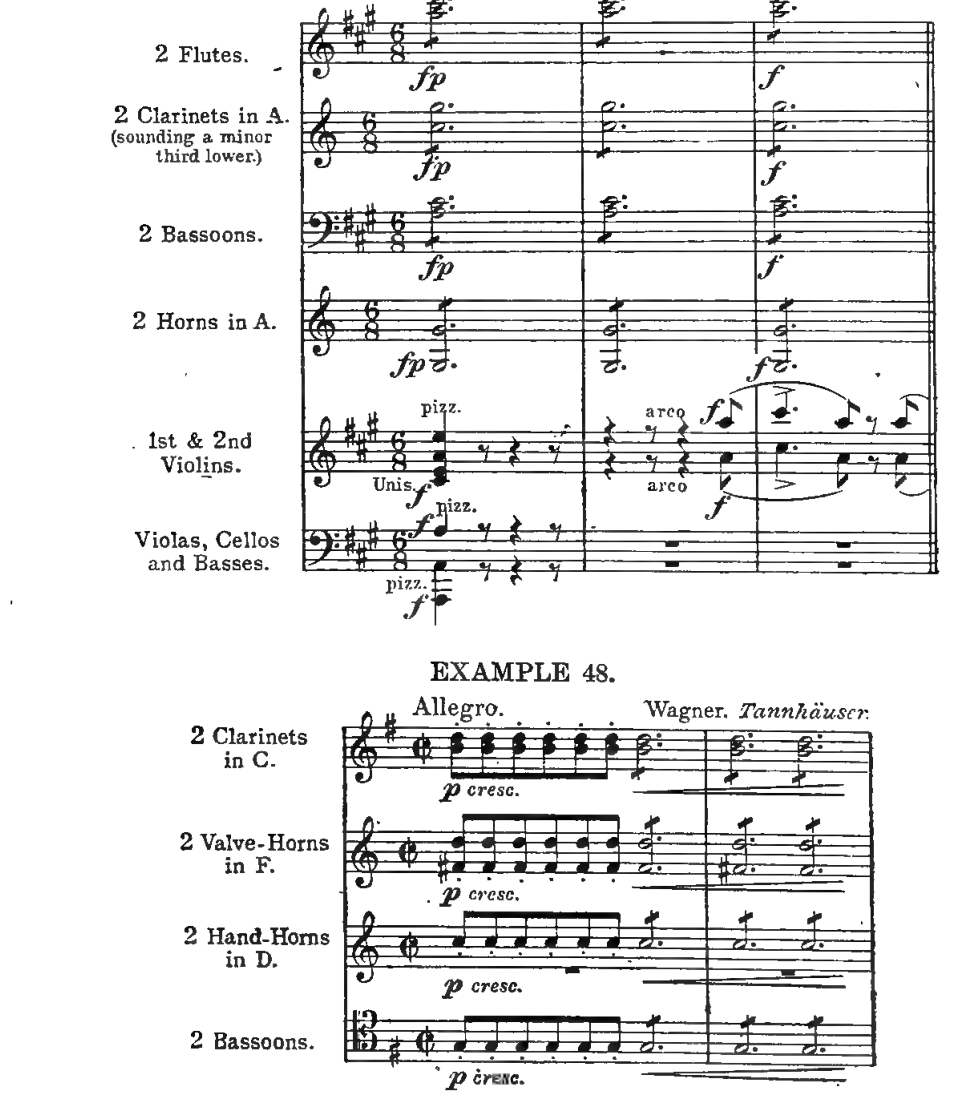
Repeated notes for accompanying are so common nowadays as to be scarcely worth quoting. They are almost invariably combined with some form of Wood-Wind, generally Flutes, Clarinets, or Bassoons. The opening of Mendelssohn's Italian Symphony and the introductory bars to Elizabeth's "Greeting to the Hall of Song" (Tannhäuser, Act II.) are familiar examples of this charming method of accompaniment.
EXAMPLE 47. Allegro Vivace. Mendelssohn. Italian Symphony.
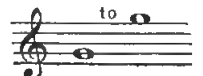
For shakes, the Horn-player uses his lips only. As may be imagined, they require the greatest nicety in the adjustment of the em bouchure. Minor shakes are generally out of the question, and even major shakes can only be made successiul in the upper-middle part of the compass, where the Harmonics lie just sufficiently close to each other to be picked out by the player's lips. The somewhat narrow limits between which they may be written are about
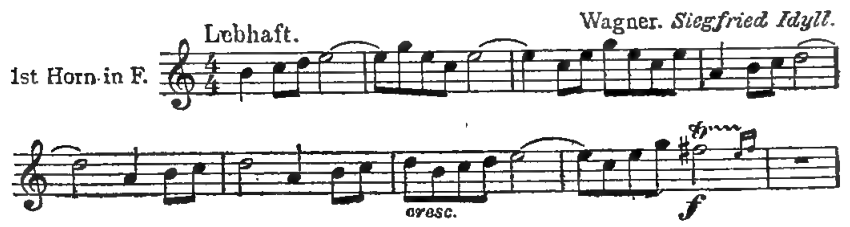
Wagner, whose writing for the Valve-Horn is as classical as that of Mozart for the Hand-Horn, rarely uses shakes at aul. There are, however, a few well-known examples, such as the high if shake just before the triplet figure for Strings in the Siegfried Idyll,
Example 49
In the Coda of Till Eulenspiegel Strauss has a four-part shake for Horns:
Example 50
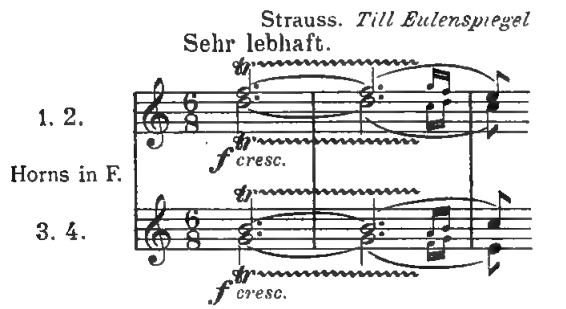
It will be noticed that they are all pitched tairly high, and that of the four shakes three are major. Furthermore, if reference is made to the Full Score it will be seen that they are all pretty well covered up by the heavy Brass and the strings, and that the whole of th
From what has been said above, the student will gather that the Horn differs materially from all other Brass instruments. It is, indeed, at a higher artistic level altogether. The player is not a mere He often has the choice of many methods of execu- "piston-opener. hand, and in order to solet the beat he was to kep her t i i be quite untrue to say that the modern ValveHorn "has replaced" the old Hand-Horn. The latter instrument is incorporated in the former, and is still the foundation of its technique. The player has now the advantage of being able to set and re-set his instrument instantaneously in any key he wishes by means of the pistons, but when once it is so set, his problems of artistic expression, of varied tonecolour, and of technical adjustment, remain much what they were in Beethoven's day.
valvesystem for the borsked he a, win, have ve lost a in adopting the answers to that question vary from the statement that the valve-notes are "slightly more resonant and trombone like" than the open notes, the he for on that he thorns or caS it has is planed on hesitation elvet i go apied the latter air Thares Sta focand Personally, I have not a second's The difference is perhaps not the difference between day and night, but it is the difference between a November and a June day. An experiment which will convince the student on this point once and
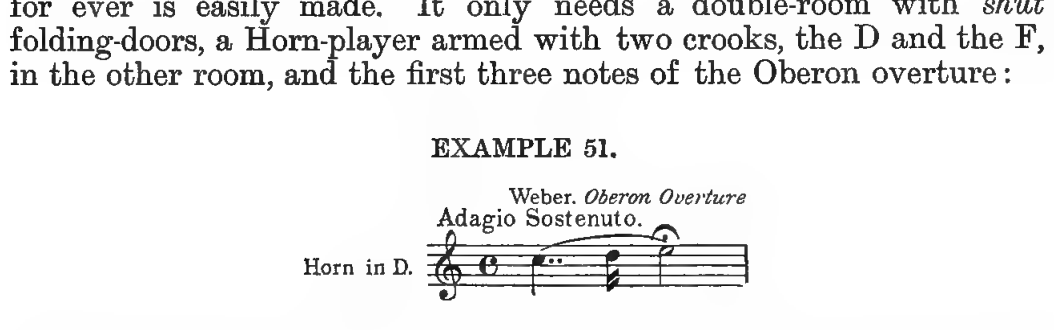
One could wish that the music of the old masters should be performed only on the instrument for which it was written, the Hand- Horn. In Berlin, where the chief Opera house is "patronized" not only in a social but also in a financial sense by the reigning monarch, this is the practice. A set of Hand-Horns is provided for orchestral pur- Poses, unk hezal, and be Whoren The Plates night, Hand Horny of tenure, and a certain necessary amount of leisure, which permit them to nurse their embouchure and adapt it to the varying conditions of performance. . In London, where a brilliant artist may be rehearsing a Symphonic Poem of Strauss in the morning, playing a Mozart Symphony in the afternoon, and blaring out pantomime-music in the evening, no such ideal results can be expected. However, nothing comes of grumbling at our conditions. The instrument itself has changed. It has gained something and lost something. The gain is in the direction of added flexibility, and even when we sum up the loss it leaves the instrument still with a tone of great purity, beauty, and nobility.
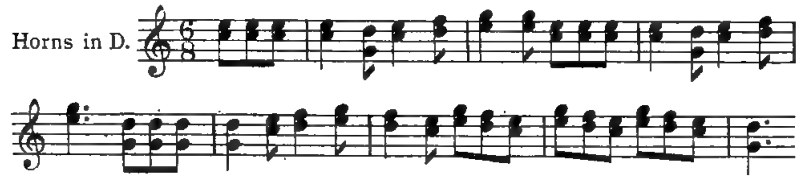
As might be expected, the music written for an instrument which has undergone two such violent changes as the addition of crooks and valves varies greatly in character. In the very earliest days of its introduction to the orchestra the Horn was scarcely distinguished from the Trumpet. Both were continually associated with the Drums, and were chietly required to play Hunting-calls and military flourishes. Their type is to be seen in such passages as this:
EXAMPLE 52. Traditional Hunting-call used by Philidor, Méhul, and Haydn.t
By the beginning of the eighteenth century the quality of the Horn had become continually sotter; not so much, however, but that its roughness was still matter of surprised comment on the part of English visitors who first heard it on the Continent. Its music was not now greatly altered in character, but much extended. At all times during its history it has been used for what the French call remplissage, but at this time one feels that when the Horns are brought prominently forward in the orchestral scheme it is only to play passages which are a grandly elaborated series of Hunting-calls.? word, the associated ideas and the restrictions of the instrument govern the composer's technique.
At the same time, with the growth of the purely contrapunta. school, the Horn became involved in a fearful series of difficulties. If the student will turn to the notes of the Harmonic Series on page 73, he will see that the Horn was only a contrapuntal instrument from its seventh Harmonic
upwards. Below that it was "harmonic" only. It had, however, to be brought into the contrapuntal scheme. Hence come all those terrifying eighteenth-century passages in which a descent below the 8th Harmonic comes to both the player and his audience as a heaven-sent boon. In the works of Bach—the most earnest of all men to colour his music by means of purely musical subtlety—the external question i his Horn and Trumpet parts becomes, tor players ana conductor alike, an acute problem. In such passages as thes
Example 53

" In Tom Jones, Le Jeune Henri, and The Seasons, respectively.
" See, for instance, the elaborate passage for Horns and Strings in Händel's Alexander's
Feast.

Bach. Mass in Bminor. (Credo.)

the at of the ground as they say in weet, seems to layed "But" the student may possıbly ask, I'his is a difficult question to answer. Players of to-day generally say that they were not. Crities usually murmur something about a "lost tradition," or merely state that the technique of the eighteenth century players was "perfectly astonishing."1 One thing, however, is quite certain. If they were played, they were played in the octave in which they were written, not as we should probably write and play them to-day, in the octave below. A mere glance at the notes of the Harmonic Series—the only notes then available on the Hand-Hornwill prove this assertion.?
In the next period, that of Haydn and Mozart, we find two Horns incorporated as a fixed element in the orchestra, but with a clear recognition of their limitations. Except for very special purposes they are confined to unobtrusive but most important holding-notes, to repeated notes, and to simple successions of thirds, sixths, and octaves. To the extreme fastidiousness of his taste in this matter Mozart owed a great deal of his orchestral charm. His Horn-notes always seem to be "placed" in exactly the right spot, at exactly the right pitch, and to be neither one too many nor one too few. The student cannot spend an afternoon better than by going through the Score of Don Grovanni from beginning to end, with the object of studying the Hornparts. It is only rarely that Mozart calls on his Horns to take part in the general melodie scheme. When he does, however, one occasionally sensible of the height at which the parts are necessarily written.
Example 54

But this must not be taken in any sense as a general criticism of Mozart's writing. He is the ideal master to study if one wishes to achieve the maximum of effect with the minimum of means.
1 Gevaert, p. 225.
" As far as the Trumpet goes, it is a historical fact that early eighteenth-centur instruments were made of a bore and length to facilitate the production of these hich The introduction of the Clarinet may have had a good deal to do with the disuse of the top Trumpet-Register. It may be mentioned that the modern « Bach Trumpet" is not by any means the instrument of Bach's day. It is, as Mr. Galpin says, "a return, with very modern additions, to the straight Buzine of the Middle Ages."
With the advent of Beethoven, of course, all was changed. Bent as he was on utilizing every instrument to the utmost capacity of its technique and on associating every instrument closely with his musical thought, he soon began to make a sort of strategic rearrangement of the Horns. Adopting early the use ot two pairs of Horns' as part of . his orchestral armament, his philosophical mind began to consider an elaborate both harmonic and melodic schemes into the substance of which he could weld his Horn-parts. They were to be no longer mere subterranean instruments emerging only rarely into the light of day. A place was to be found for them "in the sun." He did not by any means deny them their humble, useful function of "filling-up," but he added to it other functions more brilliant and more poetical. was able to do for the Horns what he was doing for the Drums and some other instruments: to lift them from a position of servitude to one of equality with, and occasionally even mastery over the other instruments. He not only gives us, in passing, delightful surprises of this sort,
Example 55
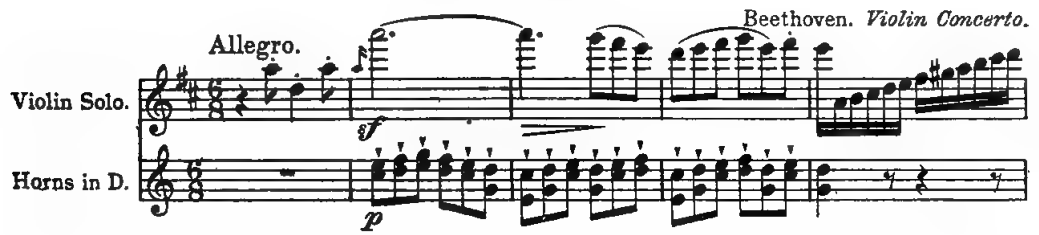
but the admirable melodie balance of his mind, inclining equally to the harmonic- and the scale-type of tune, was able to allot many of the former and some of the latter to the Horns. It would be quite outside the scope of this book to give a detailed list of these passages. They are to be found in such works as the Eroica, the C minor, the Pastoral, the A major, and the Choral Symphonies.
Une must, however, notice three points in which Beethoven's enlarged musical demands created a corresponding enlargement in the technique of the instrument.
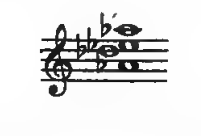
(I) In the first place, he calls into play a much larger number of stopped notes than had been usual betore his time. In a passage of four bars from the Ruins of Athens, out of 32 notes 17 have to be artiticially flattened with the hand. Similarly, out of 14 notes contained in four bars of the 7th Symphony, 8 are partially stopped In the celebrated 4th Horn passage of the Choral Symphony, of which a portion was quoted above (Ex. 44), he does not hesitate to write phrases which are poised on such difficult notes as
‹ Mozart (in Idomeneo) and Cherubini (in Lodoiska) were actually the first composers to use four Horns.
In this connection it is interesting to note that Beethoven scarcel ever uses the stopped notes of the Horns when they are merely filling.

up or accompanying. When, however, they are brought to the tront as obbligato instruments, he has no scruple in writing them. It must be remembered that neither Haydn nor Mozart used the stopped notes at all.
(2) In the second place, Beethoven's parts occasionally, not nor-

of the Harmonic Series. This is a most important point for the student's consideration, for it is very certain that, whatever is said to the contrary, the lips which can produce the higher Harmonies Without hesitatere dould pass daily on emmediate pro t
instruments, and in the greater part of their compass, let us say from
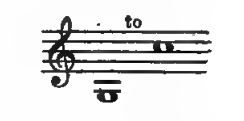
are equally comfortable and happy. On occasion the upper instruments-the Ist and 3rd—can deseend the ladder without stumbling to low C
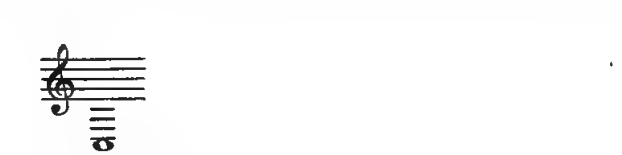
while the lower instruments-the 2nd and 4th-can ascend to high G, or even, at a pinch, to A.
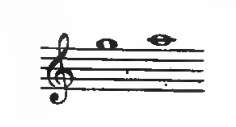
But in both cases it is merely humane to approach the extreme notes with discretion. Allow the player reasonable time and he can adjust his embouchure: give him a sudden complete change of tessitura and he is done. Hence comes the practice which, in ordinary filling-up parts is nowadays matter of ordinary prudence, the practice of always using the Horns as two pairs, of which Nos. I and 3 play the upper parts and Nos. 2 and 4 the lower. To give the simplest instance possible, the normal way of writing out the chord of F major for four Horns is not
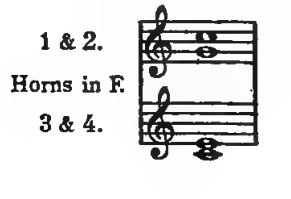
but with the notes of the chord " dove-tailed," thus
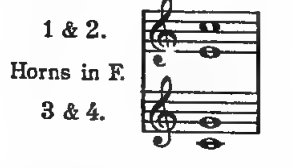
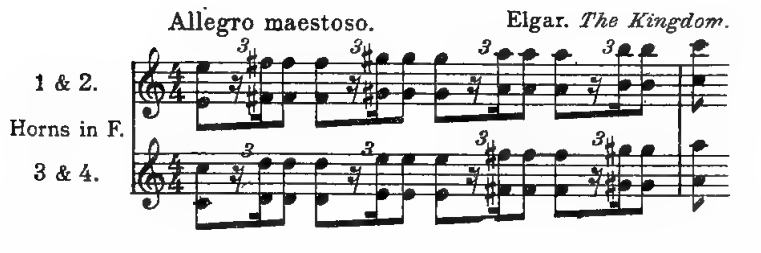
The chord is, of course, merely a symbol. The principle applies in general to all Horn music, whether it be in four-parts or not. To the leaders of each pair are allotted the highest parts. Examples may be found by opening any score at random, or the student may look at the quotation from the Eroica Symphony (Ex. 57), where the 3rd Horn is pitched throughout above the 2nd. In the extreme passages that are found in some modern scores it is out of the question to expect 2nd and 4th Horn players, especially the latter, who are generally «low-note specialists," to rise to the occasion. thirds reduplicated in the lower octave) which shows the practical advantage of "dove-tailing" the Horn parts. It is quoted from Elgar's Oratorio The Kingdom, page 194 of the Full Score:
Example 56
A reference will be made later to the many modern instances where the four Horns play unison phrases that sometimes rise as high as the 12th and 13th Harmonics. As a rule such passages, however dizzy their height, do not cover a greater range than that of an octave or a This makes all the difference in performance. • (3) The third point that calls for mention with regard to Beethoven's Horn writing is that the Ist Horn part, even when its range is not great, occasionally lies very high. It is in such places as these that Horn players are still compelled to use the specified crooks. Let us see the reason for this. It is scarcely necessary to say again that the higher Harmonics are all easier to get on the lower crooks, and the lower Harmonics on the higher crooks. Top O, for instance-unplayable on the Bb-alto-crook- is a perfectly easy note on the C-basso, and easier still on the Bb-basso.! Such crooks as these are quite disused for ordinary purposes. Beethoven, however, never writes the highest Harmonics for the high crooks. The modern player, therefore, in attacking these passages, has the option of playing the top notes (1) as a slightly lower series of Harmonies on his medium-pitched
. 1 See list of crooks on p. 78.
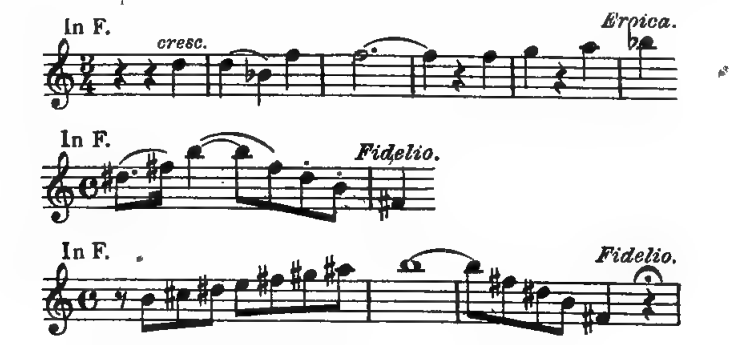
E-crook, or (2) of taking a very high crook and playing them as a considerably lower series. The latter is the general though not invariable practice. f'or instance, in the following three examples, of which the first is trom the Eroica symphony and the second and third from Leonora's air in Act II. of Fidelio:
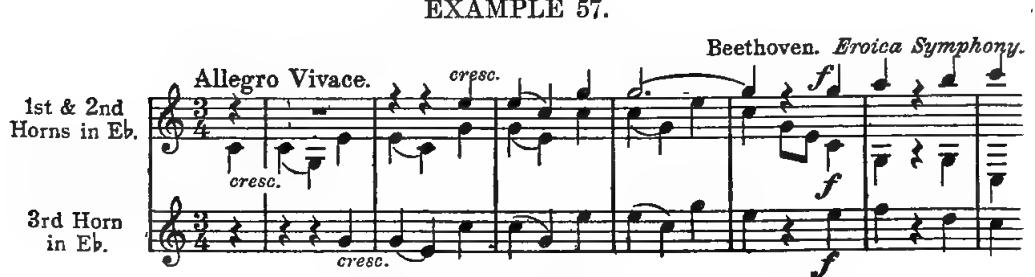
Example 58

Example 59
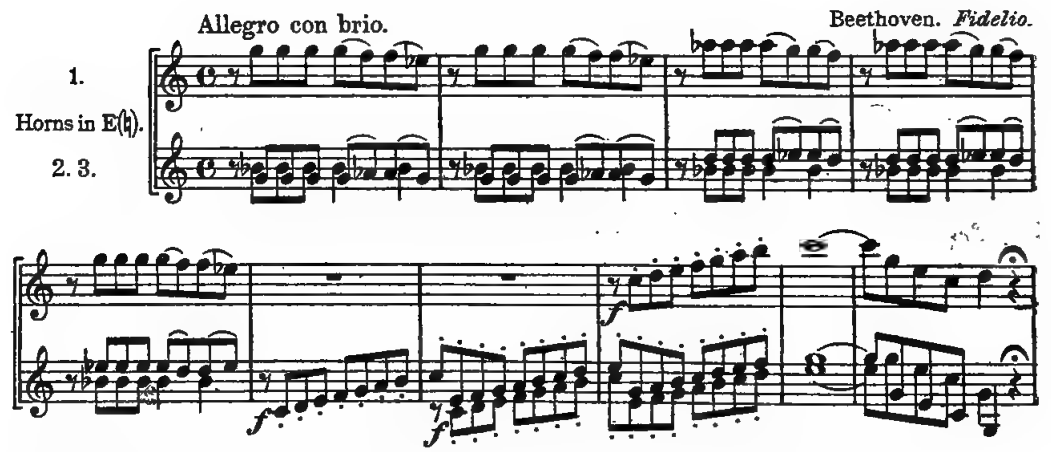
the topmost notes of the Ist Horn would be, on the F-crook,
while, on the very high crooks Bo-Alto and A-Alto, none of them would rise above the 12th Harmonic (G): :
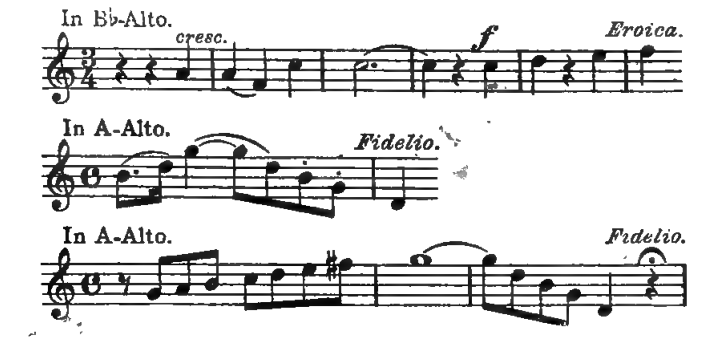
In fact, for a given high sound, the higher the crook the more feasible the Harmonic; and conversely, for a given low sound, the lower the crook the more feasible the Harmonic. The difference in the height of the Harmonies caused by the choice of crook can be seen at a glance by reading the unison-sounds of the four Horn-parts in Ex. 70. With the change to valve-mechanism the Horn naturally began to occupy a much more assured position in the orchestra. Halévy was the first composer to introduce both Valve-Trumpets and Valve-Horns into the orchestra. In La Juive (1835) he writes for two "Trompettes pistons" and two "Trompettes ordinaire" and for two "Cors à pistons" and two "Cors ordinaire." The first appearance of the Valve-Trumpets must have caused considerable astonishment. occurs in a Drinking Chorus in Act I., and the instruments start off gallantly with this sort of thing:
Example 60
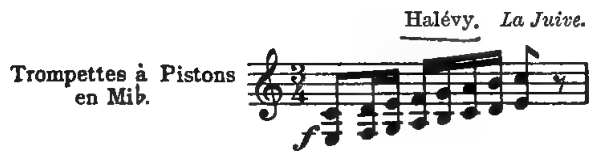
Later on, however, and, indeed, almost all through the Opera, habit becomes too strong for them, and they revert to their trusty C-E-G style of part. Wagner, in Renzr, was the other early composer to pair of Hand- Horthe amd boe pair of valvestors boastery soot pime, however, the former instruments found themselves in the ranks of the unemployed. This was only to be expected Music was undergoing startling changes, and for all the old-fashioned instruments it wai "get on or get out." So we come to the new era, in which the progress of the instrument can be traced from krenzi, through the Flying Dutchman, Tannhäuser, Lohengrin, the king, and the Merstersinger, to its latest developments in the Symphonic Poems and Operas of Strauss.
In this connection attention may be drawn to a few of the more modern uses of the Horns. In the first place, though still possessing their inherent tendency to hold notes, they can now pass easily either by diatonic or chromatic steps, to any other notes. Hence they are available either in the f or the p for any midale part, not merel or a stationary middle part. The effects of such parts,l conceive either contrapuntally or chromatically, for one or more Horns, is invariably charming. The tone-colour of the instrument combined with its exquisite smoothness lends a sort of unobtrusive distinction to the part which it is playing. It is scarcely necessary to quote instances of this delightful use of the Horns. They occur in every modern score, and most often in that first of all models, Die Merstersinger.
Another modern type of Horn melody is the curiously fascinating alternation of a single note backwards and forwards, perhaps at varying degrees of pitch, with its next-door neighbour. This, perhaps, has its origin in the fact that the Horn has always been able to play such passages when not pitched lower than
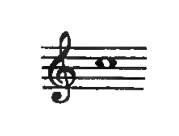
It has always been well in the character of the instrument, and hence makes an immediate appeal to our emotions. As an example, the student may refer to the Horn passage in Ischaikowsky's Romeo and Juliet beginning
Example 61
Allegro Giusto.
Ischaikowsky. Romeo and Juliet.
" Horn in F.
p espressivo
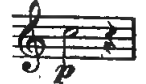
• and the type receives a sort ot apotheosis in the extraordinarily suggestive passage in the Ist Movement of Brahms' Symphony in D major, where the Horn struggles up through fourteen bars to a
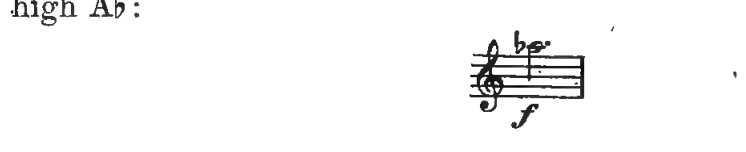
and then returns through eight diminuendo bars to a C:
up dorot to es of worker anship by means of ago thick layer of my for in of or te
The first few bars of the passage as as tollows:
Example 62
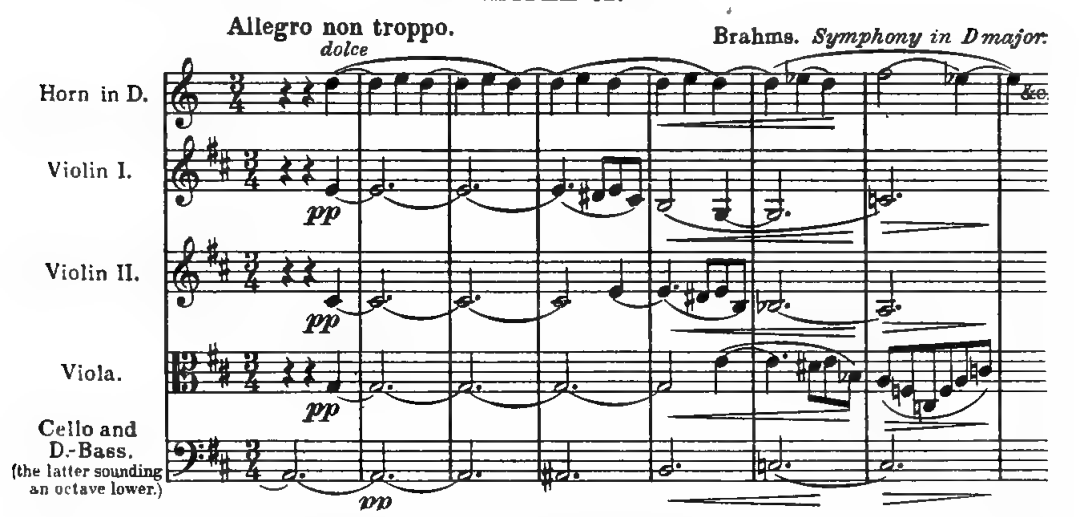
Since the introduction of the valve-system Horn Solos have, of course, become a constant feature of the orchestra.' The very natural tendency, however, is to confine such Solos to series of notes characteristic of the Horn technique. By that one does not mean to say that every note should be considered only in the light of its possibilities on the Hand-Horn, but merely that an eye should be kept on the restrictions of the old technique and the valves invoked only to fill up deficiencies. Such Solos as that at the beginning of the D major Symphony of Brahms:
Example 63

or the one that appears first at the Più andante in the last movement of his Ominor Symphony:
Example 64

are actually playable, though usually not played, on a valveless Horn. On the other hand, such a subject as this, from Dvořák's New World Symphony,
• The repeated Horn note in Schubert's C major Symphony—a high G for two unisor urned to aunt magical example of the way in which even a single sound can b
Example 65
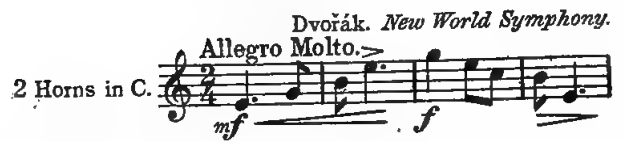
contains a note—the B'—which, if interjected as a stopped note, would make the passage ridiculous. Yet this sounds like and is a characteristically good specimen of Horn-music.
Again, there is the well known Horn-call in the 2nd Act of Siegfried (page 221 of the Full Score). In this passage, which is thirty-nine bars long, there is only one note (the
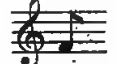
oceurring once in Bar 22) which is absolutely unplayable on the Hand- Horn. In addition there are three notes—the F, B, and A—occurring twice in the middle phrase,
Example 66
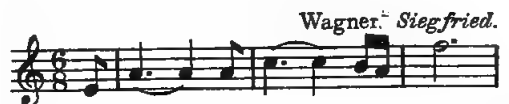
which would need either complete stopping or slight modification. The rest of the thirty-nine bars is made up of the notes of the

and, as far as the actual sounds go, is pure Hand-Horn music. Yet this very passage is specially cited by Gevaert to show the great advantage in "melodic variety" which the Valve-Horn has over the "old hunting horn."
instance ot a Valve-Horn passage preserving almost intact all the characteristic features of the old Hand-Horn music.
A similar but somewhat modified remark might be made about the Horn-opening that succeeds the Introduction to Till Eulenspiegel:
Example 67
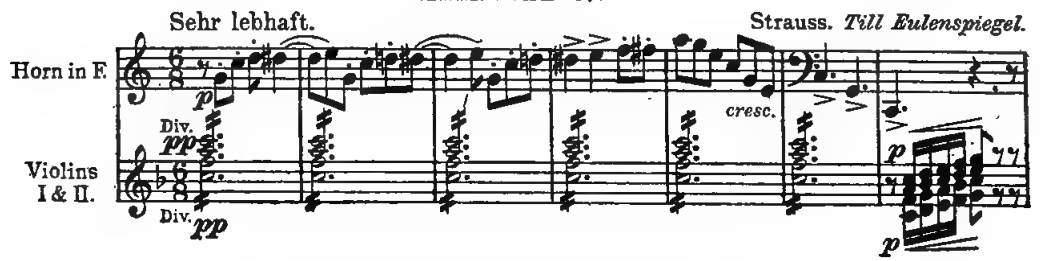
Here we feel that the first part of the tune is quite naturally built on the open notes
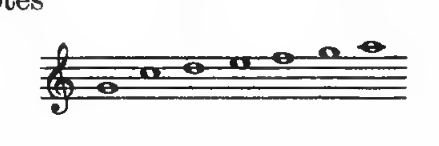
and that the composer is making a legitimate use of the valves to bridge the space chromatically, tirst between the D and the E, and then between the F and the G. The last three bars are pure Hand- Horn music, and the whole tune, modern as it sounds, is really an excellent example of the new with its feet planted in the old. In the notation of the above example the bass-clef is used in the old-fashioned way an octave below its correct pitch. The éxtreme range of the last three bars is also worth noticing: In pertormance, as a rule, the Solo player either stops short before the last two notes and hands them over to the 2nd or th player or one of the latter enters and helps him out a 2 with the passage.
There is, of course, another type of Horn Solo, the type _which might be played by almost any sott Valved-Brass instrument. In this type the tundamental peculiarities of the Horn and its historical usages are totally ignored, and a purely vocal cantilena allotted to the instrument., The long Horn Solo at the beginning of Tschaikowsky's se itative Shrase toy sled more towards ahead of Lists The short The short
is another. In the latter case the phrase itself is effective enough, yet one feels that it is not very characteristic of the instrument.

It is the commonest thing nowadays to reinforce a single series of • by the Horn-notes by the addition of a 2nd, a 3rd, or a 4th instrument. have already quoted such a passage (Ex. 19) from Bizet's Ist Suite L'Arlésienne. The notation given above is, of course, not the notation in the full score. There the part is written (page 40) as follows:
Example 69

A simple but wonderfully effective passage trom Wagner's Flying Dutchman Overture is to be found below (Ex. 80). The opening phrase of the overture to this Opera furnishes us with one of the earliest instances of the modern forceful method of writing tunes for
' Unaccompanied except for a "diminished seventli " chord on the first note.
four Horns in unison. Here is the melodic passage with the accompanying open fifths omitted:
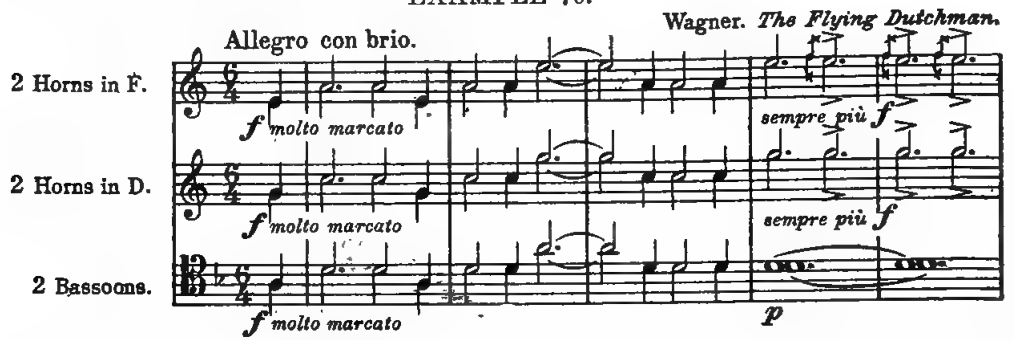
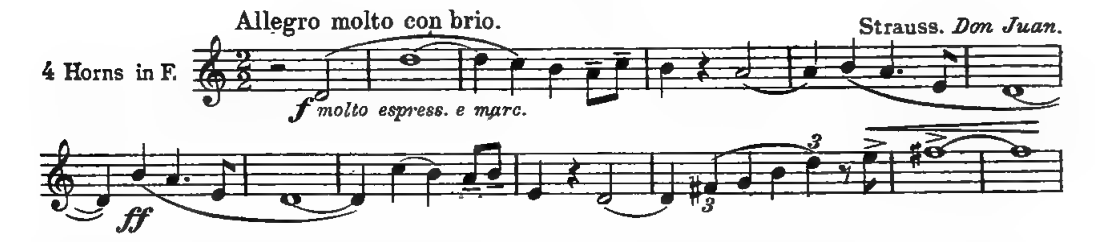
Of a totally different chatacter is the following striking subject from Strauss's Don Juan.. The four Horns begin this tune to no more accompaniment than a string tremolo, Violins on the note G,
Example 71
Finally, we may quote a few bars which, for this sort of writing, only just fall within the boundaries of the possible. They occur in Elgar's Oratorio The Kingdom, and probably gave their distinguished author some qualms as to their success.
Example 72

However, they are a good example of courage justified in performance. The danger of a passage like this is not its range—a thirteenth —which is easily within the compass of any Horn player, but its height when played by four instrumentalists, two of whom are seldom asked to take high G♯'s and A's. In this special example no very real risks are run by the composer, as his Horns are supported in the unison by Violas, Cellos, and three Trumpets, of which the last-named are directed to play with " subdued tone."
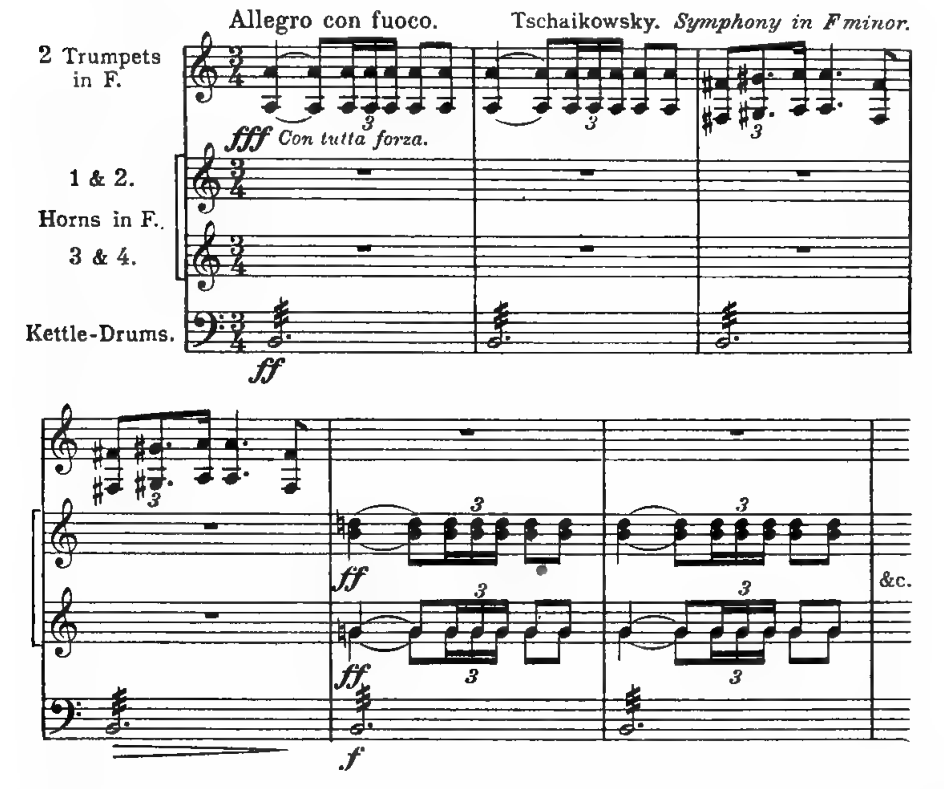
When the Horns are employed in harmony, especially when they are meant to stand well in the foreground, it is often convenient to write their close-harmony in three parts, not four. In such cases if the music be p or mp three Horns only are employed: in anything from mf to It, however, it is usually just as well to double the bottom part. No one who has heard Ischaikowsky's Fourth Symphony can forget the effect of the sudden re-entry of the motto-theme on the Trumpets followed by the tremendous rhythmical emphasis of the four Horns. In this case a Clarinet plays in unison with each of the two upper Horn-parts, and two Bassoons with the 3rd and 4th Horns.
Example 73
Another and very impressive use of three-part Horn harmony, this time with a light string accompaniment, is to be found in the second Act of Wagner's Flying Dutchman (Erik's Recitative):
Example 74
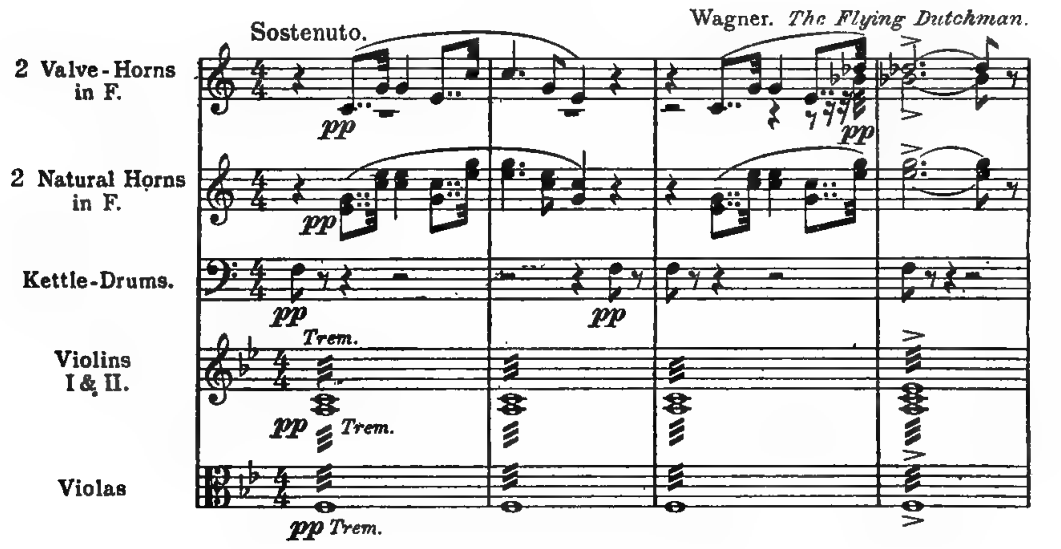
Here the music is pp, and the composer needs only three Horns till the end of Bar 3, where he introduces a 4th to complete his harmony. In this extract the Natural Horns have to be kept to the two upper parts, quite apart trom any consideration of their better tone colour a consideration that constantly weighed with composers in the early days of the Valve-Horn-for the simple reason that, at the minor ninth chord, the only two open notes are those at the top.
Passages for four Horns in harmony, either quite unaccompanied or associated with the Strings or Wood-Wind, have been common trom the days of the Semiramide and Freischütz overtures to that of Hänsel und Gretel. The effect is always delightiul. In writing such passages unaccompanied one has to be careful not to take the 4th Horn too low. In the bottom fifth of its compass, especially in chromatic music when it is supporting chords _other than common chords, it has a tendency to drop out of sight. In cases of this sort it is as well to add a Bassoon or Bass-Clarinet to the 4th part, but this adds a totally new tone-colour, and the better way is to keep the bass, if possible, not too low.
In recent times composers have generally been more inclined to write cunningly constructed chromatic harmony for the Horns, and to mark the parts Con Sordino. This gives a delicious tone-colour, but, of course, It can never be what one may call "daily bread" in the orchestra.
Weber introduced eight Horns into his opera frecrosa for a special effect, and Wagner even wrote for sixteen in the first Act of Tannhäuser. But of these twelve are on the stage; the orchestra has only its usua. quartet In his later work Wagner adopted the eight Horns as part of his ordinary orchestral method. Their use for purposes of increased force, of contrast, and of allowing the players sufficient rest in the long acts of his Music-Drama are obvious. Sometimes the whole eight are employed in the theatre orchestra, and sometimes one or second Act of Tristan, of the eight Horne, sis play the "calls behind more players are detached for service on the stage. the scenes, while two remain in the orchestra. Since Wagner's day, e or Choral real Music six or even eight Horns have become almost normal in the concert room for the accompaniment of Choral Music and for Symphonic works of a large size. They are not otten used in full eight-part harmony, but rather as a double quartet, whose power of added weight and accentuation can be brought to bear at any desired point.
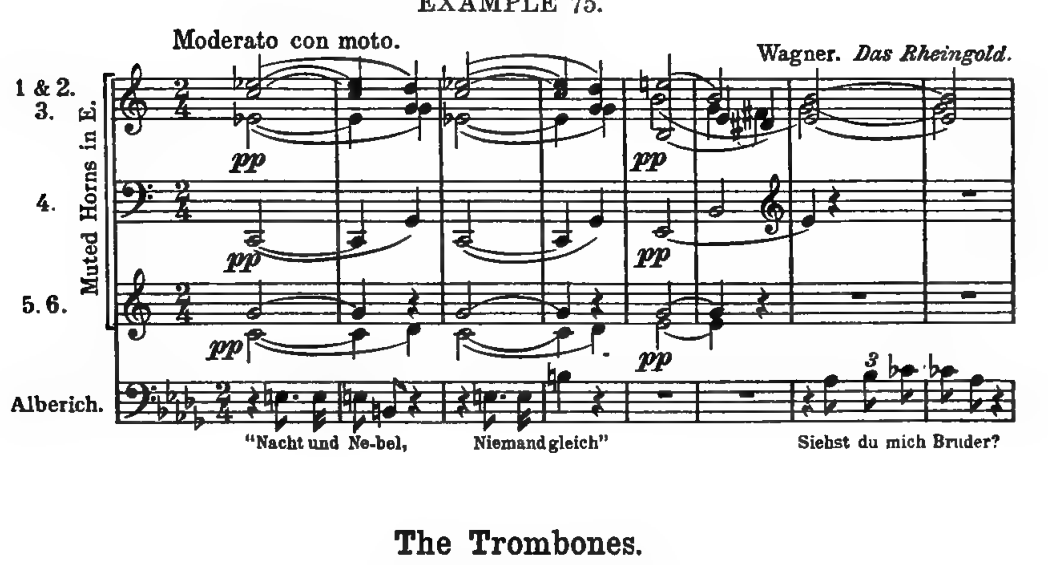
A very short example of muted Horns in harmony has already been quoted from Elgar's Grania and Diarmid (Ex. 4). There the Horn parts were given for the student's convenience in their actual sounds. We may, therefore, give a final example here of the Horns in their transposing notation. (Example 75, p. 133.)
This is a characteristic Wagnerian example of six-part harmony on the muted Horns. The 4th Horn part is to be read a major third higher, not a minor sixth lower. The student would do well to write out these few bars as they sound, noting the negligible enharmonie differences between the Horns and the voice.!
I A few notes for muted Horns may be seen in Ex. 134. They are used merely to fill in the harmony.
Fr. Trombones; It. Tromboni; Ger. Posaunen. PRELIMINARY.
There are four different sizes of Trombone,' the Alto, the Tenor, the Boss and the tol cole decay Ba large family, l nich the Under the name of Sackbuts they have existed from early times much as they are at present. Indeed, in many pictures of mediæval bands and orchestras it is the familiar slide-mechanism and the characteristic downward slope of the bell-joint in the Sackbuts that first attract a modern musician's attention.
In the sixteenth and seventeenth centuries there seems to have been, besides the Alto, the Tenor, and the Bass, a very high Soprano- Trombone, in appearance and pitch something like the Soprano Irumpets which one sees in Bersaglieri bands. In Bach's day it was the custom at Church-Festivals to give each of the four parts of the chorale to a Trombone in unison with the voices, and it was either to this Soprano-Trombone or to the old Zinke' that the highest part was allotted.
" Italian for "big Tromba," i.e. big Trumpet.
"The extreme compass possible on the Zinke-family was from
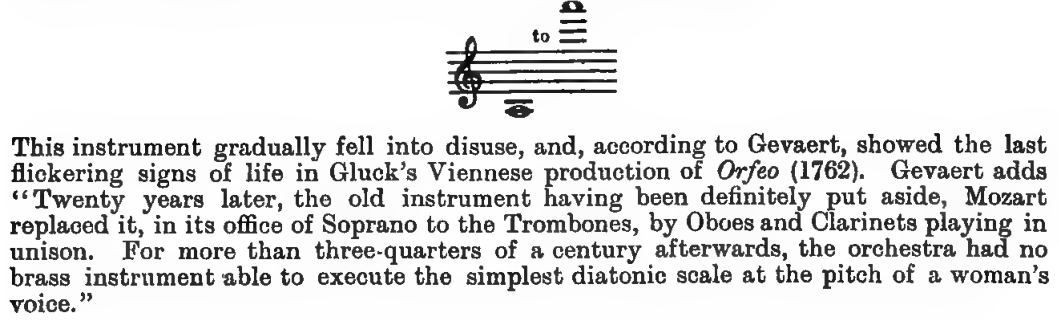
The Soprano instrument soon dropped out of use, leaving the Alto, the Tenor, and the Bass in possession of the tield, continued to be the usual arrangement down to Beethoven's middle life, when the Alto-Trombone began to find itself edged out of the orchestra. This was due to the fact that its tone-quality in the middle and lower registers could not compete successfully with that of the Tenor-Trombone, while in its upper register it was at an equal disadvantage with the Trumpet. So it had to go. Still, when it went, the orchestral tradition was already firmly fixed of Ihree Trombones. Another Tenor-Trombone was, therefore, introduced in its place, and the formula became what it is in most countries at the Present day-Three Trombones, of which two are Tenors and one An exception to this tradition is to be found in France. the Bass-Trombone began to be disused about 1830. Since then the French custom has been to write for Three Trombones, all Tenors. Finally, in this somewhat uneventiul tamily-history, a deep Contra- Bass-Trombone was added by Richard Wagner for the pertormances of his Music-Drama.
It is to be observed that the changes which have occurred in the arrangement of the Trombone-group are changes of compass only. No essential change has been made in the mechanism of the instrument. Again, one sort of instrument does not vary from any other sort except in size-that is in pitch. A description, theretore, of the most commonly used instrument, the Tenor, will sutice for all.