 Playable Books
Cecil Forsyth · section 31 of 60
No. 27. The Saxophones
Read and hear this section in the playable edition →
Fr. Saxophone; It. Sassophone; Ger. Saxophon.
These again are hybrid instruments due to the inventive genius in Adopte Sat Thre a mig bite asite printer i of tobical. or with the Wood-Wind.' They have no past history of which to be either proud or ashamed.
Their tubes are of brass and the vibrating-medium is a thickish, flexible, and slightly convex reed secured by a metal ligature to the lower part of the mouthpiece. At its upper end-that is to say at the end nearest the player's lips—the reed lies close to the "table" of the mouthpiece. There is, however, a distinct aperture.
The reed receives its motion from the breath of the player and vibrates to and fre of pee air-end matirations gardet he tate his latter rate of vibration depends, of course, solely on the length of the air-column, and is therefore controllable by means of an elaborate series of holes covered by keys.
Now, a cylindrical pipe when played by a reed has the properties of a "stopped pipe." Its fundamental tone is an octave below that of an "open pipe of the same length. It also "overblows a twelfth,"" that is it reproduces its natural scale at the distance of an octave-anda-fifth higher.
Un the other hand, a conical pipe when played by a reed has the properties of an "open pipe." Its fundamental tone is the same as that of an "open pipe." It " overblows an octave."
The Saxophone tamily belongs to the latter group, and its scale is therefore reproducible at the distance of an octave higher.3 This fact differentiates it completely trom the Clarinet group.*
The fundamental scale of the Saxophone is chromatically from
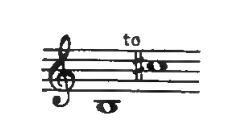
and therefore the second Series of Harmonics is chromatically from
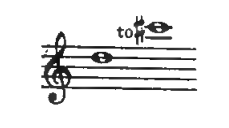
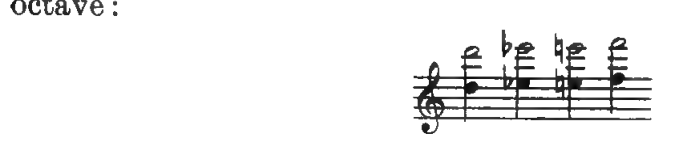
The last four semitones above the high C are got by means of extra keys. They are "overblown" from fundamentals an octave lower, but these four fundamentals themselves are not used, as they
" See pages 13, 18. "See page 100 (foot-note).
* For a fuller discussion of this "overblowing" see pages 178-9. * See pages 180, 253.
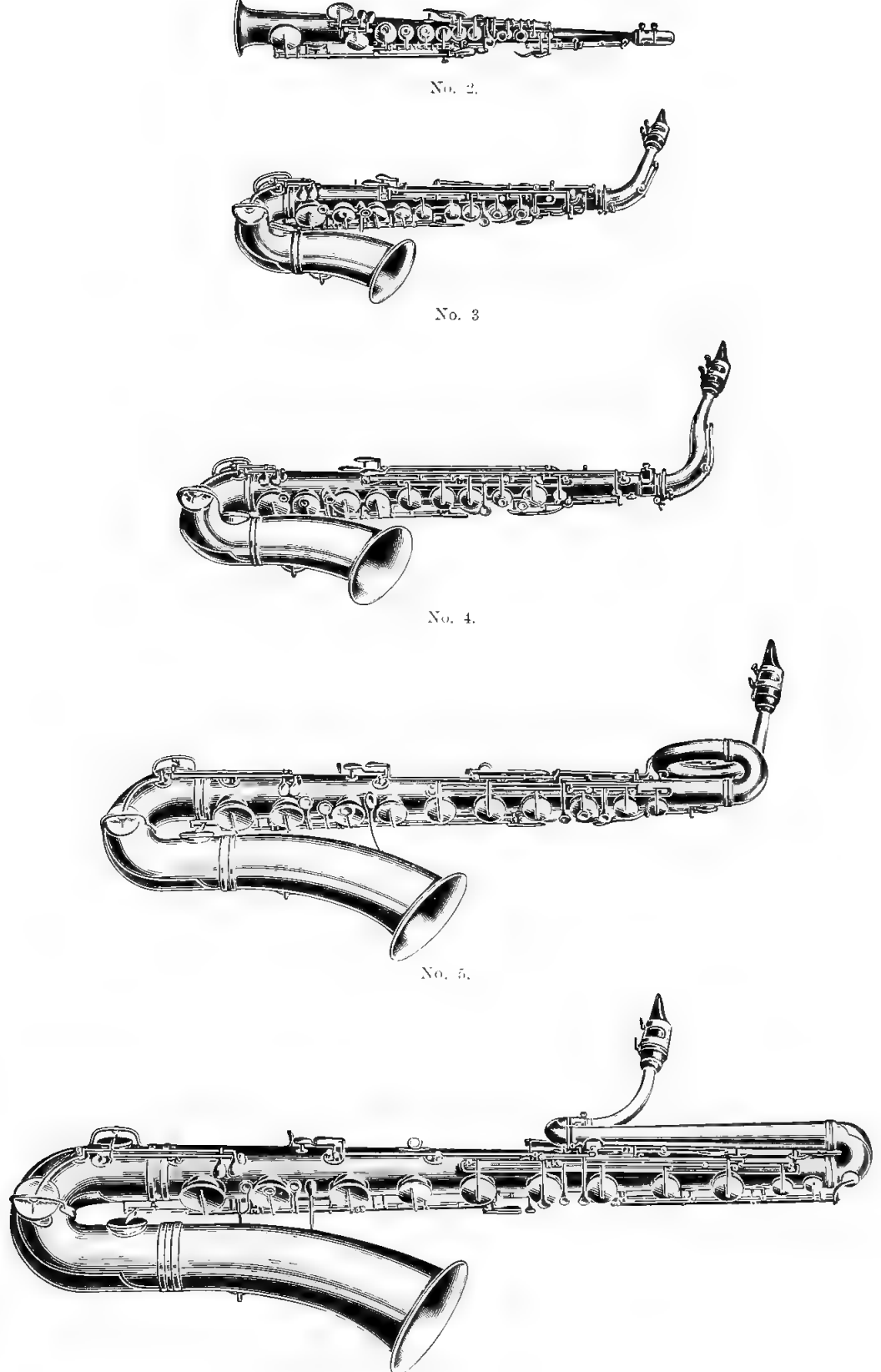
No. G. THE SAXOPHONES.
By kind permission of Messrs. Booses & Co.
Facing p. 167.
merely reduplicate the first four semitones of the first " overblown"
Five varieties of this instrument are made in this country. Like the Saxhorns they are built alternately in Eb and Bb. These five varieties are, in the list given below, numbered 2, 3, 4, 5, 6. Iwo other instruments are used in France and Belgium. " instruments, one in the treble, the other in the are both may add them to our list as Nos. I and 7. The complete catalogue is
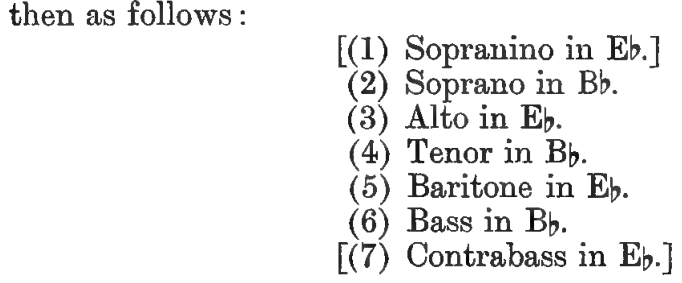
The whole series of these seven military instruments, alternately in Eb and Bo, is also reduplicated abroad by orchestral Saxophones alternately in F and U. It must be mentioned, however, that even abroad No. 7 (the "Contrabass") scarcely exists except as a workshopcuriosity. The Bass Saxophone in Bb (No. 6) is as heavy an instrument as any Wind-player would care to tackle. The "Contrabass," therefore, has been omitted entirely from the list of these instruments given on pages 7 and 8.
The general appearance of the Saxophones can be gathered from the illustration on Plate VI. The five instruments shown on the Plate The extreme are numbered to correspond with the ust given above. instruments are therefore the Bo-Soprano (No. 2) and the Bo-Bass (No. 6). The student would do well to note the essential simplicity of all these instruments, despite their elaborate external turniture and their outlandish appearance. If he will imagine the rods and keys removed from the Bb-Soprano (No. 2) he will see what the Saxophone actually is, —a conical tube of metal pierced by holes with a singlebeating-reed at the smaller end. The twists and turns in the tubes of the heavier instruments are introduced only for convenience to the player.
in compass, technique, and notation all these instruments are practically identical. The compass of all is from
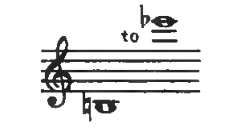
with this amplification, that when writing for Nos. 3, 4, and 5 one can command two higher semitones still, the El and I in alt. These three middle Saxophones-the Alto, Tenor, and Bartone-are the instruments most used both for solo- and ensemble-work. A key to give the low Bb
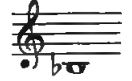
is now regularly fitted to French instruments, but it is not in general use here.
All the abore Saxophones are transposing instruments, and a single example (which will include the extreme and rarely-used Nos. 1 and 7) will show what these transpositions are. Let us suppose that the seven Saxhorns, beginning with No. 1 and ending with No. 7, play this triplet one after the other:
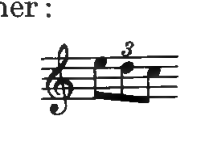
the actual sounds will be

This petrified system of notation, so dear to the French mind, has one great advantage, that, as the fingering of all the Saxophones is identical, a player can with little trouble pass from one instrument to any other. For this reason the Saxophones will probably always remain transposing-instruments with treble-clet parts. On the other hand, the logical absurdity of indicating the note

It would, perhaps, be more satisfactory to use the treble- and bassclefs at discrètion: to leave No. 1 as it is, an instrument transposing upwards a minor third like the Eb-Clarinet: and to write all the other Bb-and Eb-Saxophones in their proper clefs and keys at a distance of a major second or a major sixth respectively above their actual sounds. The treble- and bass-clefs only are necessary.
The technique of the saxophones is remarkably easy, simple, and regular. Scales, arpeggios, and florid figures are, especially or Nos. 2, 3, and 4, easily played and effective. On Nos. 5 and 6 the characteristic heaviness of the instrument asserts itself more and more.
Shakes are quite easy and extremely effective throughout the whole compass of the Saxophone. The only exceptions are the five whole-tone shakes on these notes,
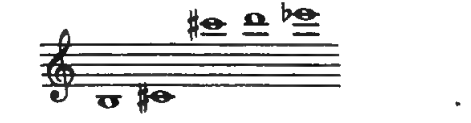
which are difficult and should be avoided.
The tone of the Saxophone is curious: orchestrally a sort of bridgequality between that of the Horns and the Wood-Wind. Thicker and heavier than the Clarinet, it has extraordinary powers, especially in the middle and lower registers of crescendo and diminuendo, of sostenuto, and of cantabile. When written in four-part harmony it produces at one time the effect of Violas and Cellos divisi with added Clarinets and Bassoons, at another the effect of the Organ diapasons. out of sight!; less capable than the Clarinets and Bassoons of "dropping when required. It always remains a little in evidence. This, of course, only applies to the p of the orchestra. On the other side, we must remember that in the mf and the f of the orchestra it is distinctly below the level of the Horn-quartet.
The Saxophones are principally used as melodie and "background" instruments in foreign military bands. Their tone, so much richer and fuller than that of the Wood-Wind when heard out-of-doors, lends a characteristic colour to such combinations. French and Belgian military bands in particular owe their peculiar flavour to the five or six Saxophones that are always concocted as ingredients in the Full Score. In England one or two at most are used. Of these one is invariably the Alto (No. 3), and it is employed both harmonically and with various effective "doublings" as a solo instrument.
Naturally in those countries where the Saxophone has been officially adopted in the army, and where no difference exists between civil and military piteh, its passage into the orchestra has been easy. At the same time the French orchestral composers do not as a rule
a quartet of Saxophones into his Sinfonia Domestica. they fill a subsidiary part mainly in enriching the middle harmonies. It must be said, however, that Massenet has used a quartet in much the same manner. In Fervaal Vincent d'Indy writes for Nos. 1, 2, 3, and 4, not, however, under their usual names of sopranzno, soprano, Alto, and Tenor, but as Soprano, Contralto, Alto, and Baritone. Saint- Saëns uses No. 2, the Soprano-in-Bo, in his Symphonic Poem La J eunesse d'Hercule.
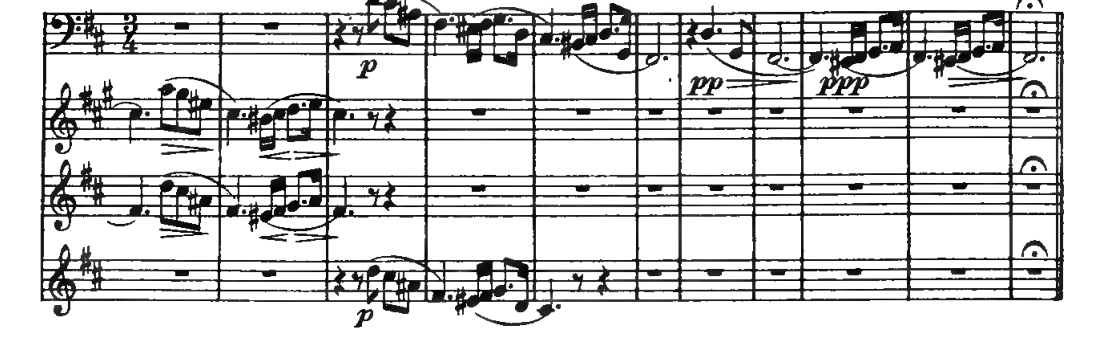
Meyerbeer, Bizet, Massenet, Thomas, and every other French composer who ever put pen to paper, have all written little cantilenas for the Eb-Alto (No. 3), and it is to that instrument that the well known cantabile in Bizet's Suite, E'Arlésienne, is allotted. This has been so often quoted in instrumentation books and so oiten played (on the Clarinet) in our concert rooms that it is unnecessary to give the passage here. Instead I shall give a little unaccompanied melodic passage in A minor from Holbrooke's Apollo and the Seaman. quotation, which is purposely chosen for its simplicity, includes Bassoon, Bass Clarinet, Soprano Sarrusophone, Soprano Saxophone, and Tenor Saxophone. The two Saxophones used in this work are those given above as Nos. 2 and 4. Their transpositions respectively, a major second and a major ninth downwards.
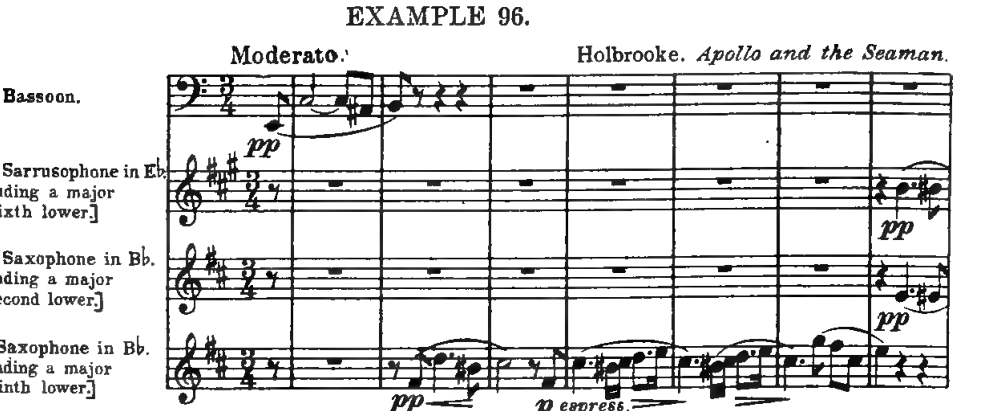
Holbrooke. Apollo and the Seaman
Bass Clarinel in Bp. [sounding a major second lower.]
A second Saxophone example from the same work may be found below (Ex. 97). • In this latter quotation the Soprano Saxophone (No. 2) and the Es Clarinet have a little passage in thirds. The Saxophone plays the upper part.