 Playable Books
Cecil Forsyth · section 30 of 60
No. 26. The Saxhorns and Flügelhorns
Read and hear this section in the playable edition →
A few words must be said here with regard to these two groups of instruments, though in this country they have little orchestral significance.
The Saxhorns are a hybrid invention of Adolphe Sax. They are practically an application of the valve-mechanism to instruments of the Bugle-family, but with the difference that, whereas in the Keyed- Bugles and Ophicleides the lateral holes produced an ascending chromatic scale, in the Saxhorns the valves provide a descending scale. They are all played with a cup-mouthpiece.
The Saxhorns are built in at least seven pitches, alternately in Eb and Bb. And in order to associate the lowest three in the student's mind with the three heavy English military Tubas, I shall number them with small letters thus:
(a) Sopranino in Eo..._Practically the little bo-Cornet] In German the Piccolo-in-Es.
(b) Soprano in Bb1 ...[Practically the Bo-Cornet.
In German the Flügelhorn-in-B.
(c) Alto in Eb...[Practically the Althorn].
(d) Tenor in Bb..._Practically the Bo-Baritone].
Known in Germany and Austria respectively as the Tenorhorn-in-B and the Bassflügelhorn.
• As an instance of the confusion in the present-day nomenclature of the Brass-Wind. it may be mentioned that the Soprano Saxhorn ("b" in the above list) is known ir France as the Contralto and in Belgium as the Tenor Bugle.
(W) Bass in Bo...[Practically the Euphonium (W)].
Known in Germany as the Euphonion, Baryton or Tenorbass-in-B.
(x) Bass in Eb!...[Practically the Eb-Bass (X)].
(y) Contrabass in Bb...[Practically the BBb-Bass (X), but with a 4th valve filling in the five semitones above the fundamental Bb. Known in Germany as the Kontrabass Tuba].
Of the above Sashorns a, b, c, d are half-tube instruments. Any of them would require 16 feet of tube to produce 8 feet C, where the Euphonium would require only 8 teet. Their conical bore is greater in calibre than that of the French Horn but less than that oi the Tubas. Like the Cornet they employ Harmonies 2 to 8
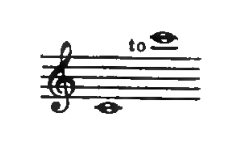
with the usual piston-extension downwards to
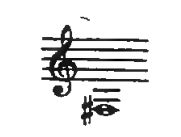
w, x, y are true Tubas able to produce their fundamental note, and with the necessary valve furniture to enable the player to reach it chromatically. Theoretically they employ Harmonies 1 to 8
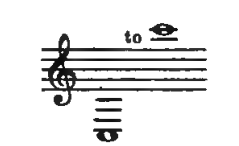
but, in practice, the top fourth on all three instruments is a little lificult to get, and not much needed, while on "y" the lowest sever emitones are unsteady and of doubtful intonation
The difference between "d" and "W," instruments of the same pitch, is obviously the difference between a half-tube and a wholetube instrument. "W" is built to produce its fundamental note, while "d" is not.
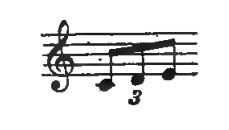
The student must read the above observations on compass in the light of the fact that all Saxhorns are transposing-instruments. A simple example will show him what these transpositions are without possibility of doubt.
a" and ending with pos nay this triplet one after then with .
1 First used by Meyerbeer in Le Prophète, 1849.
the actual sounds will be

If the student will now consider these transpositions and see what they mean when applied throughout the whole compass of the seven instruments he will perceive that the Saxhorns give us a practically homogeneous chromatic compass of five octaves and a fourth
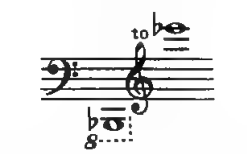
In French military bands the method still persists of writing all the Saxhorns and Tubas as transposing instruments in the treble-clef. Its only practical advantage, as far as these instruments go, seems to be that the notes, when so written for the Eb-instruments look like the real sounds in the bass-clef. See, for instance, the 6th triplet in the 7/4 bar above. Even in such cases as these, however, a mental transposition of an octave or two has sometimes to be made. . See the However, this system of a castison treble-del notation as undoubted eventans s as we shall see. when applied to the Saxophones with their complex key-mechanism.
The Flügelhorns are à group of instruments somewhat similar in character to the Saxhorns. They are played with cup-mouthpieces and they have a conical bore. This bore is distinctly larger than the Saxhorn bore and there is a corresponding difference in tone-quality. They are often made with rotary valves and employ the same Series of Harmonics as the Saxhorns. The best known of these instruments are
(1) Ihe Bo-Flugelhorn used by continental milltary bands tor "Cornet parts." It is also used regularly in English Brass Bands. As a rule the number of Bb-Flügels is not more than half or a third that of Bo-Cornets. In compass and method of notation the two instruments are precisely the same. The Bb-Flügel, however, preserves much more the quality of the old Keyed-Bugle. Its tone may be best understood from the statement that the Cornet stands midway in the matter of brightness and mellowness between the Trumpet and the Flügel. The Trumpet is, of course, the most brilliant of the three. Then come the Cornet and the Flügel in an ascending order of richness, but in a descending order of military smartness and "attack."
(2) The Alto-Flügelhorn (or Althorn) in Ho. It is on this instrument that Wagner's "Tuba" parts "Al" and "A2" are sometimes played abroad. As a crying instance of the confusion in military- ›and nomenclature we may mention that the Germans call our Eb-Tenor-Horn an Eb-Althorn; our Bb-Baritone, a Bo-Tenorhorn; and our Euphonium, a Baryton.