Playable Books
Cecil Forsyth · section 32 of 60
No. 28. The Sarrusophones
Read and hear this section in the playable edition →Fr. Sarrusophone; It. Sarrusofone; Ger. Sarrusophon.
These instruments, invented late last century by a French bandmaster named Sarrus, have a brass tube of wide conical bore. The player's brists oets thie in brain by man a a one reed The narrow aperture at the mouth end of this reed takes the form (), and it is by the alternate rapid closing and opening of this aperture that the air column inside is set in motion. The Sarrusophone is, in fact, a sort ot netal hybrid constructionally based on the Bassoon (g.v.) fingering, and method of tone-production are the same in the two instruments.
French Sarrusophones are made in six sizes, like the Saxophones, alternately in Bo and Es. They are as follows:
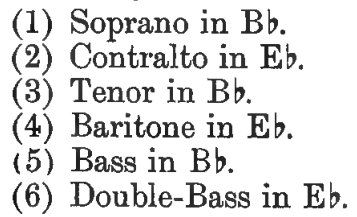
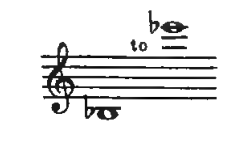
They are all written in the treble-clef and they have a uniform chromatic compass from
They are all treated as transposing instruments, and their transposi-
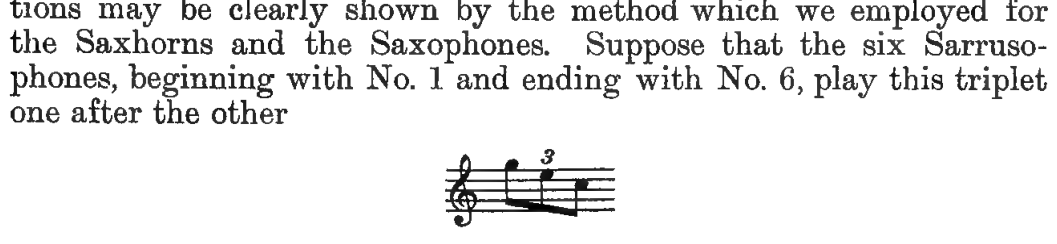
The actual sounds will be
The only use of the Sarrusophone in the orchestra seems to be as a rival to the Double-Bassoon, and it is for that reason that French instrument makers have begun to construct a Double-Bass Sarrusophone in C. It is written for, like the Double-Bassoon and the Double-Bass, in the bass-clef an octave above its actual sounds. Compass:
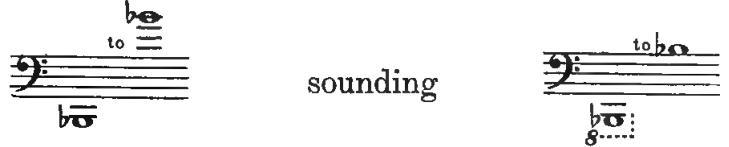
The top octave is poor and thin in quality. It is, however, only the bottom octaves that are needed in the orchestra, and the instrument is specially constructed to produce these in a heavy powerful quality.
The Sarrusophone has pretty nearly as much agility as the Bassoon. Even shakes and rapid staccato passages are easy: The taste for its tone quality, one thinks, must be acquirea. Un this point alone it will have ditticuity in ousting the Double-Bassoon, now that the construction of that instrument has been so much improved. It is, however, scarcely fair to make comparisons between the two when the former is so rarely heard in this country.
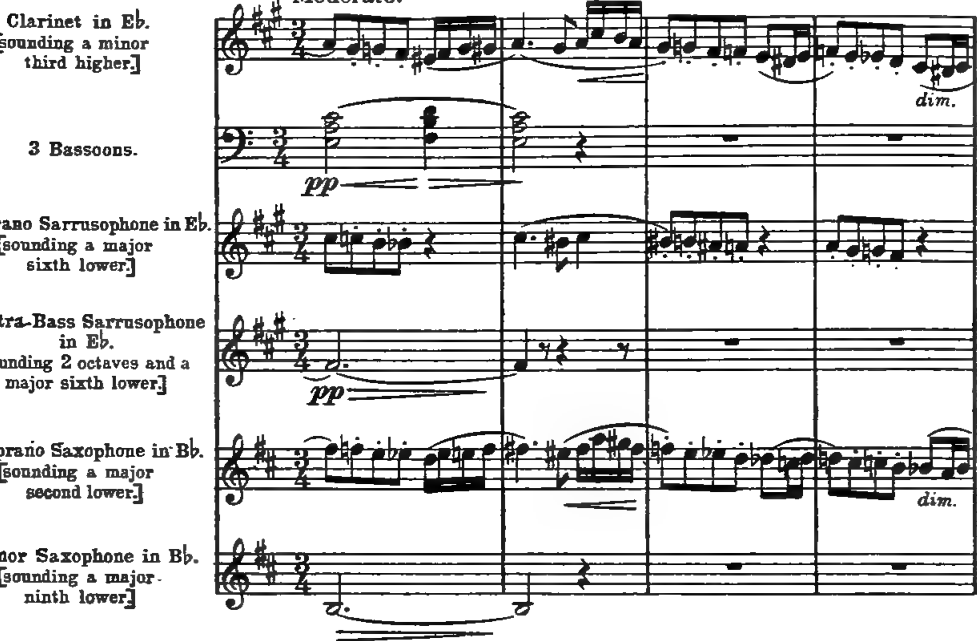
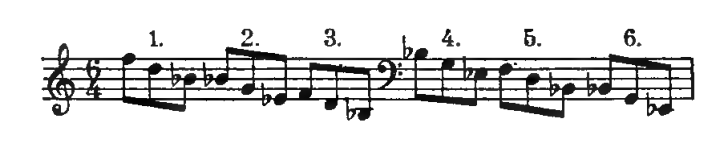
Many French composers have written Double-Bassoon parts for Contrabass Sarrusophone in C, and it now seems to be generally adopted in Paris in place of the Double-Bassoon. In England Holbrooke has written parts for two Sarrusophones in his Apollo and the Seaman. He uses No. 2 and No. 6, the former under the name of "Soprano in Eb," instead of the more usual " Contralto in Eb." The
French treble-clef notation is employed. Here is a short extract from the work:
Example 97
Holbrooke. Apollo and the Seaman.
Moderato.