 Playable Books
Cecil Forsyth · section 34 of 60
Wood-wind instruments
Read and hear this section in the playable edition →Preliminary
WE now come to an instrumental group which is normally called on to play much more complex passages than any we have hitherto met.
less uniform than those of the Brass.
In all these instruments the tone is produced by the setting in motion of a column of air in one of three ways:
(1) By direct blowing either at the end (eg. Flageolet) or through
a hole cut in the side of the pipe (eg. Flute).
3) By means of a giouble-feed e-re and Bassoon,
The original type of Wood-Wind instrument, still found among various savage tribes, consisted of a pipe which was blown into either directly or by means of a reed. There were no holes, and the instrument was heretown tot to a in hey to persons one or its oaterial this instrument was marked ourears ago that holes had ceoraine v we nna several thousands of already been cut laterally in the pipe and that by means of these holes the length of the vibrating air-column-that is to say, the pitcl of the notes—could be altered.
The hand of man, however, had developed not in harmony with musical necessities but under the sterner pressure of the desire for food and life. It was, therefore, and still is, better fitted to grasp a stone-axe or chip a flint arrow-head than to cover with its finger-tips the parately set hole hese need per not ca nd thy, me they were needed for purposes of correct intonation, but in a sort of compromise-position as nearly correct as possible, yet still with greater regard to the hand than to the ear.
Various devices to overcome these difficulties were suggested at various times, but they were all superseded by the invention of the Boehm mechanism. This invention allows the pipe to be bored without any reference to the limitations of the human hand. The holes are cut exactly where they should be in order to secure a scientifically pertect intonation. For instance, Boehm's mechanism makes it possible to place eleven holes in the pipe of the flute so that their successive openinghore eleven saintones that lix bet the right proportion for
At the same time this mechanism gives every Wood-Wind player an apparatus by means of which he can easily stop or unstop any holes or combinations of holes. This is effected by means of a series of padded metal keys fitting closely over the holes, and by an elaborate arrangement of metal trackers, rollers, and tinger-pieces.
From this short explanation the student will easily see how much more complex are the movements of the Wood-Wind-player's hands than those of the Brass-player's, and therefore how necessary it is to study the peculiarities of the Wood-Wind-player's technique. Passages which are musically very simple—-even a single trill which a beginner could play on the Violin--often present quite serious difficulties when attempted on a Wood-Wind instrument. They may involve, perhaps, he sudden rearrangement in position of five or six fingers; and thi rearrangement may have to be effected and abandoned within the fourth part of a second. Passages of this sort, even when played by first-class artists accustomed to surmount difficulties, always sound tussy and stupid. Nine times out of ten the player, intent on overcoming the difficulty, has no time to think of the music.
Of course all Wood-Wind instruments, whether they have an external mechanism or not, depend for their compass on the holes pile fd lateraly in their pip or They mot, the reper a pose sed by They must, therefore, either have a columns of air when confined in pipes, the property of splitting up and vibrating in fractions of their whole length.
As was brietly explained above under Saxophone, all pipes whose air-columns are set in vibration by means of a reed may be divided into two classes-
(1) Those whose pipes are cylindrical.
(2) Those whose pipes are conical.
(1) Cylindrical reed-pipes have two properties:
(A) They act in the same way as the stopped pipes of an organ. The air-vibrations have to travel not merely from one end of the pipe to the other, but back again as well. The result is that in the stopped Urgan-pipe the note produced is an octave lower than it would be if

produced is an octave lower than it would be in a conical reed pipe of the same length. This is important, for as Professor Prout has pointed
- See page 166.
out, it enables the Clarinet to produce middle C with only one foot of pipe where the Oboe requires two.
(B) They all "overblow a twelfth," that is to say, their fundamenta. scale is reproducible by means of a difference of embouchure, at a distance of a twelfth upwards
Example. The Clarinet, a cylindrical reed pipe, needs at least eighteen holes to produce a chromatie compass from
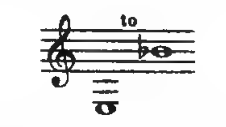
The next octave is not produced by a fresh series of holes but by opening the "speaker-key." _ This is a little hole pierced in the pipe. Nhen opened it assists the players embouchure to divide up the vibra ¡ions of the air-column and so enables him to reproduce his tunda mental scale one twelfth higher. This takes him to top F, and there

top-notes are will be given later under Clarinet.!
(2) Conical reed-pipes, on the other hand, have these two properties:
(A) They act in the same way as the open pipes of the Organ. The air-vibrations have only to travel once through the length of the pipe. The note produced is an octave higher than it would be if the pipe were stopped.
(B) They all "overblow an octave."
Example. The Flute, a conical instrument in which the windstream from the player's lips acts as the vibrating-reed, has as its fundamental scale the octave-scale of D. After that the player produces his second octave by compelling the vibrating air-column to split up fractionally. In ordinary words, he uses the same fingering but a ditterent embouchure. In the third octave he again overblows from the bottom octave, but this time opens certain of the holes. His object in doing this is the same as the object of the Clarinet player in opening his " speaker key." He assists his embouchure and helps the aircolumn to break up into the smaller tractions required. It must be remembered, however, that neither Wood-Wind-, Brass-, nor Stringplayers always do in practice what they might be expected to do in theory.
The student should notice that in the above remarks the term «fundamental scale" is used rather loosely but conveniently. He need not be confused by its use, but he must not imagine that there is anything in a reed-pipe which corresponds at all strictly to the "funda-

shape of the pipe and the convenience of the player. But no Series of
1 See page 254.
Notes such as the "Harmonie Series" of the Brass can be produced from this single note. This has an important bearing on instrumental performance. In the Brass, while it is by no means always necessary to shift the fundamental for each note played, it is always a slightly cumbersome matter to do so. In the Wood-Wind it is a practical necessity to alter the fundamental for every successive note, but this is compensated by the extreme ease and lightness with which it can be done.
Classification.
The whole family of Wood-Wind instruments may be conveniently divided into five classes, according to their respective methods of tone-production.
(1) Lipes without embouchure or mouthpiece. LUbsolete: The Syrinx, a little set generally of 7 pipes blown by directing the breath not into but across the open end so that it impinges on the rim. The pipes were stopped at one end, and theretore produced a note an octave lower than they would have it open. There were no lateral holes, and so the rule was "one pipe, one note." They were, however, probably all overblown.]
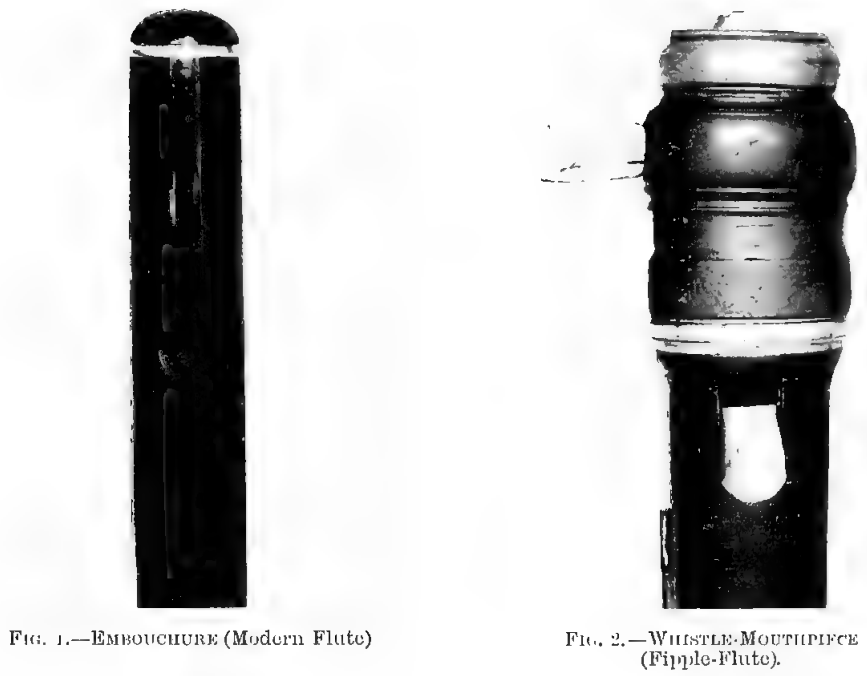
(2) Pipes without mouthpiece but with embouchure. The Modern Flute, the Bass Flute, the Piccolo. [Used only in military bands, the Fife.]
(3) Pipes with whistle-mouthpiece. [Not used in the orchestra: The Whistle, the Flue-work of the Organ. Obsolete: The Recorders. Obsolete in the orchestra: The Beak- or Fipple-Flutes, the Flageolet.]
(4) Pipes with reed-mouthpieces, subdivided into:
(A) Cylindrical Pipes overblowing a twelfth: The Eb-Clarinet, the Bo-A-Clarinet, the Alto-Clarinet, the Bassett-Horn, the Bass-Clarinet. [Rarely used even in military bands: The Pedal Clarinet. Obsolete: The Classical Aulos and Tibia, the mediaeval Cromornes.]
(B) Conical Pipes overblowing an octave: The Oboe, the Oboe d'Amore, the English Horn, the Bassoon, the Double-Bassoon. [Rarely used : The Bartone Uboe. Ubsolete: The mediaeval Schalmey, Pommer,

actually made of brass, not wood, it has been thought better to describe them in the section devoted to Brass Instruments.
(5) Pipes of conical bore pierced with lateral hole and played with a cup- or funnel-mouthpiece. Obsolete: The Zinke or Cornet à bouquin, its bass the Serpent.]
For purposes of modern orchestral classification these five groups can practically be reduced to three:
The Flute-group. The Uboe-group. The Clarinet-group.
* This is the classification adopted by Miss Schlesinger in the Encyc. Britt., XI. Ed. See sub. "Wind Instruments."
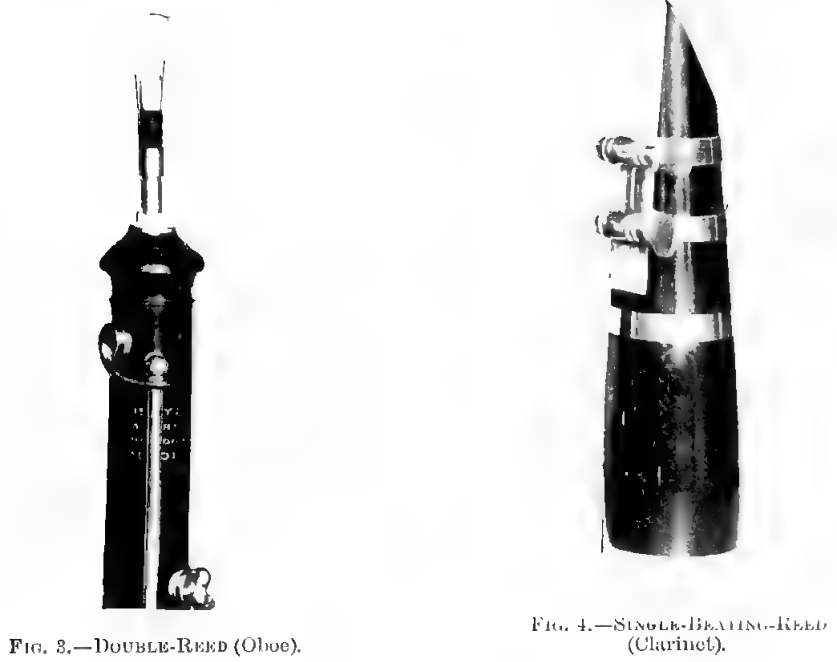
By kind pormission of Mossrs. Boosey it Co
Facing p. 180.
We shall discuss their technical details in that order. But before doing so we must note that, of the five classes mentioned above, only Nos. 2 and 4 furnish us with any modern orchestral instruments. the other three classes No. I (pipes without embouchure or mouthpiece) has no musical significance at all and may be dismissed without further comment. We have already dealt with the principles employed by No. 5 (pipes with lateral holes and cup-mouthpieces). The whole series is obsolete, and only a lew sentences need be given to the Wireption of the Serpent. These will be found under Obsolete Word No. 3, however (arpes with whistle-mouthprece), though totally disused in the orchestra, has had some importance in the history of Music, and, as it includes the family of Fipple-Flutes and Recorders, a few words may be devoted to a description of its technical principles.
In all these instruments the air-column was set in vibration by means ot a beak- or whistle-mouthpiece made of bone, ivory, or wood. The air-stream was directed against the sharp edge of a "bevel" cut in the pipe. These were the two characteristic features of the whole family,—the "beak" and the "bevel." They can both be plainly seen in fug. 2, Plate VIll. The ivory beak projects to the left from the top of the "head." This is a somewhat abnormal position for the mouthpiece, but the illustration has been chosen in order to show the bevel with the utmost clearness. It lies immediately below the ornamental ivory ring that connects the two "joints." A third characteristic feature of this instrumental group was the thumb-hole pierced in the back of the pipe.
The mediæval Recorders were all members of this family. Their size varied from that of a "penny-whistle" to that of a modern Bassoon. Indeed in the Bass-Recorders a crook almost exactly like a Bassoon-crook led from the top of the pipe to the beak, which was in the player's mouth. This was, of course, merely matter of convenience to the instrumentalist. In old pictures the shape of this crook and the apparent likeness of the beak-mouthpiece to a large double-reed may sometimes mislead the student as to the instrument intended. In every case, however, the presence or absence of the bevel decides the question.!
The Recorders had a somewhat tame but pleasant, sweet, and woody tone. To the ears of our Tudor forefathers, accustomed to the harsh quality of the double-reeded Schalmeys and Pommers, they probably afforded the same sort of reliet as we get to-day trom the Strings in the orchestra.
The only survivor of this ancient family is the flageolet. This instrument may be called a super-acute Recorder. It has the usual whistle-mouthpiece and bevel, but is moditied so tar as to require two thumb-holes at the back. We owe its introduction to the craze for French fashions which set in at the time of Charles II. The
and illuminations these often The integral difference, of course, is that the former were reedless, while the latter were true reed-pipes.
instrument was used by Händel in "Hush, ye pretty warbling quire" (Acrs and Galatea). It is also in all probability intended ruddier than the cherry," though the Score merely says "Flauto" and a Piccolo is generally employed. Gluck used the instrument in Dre Pilgrime von Mekka, and Mozart in Il Seraglio. The compass was
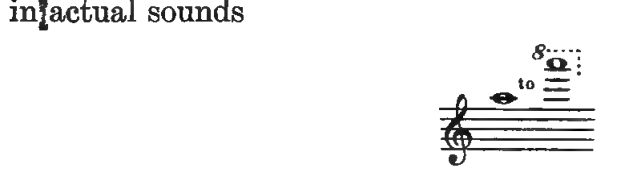
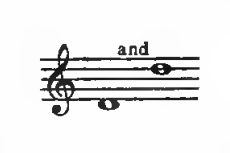
and it was written for as a transposing-instrument sounding a twelfth above the written notes. For instance

It is worth noticing that the Pipple-Flute, that is to say the Flute blown with a beak-mouthpiece, was the characteristic English Flute. It was in common use here in the sixteenth and seventeenth centuries, and was generally known to learned writers as "Fistula Anglica." The opposing instrument, the "Cross-Flute" or "Flauto Traverso," was blown through a hole in the side like a modern orchestral Flute, and was known as "Fistula Germanica." These invaders the Cross- Flutes were actually in evidence from about 1500 onwards, but it was not until much later that they managed to secure a firm foothold in England._Indeed the mouthpiece of the English-Flute represented on Plate VIll., Fig. 2, owes its peculiar right-angled position to a sort of defensive strategy. the instrument redity a was a going in playe mother, a mech easin task. It was, in fact, a species of "cheat" which has been revived in our own day with some of the Valved-Brass.