 Playable Books
Cecil Forsyth · section 35 of 60
No. 30. The Flute
Read and hear this section in the playable edition →

Fr. Flate; It. Flauto; Ger. Flöte.
The natural scale of the orchestral Flute is the scale of D major
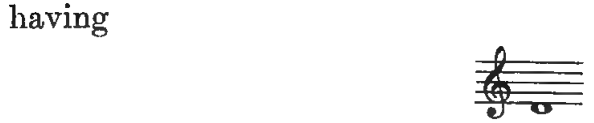
as the bottom note of its first octave. Hence, though it is alway written for as a non-transposing instrument, it is sometimes called the This looseness of nomenclature extends to all the nonorchestral Flutes used in military bands.?
' Bainbridge and Wood's "Patent Chromatic Albion Flute." " See page 203.
The compass of the instrument begins nowadays not at the D mentioned above but two semitones lower at middle C. This will be explained later.
The Flute is nominally a "stopped-pipe." The upper end beyond the "embouchure," that is to say beyond the hole into which the player blows, is actually closed. The embouchure itself, however, gives the Flute the properties of an open-pipe.
Urginally cylindrical the flute, about 130 years ago, became conical with a cylindrical head. In this type of instrument the conical bore was so arranged that its smallest diameter was farthest away from the embouchure. Nowadays the Flute is generally cylindrical with a parabolic "head."
The instrument is made up of three pieces or "joints":
(1) The Head, about s the total length ot the instrument, plugged at the end and containing the embouchure or hole for blowing into It is this portion between the embouchure and the plug—technicall called the " stop"—which is now generally of a parabolic shape. An illustration of the "head " with the embouchure-hole will be found on Plate VIII., Fig. 1. The "stop" is the portion upwards (in the illustration) from the hole. The "plug" is at the extreme upper end
(2) The Body, a long joint bored with the holes and carrying the keys necessary to produce the fundamental scale of D. This is a point of theory only, for when
(3) The Foot-joint or Tail-joint was added and bored to allow of the production of the two bottom semitones C4 and Cf it was found •desirable to abandon the old D and substitute another playable by opening a key in the Foot-joint.
The instrument is made either of cocus-wood, of ebonite, of silver, or even of gold. Those of wood have the best and most "flutey" tone: those of metal "speak" the most easily.
The Flute is, of course, a reedless instrument. The part played by the reed in such instruments as the Oboe and Clarinet is taken, in the Flute, by the actual air-stream from the player's lips. This air-stream, technically known as the "air-reed," is directed by the player against the sharp edge of the embouchure, and produces the sound-waves in the air-column which is contained in the pipe. The pitch of these sound-waves depends solely on the length of the air-column, and this again is controlled by the opening and shutting of the lateral holes. The effective length of the vibrating air-column is merely the length between the embouchure and the nearest open hole.
The mechanism of the modern Flute not only allows the holes to be bored in their scientifically correct places, but it also enables them to be cut with a sufficiently large diameter. This is an important point. In the days when the holes had to be cut too small, they also had to be placed too near the embouchure. Otherwise the pitch would have been altered and the tone muffled.
The distinctive tone-quality of the Flute appears to be dueslightly—to the material of which it is made and-chiefly-to the shape and position of the stopper and of the air-space between that and the embouchure. Considerable differences of opinion have been expressed as to the reasons for the Flute's "breathe-y" quality in its buted to the paucity of «harmonics" or « overtone , Positively attribottom octave. Un the one hand, this has been present in these notes. This perhaps explains the fact, familiar to all Flautists, that persons, judging solely by ear and not by any knowledge of the Flutetechnique, often suppose them to be playing an octave lower than their actual pitch. Un the other hand, precisely opposite and equally positive statements have been made as to the wealth of these lower notes in Harmonies. On the whole, the former opinion seems to be the more satisfactory. One may add that all practical musicians have noticed the curious likeness between these notes and the sounds of the Trume when payed pichestral Flute is chromatically from
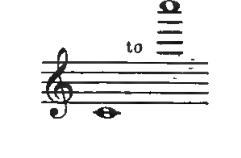
Some Flutes appear to have had the low BI
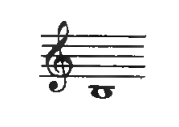
At any rate, Wagner writes down to that note in Lohengrin. On a modern Boehm Flute the addition of this note puts the whole instrumelt oed abure, the bout semitones to additional not ersy e explained above, only by means of holes in the foot-joint. From these upwards we have the natural scale of the instrument, the scale of D major. The second octave D to D is produced by overblowing from the first octave. The technique of this overblowing is merely an alteration in the angle of the aix-reed and an increase of wind-pressure. The third etave is obtained in a similar way, but with the help of openin ertain of the vent-holes as mentioned above. The top Bl and C ar by no means easy notes to get. They should not be written piano. The same caution applies still more strongly to the extreme compass
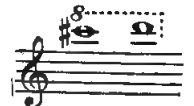
given by Strauss as possible in the forte. Only the most exceptional players can touch them.
Fourteen semitones of its fundamental scale, viz:
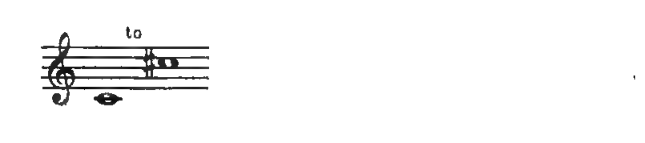

can be overblown at the twelfth. This gives to the ear a chromatic
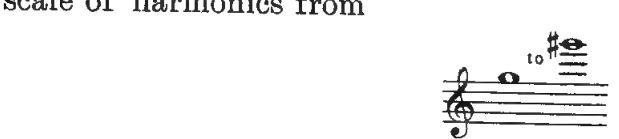
All these notes are written in the pitch at which they actually sound with the addition of a little "o," thus:
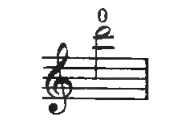
In quality they are thinner and less bodily than the saine notes when blown in the ordinary way. They are only mentioned here for the sake of completeness, as they are sometimes to be found in the old style of Flute-music. On the modern Flute the whole series is hopelessly flat.
Although the complete three-octave compass of the flute can be produced with regularity and smoothness by a good player, there are certain differences of colour as the notes proceed upwards. The temptation for a writer is to make these differences correspond with the three octaves of the scale, but to the ear this is not quite correct. From bottom C up to about A (a major sixth higher) the Flute has a thick, heavy breathe-y quality, "something," as it has been expressed,

"like thick plush." This part of its compass is extremely effective but lable to be easily covered up. The Double-Basses in especial with their wealth of Harmonics seem to have the faculty of blurring the low notes of the Flute. The student should notice how often in the accompaniment of Flute solos they are omitted altogether. without the Basses a String tenuto needs very delicate playing if it is not to cover up the lower notes of the Flute. A subject like the following from Dvořak's New World Symphony:
Example 98
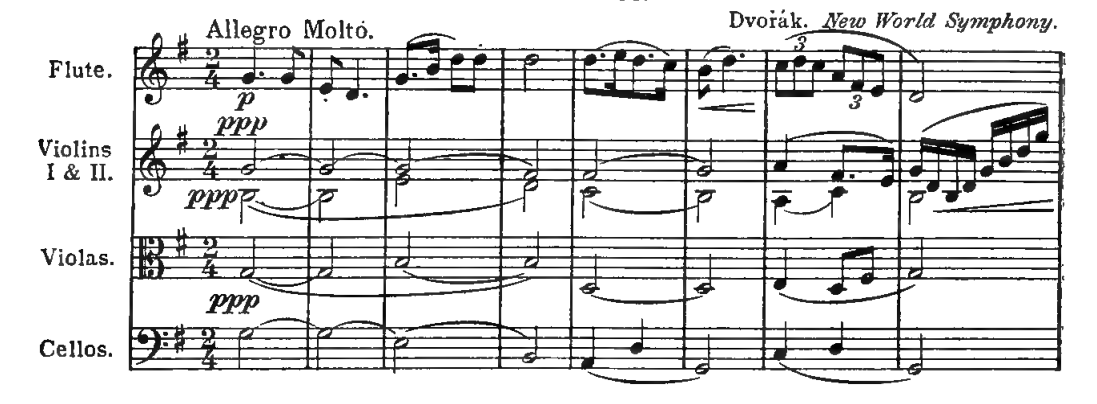
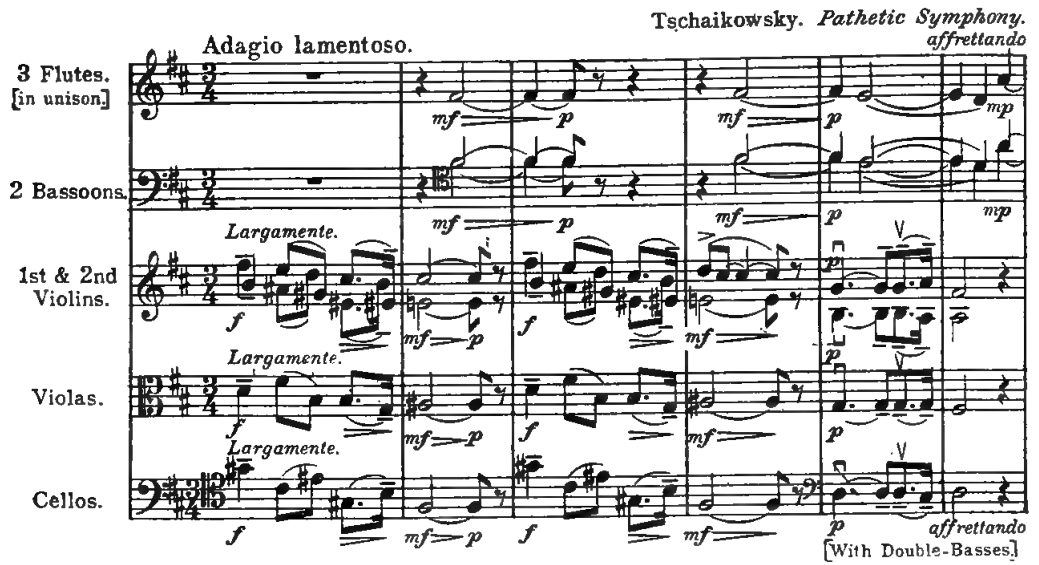
sounds poor and stupid when there is the slightest over-thickness in the accompaniment. Of the emotional, almost exotic sound, of the low Flute no better example can be given than Ischaikowsky's F7's in the
Pathetic Symphony (opening of last movement). The effect of this fivepart unison of three Flutes and two Bassoons is eerie in the extreme.
Example 99
A charming series of suspended sixths, played by three Flutes in unison in their bottom octave, may be found in Elgar's Enigma Variations (Dorabella, page 64 of the Full Score).
It has often been observed that the bottom two or three semitones on the Flute have a tendency to sound out of tune. One must confess that in cases where these notes are undoubled and quite uncovered, such as in the charming accompaniment to Gretel's Ballad in Act II. oi Hänsel und Gretel, there is sometimes a certain uncomtortable feeling about the bottom notes. This is, no doubt, due to their com- The lack of these overtones is not noticed in plete want of overtones. the upper octaves, but in the very bottom notes one feels their absence, because one is accustomed to hear them in the same notes when played by other instruments. This helps to explain the Flautists explanation that "the notes are not really out of tune. They only sound so."

Ein Männlein steht im Wal de ganz still und stumm, es hat von lau-ter Pur-pur ein Mänt-lein
Sagt wer mag das Männlein sein, das a steht im Wald al-lein mit dem purpur-ro - ten Män-te • lein?
Upwards from A (the sixth above the bottom C) for about a minor

the instrument generally loses its thick quality and substitutes a delightiully smooth and silky tone-colour which bears the same analogy to its upper and lower registers as the "A" and "D" string of the Violin bear to the "E" and " G" strings
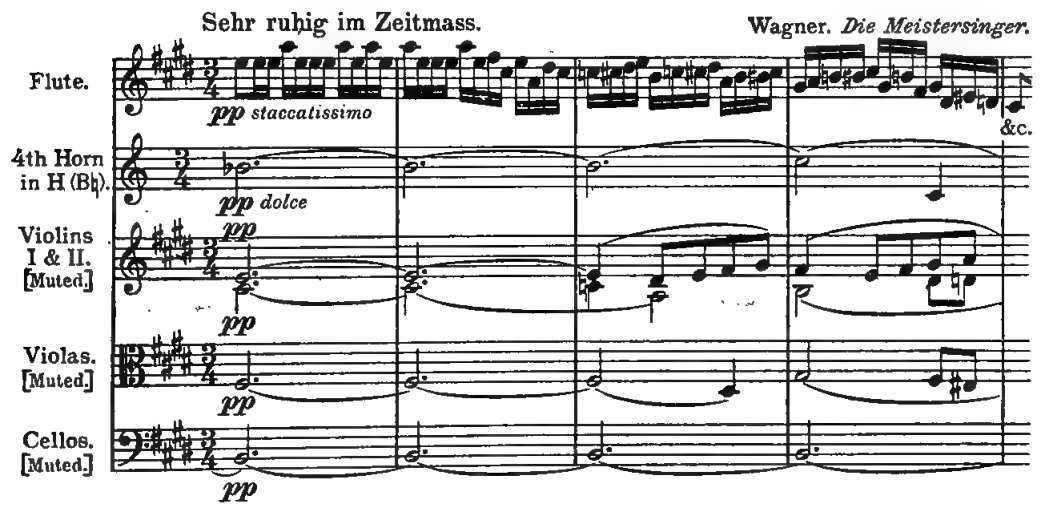
It is in this, not the top, octave that the greater number of lightly accompanied Flute solos are written. In this part oi the compass it has a sort of unparalleled ease and serenity. No one who has heard it can forget the delicious moment just beiore the 2nd Act Curtain ir Die Meistersinger, where the Flute has these semiquavers accompaniec by one Horn and the muted Strings.
Example 101
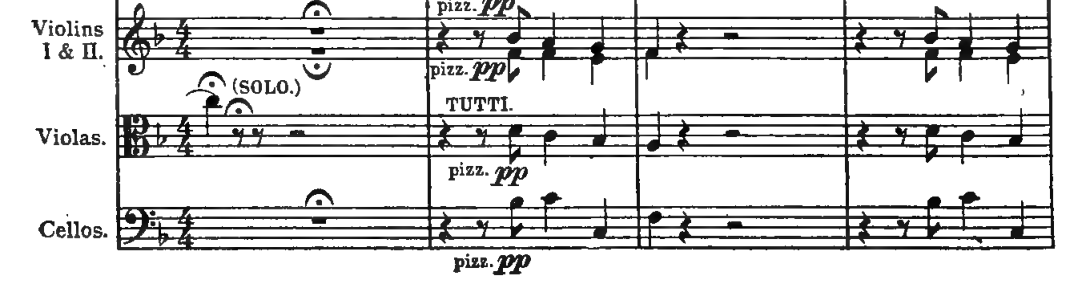
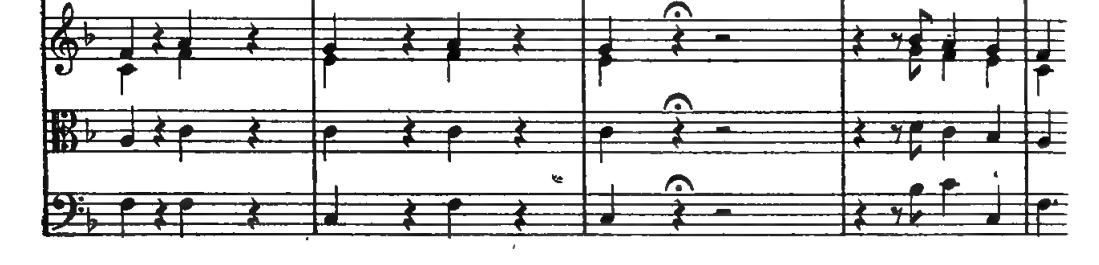
Another charming example of the flute in its middle octave is to be found at the opening of the Andante in Ischaikowsky's Bb minor
Pianoforte Concerto. The cantabile of the solo instrument is supported only by the pp pizzicato of the Strings.
EXAMPLE 102. Ischaikowsky. Pianoforte Concerto in Bb minor. Andante Semplice.
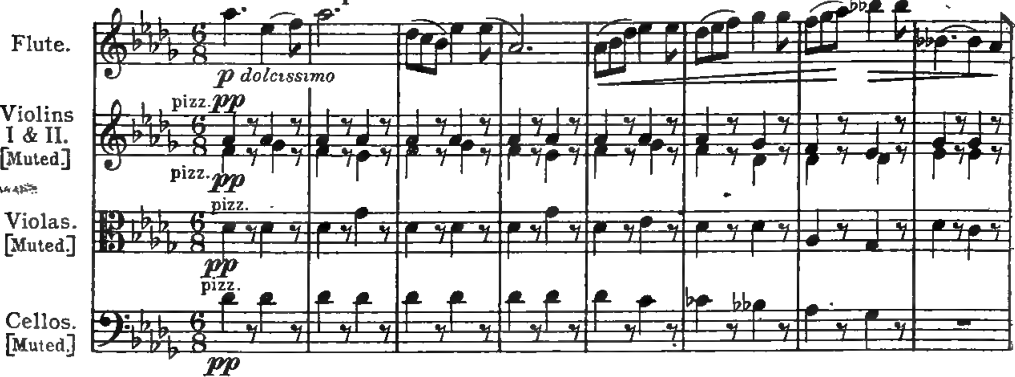
The student should also examine the place in the same work where che flute repeats the little Uboe phrase in the same octave. It occurs at the foco pru andante, page 67 of the Full Score
One of the simplest and most beautiful of these middle-register solos occurs in the 2nd Act of Gluck's Armide. The accompaniment is for pr Strings with the addition of a single Horn, a single Oboe, or a single Clarinet, etc. The number is in D major, and the Flute part lies mainly between its middle D and the fifth above with an occasional rise to the top D.
Dvorák uses this same register very happily in the Largo of his New World Symphony, but lends the Flute-tone a fascinating reediness by the addition of an Oboe in unison. The accompaniment is almost toneless, a pp tremolo for Violins and Violas.
Example 103
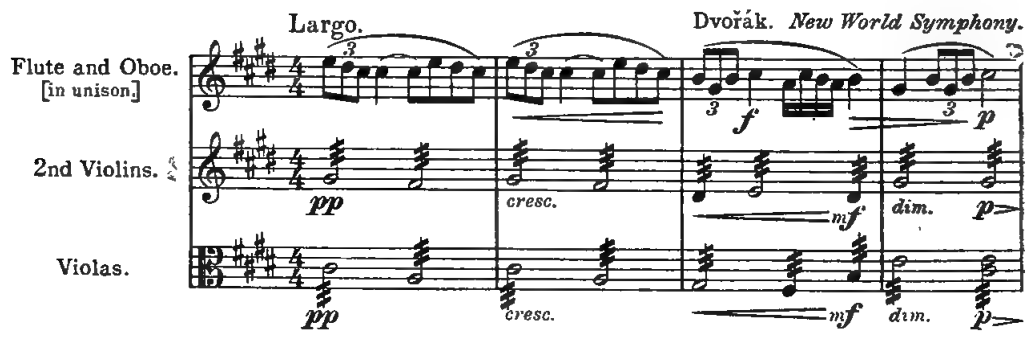
This tone-colour was a favourite with Dvořák, and he used it to perfection. What can be more charming than the following little tune with its extremely simple but eflective accompaniment—a sort of "orchestral five-part" manufactured out of almost nothing?
Example 104
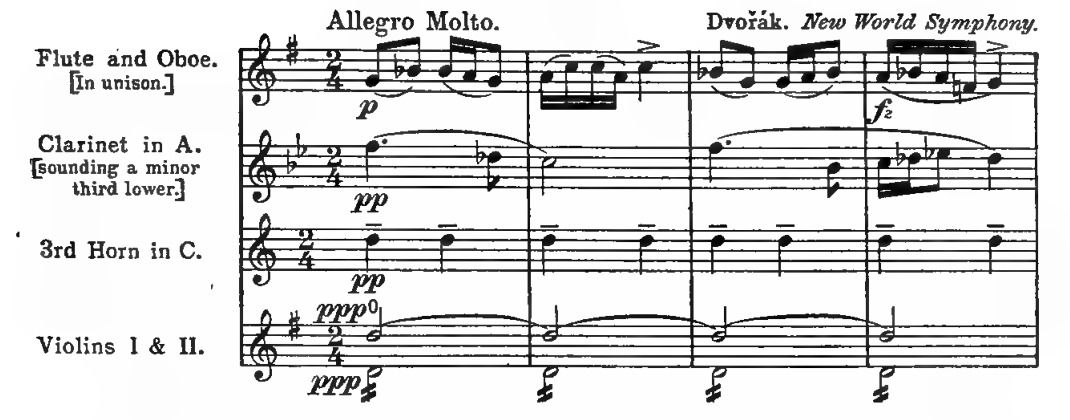
We now come to the top octave of the Flute. From the second G upwards the instrument acquires the bright telling quality which is its most characteristic and useful feature. Ut this register there 1s scarcely any necessity to give examples. The student has only to glance along the top line of any Full Score in order to find instances. These, however, are generally in the tutti. When employed purely as a vehicle for accompanied melody the topmost register is not so treely used as might have been thought probable. A certain number of impassioned solos-such as the long and lovely D minor lento in Gluck's Orfeo-lie in this part of the compass. Their number, however, is not very large. The Gluck passage is too long to quote here. It has already been eloquently analysed by Berlioz. The student should take an opportunity of examining this passage with care, as it shows the utmost artistry in the "placing" of the various phrases to make the greatest possible effect. For a more modern example of the bright top-notes of the instrument he should look at the Introduction (Più Andante) to the last movement of Brahms's Ominor symphony (page 95, small Full Score). The passage at the opening of the 2nd Act of Iristan, beginning
Example 105

is a beautiful example of legato Flute writing: It has an accompaniment of Wood-Wind, two Horns, and Strings. Bizet, whose writing for the Wood-Wind is always instinct with a delicate feeling for tone-colour, has written many charming Flute-solos. In its simple way the following little tune affords a good example of the Flute legato in its top octave. The quotation is from Carmen (Entr' Acte before Act III.), and there is nothing in the Score beyond the Flute and Harps:
Example 106
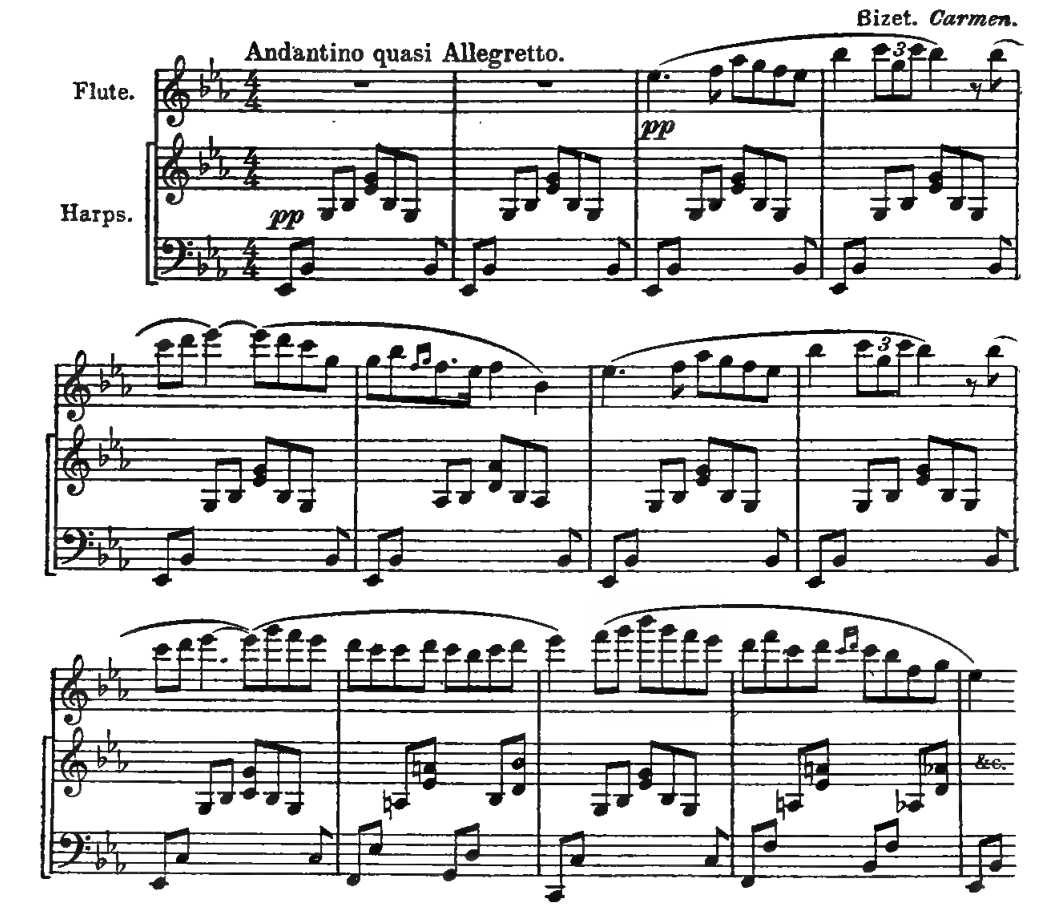
We must now return to the purely technical consideration of the Flute. But before dealing with the Shakes and Tremolos it must b said that, for the sake of simplicity and economy of space, the bottom notes only of the tremolos are in most cases given. This applies throughout the Wood-Wind and String sections. A tremolo, whenever mentioned as being "on" a particular note, is regarded as being upward trom that note. In pertormance, of course, a tremolo is just as practicable or impracticable upwards or downwards. The way of writing it—whether upwards or downwards—makes no difference to its technique. Nearly all shakes and tremolos are possible on the

of which the first four are impossible and the last two excessively difficult. All shakes other than the five given in the above example are practicable. With regard to tremolos, however, some further cautions are necessary. Up to
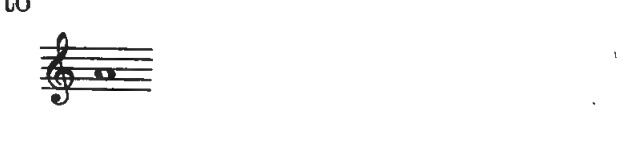

(regarded as the lower note in the tremolo-combination) avoid all tremolos containing a greater skip than an augmented fourth. Above
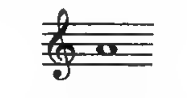
confine your tremolo within the limits of a major third except on the

where tremolos are possible up to a perfect fourth. From
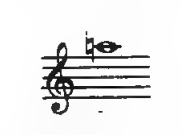
upwards the only practicable tremolos, as opposed to major and minor and shakes, are the following:

The above restrictions with regard to tremolos only apply to cases in which the composer actually relies on the instrument to produce its tremolo audibly and unsupported. In passages where the tremolo is being pertormed by Wood-Wind tutt or by Wood-Wind and Strings some licence may be taken without appreciable loss of elect
In figures and melodic phrases the legato of the Flute is practicable throughout its entire compass, and is limited only by the capacity of the player's lungs. It is, however, more in the character of the Flute polate detached ones and groups of notes, and generally to substitutgenerally to substitute a vivid manner of performance for its more vapid legato style.
Single, double, and triple-tonguing are the nerves and sinews of the Flute-technique. In single-tongued phrases the Flautist achieves a consonantal clearness and distinction that is more akin to speech-insong than to anything else. Each note can be made to sound like a falling hailstone or an unstrung pearl. A reasonable degree of speed can be obtained by this means, but for its greatest rapidity of utter- These methods on ar theirt, the T-K, T-K, and the TR.1, TR, have already been mentioned in connection with the Trumpets and Horns. They are, of course, employed in note-groups which have for their basis the numbers two and three respectively. They are not solely used in groups of repeated notes, though they are often so used.
As an example of double-tonguing the student may be referred to the difficult Solo Flute passage in the Scherzo of Mendelssohu's Midsummer Night's Dream, or to any one of the little introductory scale passages which are so characteristic of Beethoven. The seale, which leads back to the subject in Leonora No. 3, is so quick that it would naturally be doubletongued.
Example 107

On the other hand, the passage which depicts the sun breaking through atter the storm in the Pastoral symphony is quite slow enough to be single-tongued, and demands that method for its proper. emphasis.
Example 108

The quotation from the opening of Mendelssohn's Italian Symphony given above (Ex. 47) is a good example of triple-tonguing. In this connection the student may profitably examine the whole of the Flute part in the last movement (Saltarello-Presto) of that Symphony. After a few introductory bars the Flutes begin with a subject in thirds, to which they lend exactly the right nimbleness and airiness.
Example 109
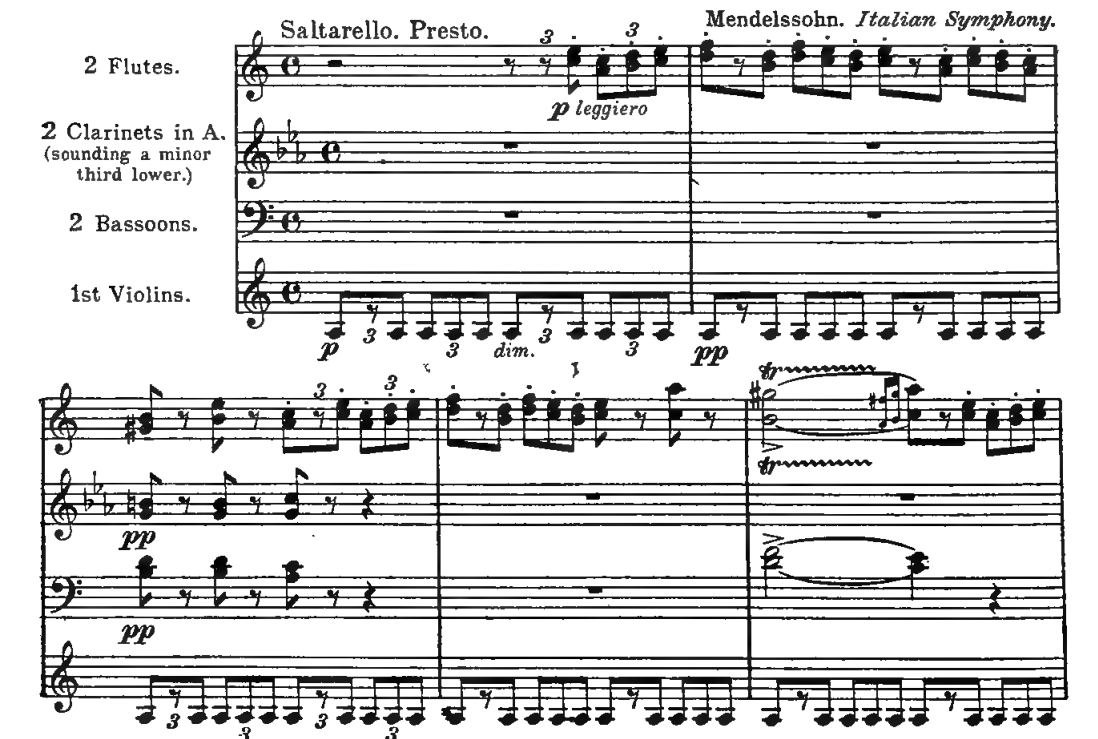
This is an effective instance of the Flutes used with a pp accompaniment in their quietest register. The student should look at the repetition of this tune that immediately follows in the Full Score. The Clarinets now play the Flute parts, and the latter instruments double them in the octave above.
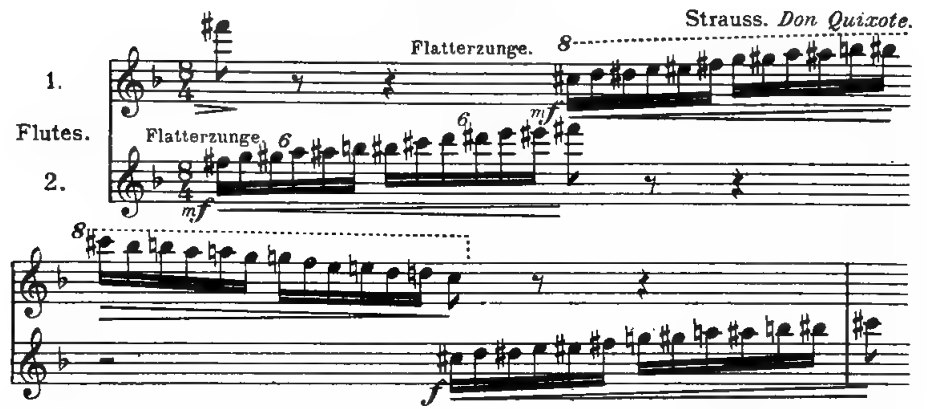
Besides the species of tonguing already mentioned, Strauss has introduced a method called Flatterzunge, or Flutter-tonguing. This is applicable to the Flute, and, a good deal less conveniently, to the Oboe and Clarinet. The player, while executing a moderately quick chromatic scale, rolls his tongue thus d-r-p-r without touching his lips. Strauss employs this method of delivery throughout the " Windmill" Variation in Don Quixote. The bars are all more or less of one pattern, and this is a sample:
Example 110
The Flute has no great powers of sostenuto or ot In its lowest notes especially any idea of an extended legato has to be put aside.! The length and bore of the pipe are so great that the player has to breathe after every tew notes. On the other hand, its nimbleness and general ability to "play anything" have passed into a proverb. This is perhaps crystallized in the answer of the American, who, when asked if he could read a Chinese laundryman's shop sign, said, "No, but I think I could play it if I had my flute."
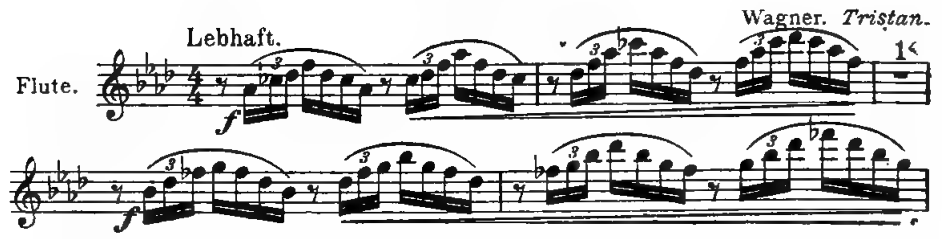
Staccatos, repeated notes, turns, shakes, skips, arpeggios, scales diatonic and scales chromatic, and all sorts of agile tigures founded on such types, are child's play to a good Flautist. Quotations might be given here by the dozen. We shall, however, content ourselves by a reference to one single passage. It occurs in the last Act of Iristan und Isolde, where Tristan, seeing Isolde's ship approaching, exclaims, "Es naht! Es naht mit muthiger Hast! Sie weht, sie weht, die Flagge am Mast!" Here the arpeggios of the Flute so often used for trivial purposes conjure up a living picture of what is before the dying man's eyes.
1 The student should compare the Wood-Wind slur marks in any of Wagner's Scores with what he actually sees and hears the players doing at a performance.
Example 111
Before leaving the Flute one may mention a peculiarity which has often been noticed. No instrument is so much affected by a difference of mode, major or minor. As a rule, its own lack in the matter of natural Harmonics seems to demand the major mode when it is brought prominently forward. At any rate, in its top and middle registers it is much more employed in the major than in the minor mode. In its bottom octave, on the other hand, the substitution of the minor for the major, especially in slow melodies, seems to give it a curious searching tenderness and a sort of "antique" sound that is unique in its octave and only comparable with the lowest fifth of the Viola and the middle register of the Bassoon.
The number of Flutes employed in the orchestra has varied from time to time. For special purposes three were used as early as Haydn and Grétry. They may be found in the former's Creation,, and the latter's Andromague.
Mozart found one enough for his Symphonies.
The classical tradition required two, with the 2nd player taking the Piccolo when necessary. Two is really the minimum, without which it is not possible to fill-up the top octave at all satisfactorily.
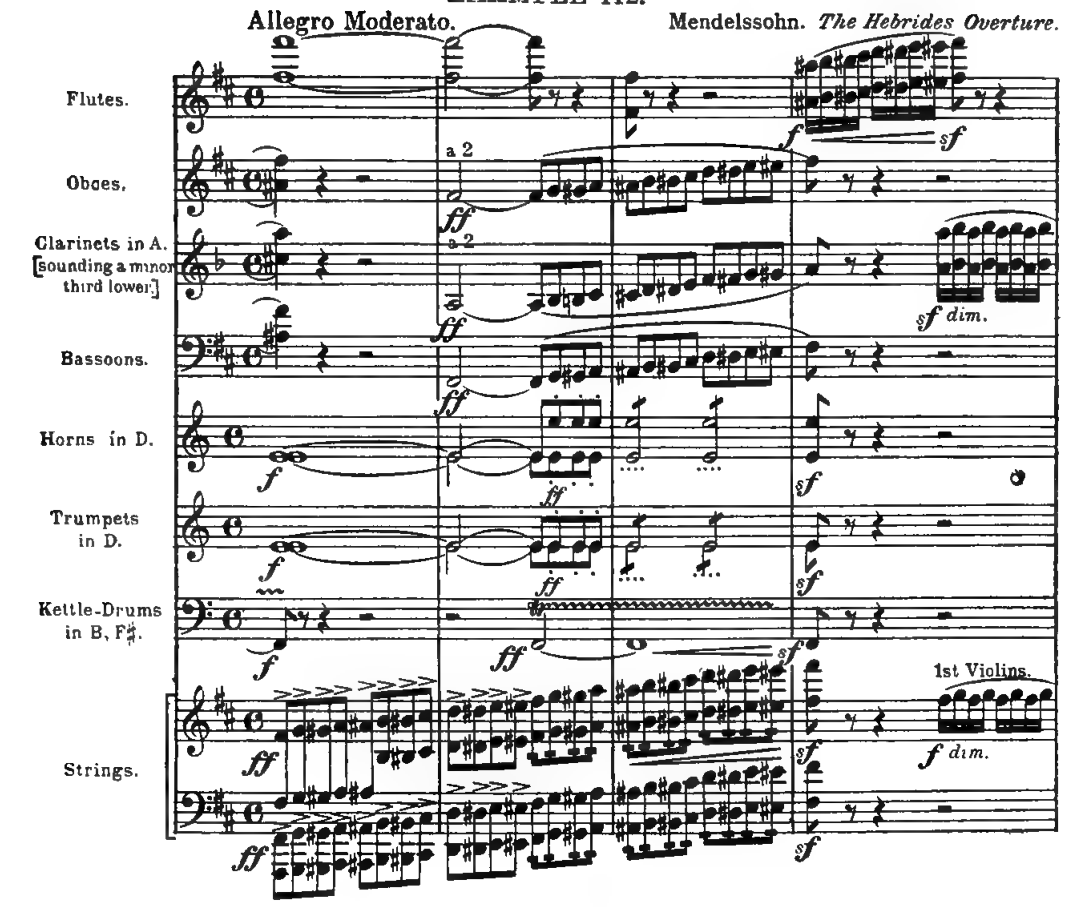
Mendelssohn has made at least one charmingly poetical use oi his Flutes. There is a place in his overture "The Hebrides" where the upward rush of the two Flutes after the ff of the rest of the orchestra suggests, in the most picturesque manner, the little crest of spray flung into the air by the huge wave as it breaks. The passage is as simple as it is vivid,—merely an Ft and a chromatie scale, but as a tiny piece of tone-painting it is quite irresistible. (Ex. 112, p. 195.)
The Symphonie rule to-day is "three flutes. The 3rd player oscillates between Flute and Piccolo like a cherub " 'twixt sphere and sphere."
any three aftod-find date, the student old endear in ra give the 3rd player a prominent first entry. He has a cold—that is to say, a comparativel lat—instrument to play on. His colleagues have been blowing into theirs all through the piece. And this blowing leads, both in the Wood and the Brass, to all sorts of undesirable "sharp practices" distressing to a "3rd player" with nothing to do.
The artistic success of Example 113, p. 195 (the opening of the Danse des Mirlitons from Tschaikowsky's "Nut-Cracker" Suite),
1 Part III.
depends not on the Ist Flautist but on the ability of the sra player to change from Piccolo to Flute in the 10 seconds pause which follows the Danse Chinoise, and to blow the bottom part in tune. Incidentally the quotation gives a good example of the light, easy writing which . IS SO effective on three Flutes. The accompaniment is a mere feather-weight:
Example 113
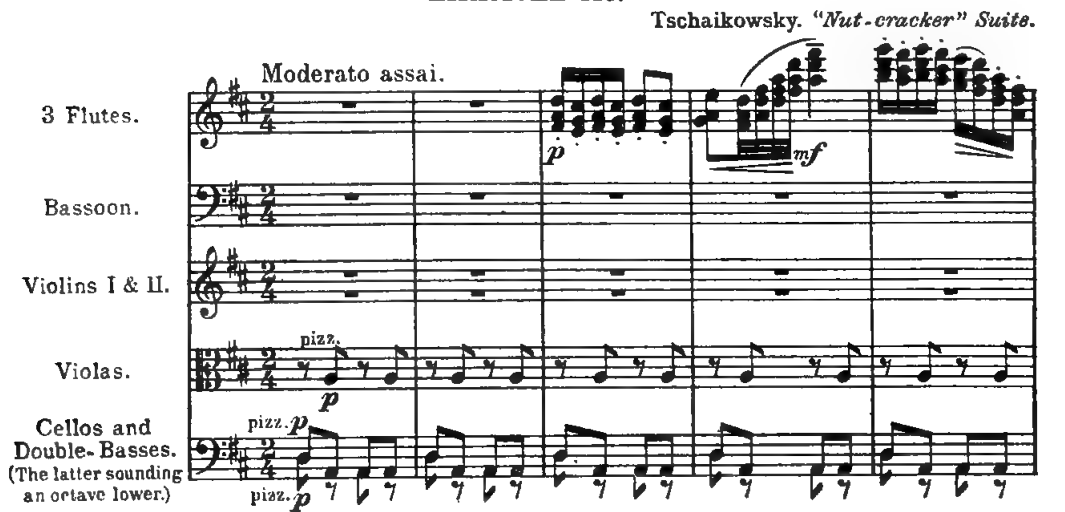
1 For reasous of space the String-parts have been compressed onto two staves.
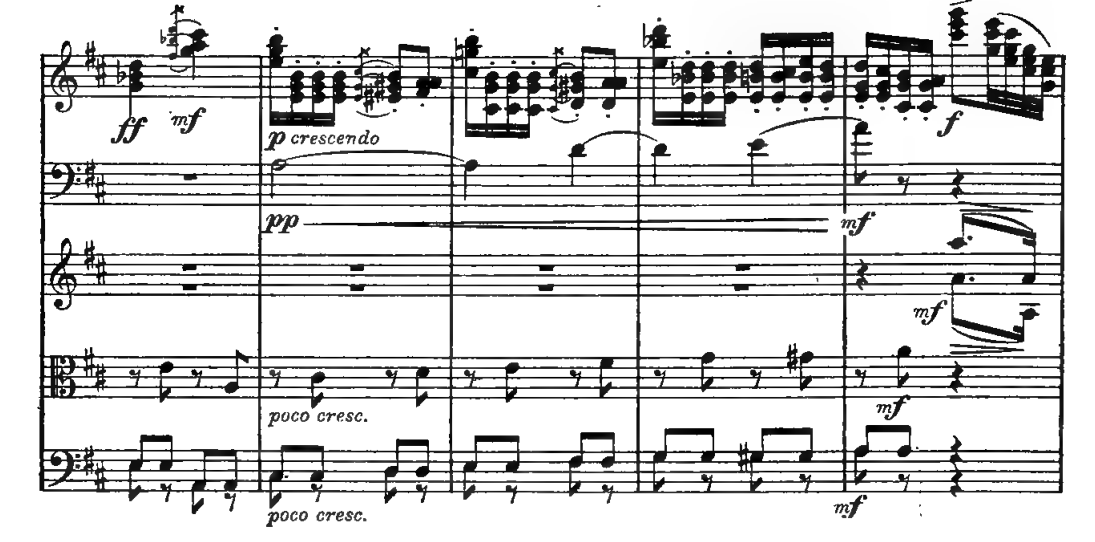
Before passing on to the other orchestral Flutes, a word must be said with regard to the Wood-Wind keys. These will be dealt with when necessary in greater detail under the headings of the various instruments. In general, however, one may say that the fewer sharps and flats there are in the part the better for the player. But this caution need not be taken too seriously, at anyrate for symphonie purposes. With an old S-keyed Flute, and most of the holes where they ought not to have been, a Flautist might well be excused for shaking his head at Db and Bb major. Times and mechanisms, however, have changed. It is still true to-day that it is easier for a Wood-Wind instrument to play in a key somewhere near its natural scale, whatever that may be, but one need not allow that restriction to become an obsession. Of course if one's favourite orchestral key is Ef major one deserves to suffer.