Playable Books
Cecil Forsyth · section 36 of 60
No. 31. The Bass-Flute
Read and hear this section in the playable edition →
Er. La Flate Alto; It. Flautone; ' Ger. Altflöte.
This beautitul instrument should perhaps rather be called by its Continental name the " Alto-Flute." In size and shape it is merely longer and wider-bored variety of the ordinary Concert-Flute. Like that instrument it is now provided with a Boehm mechanism for orchestra. purposes.
The fingering and written compass of the two instruments are precisely the same. On the Bass-Flute, however, the written chromatic compass from
sounds a perfect fourth lower
1 I.e. Big flute.
The whole compass of three octaves is producible with ease and certainty. The executive capabilities of the instrument, especially in the middle and top registers, are not much less than • those of ordinary Flute.
Bass-Flute is, for the player's convenience, treated transposing-instrument, and its part is written a fourth higher that che actual sounds required. Its key-signature has a b more or a • less than the key-signature of the piece. The treble-clef only is used.
An eight-keyed "Bass-Flute in Bb" is commonly employed by the "Drums and Fifes" in the army. The key in which it is built gives it facility of fingering for the military flat-keys. For the sake of economizing space on the march the "Head" of this instrument is generally curved back upon itself in the shape of a long narrow letter "U."
It may be mentioned that, from the sixteenth century onwards, many attempts have been made to construct Tenor- and Bass-Flutes with a compass even lower than that of our modern Bass-Flute. The largest of these instruments—a sixteenth century Italian Bass-Flute— has a downward compass to low C, the bottom-string of the Viola. An instrument of this sort, with a bore of an inch and a length of 43 inches, is practically unmanageable by human lungs and lips. calls for a special race of men, or rather of heroes.
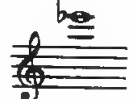
In tone-quality the Bass-Flute is indescribably rich, soft, and velvety. Its characteristic bottom sixth is remarkably strong and sounds almost like a unison of Horn and Bassoon. Above that it has a delightful quality, something like that of the Flute's middle register, but rounder and more tender. The top sixth of its compass though perfectly easy to play has a tendency to sharpness, and is besides not of so good a quality as the same notes on the ordinary Flute. Little is gained, therefore, in writing the instrument above
The relationship of the Bass-Flute to the ordinary Flute in the matter of tone-colour is very much the same as that of the Oboe d' Amore to the Oboe or of the Viola to the Violin. That is to say it is less brilliant and incisive but smoother, mellower, more placid and at times more expressive.
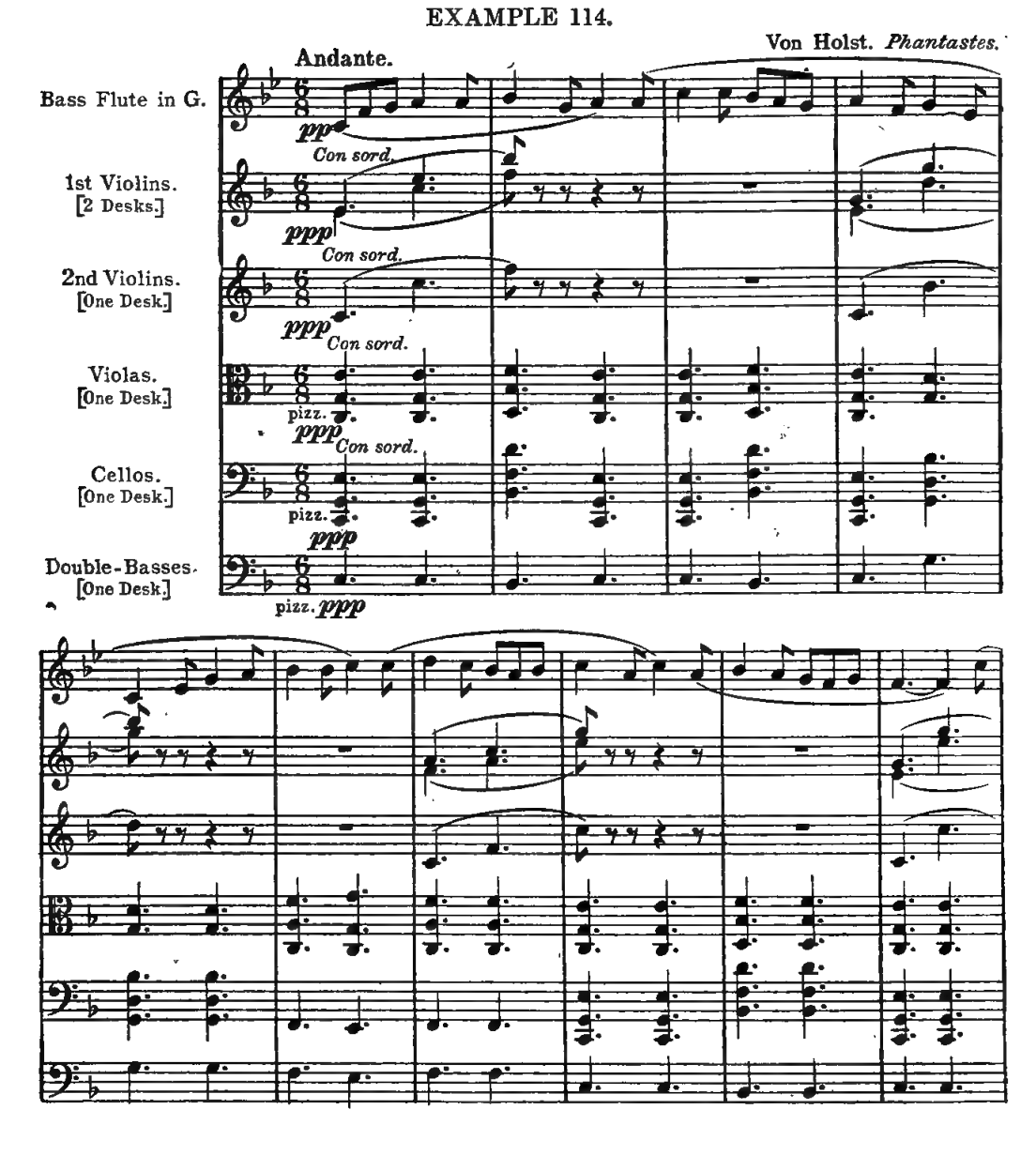
In the orchestra the Bass-Flute has not been used as much as it deserves. Weingartner has written for it in his Symphonic Poem Das Gefilde der Seligen, Rimsky Korsakov in Mlada, Glazounow in his latest Symphony, and Holbrooke in his Opera I'he Children of Don. The following example of a tender little melody in its bottom register is taken from the 3rd movement-Sleep—of Von Holst's Suite Phantastes. The effect of the deep, quiet notes of the bass-flute with the thrummed accompaniment and the little three-part phrase in the Violins is charmingly representative of the subject. The student should notice the extreme lightness of the accompaniment, twelve stringed-instruments only, all muted.