 Playable Books
Cecil Forsyth · section 37 of 60
No. 32. The Piccolo.'
Read and hear this section in the playable edition →
Fr. Petite flute; It. Ottavino; Ger, Kleine Flöte.
This is a small-sized Flute less than half the length of the ordinary Concert-Flute. Its pitch, depending, of course, on the length of the air-column in the pipe, is an octave above that of the Flute. Ihe Piccolo, however, lacks the foot-joint which permits the Flute to produce its two bottom sernitones. The compass, therefore, begins

i.e. Octave Flute. In Germany the regular name is Kleine Flöte, but the word Pickelföle also exists.
with the first degree of the natural scale, low D. At the other end the piercing top-C can only be blown in the fff; while the semitone below it—B—is still more difficult to produce. If needed, for instance, in the brilliant upward rush of a scale supported by the Brass, it can just be played by the instrument and, one may add, tolerated by the
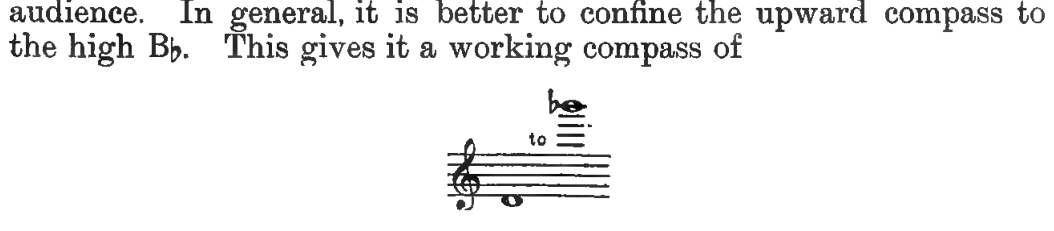
The Piccolo is always written in the treble-clef an octave below its real pitch, so that the compass in actual sounds is
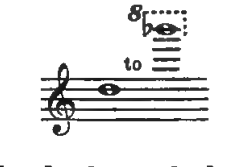
The fingering and indeed the whole technique are exactly the same as those of the Flute.
Bearing in mind, then, the restrictions of the Piccolo with regard to the two semitones at each extreme of its compass, one may say that anything which is effective on the Flute in the way of scales, arpeggios, trills, figures, turns and so on can be played on the Piccolo.
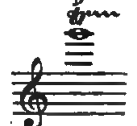
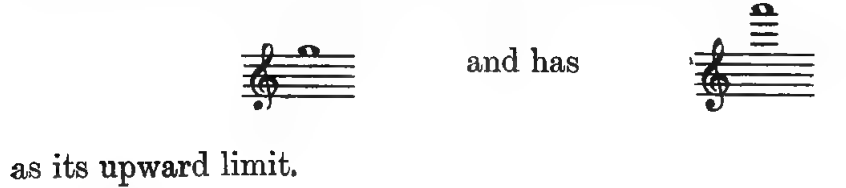
must, however, make two reservations here. In the first place, as the ficcolo reaches the top of its compass, the notes are produced with greater difficulty than the corresponding notes of the Flute, which are pitched an octave lower. The limit-note of a trill in this part of the Piccolo's compass is
In the next place, though the Piccolo can play almost anything, there are not many things to which it can lend distinction. There are also some things which it can very eflectually spoil.
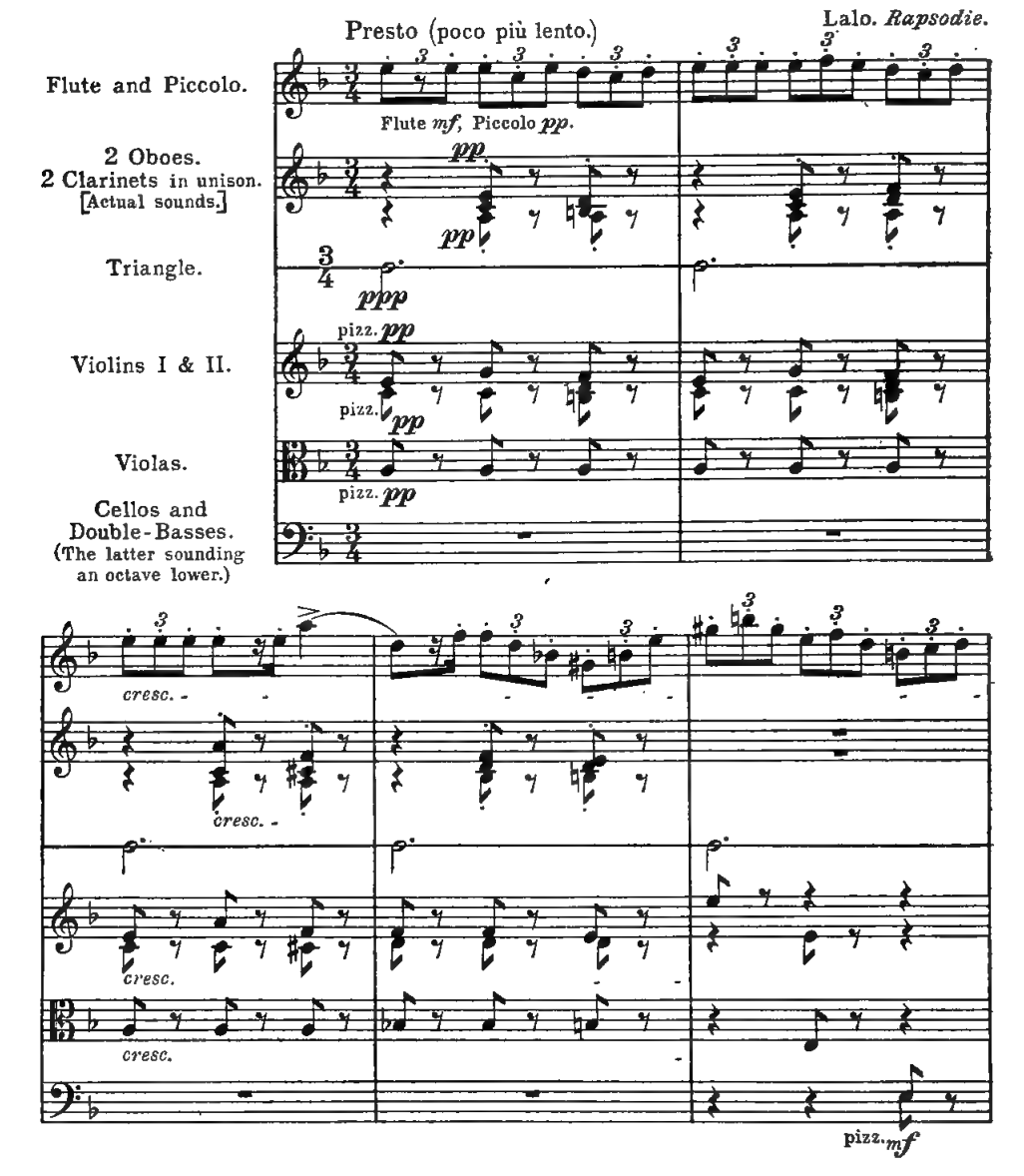
In this connection we must remember that all the Flute-family is reedless. That is to say the tone-production does not in the slightest resemble the tone-production of the human voice. It, therefore, totally lacks the strong associative appeal which is possessed by the Oboe, the Clarinet, and the Bassoon. The ordinary Concert-Flute substitutes for this appeal a limpid and exquisite clarity. Furthermore, it has this advantage, that for two-thirds of its range it is producing notes within the compass of the Soprano voice. On the other hand, the disabilities of the Piccolo in the way of tone-colour, are accentuated by the fact that it is nearly always playing in a register outside that of any human voice. Consequently the harder, brighter, and more automaton-like the Piccolo part is the better will it suit the instrument. A little phrase like this in which the Piccolo merely " gilt-edges" the notes of the Flute, sounds charming:
Example 115
whereas a fine phrase like this (from the C minor Symphony), with its thin twitter at the end, only sounds poor:
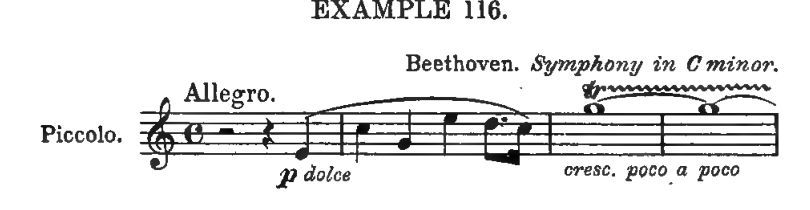
ile in the other it fails to adly mechanical fun pion sue cesch is essentially a vocal phrase.
With such limitations as these the Piccolo is most often called on to brighten the upper octaves of the Wood-Wind. It is impossible, within reasonable limits of space, to give examples of these "doublings." They include combinations with practically every possible series of single Wood-Wind notes and with every possible Wood-Wind octavepassage. These may be made up of Flutes, Oboes, English Horn, Clarinets, and Bassoons in any vertical arrangement that may please the composer's fancy.
In these combinations one occasionally finds the middle octave omitted altogether. The Piccolo then doubles the Wood-Wind phrase at the 16th. For instance, in the Entr' Acte before Act IV. of Carnen the Clarinet has a pp semiquaver passage in its middle octave while the Piccolo has the same series of notes p two octaves higher. The effect is curiously and characteristically French:
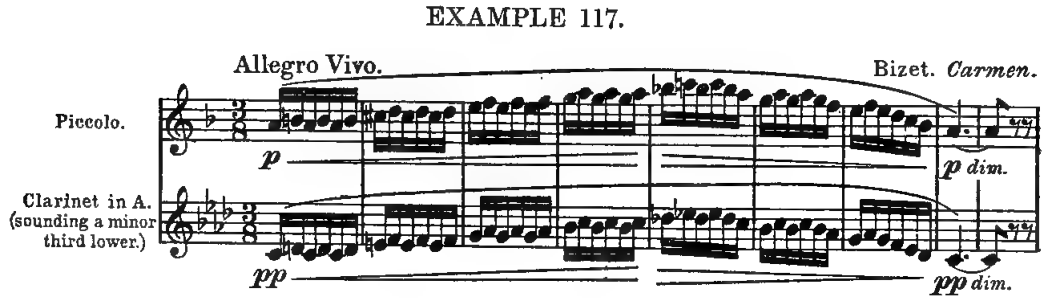
In the above example the whole of the accompaniment is omitted. It consists of pizzicato Strings, Harp, Tambour de Basque, and a single Oboe "A" held for four bars. The student should also look at the Chanson Bohême (opening of Act II, of the same Opera), where there is a somewhat unusual series of sixths between the Flute and the Piccolo.
It is often prudent to double the extreme top notes of the Flutes by the Piccolo in unison, not in the octave. This is matter of daily practice. A passage like the following from the Finale of Strauss's Sinfonia Domestica
Example 118
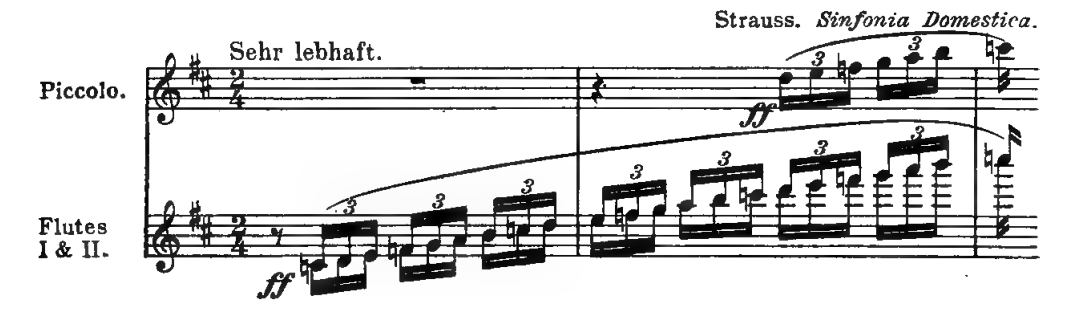
is nine times out of ten better arranged as above than with the Piccolo part written to sound an octave above the Flutes. On the other hand, if the Flute-scale had ended about a fifth lower the Piccolo would have added little and would probably have been omitted or written in its upper octave.
Held notes are as a rule ineffective on the instrument. They lack vitality, and if pitched too high approach dangerously near to the scream of a steam-whistle. Even when played ppp the upper notes are totally wanting in tenderness and charm. See the passage quoted below (Ex. 238) from the extreme end of Strauss's Also sprach Zarathustra. Unless one is very far from the orchestra in a very large hall these harmonies, in which two Piccolos play the top Wind-parts, sound unsatisfactory. Of course in the case of this special example no other Wood-Wind instrument could produce these extremely high notes at all.
Berlioz has pointed out that it is mere matter of prejudice to think that the Piccolo should "always be played loudly." This caution, perhaps more needful in his time, is scarcely called for at the present day, when the art of the orchestral player has been advanced along such artistic lines. It may, however, be repeated here as applicable to every instrument in the orchestra. With regard to the Piccolo in particular the student should examine the extraordinary piano use of the instrument at the end of Brahms's Gesang der Parzen. The Piccolo Parzeing with the muted Strings at the words «So sangen die sixteen bars from the end of the work. There are not twenty notes to play, and the effect is in inverse proportion to the simplicity of the means used.
Une cannot recall any example of the bottom notes of the Piccolo used solo. They are weak, and, as Berlioz says, "generally better replaced by their corresponding sounds in the second octavé of the large flute." On the other hand, they might well be used in some passage requiring a great peculiarity of characterization. They have a quite distinctive tone-colour; a sort of thin, feeble, disembodied voice, such as might come from a ghost it it had a pip in its throat.
in the middle and top registers the Piccolo is, of course, very much at home. And as it is comparatively an easy instrument, the technique of the player is generally supremely good The student, however, would be well advised not to keep the instrument continually at the top of its compass. As an average example of writing for the instrument—neither extraordinarily difficult nor yet studiously simple-he should look at such a number as the Sailors Chorus in Act III. of Wagner's Flying Dutchman, "Stevermann! Lass die Wacht!" this example the average tessitura gravitates round.
The Piccolo has such marked restrictions that we must not be surprised to find that the early masters only used it on special occasions. Gluck employed a pair in his "Chorus of Scythians" in Iphigénie en Tauride. Beethoven rarely used the instrument. In the Storm of the Pastoral Symphony it has a part, but is mainly used to perform its least effective function, the holding of high notes. In the Allego con brio, at the end of his Egmont Overture, there is quite a showy part made up of little flourishes with the Horns, Trumpets, and Bassoons. Weber followed Gluck and used two Piccolos in an often quoted passage from the Freischütz, while Berlioz has made characteristic use of the same combination in his "Menuet des Follets" (Faust). Marcel's " War Song" in the Huguenots, with its accompaniment of Piccolo, Bassoons, Bass-Drum and Cymbals, and Double-Basses, has already been quoted.
In the modern orchestra one or two Piccolos are used at discretion, not for an entire work but for incidental passages in the work. When three Flutes are employed the 3rd player or the 2nd and 3rd players would take the Piccolo part or parts as required. The actual change from one instrument to another can be made in a single bar of moderate time. In this the Flute and Piccolo have the advantage over all other instruments. They have no reeds or crooks to adjust, and so can be laid down and taken up with ease. It is, however, just as well to remember that in making a rapid change the player has to face some difficulty in the alteration of embouchure. It is, however, only slight, and the difficulties with regard to pitch, already referred to on pages
It is only necessary to add for the sake of completeness that Military Piccolos in Eb and Flutes in Ab and Eb are used in the "Drums and Fifes" of the army. In addition, Db Flutes are commonly used in military bands.
All these instruments are usually spoken of not with reterence to the normal pivot-key of U, but with reterence to the natural Flutescale of D. Thus the "Eb Piccolo" is generally known as an "F Piccolo," the "Db Flute" as an "Eb Flute," and so on. An absurd and spurious piece of archaism.
The ordinary Db military Flutes and Piccolos are, of course, written for in the key of a semitone below the pitch of the piece, and, as the usual keys for military music vary from Bb to Db, it will be seen that this gives the Flutes a range of four easy keys, A, D, G, and C. In many cases the difference of a semitone in pitch exactly corrects the traumosition eAch is nec inary in ven arrato mestos mitam dell The brilliant Flute Obbligato to the English Horn solo appears in the original Score in G major. On transposition for military band the key of the piece is Ab major. The flute in Db remains in its original key.
1 See Example 7.