Playable Books
Cecil Forsyth · section 39 of 60
No. 34. The Oboe d'Amore
Read and hear this section in the playable edition →
Fr. Hautbois d'amour.
This rarely-used instrument is really a mezzo-soprano Oboe. It is built a minor third below the standard instrument, but does not possess the key-extension for producing the low Bb. Its upward range is to high E4.
The written compass is therefore

It is written for as a transposing-instrument in the treble-clef. Its key-signature has of course three b's more or three #s less than the key-signature of the piece. Its best keys, therefore, are the # major keys from G to E and their relative minors. The corresponding easy key-signatures for the Uboe d'Amore are Bo to G major with their relative minors.
In the eighteenth century the Oboe d'Amore was occasionally written as a non-transposing instrument. Nowadays, on its rare appearances, it is played by an Oboist. The fingerings of the two instruments are the same, and it is therefore more convenient to write a transposing part. restrictions as to compass, one may say in a word that the technique of the Oboe d'Amore is identical with that of the Oboe. Note, however,
(1) That the whole-tone shake on
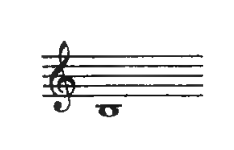
is impossible, and the half-tone shake on
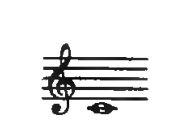
nearly That no shake is possible beyond the half-tone shake on
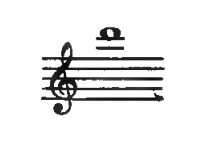
In point of tone-colour, however, there is a difference. The lower. itched instrument lacks something of the Oboe's pungeney anc distinction. In place of these it has a smooth calmness and serenity which fit it for the expression of simple tenderness and of devotional feeling.
Bach, in his Christmas Oratorio, in his Magnificat in D major, and in his eighth Church Cantata, wrote parts either for a Solo instrument, for two, or for a Quartet of two Oboi d'Amore and two Oboi da caccia.' After his time it fell into disuse, but has recently been revived by Richard Strauss for his Sinfonia Domestica. In the Schmore of that we do the beat given to the Obo
Example 138

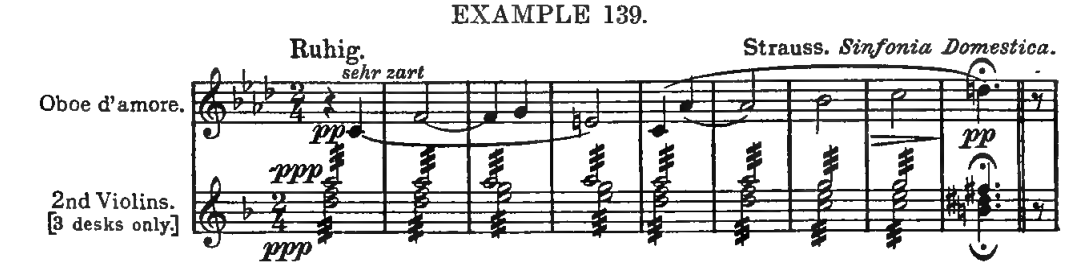
Perhaps more characteristic of the instrument is the little cantabile in the same work with its high pPp accompaniment of 2nd Violins tremolo: