 Playable Books
Cecil Forsyth · section 40 of 60
No. 35. The English-Horn
Read and hear this section in the playable edition →

Fr. Cor Anglais?; It. Corno Inglese; Ger. Englisches Horn.
This instrument, which is neither "English" nor a "Horn," is a descendant of the mediæval Alto-Pommer, No. 3 in the Schalmey- Pommer family mentioned on page 204. It may be regarded simply as a Contralto Oboe. Its wooden pipe is wider and longer than that of the Oboe and terminates in a small globular bell. At the upper end the metal crook or staple which holds the double-reed is generally bent back at an angle with the pipe itself. In old specimens of the instrument this convenient shortening in the total height was secured by bending the whole pipe into a curve. The reed used is larger and thicker than the Oboe-reed and the air-column is much more easily controlled.
1 The predecessors of the English-Horns (Cors Anglais).
2 Perhaps for Cor Anglé, i.e. Bent Hor, but the first word is difficult to explain. England the instrument is more commonly spoken of as Cor Anglais than as English-
The English-Horn is built a perfect fifth below the Oboe, and it art is written nowadays a fifth higher than the key of the piece anc with a key-signature of one b less or one # more than the keysignature of the music. Like the Oboe d'Amore, it lacks the keyxtension for producing the low Bo. The written compass of thes wo instruments is exactly the same. two octaves and a fourth
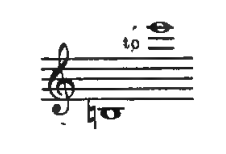
which sounds on the English-Horn
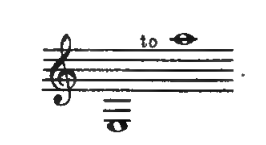
The fingering of the instrument is practically the same as that of the Oboe. France as late as Halevystime " curious notation which was used in The Oboe-player in whose hands the English-Horn was placed had, of course, to finger for
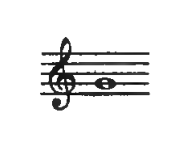
when he wished to produce the sound
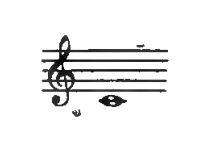
The French composer, therefore, satisfied his sense of logic by placing
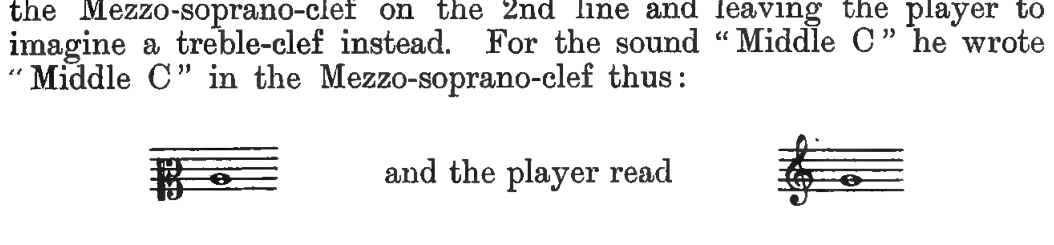
l'here seems to have been some difierence of routine as to key This perhaps explains what they did at signatures and accidentals. rehearsals in those days.
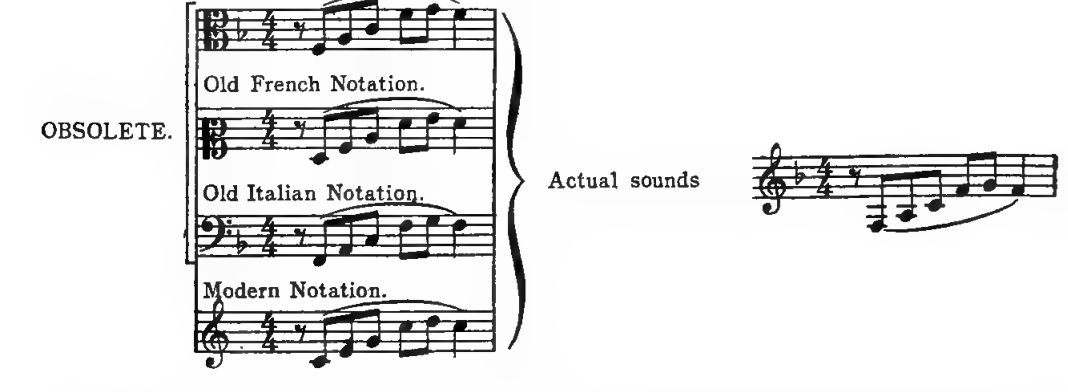
In Italy composers before Verdi's time adopted the absurd plan of writin the sounds ruquired in the baselet an artave belon their
Bach, in writing for the Oboe da caccia, an instrument similar to the English-Horn, set down the actual sounds required in the Altoclef on the third line.
The following shows at a glance the three obsolete notations and the now universal modern notation :
Bach's Oboe da Caccia Notation.
As the fingering is practically ithe same for the Oboe and the English-Horn the student may transfer all that was said above on the Oboe-technique, its shakes, tremolos, staccatos, legatos, ete., to the compass of the English-forn
The restriction with regard to the whole-tone shake on low Br anc the half-tone shake on low C' in the technique of the Oboe d'Amore does not apply to the English-Horn. Both are possible, as follows:

On the other hand, the limitation of the upwards shakes to the half-
holds good.
tone shake on
The tone of the English-Horn differs strikingly from that of the Uboe.! In its lowest fifth the notes are of a fine quality, slightly hollow but reedy and expressive. Upwards from that it has a smooth richness not unlike that of a Contralto Voice. The notes above
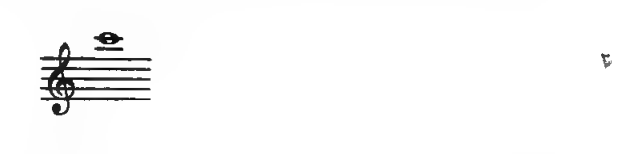
are not much used. Their quanty is interior to the correspondin notes on the Oboe. The whole compass of the English-Horn is tinged with a curious shade of reflection, of sadness, and of melancholy. In expressing ideas of sorrow and regret the instrument seems to have almost more personality than any other in the orchestra. The finest
1 This is generally supposed to be due to the bell at the end of the pipe.
example of this is the long unaccompanied Solo at the beginning of Act I!. of I'mstan. The passage is, however, too well known and beautien tango milody from Batioks New place ym man cite the too otten played to need quotation.

The Ab entry in bar nine, therefore, sounds a perfect fifth above the low Cello Db. The student should notice the curiously empty and sad etect produced by the tenths between the English-Horn and the two Clarinets in bars 5 to 9.
Example 140
Dvořák. New World Symphony
Largo.
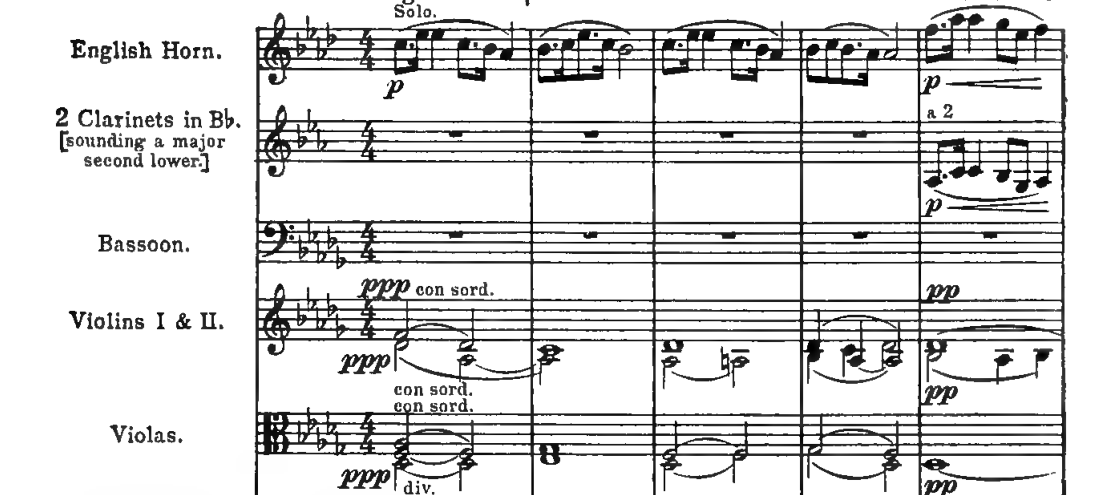
Cellos and D-B. con sord. PIP
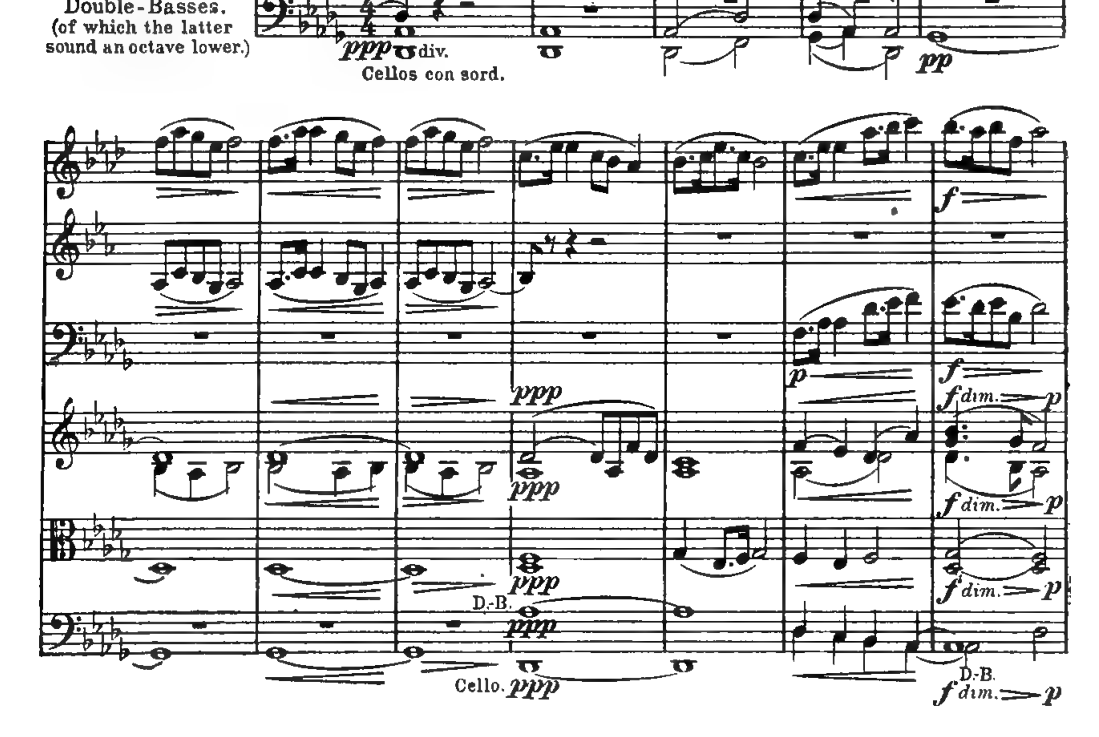
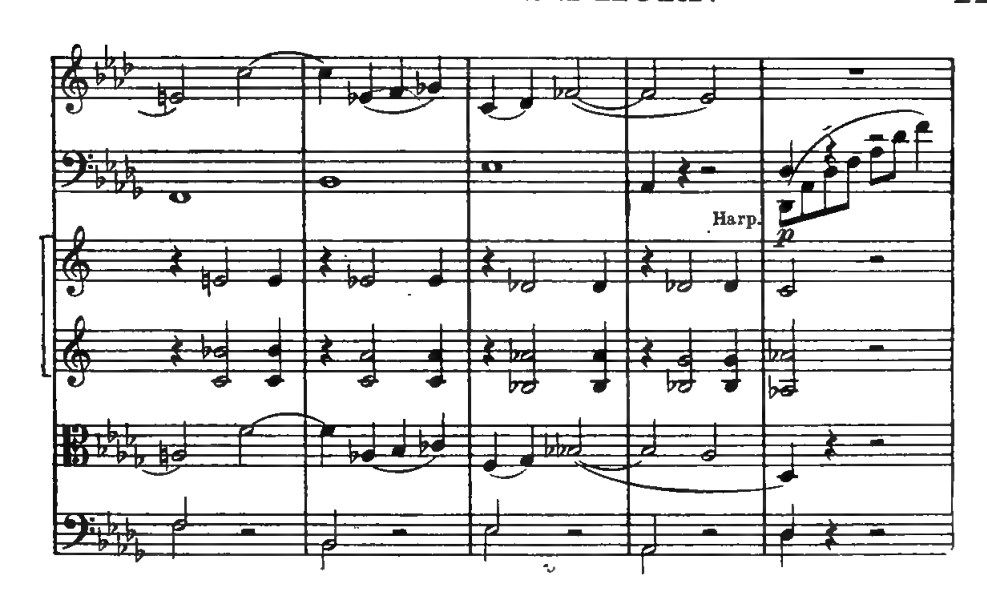
The above is an instance of the English-Horn used chiefly in its upper register. As an example of its middle and lower registers the lovely tune from Tschaikowsky's Fantasy-Overture Romeo and Juliet may be quoted. Here we have a melody which is doubled in the unison by the muted Violas. The English-Horn is accompanied by quiet syncopated chords for the three French-Horns. The effect is very happy—what one may call the entente cordiale in orchestration. The empty bar at the end of the English-Horn part is simply due to the fact that the last note of the tune is out of the instrument's compass. Unless doubled it could not have been assigned to the instrument. In this tune the muted Violas stand out more prominently than the English Horn. The two tone-colours are very similar, but the one stave represents one player and the other stave perhaps a dozen. This is the fate of almost all Wood-Wind instruments when doubling a String-melody in the unison. That is not to say, however, that the plan is of no value. The added richness which the Strings—or, for the matter of that, the French-Horns —acquire is a great factor in the success of the melody.. A very experienced orchestral musician of the last generation always used this expression, "A Wood-Wind solidifies a tune on the Strings."
for other examples of the English-Horn the student may examine the Andante § in the Overture to Rossini's William Moderato 3 passage in Schumann's Manfred (page 58) and the Obbligato to Meyerbeer's Robert toi que j'aime.
Example 141
Allegro Giusto. Ischaikowsky. Romeo and Juliet. ?
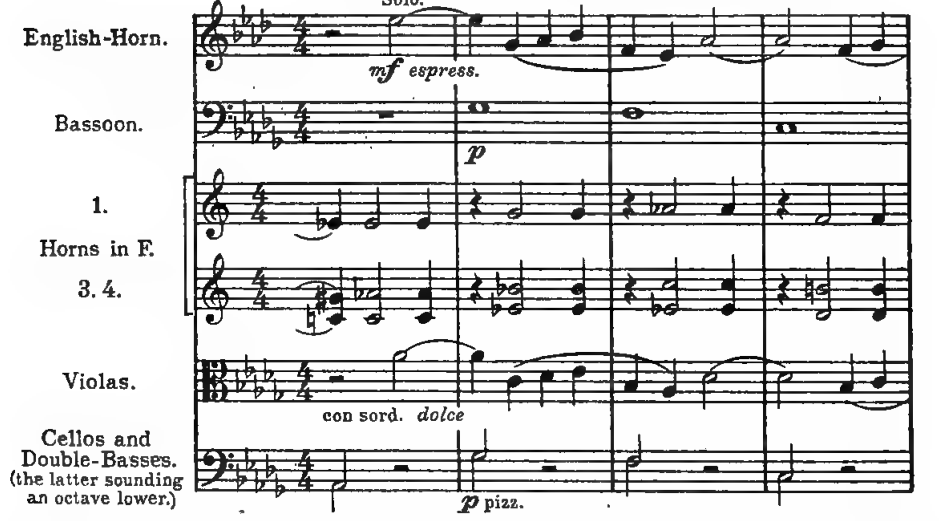
1 See, for instance, Ex. 80, where the English-Horn, though contending in the unison with the four French-Horns, undoubtedly adds something to the tone-colour of the high A's.
2 The Harp-notes are written on the Bassoon stave merely to save space. They have two staves to themselves in the original Score.
The modern tendency with the instrument is not to give it elaborate and funereal solos, but to employ it principally for enriching the middle harmonies of the Wood-Wind. Then again, it has been called upon recently to show an unusual dexterity and nimbleness. This is fortunately not at all beyond its powers. The following passages may be quoted to show its capabilities in this way:
Example 142

Example 143

In connection with the latter example the student should look at the whole Full Score from which it is quoted—the "Crities" section of the Heldenleben. This is, perhaps, the most curiously suggestive tind characteristie pasage vail to ten cote Wo, S- Veral, viperineffect produced by means of the f staccatos and the little close chromatic passages for the three Uboes, the English-Horn, and the Eb- Clarinet.
The English-Horn, for all its name, owes most of its artistic position to the French. It is true that they were not the first to use the instrument. As early as 1762, says Gevaert, the Orchestra of the Imperial Theatre in Vienna, where there were no Clarinets, possessed two English-Horns. Gluck, on coming to Paris with his Urfeo and Alceste, had to rearrange his English-Horn parts tor Clarinets. instance, the air, Plein de trouble et d'effroi, in Act I. ot Urfeo, is given in the Paris Full Score of 1774 to two Clarinets-in-U. In those days, and till much more recently, it was usual to write two English- Horn parts—generally simple successions of thirds and sixths—and to employ principally the upper register of the instrument. See, for instance, Gluck's Urfes, Act 1. and Halévy's La Jurve, Act IV.
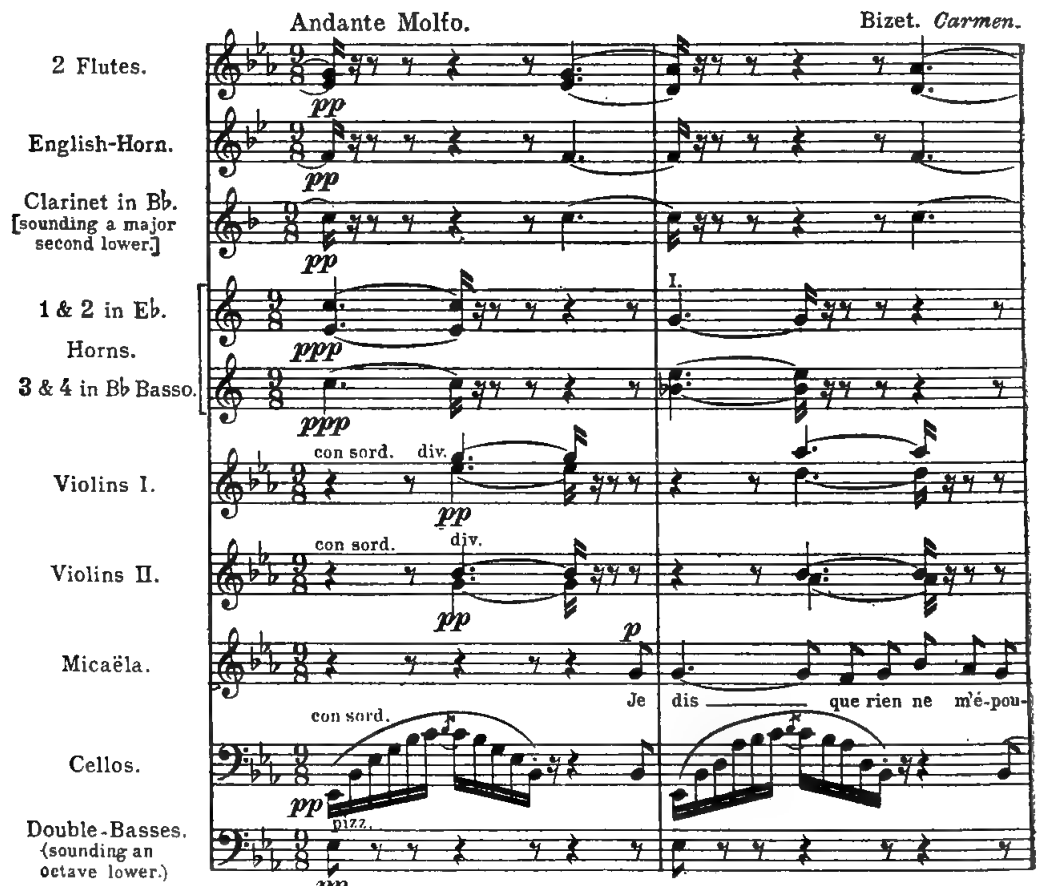
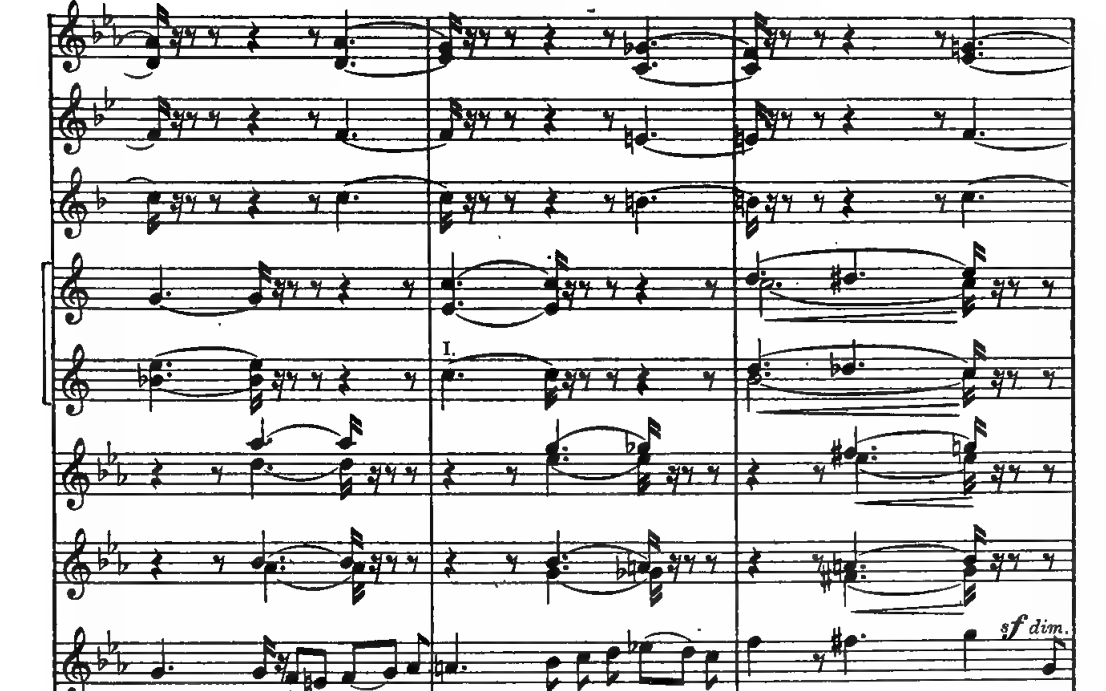
However, in 1808, the instrument was introduced to the French at the Paris Opera House in a work by Catel, called Alexandre chez Ame to Ward the Bag hated so Most the vet Obeit tom thalr every French operatic composer. It became a standard orchestral instrument in all the French compositions of the first half of the nineteenth century. Berlioz wrote for it in his symphonze Fantastrque. Meyerbeer not only employed it in dolo and Uboligato passages but used its middle and bottom registers in Les Huguenots to add a warm tone-colour to his accompaniments. This method was copied by Bizet in a charming accompaniment which is well worth quoting. occurs in Micaëla's song, Je dis que rien, in Act III. of Carmen.
Example 144
PP
j'ai beau hé- las! Mais Je que je ré- ponds de moi; dis, van te,
The pattern of the accompaniment consists of successive groups of chords for (1) Wood-Wind supported by the low notes ot the English- Horn; (2) Muted Violins divided into four parts, and playing in the upper middle register; (3) pianissimo Horns. The tone-colour of each chord is just overlapped on to the tone-colour of the next, so as to prevent any sort of "gap" between the two. The whole series of chords is bound together by a most delightful arpeggio-figure for the muted Cellos. Finally, the whole orchestral scheme is subordinate to the beautiful melody in the voice.
In Germany Bach's Oboe da caccia parts, to which reference has already been made, were practically English-Horn parts. Hayda, Mozart, and Beethoven all wrote for the instrument. The last named indeed composed a Trio for two Oboes and English-Horn. But apparently it was never with any of them an instrument of the ordinary orchestral routine. Weber, too, strangely overlooked its Possiblent i Big regig with then i ecame ut as en adopted the possibilities. Double-Reeds as the 2nd Clarinet and Bass-Clarinet to his Single- Reeds.
Nowadays every Symphony and Opera orchestra possesses English-Horn as well as two Oboes. It is, however, often convenient for a composer to arrange a small lightly-constructed composition so that the 2nd Oboist can take the English-Horn when required. In this case he should allow ten or twenty bars of moderate time in which to make the change.