 Playable Books
Cecil Forsyth · section 38 of 60
No. 33. The Oboe' (or Hautboy)
Read and hear this section in the playable edition →

Fr. Hautbois; It. Oboe; Ger. Oboe.
This is a double-reed instrument of considerable antiquity. Its Ioretather was the Schalmey, a treble reed-instrument which, with its larger brothers the Pommer and Bombard, formed the principal reedgroup in the mediæval Wind-Band
The Oboe seems to have definitely emerged from its immediate phe natter Discan-Set had, ints botom arter ass note, the low ; which is also the original lowest compass-note of the Flute. The first keys which were put on the new instrument gave the whole-tone below this (CH) and the semitone above (Df).
The six instruments which comprised the Schalmey-Pommer family were
1. The High-Schalmer, [a reed-pipe 17 inches in length.]
2. The Discant-Schalmey, [a reed-pipe 26 inches in length.]
%. The for one a red pipe la need pipent inches in
length.]
5. The four-keyed Bass-Pommer, [a reed-pipe 72 inches in length.]
6. The four-keyed Double-Bass-Pommer or Bombard (Doppelt-
Quint-Pommer), [a reed-pipe 116 inches in length.]
The average pitch of these instruments can be easily remembered, as their lowest compass-notes were respectively the same as the four strings of the modern Viola and the two bottom strings of the Cello:

These were the lowest natural notes of the six instruments. But the four keys of Nos. 4, 5, and 6 gave them an extra compass downwards of four notes, so that the actual playing-compass was continued

It needs something of an effort to imagine what a Band of these coarse, powertul, double-reed instruments must have sounded like. They were used for indoor as well as outdoor purposes, and gave our ancestors a Wind-ensemble with a tone-quality that is simply nonexistent to-day.
1 The English word Oboe is from the Italianized form of the French word Hautbois. The first mention of the word Hautboy appears to be in Robert Laneham's letter describing the entertainment provided for Queen Elizabeth in 1575 at Kenilworth Castle. The letter, which is also dated 1575, contains this sentence, « This Pageaunt waz clozd vp with a delectable harmony of Hautboiz Shalmz Cornets and such oother looud muzik."
It was from the second highest of this Schalmey-Pommer group that the Oboe sprang: The Discant-Schalmey was, as its name suggests, the main melody-instrument in the old Reed-Bands. It is continually referred to in Elizabethan and Jacobean literature, and, though the musical criticisms of poets and dramatists have to be received with some reserve, we may tairly and charitably sum-up its tone-qualities in Robert Laneham's words "looud muzik."
The Oboe inherited the rough tone and the technical impertections ot the schalmey, and continued to propagate them down to about the midale of last century. By that time, however, the Uboe had gat to be more than the English people could stand indoors. The English Oboist, Barret, suggested various improvements in the instrument, and the technical side of these improvements was worked out by Triébert in Paris. Since then the French and Belgian school of Oboe-playing, aiming as it does at refinement of tone, ease of execution, and suppleness of nuances, has been supreme in Europe.
In Germany, however, where they still call any military bandsman an Oboist and any military band-master an Oboe-master, the instrument is still regarded from the "looud muzik" point of view. It is played as if it were an outdoor-instrument liable to contend with a multitude of Trumpets, Trombones, and Tubas. The reed used is, to our ideas, thick and heavy, while the resulting tone is coarse, unpleasant, and of a terribly predominating quality. Happily, in this country our ideas on tone-colour have always run more nearly parallel with those of the French. Consequently, though the Oboe is perhaps not played so perfectly in England as it is in France and Belgium, we strive towards the same sort of perfection as that which the French have already achieved.
The Oboe is easily described. It is a small conically-bored pipe of cocus, rosewood, or ebonite, terminating at its lower end in a "bell." At its upper end is a short length of metal tubing, called the staple, into which the double-reed is fitted. This double-reed is made of two " bound together a deserted fine and then piece of prepared canet bad together the canes is very narrow—the merest slit into which a thin piece of paper can just be passed. The position of the two reeds can be clearly seen on Plate VIII., Fig. 3. At the extreme top of the illustration is the ()-shaped orifice. Below that are the reeds themselves, only one visible. The dark patch that lies immediately underneath that is the waxed-thread lapping that keeps the reeds together. Below that again comes the metal " staple," and then the upper portion of the wooden Uboe-pipe with a couple of metal keys attached. Both these keys are worked trom a tinger position lower down the pipe by means oi metal rods or "trackers." When in use the double-reed is of course actually in the player's mouth and is itself the sound-producer. The air-column inside the pipe acts as a resonating medium, reinforeing the reed-vibrations by synchronized vibrations of its own.
The fundamental scale of the instrument is obtained by the opening and shutting of the holes pierced laterally in the pipe. This is governed in the modern orchestral Oboe by a formidable metal mechanism which
The second Oboe "speaker," however, is used only to "vent" the highest notes.
The fundamental scale of the Oboe'is chromatic, and begins at middle-C
* but two lower semitones By and By to ho
are obtained by means of key-extensions. Normally the two holes covered by these keys remain open in playing. The closing of the holes lengthens the air-column and so deepens the pitch.
The instrument being conical overblows an octave, but the first note which in practice is overblown is this D
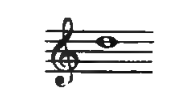
From there chromatically upwards for a major seventh, that is to
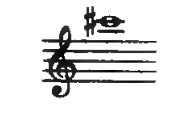
the scale is a reproduction of the lower scale, and is obtained by means of increased wind-pressure. Above that for a diminished fifth, six further semitones are playable to

These notes are 3rd and 4th Harmonies of the fundamental octave.
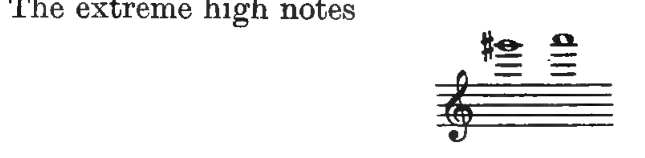
are just playable by some artists. However, their poor quality and excessive difficulty render them useless in the orchestra. Even the ugh If and G are better avoided, though they are both recognized fo oiano production in the French technique. The full orchestral compas of the instrument may then be laid down as chromatically from
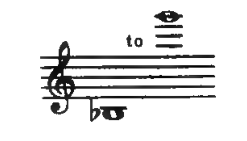
The fingering resembles that of the Flute.
1 See page 241.
Whole-tone and half-tone shakes are possible on all the notes up to and including the half-tone shake on
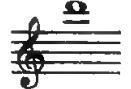
Beyond that there are two whole-tone and two half-tone shakes all possible but difficult. They are as follows:
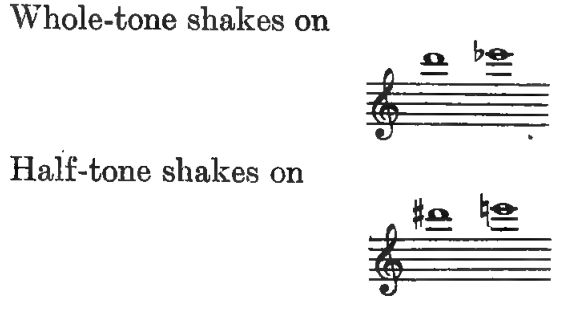
In both these cases the shake on the lower of the two notes is the more difficult.
The whole-tone shakes on
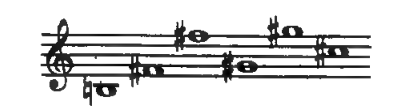
and the half-tone shakes on

which were diticult or impossible on the old instrument are now, on the modern French Oboe, all practicable.
A certain amount of caution is necessary with regard to the tremolos of the Oboe. Apart altogether from their musical ettect, there are eleven in the lower and middle registers which involve such diticulțies in the way of cross-fingering and so on as to make them undesirable or impossible. These eleven which should all be avoided are
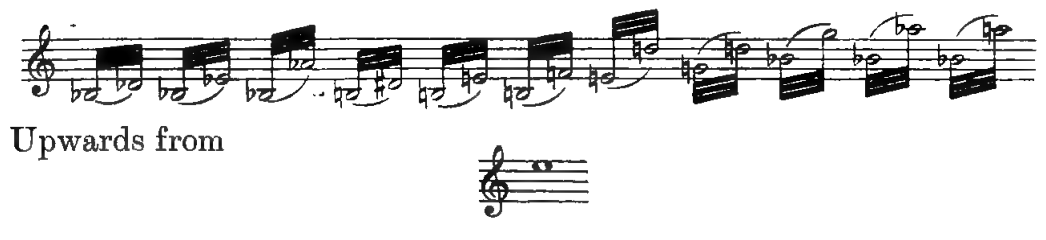
avoid any tremolos of a greater interval than a perfect fourth.
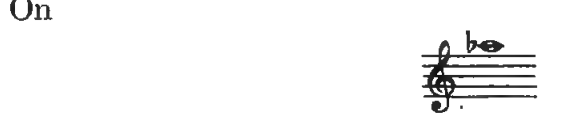
avoid any tremolos of a greater interval than a major third.
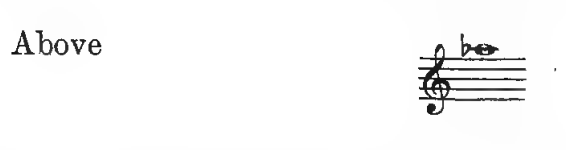
write no tremolos; that is tremolos as opposed to whole-tone and halttone shakes.
, any technical combinations of two notes both of whicl are either # or'? axe to be used with caution.
Owing to the position of the reed in the mouth, the Uboe player can use single-tonguing only. This, however, does not in any way
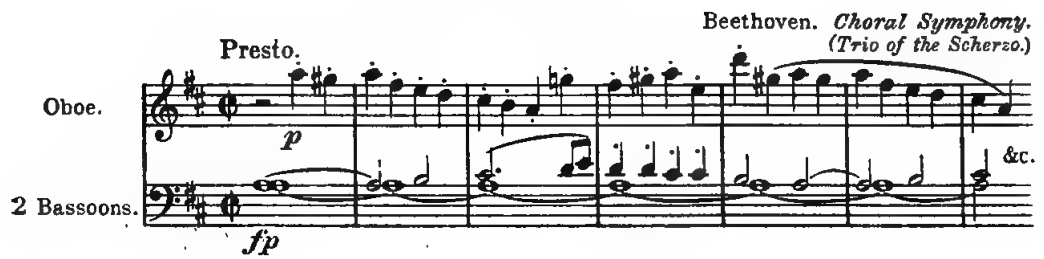
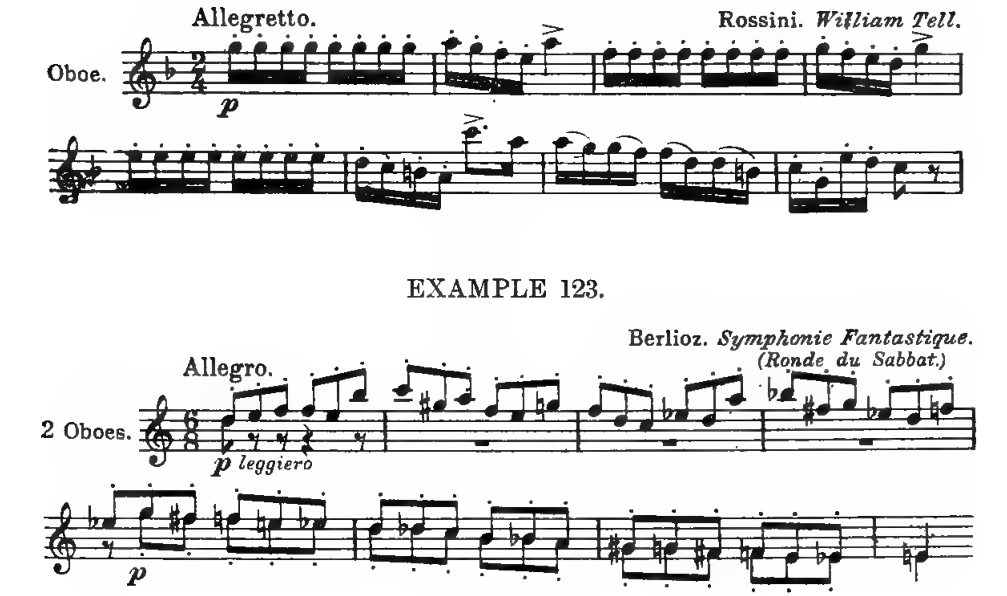
tray are mone one mod car ming chandontie of ment. This capability is not as a rule sufficiently well understood. Composers often hesitate at anything beyond a legato melody for the Uboe. It will be as well, then, to give two or three examples which the student is likely to hear in the concert-room. He can then judge for himself how well they suit the instrument when played by a good artist. The fourth example, from Act I. of Rossini's William Tell, is included as a rare instance of the quick repeated notes of the Oboe employed in a Solo. It, of course, needs the greatest refinement of execution.
Example 119
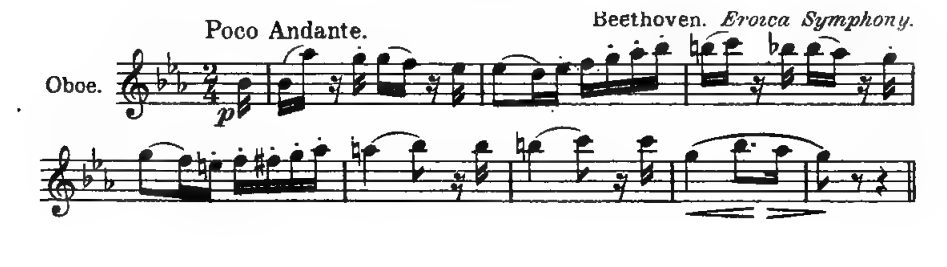
Example 120
Allegro Vivace.
Beethoven. Fourth Symphony (in Bb.)

Example 121
Example 122
Example 124
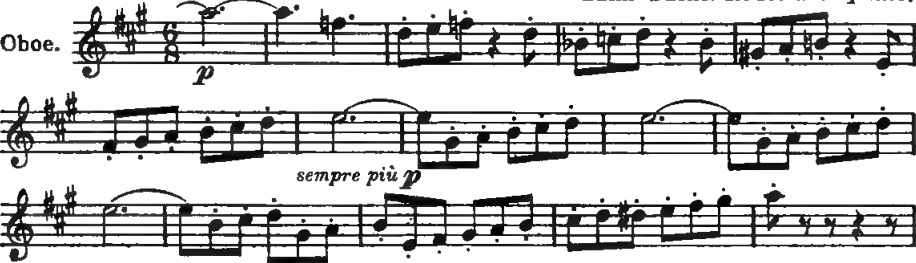
Tranquillo e Scherzando.
Saint-Saëns. Rouet d'Omphale.
The Oboe is essentially a middle-compass instrument. In that register its tone can be varied by a first-class artist from a beautiful throbbing sweetness in the forte to a piano so faint as to be almost inaudible. Within this narrow compass of an octave and a fourth
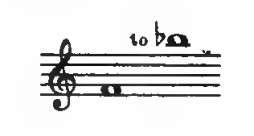
all the best Oboe Solos have been written. Their characteristic remains to-day what it was in the time of Gluck, a touching simplicity which has been happily summed-up by a poet-musician:
"And then the hautboy played and smiled, Cod-heati and la regied child,
It is scarcely necessary to remind the student of the lovely Andante which introduces the Scene of the Departed Spirits in Gluck's Orfeo,

or of the exquisite little passage just before the Baritone Soloist enters in the Choral Symphony of Beethoven,
Example 126
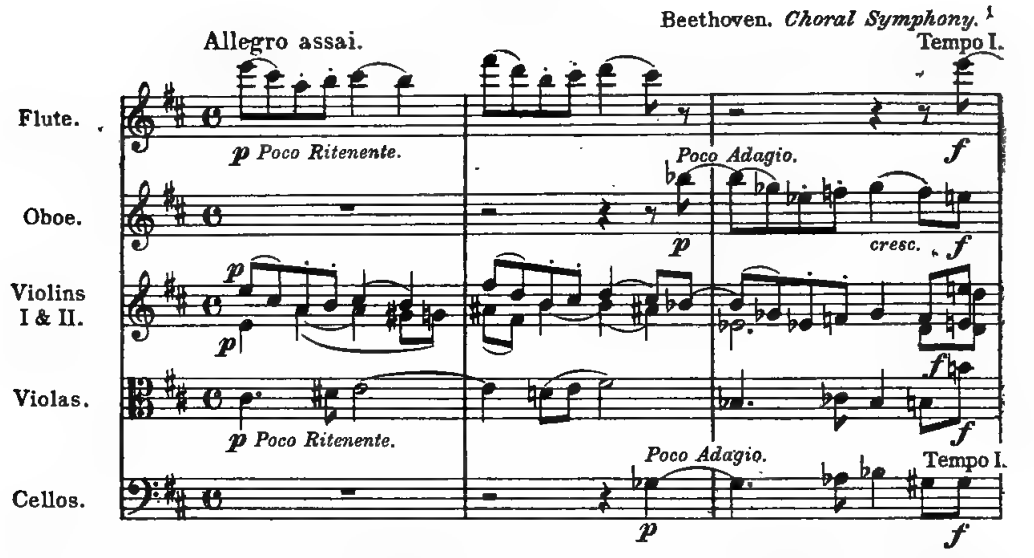
The latter is a happy instance of those short passages in which the Oboe often seems to overhear the conversation of the other instruments and to throw in its own phrase with an added and more intimate
Schubert wrote many ideal solos for the Oboe. These do not Beethoven ake the charace of the see comin sense of the word. At the same time their perfect suitability to the motrume, and these enchant op simplity, make them toniable major Symphony:
Example 127

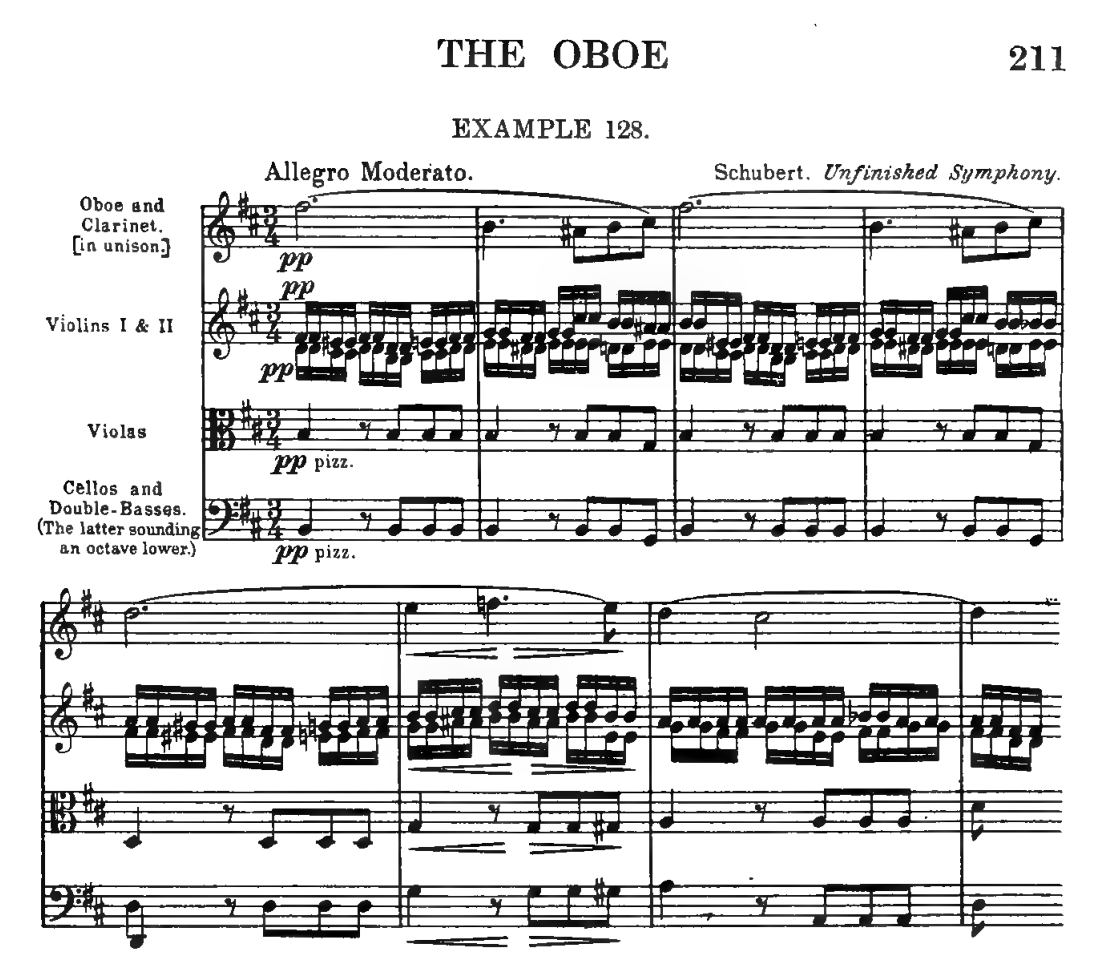
the beautiful Oboe and Clarinet unison at the beginning of the Unfnished Symphony:
1 Tutti on the last quaver of this example.
in the original full Score the Clarinet part is written on a separate stave for "Clarinet in A" in the key of D minor. (Example 128, p. 211.)
and the extended passage for Solo Wood-Wind instruments in the Andante con Moto of the same Symphony. A sketch of this example is given below with the accompaniment omitted. The student should look at it from the point of view of the horizontal arrangement of the melody on the three instruments employed. The quotation is from the return of the 2nd Subject.
Example 129
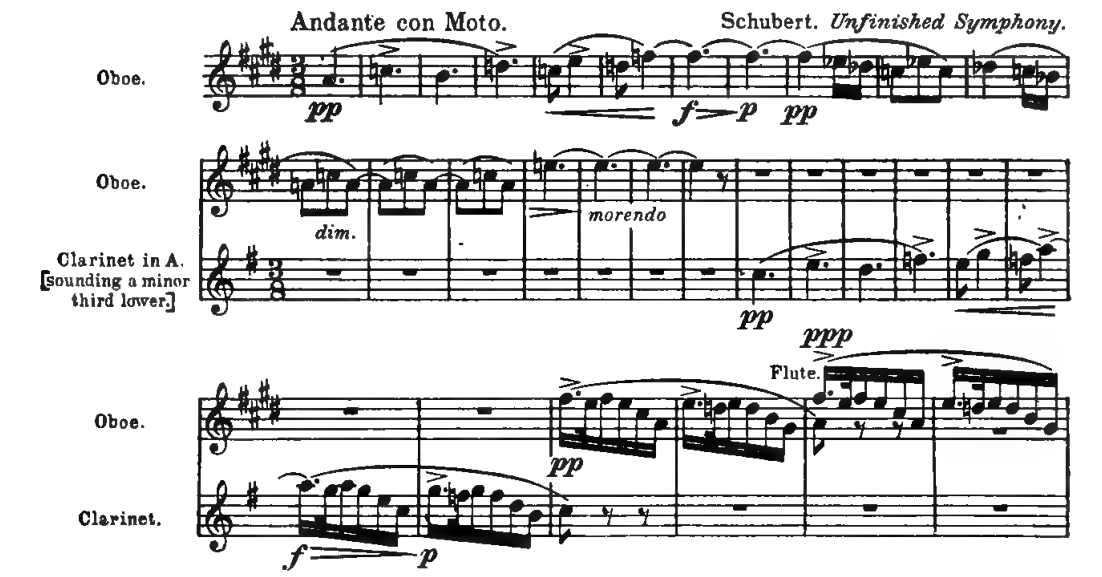
The student must not imagine that the arrangement of a passage such as this is "inevitable." In fact Schubert did . not think so. Ie arranged it differently on its first appearance in . the Movenent. The ditterence of arrangement can be found and studied ol page 24 of peters's Full Score. These microscopic differences in the horizontal arrangement of an extended melody are worth careful thought. No rule can ever be laid down on them. Often a composer will almost wilfully adopt a different arrangement for a second appearance of the same subject. If the music is simple it will probably be matter of technical indifference to the instruments concerned. Again, the same subject appearing a second time may necessitate a different instrumental arrangement by reason of its altered pitch. These things, however, are otten merely questions of personal preterence.'Iwo tonecolours equally good and effective in themselves please two composers in precisely opposite degrees. The only caution that can be given on this point is never to assign a melody on its second appearance to a less etfective instrument (or group of instruments) than that employed at its first hearing. The fact that variety is secured on paper will not enable one to ride off from the disappointment of one's audience.
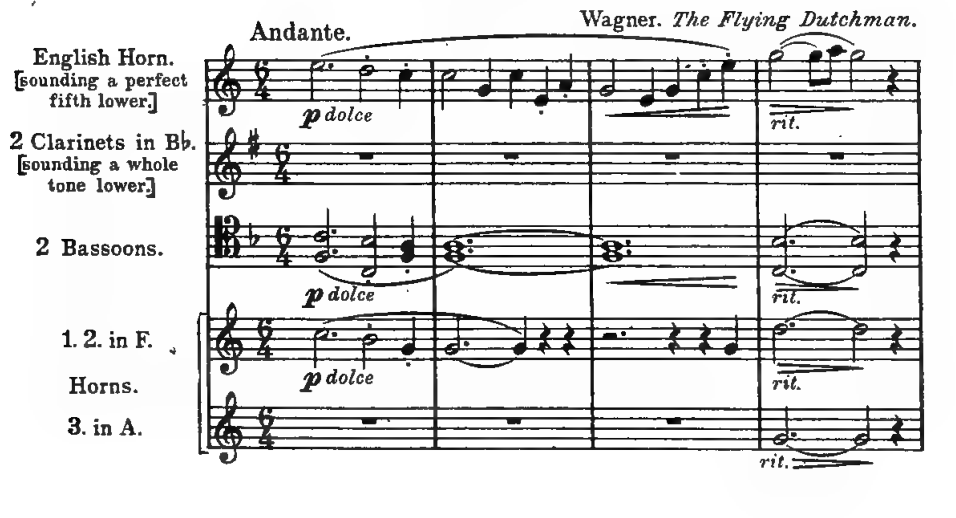
Wagner has written some delightful phrases for the Oboe, though it was apparently not one of his favourite instruments. This is generally a point of prudence on the part of the Operatic as opposed to the Symphonic composer. for the Oboe undoubtedly suffers more than any other instrument when shifted from the heights of the concert-platform to the depths of the Theatre orchestra. In his earlier works there is more Oboe solo-playing than in his later. The last notes of the little tune in the Flying Dutchman overture are said to have been given to the flute during rehearsal owing to the tact that the Uboist could not finish the phrase to Wagner's satistaction. This is the orchestral legend at any rate.
Example 130
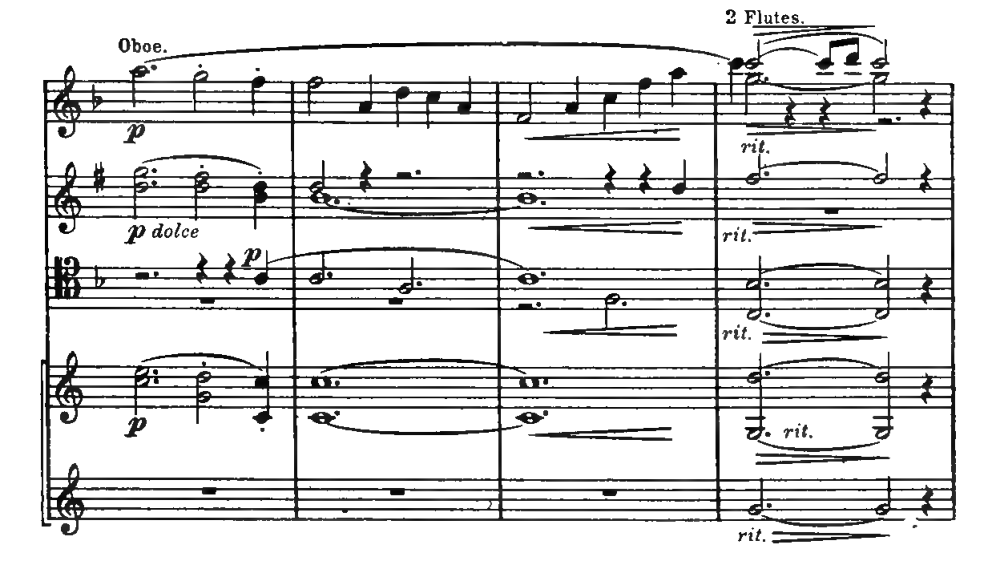
In the more significant works of his middle and later lite Wagner seems to have used the Oboe less. Isolated phrases of this character
Example 131

are to be found scattered through the Ring. When he used it he generally treated it as a purely melodie instrument. But at moments of inspiration he seems to have turned more often to the Clarinet. Perhaps he did not like the German Oboe-players.
With Ischaikowsky the Oboe was a most favoured instrument. As a rule, he wisely confined its Solo-utterances within a very narrow compass. No Oboist could ask for a more effective Solo than the little quaver tune from the Canzona of the F' minor Symphony. The accompaniment is a mere pizzicato of Violins, Violas, and Cellos.
Example 132

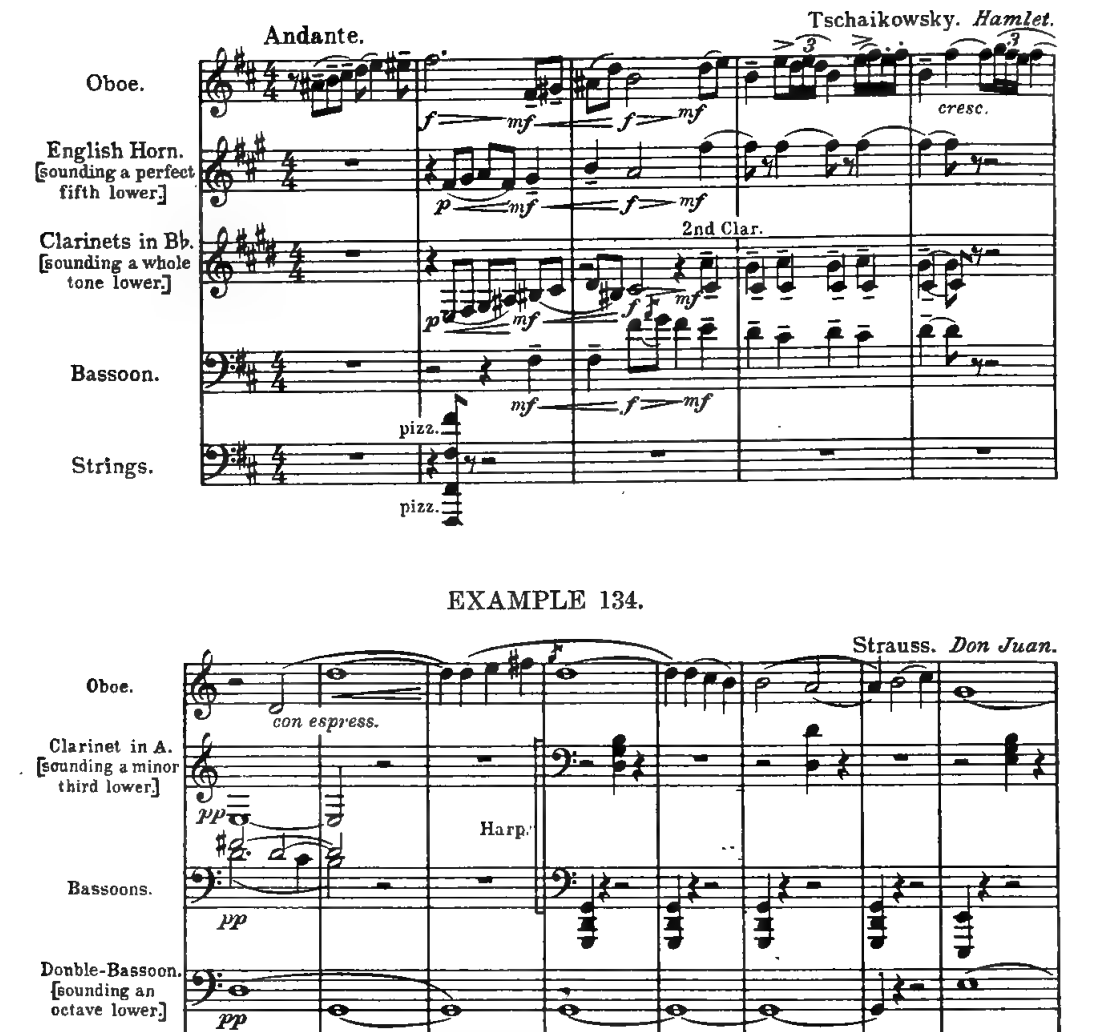
There is a striking Oboe Solo in the same composer's Fantasy- Overture Hamlet. The querulous outline oi the melody has a thicl reedy accompaniment for Wood-Wind. The "vertical" analysis of this accompaniment will well repay the student. The placing of the high Bassoon notes should be specially noticed.
1 Accompaniment of Wood-Wind, Horns, and Cellos.
Example 133
I& II senza sord. I & TV con sord. I & II con sord!
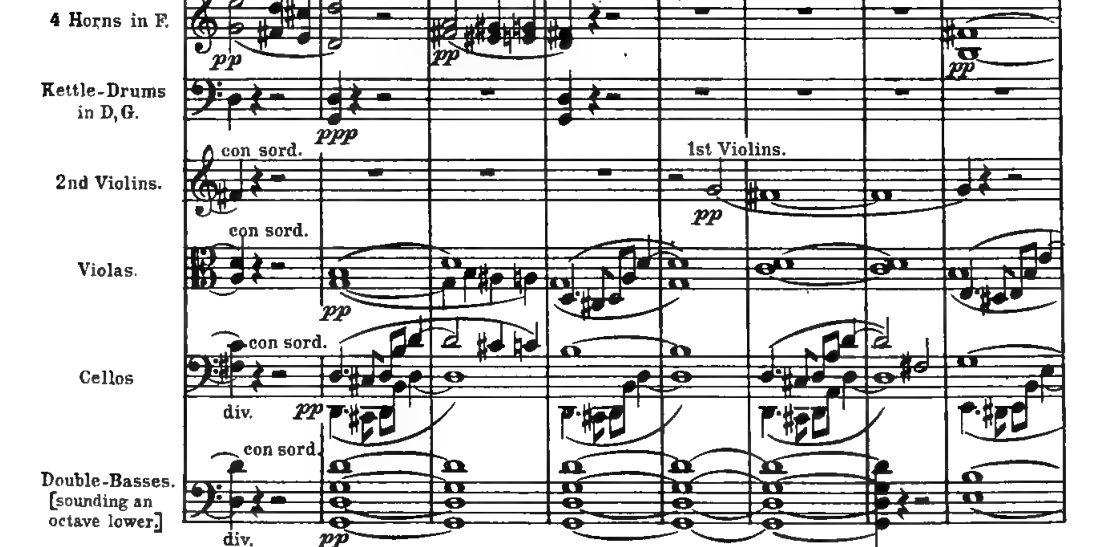
Richard Strauss, who has publicly expressed his preference for the French school of Oboe-playing, has allotted more than one delightful Solo to the instrument. The above passage trom his Don Juan (Ex. 134) is only the beginning of a long Oboe Solo. The student should examine it not only from the point of view of the cantabile, but also from that of the very modern and suggestive type of accompaniment employed. It consists mainly of deep four-part chords, held by the muted Double-Basses. The muted Violas and Cellos alternately play a phrase founded on one of the other subjects, and add the upper parts of the Bass chords. The rest is more or less unessential. This example will be referred to again when we come to deal with the Double-bass.
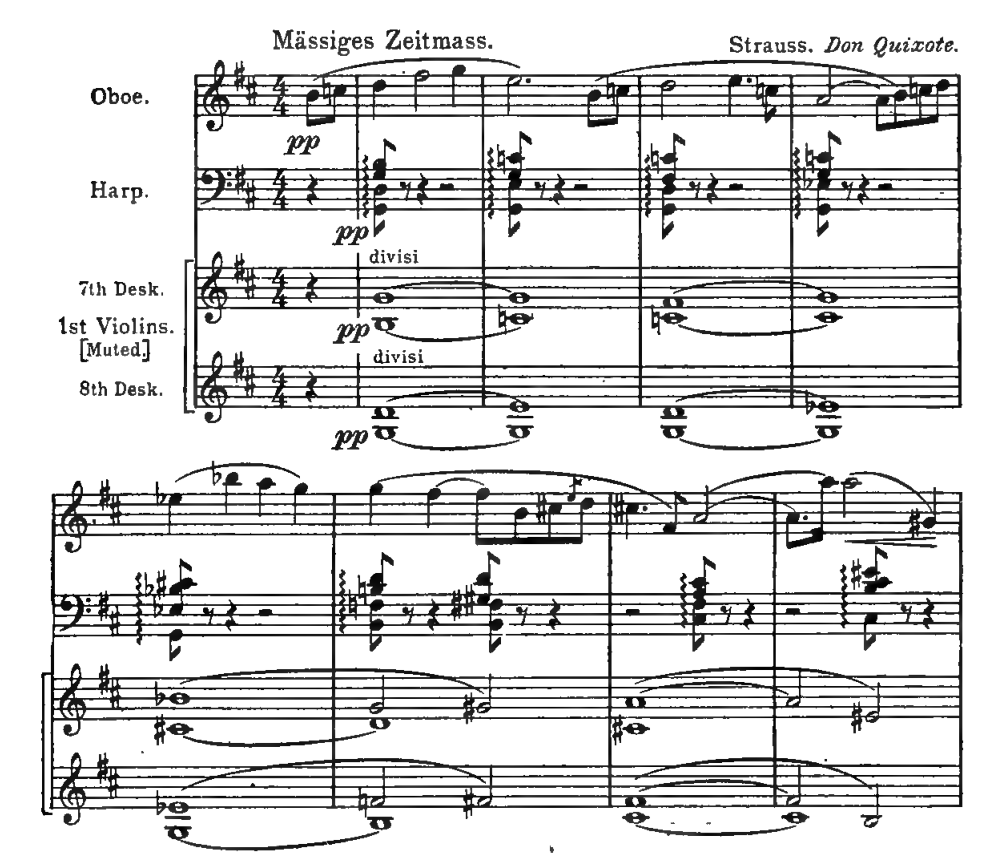
The whole of the above passage should be looked-at in the Full Score. The Oboe cantabile in the introduction to the same composer's Don Quixote Variations is an excellent illustration of the charm and fascination which the instrument can impart to a simple tune. The passage fits the Oboe like a glove, and the studied simplicity of the accompaniment only throws the beautiful tone-colour of the soloinstrument into higher relief. It may be added that the solo part in this example is not generally played at the dead level of pranussimo
Example 135
In all the above models one notices not only that the effective compass of the Oboe is somewhat small, but that the type of melody most suited to the instrument is the vocal type. In other words, the Oboe makes its main appeal not by means uf brilliant figures, arpeggios, and passage work, but by its simple tone-quality. A certain small number of solos are to be found which lie in the top register, and a few passages might be cited where the Oboe, under the dire necessity of musical logie, skips up to its extreme notes. However, these are not models. One may say with confidence that a fiddle E-string melody is not as a rule an Oboe melody. The student will find Solos not of greater effect but of wider range and greater complexity than those given above in the 3rd Entr' Acte of Beethoven's Egmont, in Berlioz's Symphonie Fantastique, King Lear, and Benvenuto Cellini, and in the slow movement of Brahms's O minor Symphony.
Owing to its penetrating tone-colour the Uboe is peculiarly titted tor purposes of humorous or sardonic characterization. This has been happily used in the little rhythmical figure-two Oboes playing in major seconds—that occurs just after the tragedy of the milk-jug in the Ist Act of Hänsel und Gretel. The two Oboes chuckle away with an agitation that is half nervous and half ironical. Meanwhile the Bassoon and Clarinet mimie each other with a fragment of the children's opening song.
Example 136
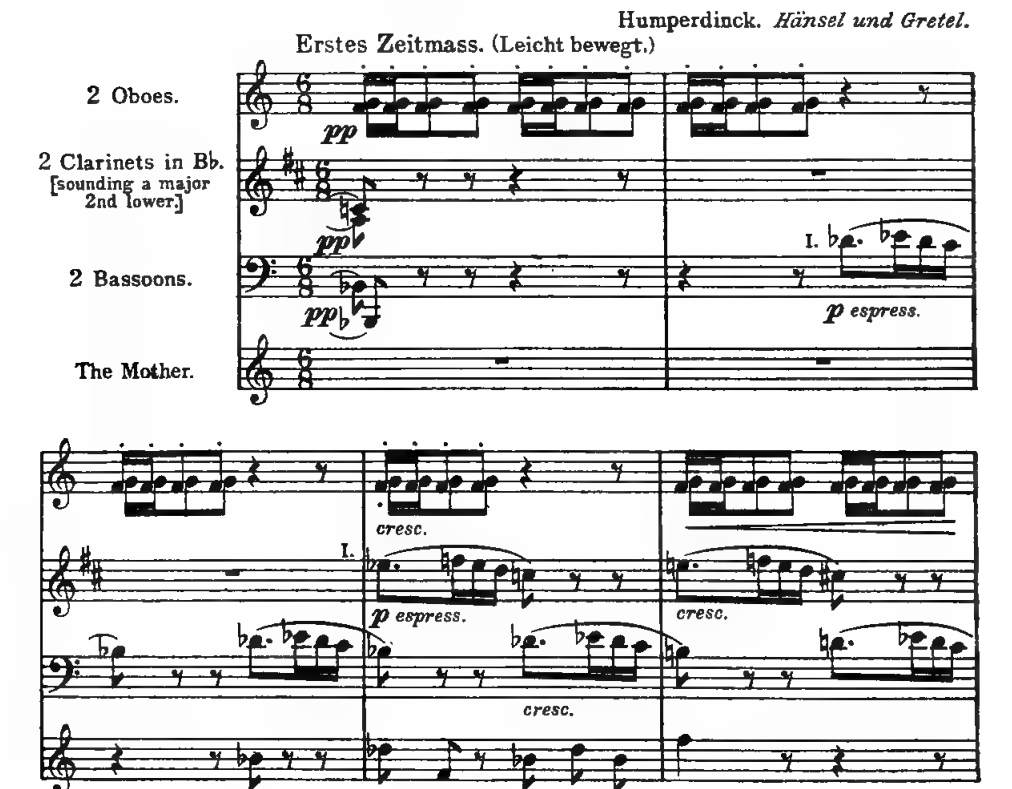
Ben - gel po lachst mich noch aus?
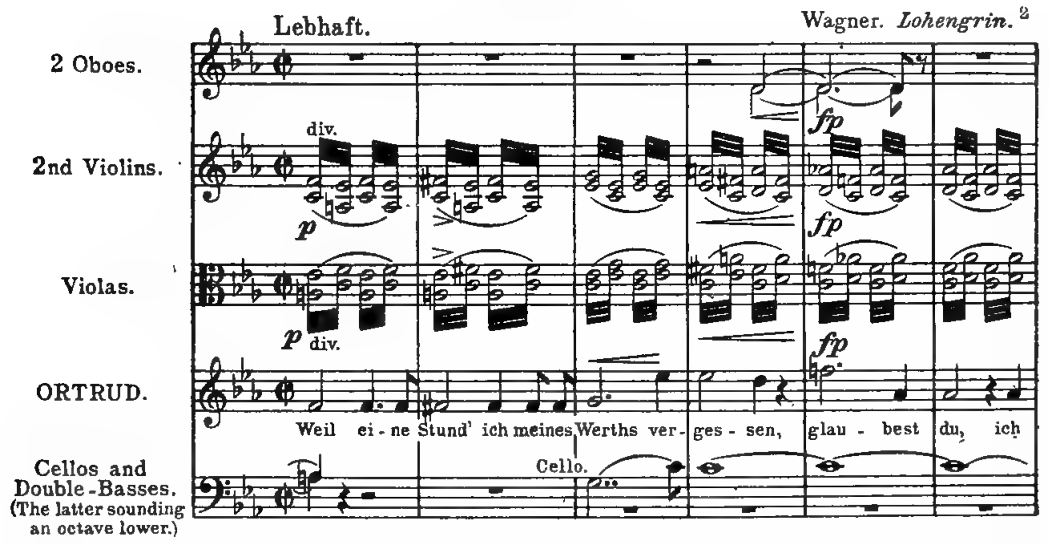
This laculty which all the Reeds possess of emphasizing the spiteful and the mischievous by means of their dry staccatos has often been used to advantage in modern Scores. In especial the Oboe has a curious un-Oboe like quality in its extreme registers. Its lower hith particularly, with its somewhat coarse and over-reedy tone-colour, ha. ›een oiten turned to account as a sort oi English-Horn effect One of the earliest examples of the conscious use oi this tone-quality is to be Iound in Act Il. Scene IV. ot Lohengrin. The two Oboes are on their low D in unison and make a crescendo to a forteprano.
Example 137
In writing for the Oboe the student must remember that the aficulty of the instrument a far as the play ras, in Cle taled is precisely the opposite to that of the In the latter instruments a huge quantity of breath is required to keep the air-

indefinite time. These Oboe sostenutos are often employed with excellent musical results, even when the rest of the orchestra is playing in some definite rhythmical pattern. Long sostenutos, however, make very great demands on the muscles controlling the lungs, chest, and The player is in fact in a continual state of tension. Except When taking breath he can only allow a thin stream of wind to escape through the pipe. The rest of his breathing apparatus is in much the same state as the wind-chest oi an organ with the weights atop
The sostenuto should therefore be used with discretion. When the instrument is brought prominently forward tor solo purposes the player may, of course, be called on for some sacritices in this way, but
1 See below, page 225.
" A crotchet C for Ist Violins is omitted from the first down-beat of this quotation.
when it is only playing a secondary part the composer's rule should be to break up the phrases wherever possible. The player has then opportunity to empty and refill his lungs. Putting solo passages aside, one may say that in order to make its proper effect the pungent Oboe tone requires an average of three or four bars rest at least to every bar of playing. That is to say, in a complete long work the number of bars actually played by the Oboe should not be more than about a quarter the total number of bars in the work.
Everý composer, from Lully to the unpronounceable Russians, has used the Oboe, and, as was stated above, there is more similarity of method to be found between the ancient and the modern Oboe parts than between any such parts for Flute, Clarinet, or Bassoon. standard number of Oboes in Symphony and Opera orchestras is two. In smaller orchestras, such as those in Comic Opera houses, one is ample. In fact the Oboe is peculiarly a Solo instrument. Its tonecolour gives it such prominence that except in purely Wood-Wind ensembles a single instrument answers most purposes. Since the Ring, however, composers have written as many as three Oboe parts, with the addition of an English-Horn. This gives the opportunity of more rest to the individual player and leaves the Ist Oboist at liberty to play the Solo passages untired by any exertions in filling-in unimportant parts.
In this connection one may point out that every addition to the Wood-Wind ensemble helps to restore to them at any rate a portion of their ancient power of balancing the strings. Ut this power they have been completely robbed, partly by the increased number of the Strings, but chiefly by the nineteenth century refinements in Wood-Wind manufacture. The constructional changes which were made at that time not only facilitated the technique and partially assimilated the tonecolours of the various instruments, but also deprived them of their former strident power. The student should keep this fact in mind, as he will occasionally find, especially in eighteenth and early nineteenth century Scores, what seem to be ludicrous miscalculations of instrumental balance.
It is true that up to the time when Mozart fixed the Symphonytradition the instrumental ensemble was not so static as it is to-day. But apart from this occasional laxity we sometimes come across a piece of carefully planned orchestral counterpoint by a great master wluch appears to be an unhappy transference of the Organ-technique to the Örchestra. To our ears it sounds as if the composer had overlooked the fact that he has entrusted simultaneous contrapuntal passages of equal interest to instruments of unequal "telling" The balance is all wrong. The passage won't "come of „power, explanation otten is that the teeble Uboe or Bassoon whose retined notes we hear is only in name the instrument for which the passage was written.