 Playable Books
Cecil Forsyth · section 41 of 60
No. 36. Rarely-used Wood-Wind
Read and hear this section in the playable edition →The Musette, Heckelphon, Heckelclarind, Tarogato, and additional
Oboes.
Passing mention may be made here of three instruments-the Of these the first is obsolete Musette, Heckelphon, and Heckelclarind. and the last two are only rarely used.
The Musette was a two-pipe bagpipe whose natural compass was from
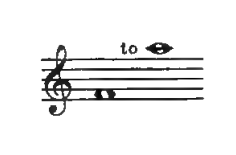
This was occasionally extended by means of keys, a minor second downwards and a minor third upwards. The air was controlled bý a bag under the player's arm. The characteristic melody, accompanied by a drone-bass, gave rise to the little instrumental movements fashionable at one time under the name of "Musettes."
The word Musette was also applied to a small Schalmey or keyless- Oboe pitched sometimes in G, sometimes in Ab.
The Heckelphon owes its existence to Heckel, the well-known instrument maker of Biberich. It is practically what the French call an "Hautbois baryton." The written compass of the instrument
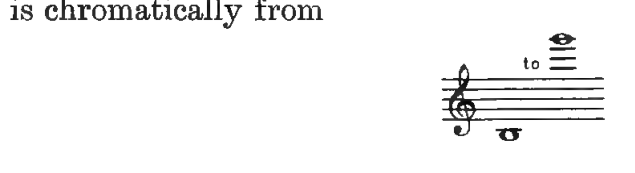
and this sounds an octave lower:
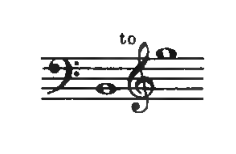
way he aire between stin obre on glish Horn and or be Basoo- The finger-technique is the same as that of the Oboe, but the four top he fotones of its compass are dificult to produce and only available
Strauss has made use of the Heckelphon in his Opera Salome.
The Heckelclarind ' was invented by Heckel with the express purpose ot playing the Solo English-Horn part in Act III. of Tristan. It is built in Bo, and possesses a written chromatic compass from
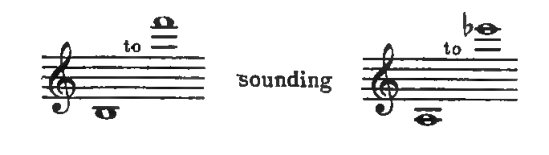
The upper tive semitones are practically useless. The air-column is set in vibration by means of a single-reed like that of the Saxophone or Clarinet. It should therefore be included in the Clarinet group However, , the instrument is so little used that for convenience of reference it is mentioned here.
In some Opera-Houses abroad—e.g. those of Paris and Brusselsthe Far gato ( Meds airies) hat been use ithout is ices, to play the shepherd's air in Iristan. conical pipe of wood furnished with a single piston and terminating in a globular bell something like that of the English-Horn. A clarinetreed is used, and the part is written as for a non-transposing instrument.
A small Oboe-in-El, transposing upwards a minor third like the Clarinet-in-Eb (see page 278), is used in some Continental military bands. Its execution is precisely the same as that of the ordinary Oboe.
Attempts have been made within recent years to extend the compass of the Uboe-tamily downwards by the construction of a Double-Bass-Uboe. These experiments are interesting, first because the Oboe and Flute are the only instruments in the orchestra whose tone-colours are not carried down into the bass-octaves, and next because it is an attempt to revive the sixteenth century Bass-Pommers and Bombards which were reconstructed as Bassoons and, in reconstruction, completely lost all affinity with the Oboes.