 Playable Books
Cecil Forsyth · section 43 of 60
No. 38. The Double-Bassoon
Read and hear this section in the playable edition →
Fr. Contre-Basson; It. Contrafagotto; Ger. Kontrafagott.
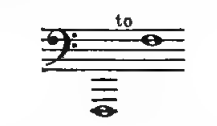
We have already explained that the Bassoon was a development, or rather an adaptation, of the old Bass-Pommer, an instrument which was the ordinary bass of the Schalmey-Pommer family. The largest and most powertul member of this instrumental group was the fourkeyed Double-Bass-Pommer or Bombard (Doppelt-Quint-Pommer). Its length was nearly 10 ft., and its actual compass extended from
1 In Gluck's time there were eight Bassoon-players at the Paris Opera House. There are now four, two of whom " double" in the truttis.
See, for example, the opening to the 3rd Pomp and Circumstance March marke "Fagotti preponderate." Algo Variations III. and XI. of the Eniuma se
From this instrument sprang the Double-Bassoon. In a general sense the last sentence is true, but we must not overlook the fact that the technical development of the Double-Bassoon has always waited on that of the ordinary Bassoon. The object has always been to reproduce the Bassoon-compass and technique one octave lower, but until recently the extreme difficulty of getting the bottom notes has left us with an instrument which lacks the two (or sometimes four) lowest semitones.
Some mention has already been made of Mahillon's attempt to reproduce accurately the tone-quality of the old Double-Bass-Pommer, and to combine it with a modern mechanism and a modern perfection of intonation. This instrument, the Hautbois-Contrebasse, has not hitherto tigured in orchestral Scores.
Though used orchestrally as early as Händel's day,' it cannot be said that the Double-Bassoon had much vogue outside Germany until Beethoven began to write for it. The extreme difficulties of manufacture have resulted in the fact that there is no standard instrument in use all over Europe. Double-Bass-Reed-parts have been continually written for more than a hundred years past, but they have been and are still played in different countries on instruments of diverse makes, compasses, and tone-qualities. These instruments are three in number, and & very briet description of each will at anyrate taminarize the student with their names and general characteristics:
(1) In France, when the Double-Bass-Reed-part is not played on a Sarrusophone, a heavy brass Double-Bassoon is used. This instrument, usually called the "French" or "Belgian" Double-Bassoon, should be more accurately known as the " Austrian Double-Bassoon," since it was invented at Presburg towards the middle of last century. It is commonly known as the Mahillon-Schöllnast Double-Bassoon. It is a seventeen-keyed instrument, in appearance not unlike an ordinary military "Brass-Bass." It has a huge conical bore, and the tube, which is about five yards long, ends in a brass "bell" like that of a "Tuba." The tone-quality is coarse and "blurty." The technique is remarkably
to
sounds an octave lower
It will be seen that this Double-Bassoon fails to reproduce the four bottom semitones of the Bassoon compass in the octave below. instrument is practically unknown to English orchestral players.
(2) The English Double-Bassoon, as designed by Dr. Stone and modified by Alfred Morton and by Haseneier of Coblentz, is a wooden instrument whose conical bore varies from a calibre of 1 inch at the reed-end to one of four inches at the open end. As in the ordinary Bassoon the open end of the instrument points upwards. There is,
1 The instrument built for Händel by J. Stanesby, jun., and played by F. Lampe at Marylebone Gardens in 1739 was exhibited at the Royal Military Exhibition in London, 1890.
however, no "bell-joint." The open end is simply finished off with a narrow rim. A heavy double-reed is used, and the compass of the

The two bottom semitones of the ordinary Bassoon compass, Bi and Bo, cannot be produced in its lower octave. This instrument, commonly known as the Stone-Morton-Haseneier Double-Bassoon, is the one which until recently was most familiar in our concert-rooms. It is undoubtedly an easier instrument to play than the "French Double-Bassoon." Its quality, however, in its lower compass—the only part that matters— leaves a great deal to be desired. The impact of the separate vibrations is unpleasantly prominent to the ear. In fact in its bottom fifth there appears to be more "rumble" than note. On the other hand, the instrument, though coarse, must be allowed to have abundant power and the capacity to support a huge volume of orchestral harmony.
The modern German Double-Bassoon, which appears likely to oust both the above, owes its improved existence to Heckel of Biberich and

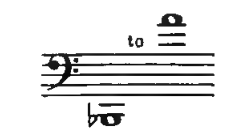
peculiarity of its appearance is the metal bell which points downwards. The crook is much like that of an ordinary Bassoon, a narrow curved tube of metal into which the double-reed is fitted. This instrument has two great advantages over any other Double-Bassoon. In the first place its quality is much more refined and much less obtrusive. vibrations in its lowest fifth are not nearly so apparent to the ear and the tone-colour is homogeneous and practically the same as that of the ordinary Bassoon, In the second place it has a chromatic compass right down to the low Bb. Its written compass is

The instrument "speaks" easily even in its very lowest notes.
One need not say that the Double-Bassoon, whatever its make, is titted only to play heavy bass-parts and bass-passages of a strictly moderate speed • In most Double-Bassoons the notes at both ends of the compass are unsatisfactory. In the Heckel instruments the top fourth is undoubtedly bad in quality. This, however, is of no consequence, as the two ordinary Bassoons can always play the parts in this portion ot the Keed-compass.
The notation of Double-Bassoon parts is always in the bass-clef and an octave higher than the actual sounds required. There seems to be only one exception to this rule. Wagner writes the instrument at its actual pitch in Parsifal.
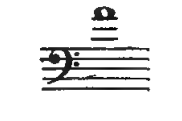
The orchestral intention of the Double-Bassoon is so obvious and its orchestral outlook so elementary that we need not devote much time to that side of the matter. A few words, however, must be said with regard to the elaborate Double-Bassoon part in the Finale of the Choral symphony. This appears to have been written by Beethoven for a smaller and more flexible instrument than the one used at the present day. We have no knowledge that such an instrument existed. On the other hand, it may have been written under a misapprehension oi the instruments limitations. This may perhaps have been caused by his deafness. He employs the instrument continually with the Double-Basses even in the Prestissimo, and writes for it up to top A
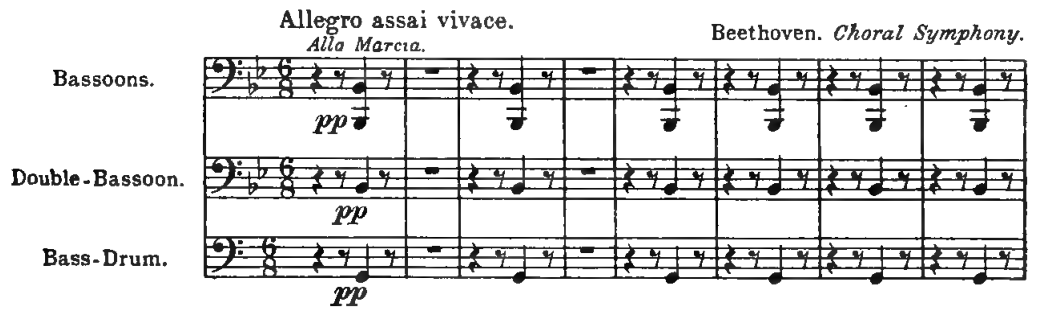
Its entry at the beginning of the Allegro assai vivace, unless very caretully played, only just misses being grotesque. The Score contains nothing for the first eight bars but Bassoons, Double-Bassoon, and Bass Drum:
Example 174
These curious infelicities are all the more remarkable as Beethoven has written at least one striking Double-Bassoon part. The passage occurs in Fidelio, where the grave is being dug,
Example 175

Brahms, in his C minor Symphony, asks as much from the instrument as Beethoven. Within thirteen bars in the last Movement he uses a written compass of nearly three octaves.
Wide ed petro to trep artares, and a maico hid notes in tiesimo with the Double-Basses, are all to be found in this Symphony. Instead of these, it is perhaps better to quote the simple chorale-subject in the Più Andante of the last Movement. In this passage the Double-Bassoon doubles the Bass-Trombone in the octave below. It always "tells" wonderfully in performance.
Example 176
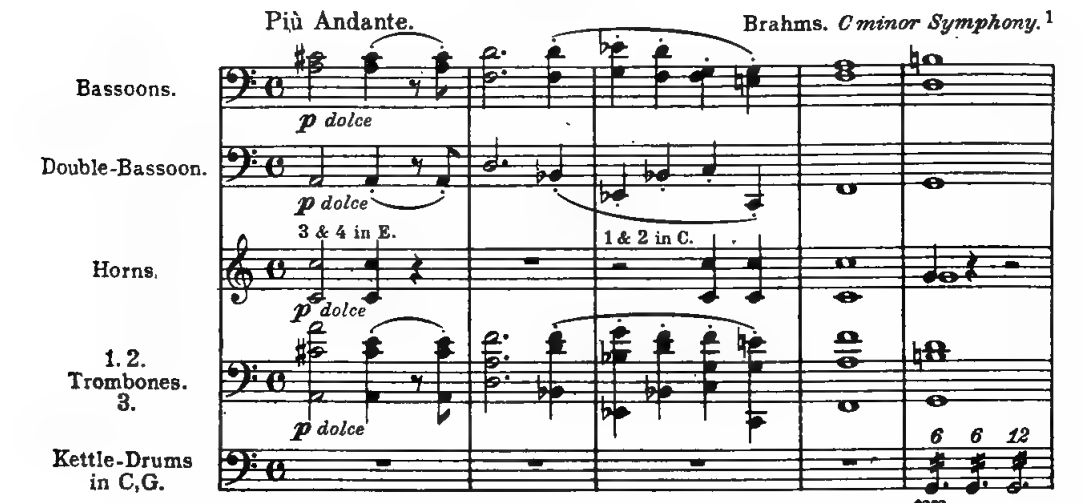
PP
Note. The Tenoroon, now obsolete, was a small Bassoon pitched a fifth higher than the standard instrument. Its written chromatic

In tone-quality it closely resembled the Bassoon. The superior power of the latter in the lower octaves and the superior tone-colour of the English Horn in the upper have prevented the Tenoroon from acquiring Solo in Rossini's William Tell Overture was originally designed for the Tenoroon is a mistake, based probably on the fact that the part was written in the old Italian Notation; that is to say, in the bassclef an octave below its proper pitch.
The Quartiagott, now obsolete, was a large Bassoon used in Germany. It was pitched a pertect tourth lower than the ordinary Bassoon.
1 See also the end of this movement, the Più allegro, where this subject appears again f.
2 Fr. Basson quinte: It. Fagottino: Ger. Quintfagott or Tenorfagott.
3 See above, pp. 221-2.