 Playable Books
Cecil Forsyth · section 44 of 60
No. 39. The Clarinet
Read and hear this section in the playable edition →

Fr. Clarinette; It. Clarino (less usually Clarinetto); Ger. Klarinette.
The Clarinet is a descendant of a mediæval instrument known as the "Chalumeau." The history of the latter instrument has furnished matter for considerable discussion. Even the existence of such an instrument as a separate and clearly defined type has been denied. Without entering fully into the various arguments that have been brought forward to support one view or the other we may put the probable facts of the case into a few sentences.
The word "Chalumeau" (Schalmey) was used irregularly and loosely to describe not one instrument of special bore and make, but almost any small Wood-Wind instrument. It was a generic name, and as such was applied (a) to wooden pipes played with a doublereed, (b) to wooden pipes played with a single-reed, (c) to the chanters of Bagpipes and Musettes.
(2) One of these early "Chalumeaux" was undoubtedly a small keyless cylindrical pipe. It had no "bell" at the end, but was played with a single-beating-reed which was scientifically the same as the modern Clarinet-reed.?
This instrument was the precursor of our present-day Clarinet. Its resemblance to the Schalmey, the ancestor of the Oboe, consisted *bele fact that both were straight keyless wooden pipes without Its essential difference from the Schalmey lay in the fact that the former was cylindrical in bore and single-reeded, while the latter was conical in bore and double-reeded.
The fact that the words "Chalumeau" and "Schalmey" were used in a confused manner to describe any small reed-instrument goes some way towards proving that, in their early undeveloped stages, all these instruments had a strong similarity in sound. It the difference in tone-colour had been very marked, this looseness of nomenclature would probably not have existed.
However, in the difference of bore and reed lay the possibility of a development which was to take the two instruments farther and farther apart. The stages in the development of the Clarinet from its archetype the cylindrical, single-reeded " Chalumeau" are well known and simple. The first milestone on the road is marked by the name of J. C. Denner (1655-1707), who added the "speaker-key."3 In doing this, he fixed the type, as it were, and gave the player the opportunity
' The word "Clarinet" is probably a diminutive of "Clarino," the old Italian word for the Trumpet, which played the top-part. Another suggested derivation is from the Italian « Chiarina" = « reed-instrument." As with most musical philology, there is very little satisfaction to be got here.
"The Pibcorn, Swegelhorn, or Hornpipe, cannot be taken into account as the ancestor of the Clarinet for, though it had a single-beating-reed, this was always enclosed in a sply terminedy to the easy be and alman ape peas a ta o
3 See page 179.
of doing with ease what had been before either difficult or impossible. The only method by which an extended scale can be produced in a cylindrical pipe is by overblowing the fundamental scale at the twelith, and in order to split up the vibrations of the air-column into their aliquot parts the assistance of the "speaker" is essential.
It may be mentioned, in passing, that the early instrument to which the "speaker" was first added appears to have had a downward
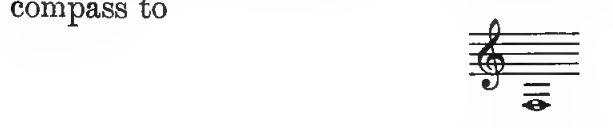
From there upwards the opening of its nine holes successively gave it a diatonic compass in the key of l' to
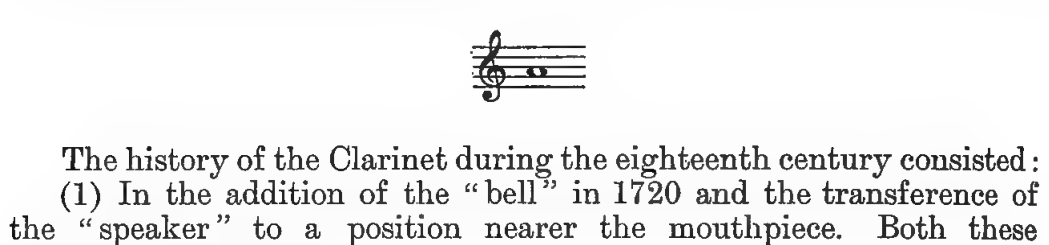
improvements are due to J. Denner, possibly a son of the man who invented the "speaker."
(2) In the gradual addition of metal keys to complete the compass and tacilitate the execution. The sixth key was added in 1789 by the brothers Stradler, the celebrated Viennese Clarinettists, for one of whom Mozart wrote his Clarinet Concerto.
By 1810 Iwan Müller was making thirteen-keyed Clarinets in Paris. This inventor improved the instrument in many other ways, and his successful experiments form the basis of all modern Clarinet manufacture. In 1842 Klosé applied the Boehm system of moveable rings to the instrument.
The Clarinet as we have it now is a cylindrical pipe of wood or ebonite two feet long, made in either one or more sections. These sections comprise the mouthprece, the barrel-joint, the left-hand or top jornt, the right-hand or lower joint, and the bell.
The mouthpiece is usually of wood. With metal mouthpieces the tone becomes clearer and more brilliant, but also harder and less sympathetic. All sorts of experiments have been made in this direction.
most beautiful tone-quality.
The upper part of the "beak" mouthpiece is flattened to form the "table" which supports the reed, a single piece of carefully prepared "cane." The beating of this reed to and tro sets the air-column in motion. It has, therefore, to be adjusted to the "table" with the greatest care. Neither too large nor too small a space must be left between the reed and the end of the mouthpiece. The reed, which was originally bound on to the mouthpiece with fine twine, has now for over a hundred years been secured in its place by means of a metal "ligature."
A reference to the illustration of a Clarinet-mouthpiece given at page 180 (Plate Vıll., Fig. 4) Will make these technical details pertectly clear. The mouthpiece there shown is that of an ordinary Bo-Clarinet, but scientifically the illustration holds good of the smaller and the larger Clarinets and of the Saxophones,—in tact of aul the singlebeating are i tremente the or ncapa hid to not in postilly. (2) the metal legature, (3) the narrow air-space just visible where the upper edge of the "cane" meets the upper edge of the mouthpiece. this is the essential part of the apparatus; tor, as we shall explain presently, it is by means of the combined pressure of his upper lip on the "table" (the portion turned-away in the illustration) and of his vibrations on the recolumn It lay be ded that to set up portion. ot the reed is quite free to vibrate under the action of the player's lips and breath. If we loosen the two screws of the ligature and withdraw the thin slip of "cane" we find that the "cane' itselt completes the pipe at its extreme upper end. In other words the material of the pipe is cut-away on that side, and, when the reed is in position, it lies in contact with the vibrating air-column.
The method of tone-production is as follows. The player takes the mouthpiece between his lips, and, by the pressure of his lips and breath, sets the flexible reed in motion. This beats against the "table" opening and closing the gap at the upper end. The rate of this opening and closing is, of course, solely dependent on the rate of the vibrations set up in the air-column within the pipe. This in its turn is governed by the opening and closing of the holes and keys.
The Clarinet being a cylindrical reed pipe has the properties of a "stopped-pipe," that is to say, its fundamental note is an octave lower than the corresponding note either of an open-pipe or of a conical reedpipe of the same length. In addition to that it " overblows a twelfth." I'ne student will see without ditticulty that in practice this means that the fingering of the Clarinet differs fundamentally trom that of the Flute and Oboe.
Boehm, Gomez-Boehm, Buffet, Müller-Bärmann, etc.—it is not necessary to go. Without touching any of these keys or using the thumbholes the player can open the seven holes in his pipe successively, and it he does this he will produce the natural scale of
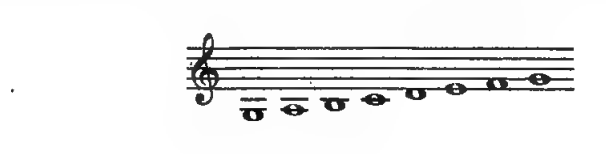
Under any of the systems, however, the compass is extended. down-

and in practice a fundamental chromatic scale is obtained from & in It is only on the late
the twelfth above his lowest note that the player begins to overblow and by this means he continues his compass chromatically upwards
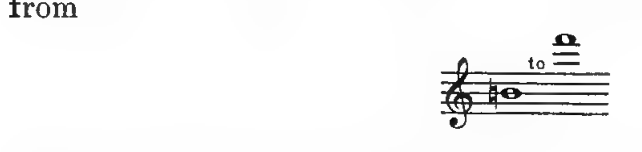
Beyond that seren further semitones are to be got up to high C
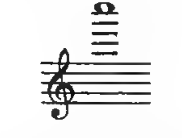
These are either fifth harmonics (two octaves and a major third above the fundamental notes) or ninth harmonics (three octaves and a major second above the fundamental notes).
In Mozart's day the Clarinet compass appears to have extended down a major third to low O
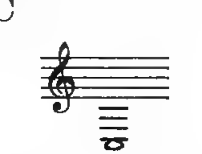
He uses that note in Clemenza di Tito, and, on the Bb instrument, for which the passage was written, the sound would of course be a wholetone lower.
During the classical period, and well into the middle of the nineteenth century, orchestral Clarinets were made in three keys:
(1) The Clarinet in C, a non-transposing instrument written for and sounding in the key of the piece.
(2) The Clarinet in Bo,' a transposing instrument sounding a major second lower and therefore written for in the key of two b's less, or two #'s more than the key of the piece.
(3) The Clarinet in A, a transposing instrument sounding a minor third lower and therefore written for in the key of three b's more or three #'s less than the key of the piece.
1 Mozart uses a B! Clarinet in Cosi fan tutte and Idomeneo. It was pitched a semitone below the C-Clarinet, and gave an easy key-signature for very sharp keys. It is quite unknown nowadays.
Of these three Clarinets the first—the non-transposing C-Clarinet— is obsolete. This leaves us the choice of two instruments with the
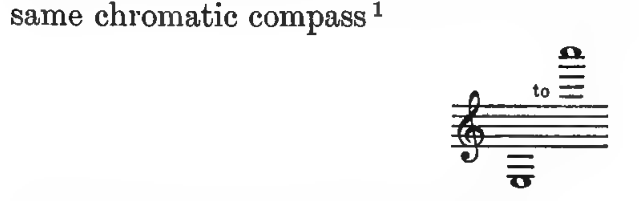
which, on the Bb-Clarinet, sounds

and on the A-Clarinet sounds
the fitst nice he chois to be he de beth diftento instruty in far tr How then is the choice to be of the lower-pitched instrument. It is, however, a good deal less than the difference between a Brescian and a Cremonese Violin. In point ot tact not even an expert Clarinettist can tell (trom its tonequality) whether a passage is being played in the concert-room on the A- or the Bo-instrument. The difference between the two instruments is more a matter of text-book theory than of practical fact. The student shoula, theretore, choose the instrument which will give the Iewest b's or f's in the Ularinet key-signature. On this point he should read again what was said above with regard to the A-and B- Cornets, as the two cases are exactly parallel? The general rule may be mentioned again: Use Bo-Clarinets for flat keys, A-Clarinets for sharp keys, and remember the possibilities of enharmonically varied key-signatures for the extreme keys. Example: Key OF's, FF major = Go major. Bb Clarinets will therefore be in Ab major (4 flats), and if the modulations are northwards, would of course be preferable to A-Clarinets playing in A major (3 sharps).
In dealing with all these questions, however, the student must bear in mind that the dexterity of the best modern Clarinettists is so great that the question of keys is not of the greatest importance.' Mechanisms, again, vary considerably, and what is easy to one playel is not so easy to another. Strauss states that his solo Clarinettist uses a system of fingering which actually makes the key of By major easier than that of Bb major. He adds that on the Sax-Clarinets sharp keys are the easier, while on the iwan Müller-barmann instruments the flat keys are the more practicable.
1 The two top semitones, B and C, are excessively difficult. See page 262.
•Some composers of the old French Operatic school (Hérold, Chérubini, Spontini tc.) used to adopt the rather useless method of writing the Clarinet part regularly in the key of the piece. The continual employment of the C-Clarinet was by no means intended. The transposition and choice of proper instruments was merely left to the copyist or player.
See page 196.
The student need not be disturbed by these differences of technique. He should select the instrument which gives as simple a key-signature as possible and then stick to it. Unless for the most urgent reasons, such as, for instance, to avoid giving the Clarinet a prominent and very dificult passage in six sharps, it is better not to change the instrument in the middle of a piece, at any rate in concert-work. difficulties of correct intonation on a cold instrument generally counterbalance the supposed simplitication of key.
We mentioned just now that a third Clarinet-the non-transposing instrument in C—is obsolete. This Clarinet was slightly harder in quality than either of our present instruments, and the statement is always made that composers when they used it did so tor the special purpose of utilizing its. bright incisive tone-colour. Conductors are therefore adjured to employ this instrument when it is indicated in a Score of the old masters. It is true that in some few instances composers may have used it with this special object in view. But it is a most surprising coincidence that nine times out of ten the desire for this hard tone-quality existed when the key of the piece happened to • be C major. There are, of course, some few examples where the composer's apparent intention is to utilize the instrument for the sake of its harder quality. An example of this is perhaps to be found in the Scherzo of the Choral Symphony, and an analysis of the Clarinet changes in that work may be of interest to the student as showing him the difficulties under which composers laboured at a time when the harmonic schemes of musical works were being much extended, but were still unhelped by the necessary mechanical improvements in the instrument.
Down to the end of Mozart's lifetime these difficulties did not exist. Music was written in short sections and rarely modulated far from "home." A suitable choice of Clarinet was made at the beginning of a piece, and only on the rarest occasions even in Opera was it necessary to change the instrument during the continuance of the music. The same thing holds good to-day. The modulations have gone farther afield, but so has the mechanism of the Clarinet. There was, however, a transition period when the boundaries of musical composition were being widened, but there was no great technical widening on the part of this special instrument. In a work like the Choral symphony, with its many changes of key-signature, a new problem was presented and evidently faced with some hesitation. The following is the analysis. The student should, if possible, read it with the Full Score in front of him:
First Movement in D minor. Bb-Clarinets throughout (written key E minor).
Second Movement in D minor and D major. C-Clarinets throughout (written keys D minor and D major). This choice would appear to have been dictated by reasons of tone-colour, but even here it is at least as probable that the change to C-Clarinets was merely made so as not to frighten the Bb-Clarinet player by a signature of 4#'s in the D major sections.
Third Movement in Bo. Bo-Clarinets (written key C major). When the signature of the piece changes to 24s and II (Andante moderato) Beethoven preters to leave the signature of O major in the Clarinet parts rather than risk signatures of 4a's and 3e's. When the signature of the piece changes to 3b's Beethoven writes-in the correct keysignature of Ib for the Bo-Clarinets.
Last Movement in D minor. Bo-Clarinets again (written key E minor). When the key-signature of the piece changes to D major (Allegro assai) there is no time to change Clarinets. Beethoven continues to use the Bb-instruments for the first 15 bars, but, instead of giving them the correct signature of 4I's, leaves their original keysignature of I and writes-in accidentals.
Fifteen bars later the Clarinets have a long rest; so he changes to A-Clarinets, and writes them with their correct signature of 1o. The music remains in D major.
The A-Clarinets are used as far as the March Movement, and, as the greater part of the music is in 2f's, their signature of Ib is generally correct.
At the Presto, however, the key-signature of the piece is 1o. The correct signature of the A-Clarinets would, of course, be 4b's, but Beethoven merely writes a single b in the Clarinet-signature, and adds accidentals for the other b's. It is difficult to understand the advantage of this, because the player has to finger and play the Ab's and Db's that occur in his part, whether they are put into the signature or not.
At the March Movement (Allegro assar vivace) the key of the piece is Bb. The Clarinets have eight silent bars in which to change back to Bb-instruments. Their key-signature is now C major.
At the 163rd bar the key-signature of the piece changes to 2#'s. 'The correct key-signature for the Clarinets would be 41's. Beethoven, however, leaves the key-signature of C major, uses the Clarinets as little as possible, and is compelled to write an accidental to almost every note they play. In one place the part vacillates betweer extreme sharp and extreme flat keys.
Atter a long rest for the Clarinets the Andante maestoso is reached. The key of the piece is G major. Beethoven changes to A-Clarinets, gives them the incorrect signature of 1b, and adds the Eb as an accidental.
When the key-signature of the piece changes to Ib and (later) to 2b's the Clarinets are written, not as they should be, in 4b's and 5b's, but in Ib and 2b's, just as if they were C-Clarinets. However, for the principal and constantly recurring key-signature of the piece (2#'s), the true key-signature of 1b is marked in the Clarinets.
At the seven bars of key-signature 5fs that come just betore the final Prestissimo the Clarinets have their correct key-signature of 2*'s.
The student should note in the above analysis that, in general, where the key-signature is fixed and the music remains near its original tonality, the choice of Clarinets and their key-signatures are quite simple, and practically the same as they would be at the present day. It is only when there is a certain change of key-signature, or when the music is likely to make a distant modulation, that all the confusion of changed instruments and incorrect signatures begins. With modern Clarinet-mechanisms, all this muddle automatically disappears. There is nothing in the whole Symphony to necessitate either an incorrect key-signature or a change of Clarinet when once a Movement has begun.
Alter this somewhat long digression we must return to our more immediate subject, the modern Clarinet-mechanism. It should be mentioned, first of all, that there are mechanical contrivances for instantaneously altering the Bb-Clarinet to the A-Clarinet. They are, nowever, not much used. Some tew artists actually play everything on Bo-Clarinet, transposing the part as required. In these cases, it li necessary for the player's instrument to be furnished with an additional key giving the low Eo. This of course produces the sound low Db (C♯), the same sound as is produced by the written lowest note
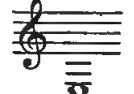
of the A-Clarinet. The practical mechanism of this extra semitone has not yet been perfected to satisty the majority of players, and the student is therefore warned not to regard it as an integral note in the Clarinet-compass.
Uccasionally one tinds passages in which the composer specially uses the A-Clarinet in order to take advantage of its lowest note. the first five bars of the Largo of the New World Symphony (key Db major) Dvořák wishes to use the bottom Db in bars 2 and 3. He has to write it for A-Clarinets. The part, however, is only eight notes long, and immediately afterwards he changes to Bo-Clarinets for the passage in tenths with the English-Horn (quoted above, Ex. 140). He therefore does not trouble to give a correct Clarinet-signature for these first five bars. He writes not in the true key of 4#'s (= 8b's), but in the key of to, the proper signature for the Bo-Clarinets in the rest of the movement. For four out of the eight notes he has to use accidentals. In practice, most symphony players would actually change instruments after these opening bars. A few, however, who use a Bo-Clarinet provided with the low Eo-key would employ that instrument throughout the movement.
Compare this with Beethoven's practice in the three Leonora Overtures. All three are in C major. In the 2nd and 3rd Overtures he uses C-Clarinets. For No. 1, however, he uses Bb-Clarinets, and writes, not with the correct signature of 2#'s, but with that of 1b. This gives them three accidentals in the main key of the piece, but puts them right for the Adagio non troppo section in Eb.
It may be mentioned, in passing, that the technical names for the metal keys on the Clarinet are not those given above for the sake of simplicity. What a layman might call the low "El key" is known by the name of its first overblown note, the "Bl key." This applies throughout the whole instrument.
From what has been said above it might be supposed that the tele for one the las in is so he comphantd. mb is are seven The right-hand thumb is engaged in holding up the instrument, so that practically only the two little fingers are quite free for key-work. The rest of the fingers have to be used only as opportunity offers. Yet so cleverly contrived are the modern mechanisms that it really becomes a difficulty to make any list at all ot " impossible passages. A general warning to the student may take the form of a caution against basing any prominent passage on these three notes
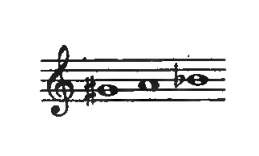
the weakest and most intractable on the instrument.
All the old last-century lists of impossible shakes are completely out of date. Nowadays all shakes whole-tone and half-tone are possible from the half-tone shake on

to the half-tone shake on
In the ordinary routine of orchestration they may all be written and can all be played sufficiently correctly and easily to make their tech-
For Solo passages, however, there are a few shakes which are neither so easy nor so effective as the rest, and these it is well to avoid. They are the two whole-tone shakes on the bottom Ft's with their
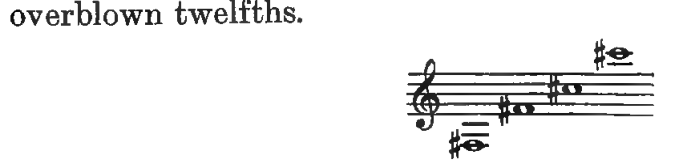
In addition the half-tone shakes on
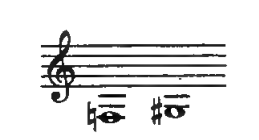
are either clumsy or ineffective.
These six shakes, all of which are possible in the tutti, should not be introduced into any passage where they are likely to be clearly heard.
The Clarinet is one of the very best instruments in the orchestra for tremolo-work. Its restrictions in this kind are few. In general all tremolos up to an octave are possible, provided the upper-note of the two forming the tremolo is not higher than
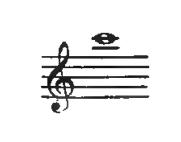
As with the shakes, however, a few of these tremolos are not so easy and effective as the rest. it the composer does not wish to throv lthculties in the way of the player he will do well to avoid th
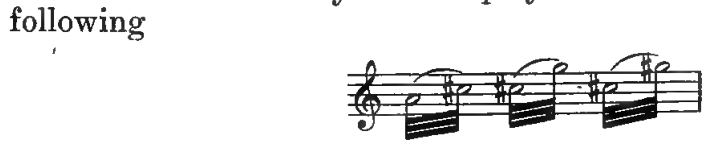
and to remember that it is always practicable and always better to confine the limits of the tremolo to thirds, fourths, and titths. Finally, though this is not of the greatest importance, he should recall the caution given above with regard to the notes
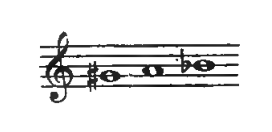
If he can arrange his tremolo so as to avoid any of these three notes, especially as the upper-note of a tremolo, his part will be improved.
Another small point which is worth consideration. Passages based on octave-skips, though congenial to the character of conical instruments, are unnatural to cylindrical instruments. On almost every orchestral instrument—Brass, Wood, and String—the player pertorms most of his octaves by setting himself in a position from which both the lower and the higher note can be taken. With the Clarinet this is impossible. Indeed out of the sixty Clarinet passages which Berlioz gives as examples of what not to do, only these two
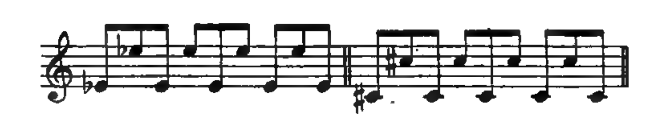
remain as practical impossibilities even with ourpresent-day mechanism. Different methods of single-tonguing are employed in different countries and schools. They vary from a sharp incisive staccato
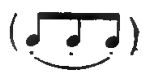
(.??) through a sort of hall-staccato
to a delightfully caressing stroke which just articulates the note as it is sounded
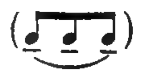
The Clarinet approaches nearer than any other instrument to the soft swish of the Violin bow when it sets the strings in motion. The easy charm and delicious refinement of the Clarinet-articulation is of course matter tor universal admiration. Naturally it cannot beat the Flute on the Flute's own ground—repeated notes—but still it is capable of a very respectable speed even there. See Exs. 47, 48.
One of the most characteristic features of the instrument is its marked difference of tone-colour in its three registers. Its bottom octave from
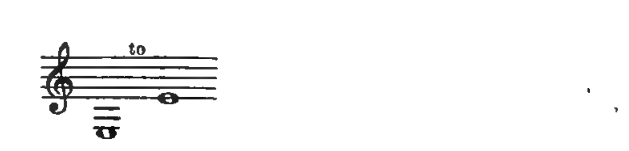
which singe by the did name to bunks a very hollo used dy composers. For special effects this register is excellent. There is, however, a difficulty in treating it. When the orchestra is tutti mf or f it is not heard, while in thinner passages it is so much overcharged with colour-especially in its bottom fifth-that it upsets the best laid schemes of the composer. Attention has already been drawn to three passages in which skilful use is made of the bottom register. The student should again refer to these extracts (Exs. 133, 192, 248). Mozart, in his Eb Symphony and in the Finale to Act I. of Don Giovanni, and after him Beethoven, in the Eroica Symphony, employed the chalumeau arpeggios of the Clarinet. They have a smooth and oily effectiveness. Nowadays, however, this sort of thing is reckoned to be somewhat too much à la "German band."
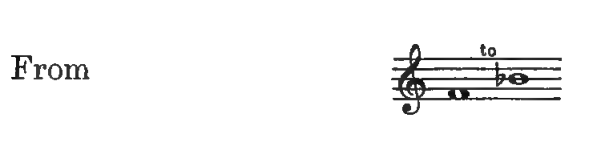
is the very worst part of the instrument, the weakest in quality and technically the most difficult to manage. It has this one virtue that, affords an ideal « background,, In the PP, almost inaudible quality, It wing to its unobtrusive and "tor the brighter orchestral colours. may be said here, in passing, that no instrument has so complete a command of - This applies to the whole of its compass, and to all the instruments of the Clarinet family. In especial the Clarinet pPp is the nearest attainable approach to "nothing at all" in the Wind department.
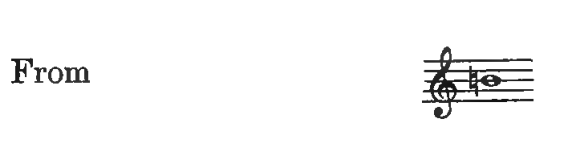
upwards we have the best register of the Clarinet. In the hands of a good artist the tone of this part of its compass is nobly expressive, beautitully clear, pure and even. The best modern players maintain a complete control over the tone-quality right up to the high Bo
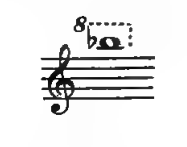
After that the two top semitones Bk and Care just playable. But they are so excessively difficult to produce, and so piercing in quality when produced, that it is better to avoid them altogether, whether in the solo or in the tutti.
The Bb-and A-Clarinets are always written as transposing instrunents in the treble-clef. In some old Scores, however, the Chalumeal notes will be found written in the bass-clef an octave lower than their proper pitch. Wagner occasionally uses the bass-clef (at its proper pitch) for the Chalumeau-register. This is a plan that might be copied. When one is using this register and writing two Clarinet-parts on one stave, the contusion of leger-lines is apt to become a nuisance.
' A few words must be said here with regard to the use of the Oboes and Clarinets for what may be called "background passages," that is to say, for subsidiary supporting-harmonies written in the register of the treble voice. The best arrangement for such passages is to interlock the Oboes and Clarinets in the same way that the two pairs of Horns are interlocked.! The arrangement downwards would then be :
Ist Oboe. Ist Clarinet. 2nd Oboe. 2nd Clarinet.
For ordinary purposes this is a good arrangement, as the Ist Oboe part may roughly coincide with the melodie outline, and, if it does, will add point and brightness.
The clever arrangement of these apparently unimportant parts is really a matter of some importance in the orchestral ensemble. student should try to imagine for himself the differences of effect produced by slight differences of arrangement and pitch. In scoring for the Theatre, where it is so continually necessary to prevent a sense of emptiness by adding subsidiary parts just underneath the melodie line hese points are well worth caretul study
To find an example of the normal arrangement of Oboes and Clarinets the student need only open any Full Score which he may possess. As an example of the opposite procedure-that is to say, where the Clarinets interlock with the Oboes but play the Ist and 3rd instead of the 2nd and 4th parts-he can take these bars from the Ist Movement of Tschaikowsky's Fifth Symphony. It is very unlikely that he will have any difficulty in remembering their sound.
1 See page 123.
Example 177
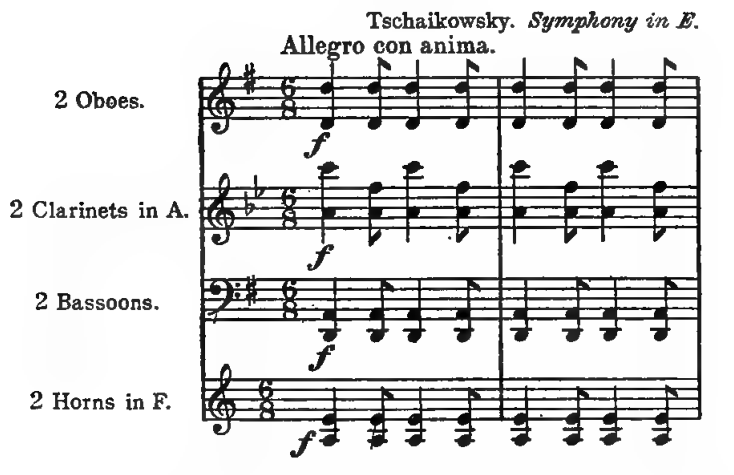
mind calised ith te ta i the he Clarite studs at always wep ten in the Full Score immediately underneath the Oboes. This is a mere accident, due to the historical priority of the latter instruments. richard strauss, than whom there can be no better judge, goes so tal as to say that, in ordinary four-part harmonies of Oboes and Clarinets it is always better to keep both the Clarinets above both the Oboes. In the tutti and in the orehestral mf where the four-part harmony in question is pretty sure to be pitched fairly high, this practice is undoubtedly to be commended. Un the other hand, in the p where nothing more than a light background is called for, it has two disadvantages. In the first place, it keeps the 2nd and often the Ist Oboe down in the bottom and worst register. Then, again, it limits the downward compass of the four-part harmony to low Bo, the bottom note of the Oboe. This in itselt is not a bad thing, but the bottom semitones of the Oboe are really unpleasant in sound, and the "lay" of the harmony may necessitate an occasional and rather fussy crossing of the parts in order to get low A's and G's.
The point, however, which is of importance for the student is that he should not get in the habit of regarding the Clarinet-parts-especially the Ist Clarinet-part-as being lower in pitch than the Oboe parts. The Clarinets are essentially unlike the Uboes. They are not to be classed as "middle-register" instruments except for the special purpose of securing a neutral background. Their most effective registers are top and bottom registers. Often indeed one finds the Ist Clarinet brought prominently forward and almost detached from the rest of the Wood-Wind. For an example of this style of treatment we may refer to the Im Garten Movement of Goldmark's Landliche Hochzert.
A very simple example of "goldsmithery" in the arrangement of Wood-Wind parts may be found in the second subject of the Ist Movement of Mendelssohn's Vrolin Concerto. The subject is played by the Wood-Wind over a held pedal in the solo Violin part. Un its first appearance the harmonization of the tune is arranged in the following order downwards: Ist Clarinet (melody), 2nd Clarinet, Ist Flute, 2nd Flute. In the second half of the subject where the lowest part passes out of the compass of the 2nd Flute, the 2nd Clarinet skips down to take its place. The 1st Clarinet, however, still goes on with the tune. Un the return of the 2nd subject (in E major) it is pertormea by Flutes, Oboes, Clarinets in the order named. In the 2nd half of the subject however, the Ist Oboe changes place with the Ist Flute and plays the melody. Microscopie studies of this sort can be made with any Symphonie work, and they will always repay the student's attention.
The technique of the Clarinet is so varied that it demands somewhat elaborate illustration. This can happily be presented within reasonable limits owing to the fact that the instrument has been continually used in Chamber Music and in Concertos with orchestral For these purposes it is specially fitted by expressive quality, its differences of tone-colour, and above all its extraordinary flexibility and variety in "passage-work." 1
The following quotation from Mozart's Clarinet Concerto in A major gives a miniature of the Clarinet technique in his day:
Example 178
Mozart. Clarinet Concerto in Amajor.
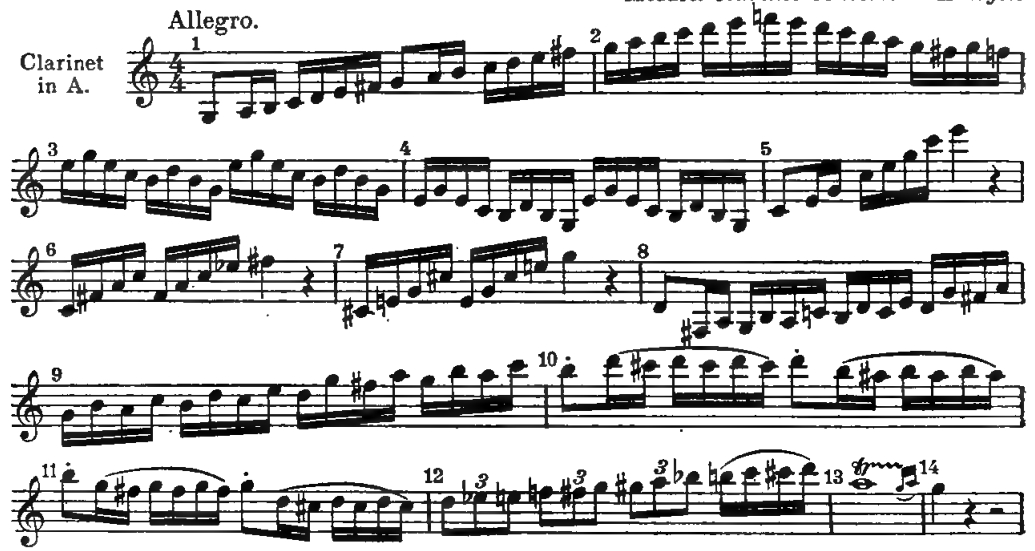
Notice the essentials:
A. Quick diatonic scale passages (bars 1 and 2),
B. Arpeggios (bars 3, 4, 5, 6, 7),
U. Figures built on the notes of the scale (bars S and 9),
D. And on the notes of a chord (bars 10 and 11),
E. Chromatic scales (bar 12),
F. And shakes (bar 13).
1 The student should examine the following works: Mozart's Quintet in A for Carnet and strings, Beethoven's Clarnet Trio in Bo, Quintet for Wood-Wind, and the Do Septet, Weber's 2 Concert pieces and the Clarinet Quintet (Op. 34) and the Brahms Clarinet Quintet.
The only essential omitted from this highly compressed illustration is the power of the instrument to skip with the maximum of effect trom one part of its compass to another. This was well understood by Mozart, as may be seen in the following three bars taken from the same work: 1
Example 179
Mozart. Clarinet Concerto in Amajor.

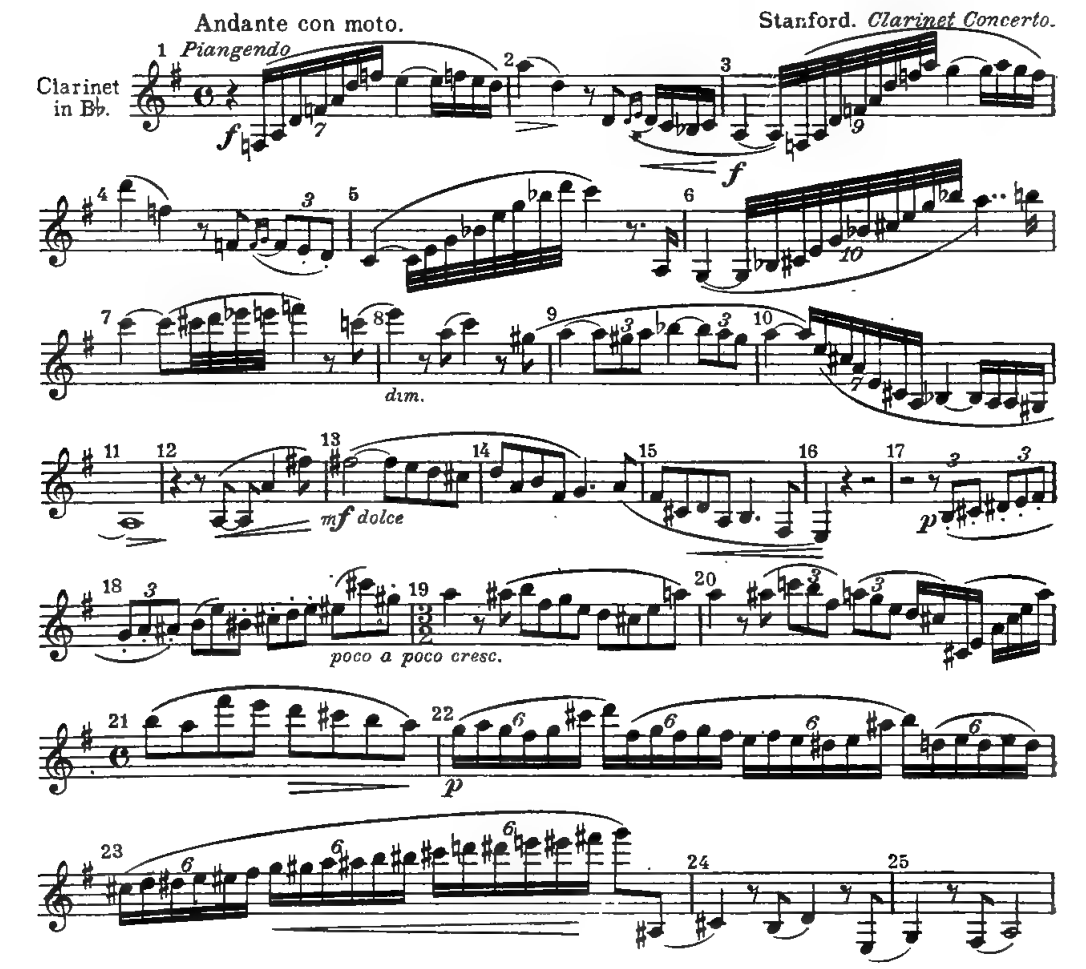
The student should now carefully examine the following passage taken from Stanford's Clarinet Concerto in one Movement. It gives a brilliant resumé of the Clarinet technique at the present day. Notice again the character of the passages, unchanged in essentials, but much enlarged in scope.
Example 180
1 The two quotations from Mozart are printed, as was the custom in those days, with very few indications of nuances, phrasing, and so on.
Here we have examples of
A. Diatonie scale passages legato (bars 13, 21),
B. Diatonic scale passages mezzo-staccato (bars 17, 18),
C. Arpeggios (bars 1, 3,
D. Melodic figures built on the notes of the scale (bar 22),
E. And on the notes of a chord (bars 14, 15, 19, 20),
E. Chromatic scales (bars 7, 23),
G. Skips up to a width of nearly three octaves (bars 5, 12, 23),
besides passages of a mixed character and a continual juxtaposition of the extreme registers.
The last point is perhaps better illustrated by another quotation from the same work.
Example 181
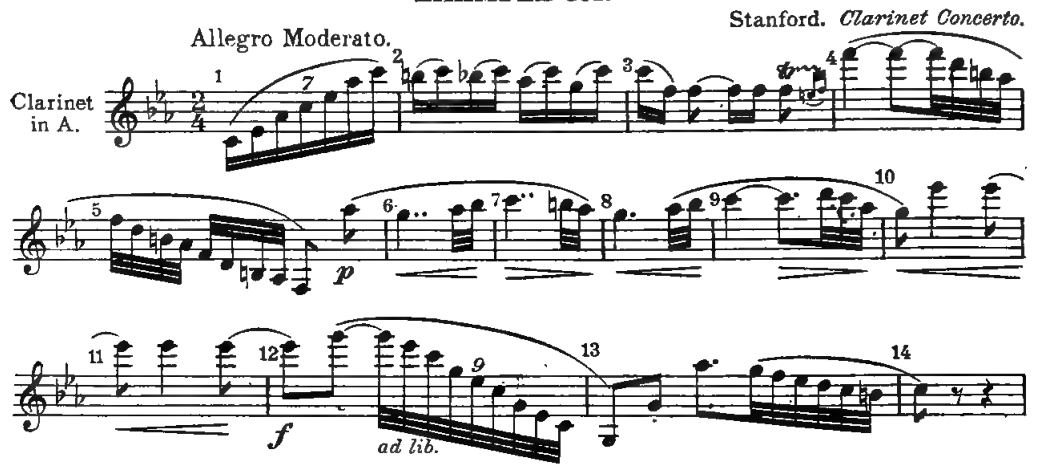
Passages like those in bars 4-5 and 12-13 must really be heard on the Clarinet to be understood. The case and certainty with which a first-elass artist can execute a brilliant f arpeggio and then immediately resume the p in a totally different register of his instrument are astonishing.
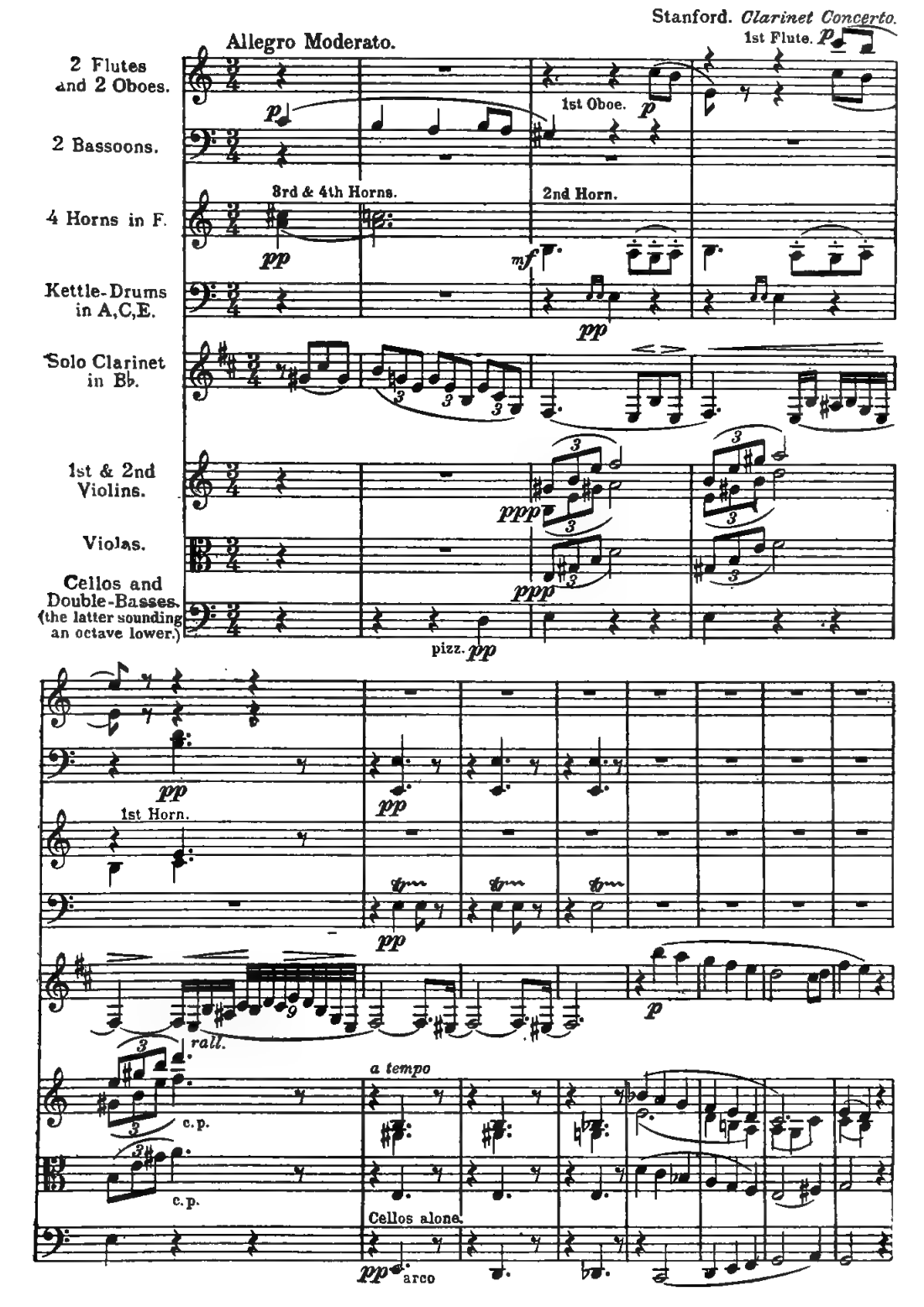
As a last Solo instance, we will quote from the same work a real piece of chalumeau writing with its accompaniment. (Ex. 182.)
Notice in the accompaniment not only its effective simplicity but also the dynamic marking of the parts. The whole passage is p both in intention and effect. Yet in bar 3 at the entrance of the Strings we have a ppp background for the overhead Strings, a pp pizzicato for the Cellos and Basses, a pp for the Drums (almost equal in dynamic value to a mp of the Strings or Wood-Wind), a p for the Oboe in order to lend it a momentary prominence, and a mf for the 2nd Horn. last named instrument is playing a variant of the Solo part, and is also pitched in its ineffective register. In fact its entry is a piece of unblushing orchestral deceit perpetrated in the interests of the Soloist.
Of course an orchestral composer cannot be always writing concerto parts for his Clarinets. That would completely upset the instrumental fitness-of-things. it is only when the instruments are called up tor active service that brilliant passage-writing becomes possible. When that does happen the types quoted are excellent models on which to rely. They are all playable and effective.
Example 182
As a happy example of the sudden unexpected prominence of a Clarinet passage, the following bars from the 2nd Act of Die Meistersinger are interesting:
Example 183
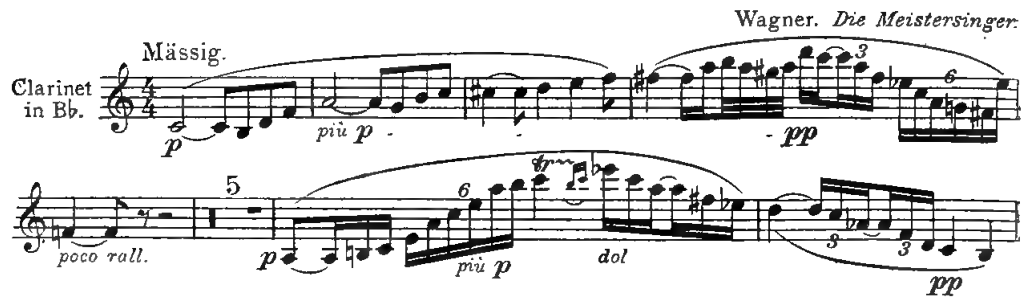
They were intended by Wagner as a sort of aural-optical suggestion of the little eddies of dust and straw that are whirled up by the wind

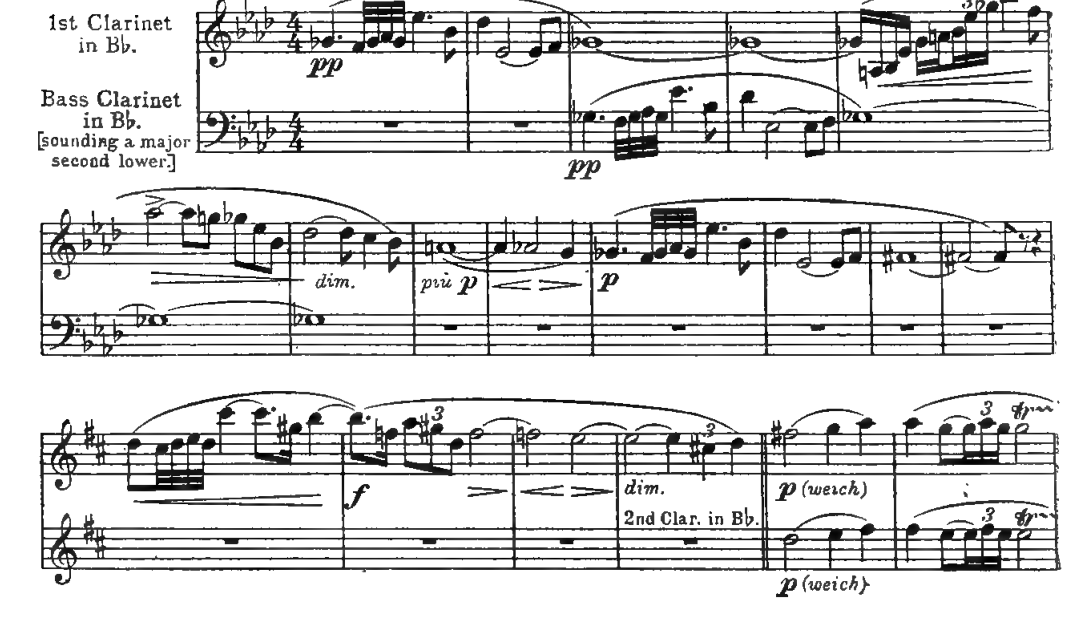
The Clarinets were undoubtedly great favourites with Wagner. He understood them thoroughly. Usually he does not give them prominence for many bars at a time, but the total number of bars in which they are prominent is large. An exception to this rule may be found in the music which precedes the 3rd Scene in the Ist Act of

to themselves for over thirty bars. this is the most hero example possible of the tavourite and effective practice of writing thirds for the
Example 184
Wagner. Götterdämmerung- Im Zeitmass noch mehr zurückhaltend.
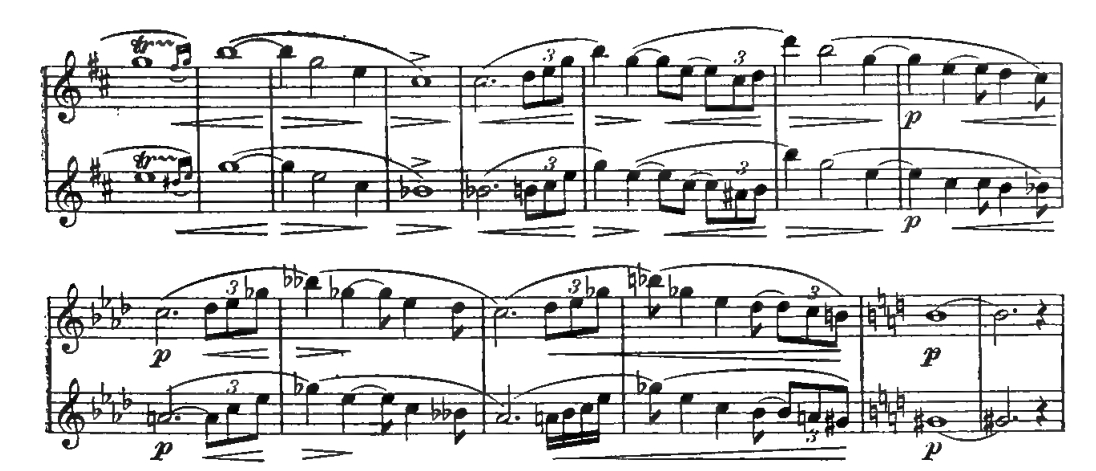
A few examples must now be given of the separate Clarinet-registers used orchestrally. Nothing much in the Chalumeau-register is to be found in any of the classical masters. Weber was perhaps the first to employ this tone-colour consciously as a means of orchestral expression. A quotation from his overture to Der Freschütz is printed below, Ex. 278. In it the low held notes of two Clarinets are associated with the Kettle-Drums, the String tremolo, the pizzicato of the Double- Basses, and the high notes of the Cellos. Since Weber's day this has been imitated more than once. As a melodic example, the student should look at the Andante subject in the Ist Movement of Ischaikowsky's Fifth Symphony. The melody on its first appearance assigned to two Clarinets in unison. The choice of instrument is undoubtedly happy.!
Example 185

In recent years this register has been employed for various effective a Caregular part melodic doublings of Violas, Cellos, and so on. Its use, however, cannot even now be fairly called a regular part of the orchestral routine.
In the middle register there is not much to quote. Weber's subject in the Oberon Overture
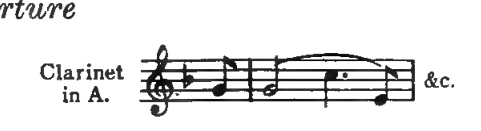
is generally cited with approval in instrumentation books, probably because it is a pretty tune. It always sounds tame owing to the fact that it gravitates round the notes
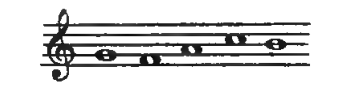
in the least interesting part of the instrument.
1 See also Exs. 133, 192, 248.
In the very best register—what one may call the lower-top-there is so much to quote that the difficulty is only one of selection. We must, however, content ourselves with two short examples. In the first, from Tschaikowsky's Francesca da Rimini, after a furious tutti the music gradually calms down and finally leaves the Clarinet absolutely unaccompanied. The instrument plays a series of simple Cadenza-like passages which ends in the exquisite melody representing Francesca herself.
Example 186
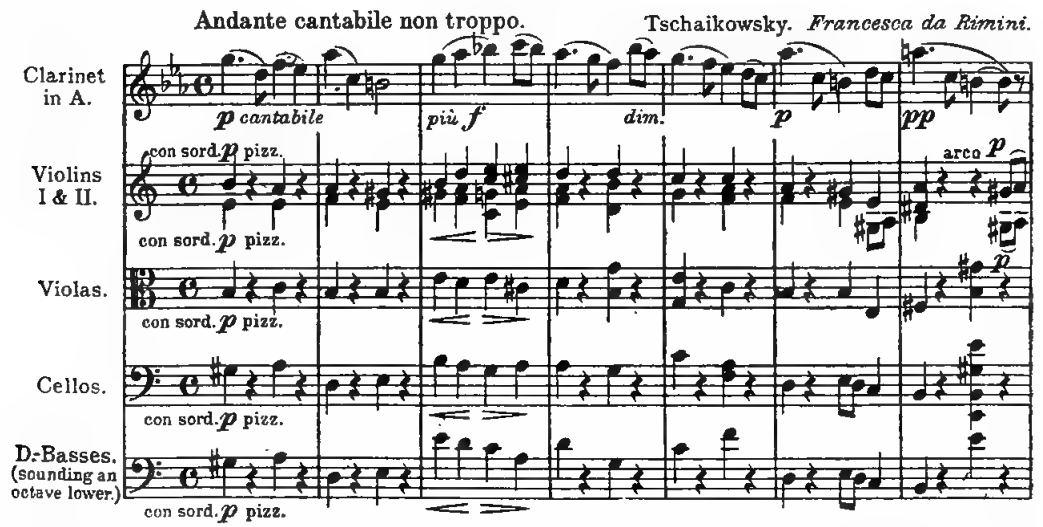
This subject could of course be played by the Flute perfectly well. If this were done, however, the ettect would be that the melody would be de-humanized. The impersonal would be substituted for the personal: the neuter for the Ieminine. It is by means of its capacity to suggest the still, small voice-from which, however, no element of the human is lacking—that the Clarinet often makes its most touching appeal.
A second example of this register, this time varying from World may be quoted from the 4th Movement of Dvořak's New Symphony:
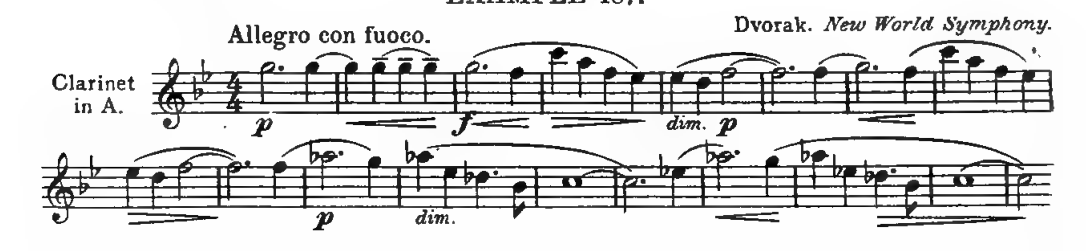
The accompaniment to the above extract consists of a light String tremolo of Violins and Violas. The only other melodic feature in the Score is the loud rhythmical interruption of the Clarinet-phrases by the Cellos. The student should note in all the Clarinet examples the large number of dynamic marks,—p's, f's, crescendos, and diminuendos.
The Clarinet has perhaps more complete control over this form of expression than any other Solo instrument, Wind or String.
Other examples of this register may be found in Weber's Freischütz Overture (Peters's Full Score, page 7), Beethoven's Eighth Symphony (Trio of the Minuet), Mendelssohn's Reformation Symphony (Andante con Moto, full Score, pages 60 and 61), and in Beethoven's Choral Symphony (Peters's Full Score, page 151 et seq.).
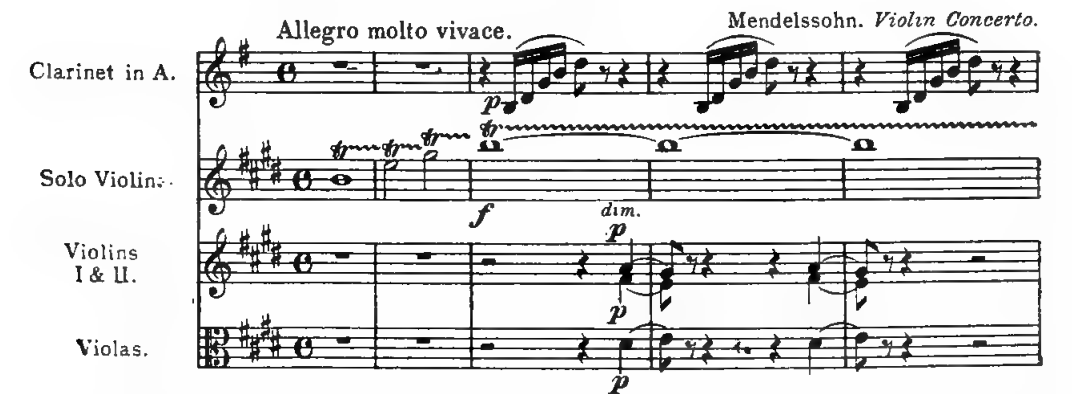
Finally, as a corrective to the somewhat rich elaboration of Clarinet technique served in the above pages, we will quote a tiny passage trom Mendelssohn's Voln Concerto to prove that effect is not incompatible with the utmost simplicity of means. The phrase is only five notes long, and is easily played at the proper lightning-speed. It sounds like a little jet of water tossed up into the sun.
Example 188
The history of the Clarinet in the orchestra is short and not very eventful. Except for a single isolated instance-a Mass written by J. A. J. Faber,? and now preserved in Antwerp Cathedral—the instrument was unused betore the production of Rameau's Acante et Cephuse in 1751. Gluck wrote for the old Chalumeaux in his earlier works but, becoming acquainted with the Clarinets in Paris, adopted them in Place rib sy armory to, an Erote stil Moad wrote for them an his Operas. Haydn took them up about the same time. Beethoven adopted them at the outset of his Symphonic career, and from his day they have retained their place as standard orchestral instruments. Gevaert points out that as a matter of orchestral routine, Haydn, Mozart, and Beethoven all consistently avoided the use of the Chalumeau register. As we have mentioned, there are isolated instances to the contrary, and Mozart in his Clarinet Concerto uses this register freely.
As a rule two "Bb-A" instruments are employed in the orchestra and, since a Bass-Clarinet and sometimes a small Eo-Clarinet
1 See also the two passages earlier in this morement, where the Clarinets play a similar arpeggio phrase in two-parts, while the Solo Violin imitates them on the alternate beats. (Peters's Full Score, pages 52 and 53.)
2 See Gevaert, page 177.
eved, in his later weeks, wultes for ore D4 instents a boell as the "Bass" and the "Eb. In this he is followed by many modern composers.
The Bb-Clarinets are to the military band what the Violins are to the orchestra. Indeed they are a good deal more, for whereas in the upper register of the orchestra the Wood-Wind instruments can take their proper share of extended figures and melodie passages, in the military band the Clarinets alone can be used to give adequate einphasis to the transliterations of these parts. This important topic scarcely comes within the province of a book devoted to " Orchestration," but if the student be a String-player, and it he will listen closely to the outline and shape of these clever Clarinet-transliterations when played by a good staff-band, he will learn more about the Clarinet "don'ts" than can be taught him by a hundred pages of examples.
Besides the standard "Bb-A " instrument four other Clarinets must be briefly mentioned. These are, in the order of their most frequent use in the orchestra:
(1) The Bass-Clarinet. In common use both in the orchestra and the military band.
(2) The small Eo-Clarinet. Used in the orchestra occasionally and in the military band regularly.
(3) The Bassett-Horn and its first cousin the Alto-Clarinet. These appear in the orchestra only at the longest intervals, and then chiefly On the other hand, in (English) military or antiquarian purposes. ands the Alto Clarinet is recularv emplover
(4) The Pedal-Clarinet. Scarcely ever used even in the largest military bands: in the orchestra almost never.
These four members of the Clarinet family are all adaptations ut the standard instrument. They, therefore, have a common technique. Beyond their differences of tone-quality and compass little further description will be necessary.