 Playable Books
Cecil Forsyth · section 46 of 60
No. 41. The Eb-Clarinet
Read and hear this section in the playable edition →l'his instrument, which is regularly used in our military bands t concert-room. In pitch it is a perfect fourth above the standard Bb-
THE BASS-CLARINET. THE Eb-CLARINET
instrument. Its transposition is therefore the same as that of the Eb-Trumpet, viz, a minor third upwards. For instance:
Example 195
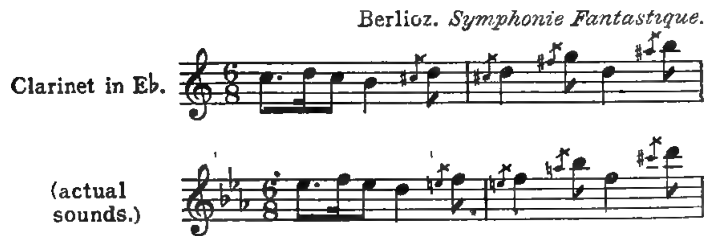
The treble-clef only is used, and the key-signature is three b's less or three fs more than the key-signature of the piece. Music written in the flat keys from Bo to Do is therefore the most suitable for the instrument, as these give key-signatures for the Eb-Clarinet of G, C, F, Bb. In military band music, where everything is in flat keys, this automatically simplifies all the key-signatures of the Eo-Clarinet. But in orchestral music the advantage is not so great. In the middlingsharp keys, such as D major and A major, the Eb-Clarinet has the awkward signatures of B major and F$ major.
The written compass of the instrument is the same as that of the
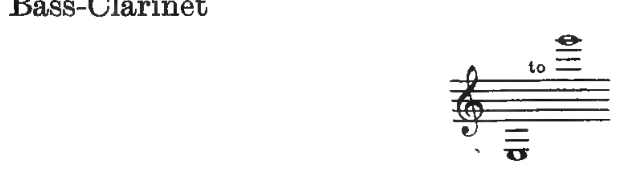
but this, on the Eb-Clarinet, sounds
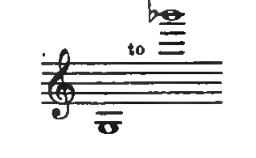
On the former instrument, as was mentioned above, the top fifth 1s scarcely ever used: on the latter the bottom tith is equally rarely employed. It is in general better replaced by the ordinary Bb-A Clarinet.
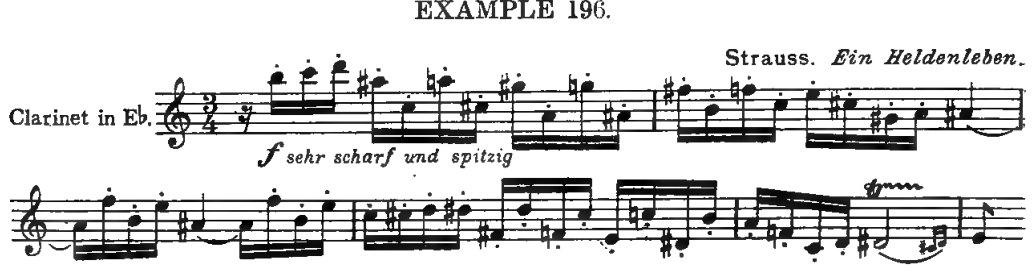
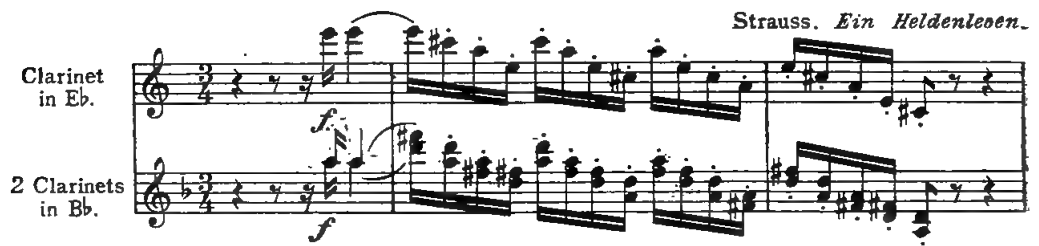
The great advantage of the Eb-Clarinet is its distinctive tonequality. This, especially in its upper register, is preternaturally hard and biting. The winning feminine charm of the larger instrument is quite wanting, and in its place we have an incisive tone-colour that has much the same relation to the "Bb" as the Piccolo has to the Flute. With regard to the technique, it is sutficient to say that it is the same as that of the Bb-A instrument. It need scarcely be said that for purposes of solo-characterization the melodie types suitable to the larger instrument are often quite unsuitable to the smaller. In particular, the psychological range of the "Eb" is much narrower. It is almost confined either to passage-work of a hard mechanica, kina, or to a special sort of mordant humour such, for instance, as is found in Strauss's Till Eulenspiegel: For the latter purpose the instruments great power of what we may call "hail-stone staccato" fits it admirably. A good. example of this hard biting staccato is to be found in the "Critics" section of Strauss's Ein Heldenleben. Here is a short extract. It sounds even more offensive than the German direction to the player, "sehr scharf und spitzig."
Another short quotation may be given from the "Battle" section of the same work as an example not only of a three-part Clarinet-arpeggio but as an illustration of the fact that it is by no means always necessary or desirable to write Clarinet-arpeggios legato?
Example 197
A similar instrument to the above is the little D-Clarinet, for which parts have been written by Gluck in Echo et Narcisse, by Liszt in Mazeppa, by Wagner in Die Walküre, and by Strauss in Till Eulen spiegel and the Sinfonia Domestica.
This instrument has the same written compass as the Eb-Clarinet, but in this case it gives the sounds, not a minor third, but a major second higher. The highest notes are more easily obtainable on this instrument than on the smaller Eb-Clarinet. An extra semitone or even whole-tone may be employed in that direction. One must not, however, overlook the extraordinarily piercing quality of these notes. See the example below from Strauss's Till Eulenspiegel where the high Ab is written. The treble-clef is used, and the key-signature is that of
1 Written for the "Clarinet in D," the continental instrument corresponding to our
the Eb-Clarinet has a part, have already been quoted. See
CLARINETS IN Eb, D, (HIGH) F AND Ab 281
two b's more or two #'s less than the key-signature of the piece. This is a distinct advantage in orchestral sharp keys. There is no difference in technique between the two instruments, and it may be mentioned that, in this country where the D-Clarinet is practically unknown, the parts written for that instrument are almost invariably played on the
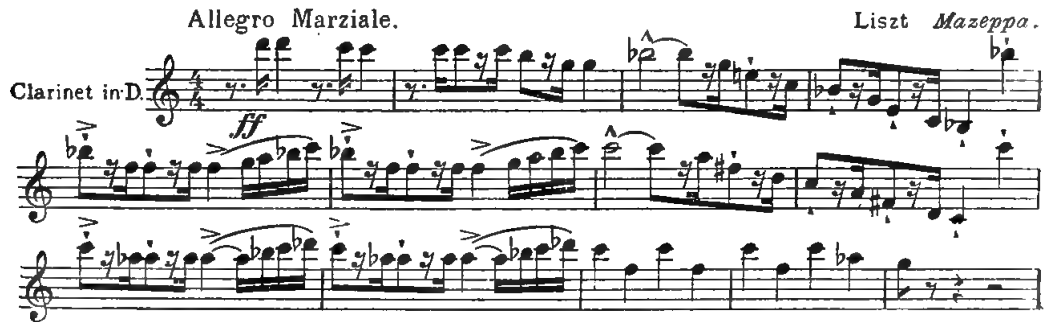
The following example from a tutti in Liszt's Mazeppa gives a fair idea of the instrument's use in the old style of scoring:
Example 198
and, for a modern instance covering the whole range of the instrument, we may reter to the extraordinarily vivid passage in Ill Eulenspiegel where the hero is hanged. The student must take into consideration the peculiar character of the situation and its musical illustration in judging the effect of these extremely high notes:
Example 199

Strauss has pointed out that, in the top orchestral register, we have nothing but the small Clarinets of sufficient weight to counterbalance either an important String-ensemble or a powerful union of Brassinstruments. The Oboes are practically useless in their top register, and the Flutes lack character in the forte. This is an important point and well worth consideration in the orchestration of large works. connection with this point Strauss draws particular attention to the Symphonies of Mahler.
For the sake of completeness it may be added that Clarinets in (high) F, and even in (high) Ab, are occasionally used abroad. The latter instrument is regularly employed in the Austrian military bands.