 Playable Books
Cecil Forsyth · section 45 of 60
No. 40. The Bass-Clarinet
Read and hear this section in the playable edition →
Er. Clarinette basse; It. Clarone (sometimes Clarinetto basso); Ger. Bass Klarinette.
This Clarinet is pitched an octave below the standard instrument, of which it is practically an enlarged replica. Its shape was originally modelled on that of the Clarinet, but this had two disadvantages. In the first place the instrument was cumbersome to manage. In the second thè "bell" was within a few inches of the floor. Consequently most of the sound was lost. Berlioz mentions an attempt to overcome the latter difficulty by means of a "concave metallic reflector." Nowadays, however, the problem is solved by introducing two metal curves into the pipe, one at each extremity. The upper of these curved pieces—the one that holds the mouthpiece-is a tairly thick length of metal tubing, in shape something like a Bassoon-crook. The lower is merely a short joint curving back on itself, and ending in a wide metal
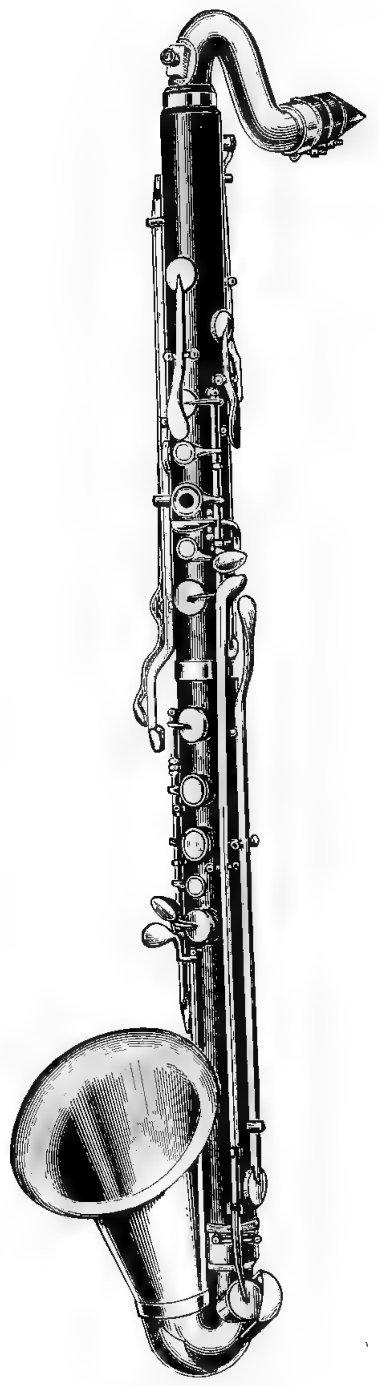
Bass clarinet
Facing p. 278-
By kind permission of Messrs. Boosey & Co.
Plate X. It lies on the lower side of the beak-mouthpiece immediately to the right of the ligature-screws. The student would do well to notice the necessarily great length of the metal rods controlling the lower keys. Apart altogether from the difficulties of regulating the aircolumn in so long and wide a pipe the player is at a disadvantage in this respect when compared with the standard Bo-Clarinet player.
Bass-Clarinets were formerly built on the analogy of the ordinary Clarinet, both in Bb and A. The lower-pitched instrument, however, has not proved itsell to have any great advantages beyond the possession of the extra low semitone. It has consequently dropped out of use, and, except in Germany, is practically unknown.
a)m We ear eat the ground hes ayed in at a Chain to refore proceed to describe that instrument in some detall. But betore doing so we may mention
(1) That the compass, key-signature, etc., of the Bass-Clarinet-in- A bear the same relationship to those of the Bass-Clarinet-in-Bo as the compass, signature, etc., of the ordinary A-Clarinet bear to those of the ordinary Bo-Clarinet.
ince Parts are occasionally to be found written for «Bass-Clarinet- This instrument, which may have existed as an orchestral experiment, is nowadays quite obsolete. Its parts, as, for instance, that in Liszt's Mazeppa, would be performed on the ordinary Bass- Clarinet in Bb.
As the student will perceive, the written compass of the Bass-
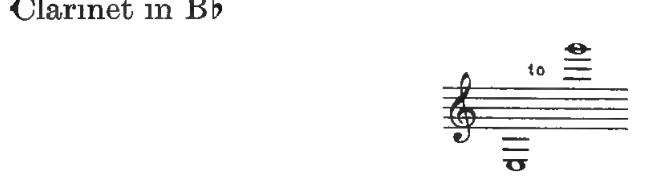
is not so great as that of the ordinary Clarinet. Three octaves and a minor third as opposed to three octaves and a minor sixth. The actual sounds of the Bass-Clarinet compass are an octave and a major second below the written notes, viz:
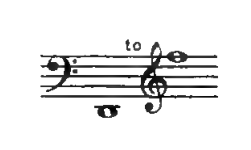
The top fifth is scarcely worth writing, except perhaps when, doubled by some other instrument, it is used to complete the contour of a melodie figure.
There are two distinct methods of notation for the Bass-Clarinet.
(1) The part is written in the treble clef and sounds a major ninth This is the French method. below the written notes.
(2) The part is written normally in the bass-clet and sounds a major second below the written notes. For the highest notes the treble-clef is employed, but only as a continuation upwards of the bass-clet; that is to say, the sounds are still a major second below the written notes. This is the German method
Whichever notation is adopted the key-signature is 2o's less or 2f's more than the key-signature of the piece.
In order to make both notations pertectly clear, we shall take pnrase trom Meyerbeer's bes Huguenots, and write it out both in the French and in the German notation.
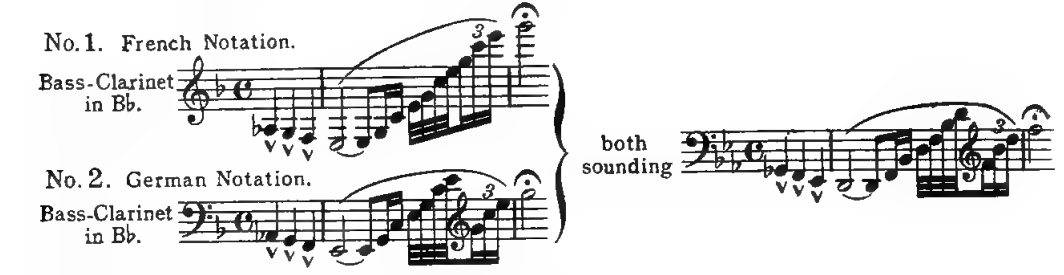
The German method (No. 2) is the more logical and the easier for the Score-reader. On behalf of the French system the intimate association between the fingering and the written notes has been This is undoubtedly of importance, in view of the fact that Bass Clarinet players axe all nurtured on the ordinary instrument and that the fingering on the two instruments is the same. A player can pass without difficulty from one instrument to the other. This is certainly an advantage, and would be more so were we to suppose that a knowledge of the bass-clef was one of the supreme attainments of the human mind.?
It is not of very great importance which notation the student adopts. It will, however, be wise for him to put a note at the beginning of the part "to sound a major second lower" or «to sound a major ninth lower" This will prevent the possibility of any mistake. Josh la bad be whether th in ard begin iat he treblecthe hasactually effected that most difficult of all tasks, a reformed notation. Their Bass-Clarinet players are taught to finger their Bb-instruments in the same way that a Euphonium- or a BBb-Bass-player would, that is to say, at concert-pitch. The consequence is that, as they are all taught in the bass-clef, the two Bass-Clarinettists in a military band can play and do play off the Ist and 2nd Bassoon parts respectively.
It is a little ditticult to describe the tone-colour of the Bass- Clarinet. Only a certain type of smooth legato passage is suitable to the instrument, and this has evidently influenced opinion as to its capabilities. Even with regard to its bottom and most characteristic
" Quoted below, 4th, 5th, and 6th bars of Example 190.
2 Widor, in his book The Teclnique of the Modern Orchestra, suggests a musical congress to decide the question of notation for the Bass-Clarinet, the Horn, and the Cello.
register diametrically opposed statements have been made by acute observers. "The tinest part of the instrument is its rich lower register" (Prout). "The tone is hollow and wanting in power, in the lower register particularly" (Schlesinger).
As a matter of fact, there is a certain windiness and flabbiness in its tone-quality throughout its entire compass. This and its total want of "ictus" are probably due to its necessarily large bore. In tact, the faney-title "Bass-goblin" that has been applied to it pretty well describes its musical make-up.
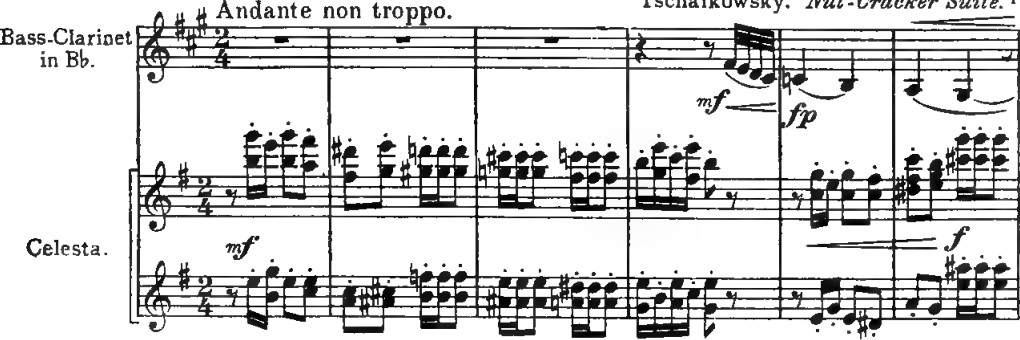
Simple little scale-passages, such as those in Tschaikowsky's Nut- Cracker Suite (Danse de la Fée Dragée), come out well on the instrument. Their goblinesque effect is charmingly unexpected.
Example 189
Bass Clarinet 2 tut Andante non troppo.
Melodies of a certain unctuous type, such as that quoted above from Strauss's Don Quixote Variations (Ex. 89), are undoubtedly effective. Solo subjects, however, which call for strong rhythmic energy or heroic expression, are quite unsuited to the instrument.
Example 190
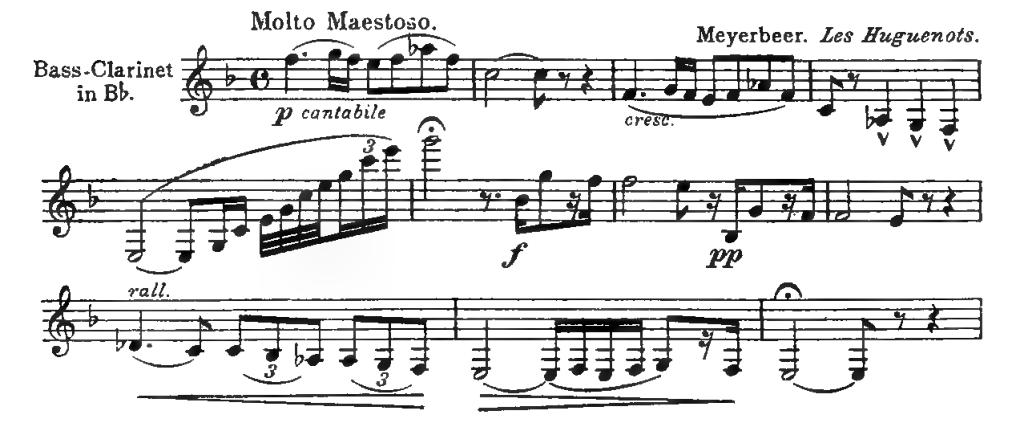
Meyerbeer was the first to perceive the great possibilities of the Bass-Clarinet in the direction of characterizing certain sombre states of the mind. Examples of this are to be found both in Le Prophète (Act IV.) and in Les Huguenots (Act V.). In the latter work!the
1 The light string pizzicato accompaniment is omitted for reasons of space.
tragic situation of Raoul and Valentine, who are joining their hands at the moment of the St. Bartholomew massacre, is emphasized by an unaccompanied Bass-Clarinet Solo which covers the whole range of the instrument. The passage, which immediately precedes Marcel's address to the two lovers, is written in the French notation and sounds is curiously a major ninth lower. For its time and place it Wagnerian. See the quotation, Example 190.
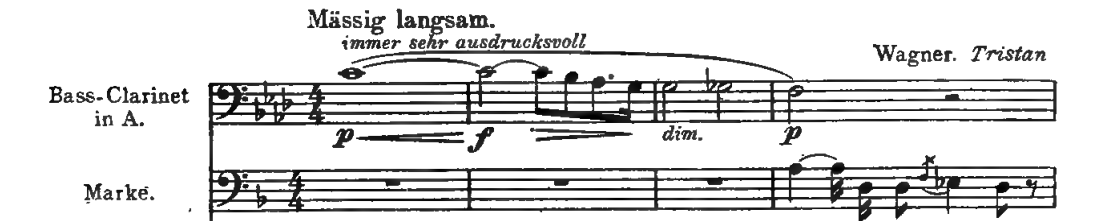
Example 191
Tha - test du's wirk-lich?
Wähnst du das? Sieh' ihn dort,- den treu'-sten al-ler
Treu-en: blick' auf inn, - den freundlichsten der Freunde:

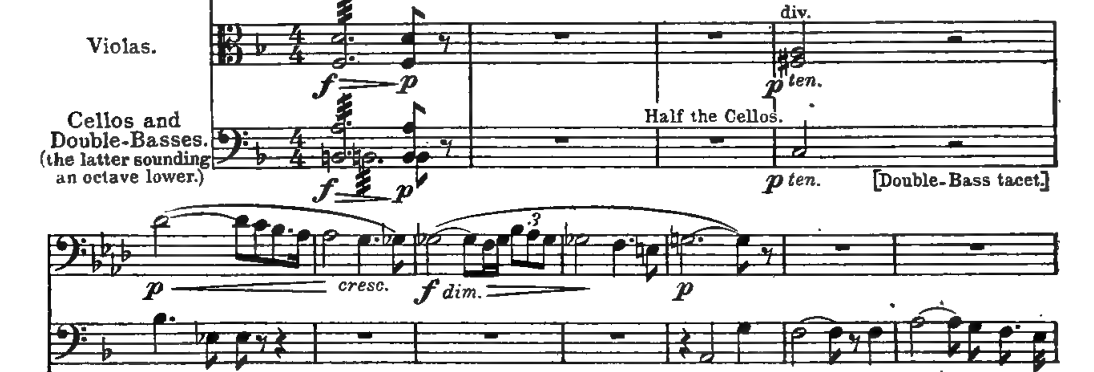
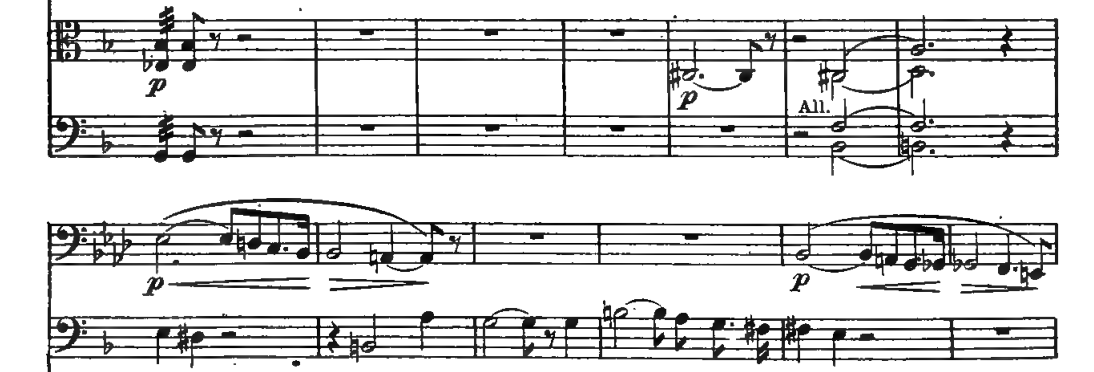
The poignant dramatic moment in Act II. of Tristan is characterized by the composer with exactly the same tone-colour. With Wagner of course the element of instrumental display which robs the Meyerbeer passage of some portion of its sincerity is totally absent. Obbliguto part in this passage is written for Bass-Clarinet-in-A, and as it touches the bottom note—the low El sounding C♯ (Db)—needs that instrument Ior its correct pertormance. The notation is the ordinary German notation sounding a minor third lower. The tull accompaniment is given.
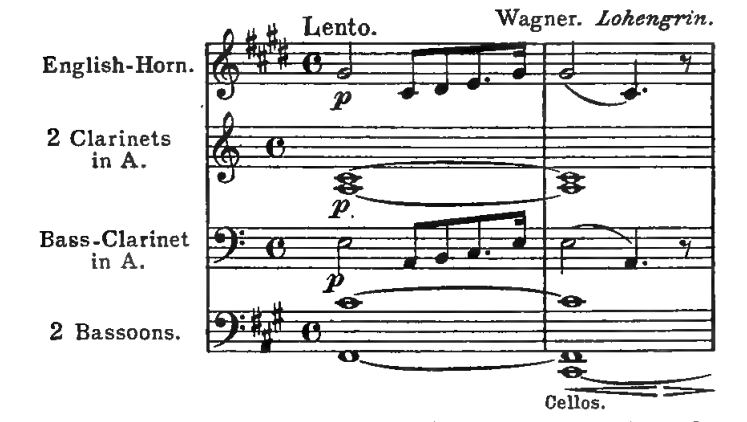
In Lohengrin (Act II.) Wagner uses the same dark and immovable tone-colour for the expression of doubt and uneasiness. This time the melody is assigned to an effective octave-unison of Bass-Clarinet and English-Horn. German notation.!
Example 192
It is quite unnecessary to give elaborate examples of the Bass-Clarinet It is practically the same as that of the Bb-A-Clarinet, with some limitations of agility, owing to the size of the instrument, its large reed, wide bore, and heavy key-apparatus. In the tollowing extract from Strauss's Sinfonia Domestica the chromatic power of instrument is freely • utilized. The student should note that, though this example begins in the treble-clef, the German notation is employed. The transposition downwards is a major second throughout, and the treble-clef is only written for convenience of notation. It is used merely as a continuation upwards of the bass-clef. The two notes A and Ab, where the clefs meet in bar 3, are a semitone apart.
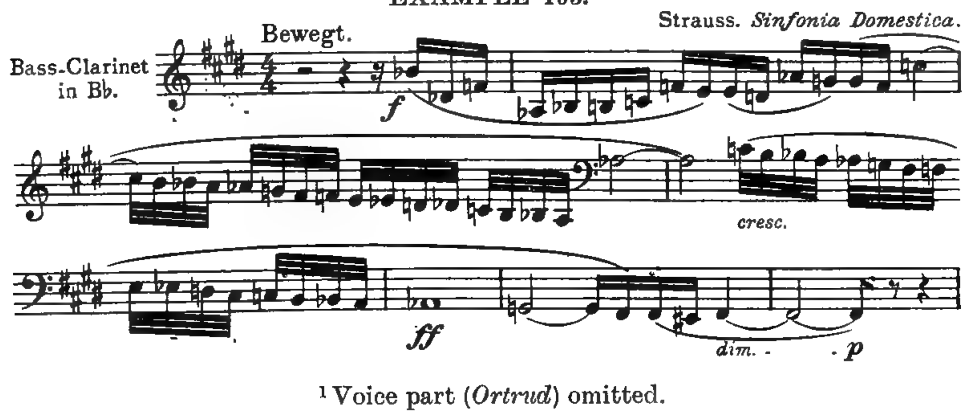
To this style of elaborate running-passage the Bass-Clarinet lends a sort of effortless prominence that is most effective. It is, however, rather as a steady bass to the whole Wood-wind group that the instrument proffers its best service to the composer. When used thus it has a happy knack of enriching the harmonies by reinforcing the perpaul Score i necessary to guote in escape bert. remark that "four or five Bass-Clarinets employed in unison give a rich and excellent sonority to the Wind instruments of the orchestral bass" is not the less true because of its heroic courage and its total disregard of the economics of the concert-room.
Like all the other instruments of its family the Bass-Clarinet has
- Its pop is almost a silence. phenomena, powers of -=
For this reason the unaccompanied Bassoon Solo that precedes the sudden outburst of the Allegro Vivo (ff) in the Ist Movement of
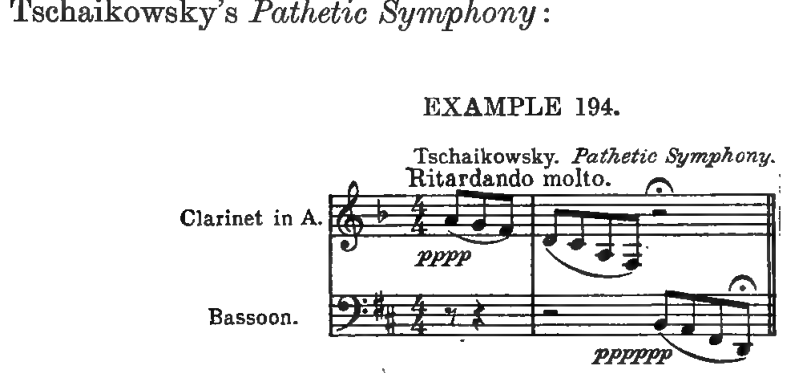
is usually transferred to the Bass-Clarinet thus :
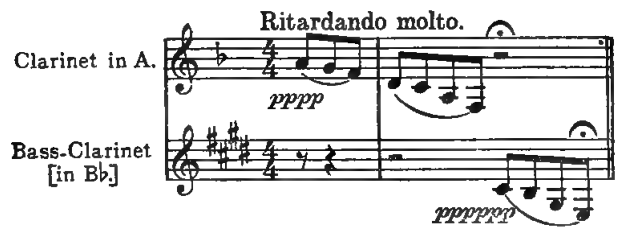
with general advantage to the composer, the player, and the audience. pond a a to the so stre led prat on order. Apollo and the Seaman (Ex. 96).