Playable Books
Cecil Forsyth · section 47 of 60
No. 42. The Bassett-Horn and The Alto-Clarinet
Read and hear this section in the playable edition →
F'r. Cor de basset; It. Corno di Bassetto; ' Ger. Bassethorn. Er. Clarinette alto; It. Clarinetto alto; Ger. Altklarinette.
The name of this instrument is only slightly less inaceurate than that of the English-Horn, for though not a Horn at all it is Basset. It was first introduced in 1770 by a German maker called Horn. christened his invention Basset-"Horn," that is to say, "Little Bass (Clarinet made by) Horn." The Italians translated the name " Horn" literally by "Corno." Hence their name Corno di Bassetto.
The Basset-Horn is a Tenor-Clarinet. In appearance it is much like a small Bass-Clarinet. It is pitched a fifth below the obsolete Clarinet in C. Its part is therefore written like that of the French- Horn-in-F, a fifth higher than the actual sounds. The treble-clef is used with a key-signature of one b less or one # more than the keysignature of the piece.
. In its downward compass the Bassett-Horn possesses the characteristic feature of the old Clarinets of Mozart's time? In other words, its downward compass does not end at
sounding in this case
but is continued, by means of four additional keys, to
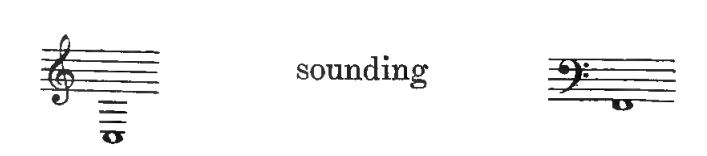
This gives a written compass of

The highest notes are of little value, and are better replaced by the corresponding notes on the Bb-A instrument. The middle-and lowerregisters are admirable, richer and fuller than those of the ordinary Clarinet, much more interesting and expressive than those of the Bass- Clarinet. Gevaert sums up its tone-quality in two words, "unctuous seriousness." This instrument, or rather its modern equivalent the Alto-Clarinet, is well worth using in large orchestral combinations
The word Clarone, though more strictly used for the Bass-Clarinet, is sometimes applied by the Italians to the Bassett-Horn.
2 See above, page 254.
Its placid tone-colour specially fits it for service as a "backgroundinstrument" in those cases where the "more personal colour of the Violas, Bassoons, and Clarinets playing in their lower register" is inappropriate.
The technique of the Bassett-Horn is similar to that of the ordinary Clarinet, and, in the hands of a good player, the instrument can give a good account of brilliant passages founded on arpeggios, diatonic and chromatic scales, broken chords, and so on. It is by no means an instrument whose sole capability is the performance of slow legato melodies.
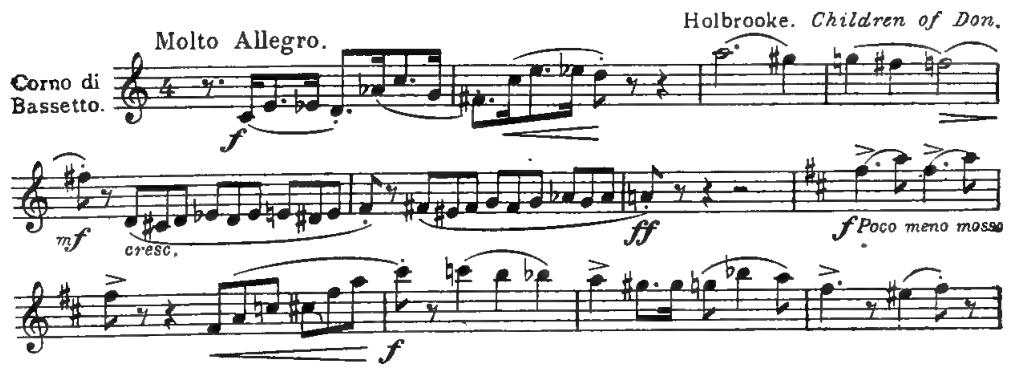
The elaborate Obbligato to Vitellia's song, "Non più di fiori," in Mozart's Clemenza di Tito is still often heard in our concert-rooms. Mozart seems to have had a special affection for this instrument. uses it either singly or in pairs in the Adagro of his Bo serenade, in the Nozze di Figaro (additional number), in the Lauberflote, in Il Seraglio, and in the Requiem. Beethoven appears to have oniy written for it once,—in his Prometheus. Modern instances are hard to find. l'he tollowing Molto Allegro passage trom the Uverture to Holbrooke huldren of Don is specially chosen tor quotation instead oi th cantabile, which is more conventionally associated with the larger Clarinets.
Example 200
The present-day representative in England of the Bassett-Horn is the Alto-Clarinet-in-Eo. This instrument is pitched a whole-tone lower than the Bassett-Horn. Its compass, however, is not prolonged downwards below E, the bottom note of the ordinary Clarinet. the sound of low G, a major sixth below the written E:
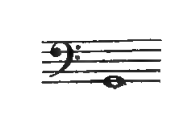
It will therefore be seen that it cannot sound the two bottom semitones F♯ and F4, both possible on the Bassett-Horn.
1 Strauss.
The difference between the two instruments in downward compass will be made plain by the following example: Lowest written note of the Bassett-Horn:

Lowest written note of the Eb-Alto-Clarinet:

The compass of the "Eb-Alto" is
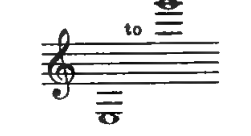
which sounds a major sixth lower, viz.,
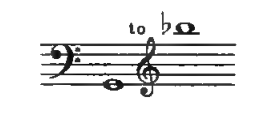
The "Eb-Alto" is written for in the treble-clef with a keysignature of three o's less or three f's more than the key-signature of the piece. Here again we see that the "build" of the instrument gives it a peculiar tacllity tor playing in military bands. it is, indeed, a regular and exceedingly useful member of all military bands in the British service. For orchestral work with its mixed tonalities the Bassett-Horn has an advantage. It also satisfies the universal hankering of composers for a couple more semitones in the lowest On the other hand, there are plenty of good players on the
more often used in English orchestras. The difference between military and civilian pitch helps to prevent its more general employment
Out of England the Eb-Alto-Clarinet is very little known. In its place there is an Alto-Clarinet-in-f,—the old Bassett-Horn under a In fact it is the old Bassett-Horn with a modern mechannew name. isn. Compass, downward extension, and technique are all the same.
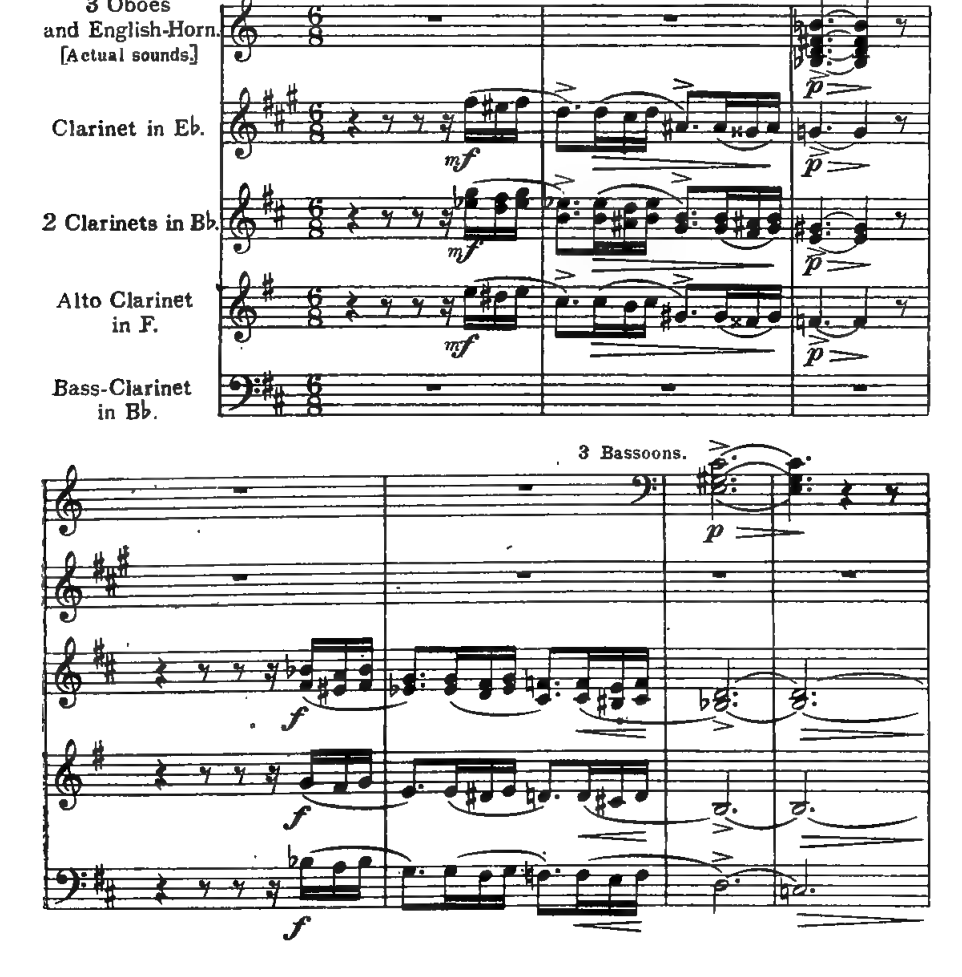
Holbrooke has written an elaborate part for Alto-Clarinet-in-F' in Apollo and the Seaman. Here are two examples. The first is brilliant passage in octaves with the Bass-Clarinet. The extract is taken from a tutti in which the Alto-Clarinet plays in unison with the Violas and the Bass-Clarinet with the Cellos. The two Bassoons and the Double-Bassoon continue the scale downwards at the end of the excerpt. The By's in bar two of the Alto-Clarinet-part are of course enharmonic to the Gb's in the Bass-Clarinet part.
Example 201
Holbrooke. Apollo and the Seaman. Poco Allegro.
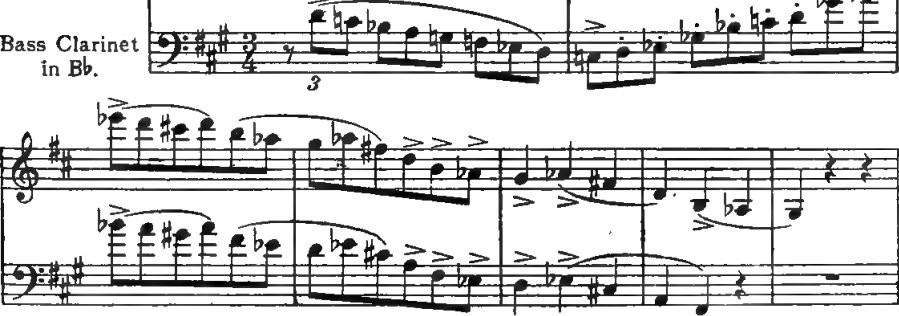
The second example is a rare instance of the employment of the Eo-, Bb-, and Alto-Clarinets without any orchestral background at all. It occurs just before the end of Part III. in the same work.
EXAMPLE 202. Holbrooke. Apollo and the Seaman Andantino.