 Playable Books
Cecil Forsyth · section 48 of 60
No. 43. The Pedal-Clarinet
Read and hear this section in the playable edition →Fr. Clarinette contrebasse; It. Clarino contrabasso; Ger. Kontrabass klarinette.
The Pedal- or Contrabass-Clarinet, an instrument scarcely known outside the largest military band combinations, is built in Bo an octave below the Bass-Clarinet. Its tube, over ten feet long, is partly conica. and partly cylindrical. At one end it terminates in a huge clumsy Clarinet mouthpiece, and at the other, after four changes in the that of the Bass-Clarinet.
The instrument is furnished with thirteen keys and rings, and has the same fingering as the ordinary Bb-Clarinet, except in its top eight semitones. The written compass is from

The bass-clef is used, and the notation is as for any other Bbinstrument with the key-signature of two b's more or two f's less than the key-signature of the piece. The highest notes, which are rarely used, would more naturally be written in the treble-clef. Another and perhaps simpler plan would be to write the whole compass in the treble-clef, transposing down an octave and a major ninth (two octaves and a whole tone).
In its lowest register the notes are unsatisfactory. They also require a great deal of wind, and can only be used in slow passages. The middle and upper registers are rich and reedy, like the Chalumeaunotes of the ordinary Clarinet.
This instrument is undoubtedly capable of improvement, and, if it ever is improved, will be a formidable rival of the Double-Bassoon. In tone-quality it is more vocal and flexible than that instrument. When the proper experiments have been made it should be of service in large orchestral combinations. It would be specially useful in those accompaniments of choral music where the heavy Brass is not desired.
Vincent d'Indy has used a ledal-Clarinet in F'ervaal, and during the 1912 season of Promenade Concerts at Queen's Hall two works appeared in which there were Pedal-Clarinet parts. One of these was apparently for a Pedal-Clarinet-in-F, pitched an octave below the Bassett-Horn, but so far as can be gathered no instrument of this pitch exists at present in England.
No. 44 Obsolete Wood-Wind.
The Serpent.
The Serpent, as we have already explained, was the predecessor of the Bass-Horn, the Russian-Bassoon, and the Ophicleide.! It was
1 See pages 18, 19, il, 72, 172.
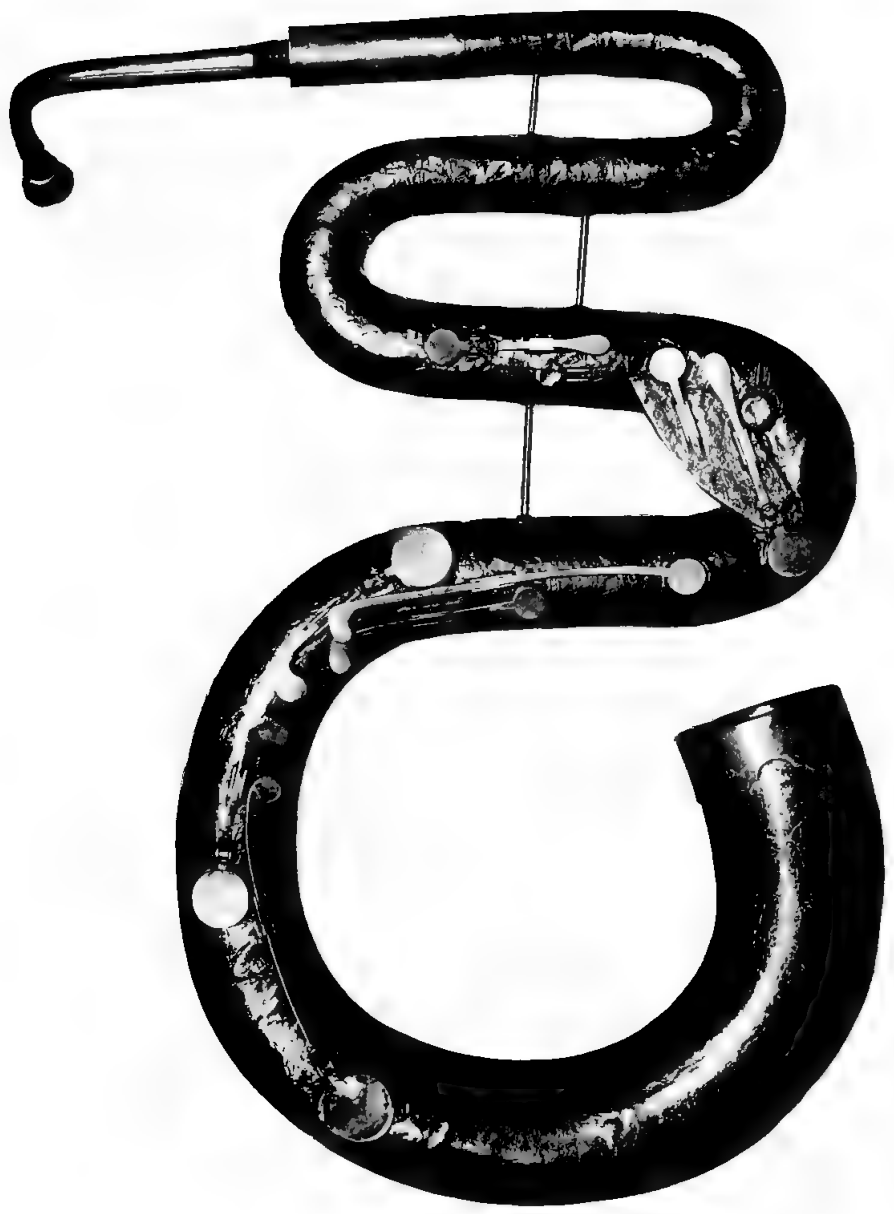
The serpent
Facing p. 287.
By kind permission of Messrs. Boosey & Co.
really the bass of the old Zinke or Cornet à bouquin, the instrument which supplied the normal treble-part to the mediæval Brass-band. All these instruments, whatever the material of their tubes, employed the same methods of tone-production and of scale-variation—the cupmouthpiece and the laterally pierced holes.
Originally the Serpent was keyless. It was merely provided with a series of six or eight finger-holes. In the latter part of the eighteenth century, however, two keys were added allowing a slightly better disposition oi the holes and consequently improving the intonation; the remaining tinger-holes were finished off with brass rims. About this time it secured royal patronage and became a recognized member of the Military Band.
Ine instrument was normally held vertically in front of the This was awkward for an infantry bandsman when marching. He could either play or walk: he could not do both at the same time. Acting on a royal suggestion, however, bandsmen began to carry their instruments sideways, and, though even with this added comfort their mental state cannot have been enviable, the change was reckoned epoch-making.
model, but in Sape, s seen to have been dear end on the dame pattern, they had another standard instrument, less cumbrous and therefore more convenient for military use. This instrument was commonly known as the "Serpentmilitaire" or "Serpent d'harmonie."
In the early part of the nineteenth century the instrument's tonal inequalities and its deficiencies of intonation had become more than even the men of Waterloo could stand. The old finger-holes were abandoned; the position of the holes was corrected; and a complete set of huge metal keys like tappers was provided. It is one of these comparatively modern and elaborate Serpents, tit for either military or civilian duty, which is illustrated on Plate XI. have no difficulty, after what has been already said with regard to this special instrumental family, in making out the details of the illustration without further explanation. The material used in the manufacture of the Serpent was wood covered with leather. A large cup-shaped mouthpiece of metal was used, and, as may be seen from the picture, the whole instrument presented the appearance : of a dishevelled drain-pipe which was suffering internally.
The Serpent was a Bb-Serpent. Its written chromatic compass from
→ therefore sounded a whole tone lower: 3 fire
In tone it seems to have been an instrument in which the early Christians might have delighted. Berlioz speaks of its "lugubrious poetry" as being fitted for nothing but the plain-song of the Dies Ira, and mentions its "frigid and abominable blaring" in terms that evidently recall his own early sutterings when he assigned it a part in the Resurrexit of a Mass.
For years the Serpent was highly popular in French churchcireles. It has, however, long since severed that connection, and now leads a respectable secluded life among the mermaids and stuffed alligators of local museums.