Cecil Forsyth · section 49 of 60
No. 45. The Cuckoo-Instrument Read and hear this section in the playable edition →
This toy-instrument is one of a somewhat large zoological family which devotes itself to imitating the cries of birds and beasts, generally in outdoor performances.
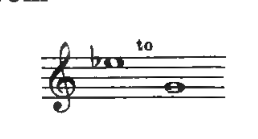
In construction the " Cuckoo-Instrument" is actually a rudimentary Church-Organ on a very small scale. It consists of two tiny Organpipes made of wood and mounted on a pair of miniature bellows. pipes are stopped, and therefore sound an octave lower than they would if open. The "stop" in each case is a closely fitting plug provided with a knob-handle. This can be pulled out or pushed in at discretion. Consequently, the vibrating air-column can be lengthened or shortened, and this lowers or raises the pitch of the two notes. utmost range possible is from
Fig. 639 · Play this example in the reader ▶ The natural or country-side cuckoo has been observed to sing anything from a major second
Fig. 640 · See it in the reader but it is well known that the theatrical variety is a military bird, born and bred in the key of Bo (major or minor)
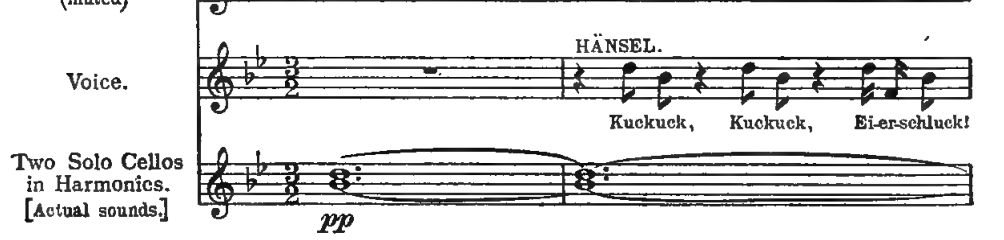
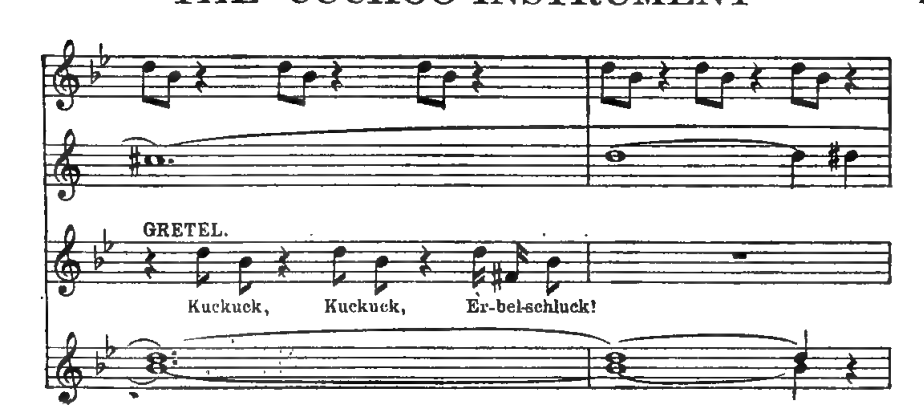
Humperdinck has employed this instrument in the l'orest scene {Act II.) of Hänsel und Gretel. Here is a short example in which it Harcomesnied by a Muted Horn and two Solo Cellos playing in
Example 203
Fig. 641 · Play this example in the reader ▶ 1 See page 242 for explanation and correct notation.
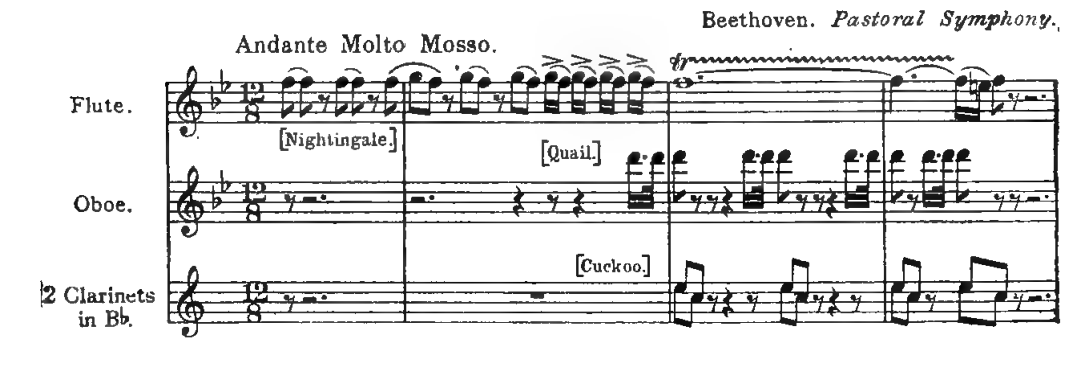
Fig. 642 · Play this example in the reader ▶ Beethoven's cuckoo in the Pastoral Symphony has the same notes done by two Bo-Clarinets in unison.
Example 204
Fig. 643 · Play this example in the reader ▶ ← No. 43. The Pedal-Clarinet All sections Stringed instruments → More Playable Books Forsyth, Choral Orchestration A whole Te Deum orchestrated bar by bar, with Forsyth’s reasons, the full score and the vocal score playable. Fux, Gradus ad Parnassum Learn how independent voices work together, one species at a time. Goetschius, Exercises in Elementary Counterpoint Build independent melodies through graded exercises, with 471 recorded examples. Goetschius, Counterpoint Applied Study imitation, canon, and fugue with 393 recorded examples. Kitson, Counterpoint for Beginners Strict counterpoint in two and three parts, species by species, with every example playable. Prout, Analysis of J. S. Bach’s Forty-Eight Fugues Follow Prout through all 48 fugues of the Well-Tempered Clavier, every example playable. Rameau, Treatise on Harmony Explore the foundations of harmony, composition, and accompaniment. Rimsky-Korsakov, Practical Manual of Harmony The classic harmony course, newly translated from the 1910 French edition, with all 640 examples playable. Tchaikovsky, Guide to the Practical Study of Harmony Tchaikovsky’s Moscow Conservatory harmony course, with playable examples. Fenaroli, Partimenti Six books of partimenti, with playable basses, contrapuntal exercises, and bilingual rules. Reger, Supplement to the Theory of Modulation Explore Reger’s modulation method with 100 analyses and 102 playable examples. Cutter, Harmonic Analysis Learn to name every chord and non-harmonic tone in real music, from Bach to Wagner, with the passages playable. Schoenberg, Theory of Harmony Read all 22 chapters, with the original German beside a new English translation. Rimsky-Korsakov, Principles of Orchestration Discover instrumental colors through scores and orchestral recordings. Berlioz, Treatise on Instrumentation Berlioz’s treatise on the orchestra, revised by Richard Strauss, with the original pages. McKay, Creative Orchestration Ranges, transpositions, texture and balance, taught through projects, with the supplied examples played by orchestral samples. Sanganeria, Arrival Build jazz lines that land, with 30 original playable examples. Bona, Complete Method for Rhythmical Articulation Practice rhythm through 120 graded studies, with playable notation and original scans. Hanon, The Virtuoso-Pianist Practise all 60 exercises with playable notation, original scans and supplied Mutopia playback. Mathews, Standard Graded Course of Studies, Grade I A first year of piano: 136 short pieces by many composers, every one playable, with Mathews’s teaching notes. ← All Playable Books  Playable Books