 Playable Books
Cecil Forsyth · section 50 of 60
Stringed instruments
Read and hear this section in the playable edition →

Preliminary
In this group of instruments the air-vibrations are set up by means o i stretched string or strings. There are three methods by which the strings themselves are set in motion:
1. By plucking either with the finger, as in the ancient Kithara or Lyre and the modern Harp, or with a mechanical instrument, such as a plectrum or quill. for musical purposes the latter group may again be divided into
(a) Instruments, such as the Mandoline, in which the strings are set in motion by a plectrum held in the player's hand.
(0) Instruments, such as the Hurpsichord or (Clavi)cembalo, in which the strings are set in motion by a quill not directly under the player's control.
2. By struking with a hammer or hammers. This group also may be subdivided into
(u) Instruments, such as the Dulcamer, in which the strings are set in motion by means of hammers held in the player's hand.
(b) Instruments, such as the Pianoforte, in which the strings are in motion by hammers not directly and completely under the player's control.
(a) Those instruments in which the application of the movins surface is not directly and completely under the player's control. The best examples of this type of instrument are the obsolete Uryanistrum and its modern descendant, the Velle or Hurdy-gurdy, in both ot which the moving surtace was a rosined wheel which pressed against the strings and was kept in motion by means of a crank.
(b) Those instruments in which the application of the moving surface is directly and completely under the player's control. . The
1 The Tambourin du Béarn is a sort of primitive Dulcimer. It has seven strings, all tuned to C or G. The player beats these as a sort of drone-bass to the tune of his Galoubet. See page 31.
most familiar examples of these are the old Rebecs, the Minnesinger- Ardels, the Viols, and the modern Violins, all played with a " bow.
The development of these groups of plucked, struck, and bowed instruments is to be studied first in existing specimens; second, in theoretical and historical works, and in the surviving ancient music which was pertormed on them; and third, in the pictures, illuminations and carvings which are to be found scattered all over Burope.
it need not be said that, with the perishable nature of musica instruments, the first method does not take us very tar back. Indeed it is with something of a shock that one comes on an occasional orchestral player who is earning his daily bread on an instrument that was fashioned in Queen Elizabeth's day. Such instruments actually exist, and are sometimes models of great construction; but in general one may say that, save for a stray specimen here and there, all instruments of an earlier date have vanished.
The historian is therefore compelled to rely mainly on illuminations, on carvings in stone, and on historical references. The whole of that field has been, or is being, explored with extraordinary patience and accuracy by various workers, and it is only possible here to hint at the results of their labours.' It may be as well, however, to give a very hasty and much compressed account of the three groups of instruments mentioned above.

This, the simplest form of stringed instruments, is also probably the most ancient. Various legends have attempted to account for its invention, but none has much value in view of the fact that even a savage who possesses a bow for the purposes of war and the chase also possesses a twanging musical instrument. The early developed type of this twanging stringed instrument is the Greek Kithara, whose shape is familiar to everyone through its constant representation in Greek, statuary, bas-reliets, and vase-paintings.
It is uncertain when and how this instrument began to develor into what we may call for the suke of shortness a Lute, that is to say, into an instrument whose strings. were stretched over a vaulted resonating-box. Iwo facts, however, show that some changes of this sort took place at a very early date.
(1) An actual instrument of distinct Lute-type furnished with a vaulted body and with three pegs in the head was dug up at Hereulaneum. Herculaneum was destroyed in A.n. 79.
(2) A four-stringed "Pandoura" is represented in a sculpture now in the Mausoleum-Room of the British Museum. This sculpture is
1 The student who wishes full information on this topic should make himself scquainted with Miss Schlesinger's valuable study, The Instruments of the Modern Orchestra and Early Records of the Precursors of the Violin Family. (Reeves, MCMX.) A list of manuscripts, carvings, and paintings from the eighth to the eighteenth centurs is printed as an Appendix to Mr. Galpin's Old English Instruments of Music (pp. 301-311). This list, however, refers only to British examples.
of about Hadrian's time, 117-138 A.D., and the instrument in question is clearly being played by plucking. It has something the appearance of a long banjo with a very small body. It differs, however, completely from a banjo in the fact that the body is vaulted like that of a Mandoline and is quite evidently a resonating-box
It is somewhat doubtful whether these early forms continuea to persist through the first centuries of the Christian era and had any true influence on the development of the mediæval Lutes. It is known for certain that the early European Lutes were based immediately on Arab forms. On the other hand, it is quite possible that these Arab forms themselves were founded on, or at any rate influenced by, the Græco-Roman instruments.1
At any rate, we find that the popular instrument in Chaucer's time (fourteenth century) was a boat-shaped Rebab which had probably come into Europe during the Crusades. This instrument, which was called a Cittern or Gittern,' was held, not in violin-, but in lute-or guitar-position, and was plucked with a plectrum or sometimes with the fingers of the right hand. The Gittern had a flat back and incurved sides much like those of a modern Guitar. In this it liffered completely from the pear-shaped Lute with its vaulted back When first it came to England the Gattern was a simple instrument oi four strings tuned either to
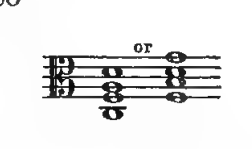
Few of these instruments survive. A fourteenth century specimen, however, restored in Queen Elizabeth's reign and bearing the arms of the Earl of Leicester, is preserved at Warwick Castle. The Citole was a hybrid-instrument, a mixture of Gittern and Lute. It combined the flat back of the former with the pear-shape of the latter. From the Gittern-type of instrument sprang the whole Lute-family, a large and historically most important group whose services to art only ended in the seventeenth century.
There appear to have been nearly a dozen varieties oi Lute disinguished from one another by their size, that is to say their pitch and by their complexity of stringing. The double-necked Bass-Lutes which in the sixteenth and seventeenth centuries took the place of our present-day Cellos and Basses, were generally known as Theorbos. These were strung with 12, 14, or 16 strings tuned in unison-pairs like those of the modern Mandoline, and all these strings were
1 The ancient British Cruth was originally a plucked not a bowed instrument. principle of the bow was, however, introduced from Asia at an early date and was applied to the Cruth. It was played in this manner both in England and Ireland from In fact the Bowed-Cruth is the instrument so often mentioned in Originally it had neither neak nor mediæval Latin by the name of Chorus. The Early English was coriun. of salteriun of fidele & of coriun " (Lay, about 1205). fingerboard. The Rebec, on the other hand, was imported as a bowed-instrument from
2 The name alone of the instrument is a debased form of the Greek word Kithara.
"stopped" by the fingers of the left hand according to a method somewhat similar to that of the Guitar. On the bass-side there were from 8 to 11 "free-strings." These were never "stopped," that is to say, they were only employed to sound the open note of their greatest length. The largest varieties of Theorbo were the Archlute, which hailed from Padua, and the Chittarone or Roman Theorbo, a huge Contrabass which stood as high as a tall man. The early method of notation for all these instruments was by means of "Tablature," a system in which the lines of the stave represented not regular degrees of pitch but the actual strings of the instrument. The fingering was then indicated by the use of letters (A, B, C, etc.) or of figures (1, 2, 3, etc.). Similarly in the Wood-Wind instruments the Tablaturesigns represented the holes covered by the player's fingers.
me The second type of plucked nobrunet ad in which the placking of the player, is represented by the Harpsichord. In this instrument a keyboard was used something like that of the pranojorte. mechanism was also provided which was set in motion by the pressure of the finger on the key. This motion was communicated to a series of quills so arranged as to "make contact" with the tense strings. The Harpsichord was used in what we may fairly call "modern music," and the nearness of its period to our own times may perhaps cause us to overestimate slightly its importance in the history of the art. Compared with the Lute, however, its importance is not great in respect either of its antiquity or of its long continuity of service.! Besides the Harpsichord there were three other instruments all plucked with mechanically-controlled plectra either of quill, leather, metal, or wood. These were the Virginal, the Spinet, and the Clavicembalo.
Of all these plucked instruments the only one which has been galvanized into modern orchestral life is, curiously enough, also one of the oldest—the Harp? Several thousand years before the Lutefamily began to have its early beginnings in the days of the Græco- Roman civilization the Harp was in use on the banks of the Nile and, apparently, in all its essentials much what it is at the present day. Of course it had neither the large compass nor the chromatic mechanism of the modern instrument; but, if we may judge from the many representations and actual specimens which survive, it was by no means wanting in either power or effectiveness.
(2) Struck Instruments.
These instruments again are, so to speak, " as old as the hills." On the Assyrian sculptures of the time of Sardanapalus, musicians are represented playing what we should call Duleimers, that is to say, instruments in which a series of strings are stretched either on a flat wooden board, or perhaps even on a flat hollow resonating-box,
1 The earliest instrumental compositions were written either for Organ or for Lute. 2 But see also what is said below with regard to the Guitar, page 479.
and beaten with hammers. This is the instrument which has been mistranslated in the authorized Version of the Scriptures by the word Psaltery. "Then an herald cried aloud, To you it is commanded, people, nations and languages, That at what time ye hear the sound of the cornet, flute, harp, sackbut, psaltery, duleimer, and all kinds of muzak ye fall based worden me has aged - survive from that day to this, and in Hungary has been elevated to the position of a national instrument—the Cimbalom—essential to the pertormance of the Czardas and other peculiar forms of Magyar music. It can scarcely be called an orchestral instrument, though in small orchestral combinations it has made its way Westward. Even in a London restaurant a Bach fugue on the Cimbalum has been heard as an accompaniment to the clatter of knives, forks, and dishes.
The Clavichord was not strictly either a plucked- or a struckinstrument. It was a pushed-instrument. and the pushing-mechanism was a small piece of metal called a "tangent.". This type of instrument was a great advance on the Harpsichord, both in the variety and the dynamic range of its tone-quality.
The modern Pianoforte may be said, without disrespect, to be a mechanical variety of the Dulcimer, to which it has much the same relationship as the Harpsichord to the Psaltery or the Lute. It is, in fact, an instrument whose stretched strings are set in vibration by means of hammers, between which and the controlling hand of the player there is an elaborate and fixed mechanism. This instrument, again, is scarcely more at home in the orchestra than the Cimbalom. As a solo instrument with orchestral accompaniment it, of course, holds the highest place, but as a regular member of the orchestra it has been used oniy for one of two purposes, either as a substitute tol a special instrument such as the Harp or Celesta, or to eke out the harmony in a poorly equipped band. It may be said that it is not very successtul in either capacity. Its poor and slightly unpleasant tone-quality contrasts unfavourably with the beautitul tone-colours of the Strings and Wind, and, in modern pianofortes, the attempt to make a sustaining instrument out of an essentially non-sustaining "box of wires and hammers" has not very happy results.
It must be added that from time to time endeavours have been made to introduce the pianoforte as a purely orchestral instrument. The latest of these are to be found in the scores of Richard Strauss's Ariadne auf Naxos and of Scriabine's Prometheus.

1 The word dulcimer is here a mistranslation for bagpipe. The true dulcimer dittered from the original psaltery as a struck instrument differs from one that is plucked. The two names, however, are continually confused in early references to these instrumenta. It is doubtful whether the ancient Irish timpan was a psaltery or a dulcimer.
and Basses. These instruments, which are often "taken for granted," really call for considerable historical explanation. Indeed one only needs to take into one's hands a modern Violin and Bow and to examine their perfection to be made aware that they represent merely the last link in a long evolutionary chain. Something is known of this chain throughout the greater part of its length. Alongside of it, however, is another rusty chain whose broken links represent to us the incomplete development of a second family of bowed instruments— the tamily whose modern descendant is the despised Hurdy gurdy. The links in the latter chain are few in number, but as they had some importance in the history of instrumental music, a tew words may well be devoted to them before we deal with the better-known bowedinstruments, the families of Viols and Violins.
The earliest attempt to adapt what one may call "bowed" 1 instruments to the service of Church-music, that is to say, to the service of the only existing organized music, was, by a curious historiçal inversion, purely mechanical. In every other department of instrumental music the strict order of development has been from instruments directly under the control of the player's hands to instruments in which a controlling mechanism is interposed between the player and the sound-producing medium. Even in the other two groups of Strings— hose that are plucked and those that are hammered-this order I strictly observed . With this special instrumental group, however, the first attempt was to set the strings in motion mechanically. It must not be supposed that, at the time when this invention took place, "bowed" instruments in our modern sense of the word did not exist. They existed, but were apparently considered outside the pale of serious art.
A stringed instrument was called for which should be able to accompany the unison choral melodies with those forbidding series of fifths and octaves which satisfied the same craving in the early middle ages as Wagner's harmony satisfied in the nineteenth century. These series of fifths and octaves are known to theorists as "Organum," and the only instrument then existing which could deal satisfactorily with them was the Pipe-Organ. The required stringed instrument was to act as a substitute for the Pipe-Organ, and was to possess the advantage of portability.
As far as one can gather from the description of Odo of Cluny and from representations which have come down to our day-for of course no actual specimens exist—.the instrument consisted normally of three heavy strings laid parallel to each other over a sound-chest. The three strings were not laid horizontally in one plane, but in the are of a circle. At one end of the strings a heavy wheel of wood, faced perhaps with leather, and well rosined, pressed against all three abbached, and by tbat means the wheel could be turned. But observe A crank, something like the handle of a barrel-organ, was that the wheel could only grind on the three strings simultaneously.
1 The word "bowed" is used loosely here to cover the third group of instruments mentioned at the beginning of the chapter.
There was no mechanism for throwing one or two out oi gear. In addition to this wheel a series of revolving wooden bridges was provided to "stop" the strings in a limited diatonic scale. These bridges were placed under the strings and were brought into action by. means of wooden turn-pins which projected outside the instrument. Like the wheel, these bridges only acted simultaneously on all three I bet was to e strings: indeed their only object was to produce the tearsome series of fifths and octaves which made up the "organum" of those very dark ages.
The instrument described above was not of very large size. It could be rested on the knees of two seated players, and could be easily carried from one place to another. Pietures are in existence showing the two players, one at the crank, the other at the keys, co-operating in much the same harmonious relationship as that which exists between the village organist and the village organ-blower. It is only: necessary, to add that the instrument was known by the name of Organistrum.
With the downfall, or rather the development, of the old system of Church-accompaniment, the necessity for the continual moving drone, ceased. A less enterprising instrument than the one under discussion would have been irretrievably beaten by the changed circumstances. The Organistrum, however, was quite equal to the new situation, and, much to its credit, at once transmogrified itself into the Vielle or. Hurdy-gurdy!
The old leathered and rosined wheel remained, but the number of the strings was increased first to tour, and then to six. The most important change, however, was that the keys no longer pressed the whole series of strings against what we should call the "fingerboard," but only the "chanterelle" or top-string. The other strings were only played "open," that is, in their greatest length, and thus, so long as the wheel was kept turning, they tormed an agreeable drone-bass to the chanterelle-melody. One must add that, in the course of time, a complete change was effected in the system of "stopping." revolving wooden bridges gave place to a series of little upright wooden rods which were originally pulled and afterwards pressed against the chanterelle. The latter form of instrument can still be y frequently in ther-onde stetsy the neally has fock. seen fairly frequently in the London strings. covered Cello-strings are used. The two middle strings-—those on which the "stopping" apparatus acts-are like long, thin, Violin E-strings.
It is very easy to make fun of such instruments as the Organistrum: and Hurdy-gurdy in the yeax 1914, but we must not overlook the fact that these instruments really played a considerable part in music during the thirteenth and tourteenth centuries, and that their services at country merry-makings continued right down to the eighteenth
1 Known also in France as Velle-a-manielle, symphonie. or Chyfonie-a-roue; in Germany as Leier, combined with some such word as Dreh-, Bavern-, Rad-, Bettler-. Deutsche.; in Italy as Irra Tedesca, Lira rustica, or Lira pagana.
century. It is by no means a stretch of language to say that the Cello-, Bass-, and Bassoon-pedals, which, even in modern works, are used to accompany dance-rhythms, have their origin in the mechanism of the Vielle-à-manivelle.
Naturally many attempts were made to improve an instrument so. well known and so widely used. Of these one may mention the Celestina, the Bogen-Claver, the Gergen-Clavicymbal, the Gergenwerk of Hans Hayden described by Praetorius, and the Bogenfügel. Une may even add the quite recent endeavours of an American inventor to produce a Mechanical Violin, that is to say, a violin—or rather a group of violins—in which the "stopping" should be mechanical, and the exciting-surtace an endless horse-hair bow.
The student need scarcely be informed that every attempt to. improve the Vielle-family has split on one of two rocks—the ditheulty of mechanically varying the application of the force according as the string is stopped into smaller or greater lengths, and the equally serious difficulty of varying the application of the force to the varying necessities of strings of different pitch, that is, of different tension. Were it not for these two insurmountable obstacles, we might all at the present day be playing Treble-, Tenor-, and Bass-Hurdy-Gurdies, instead of Violins, Violas, and Cellos.
The early history of the Violin family begins in Asia long before the Christian era. With regard to those far-off times there is little precise information to be given beyond the fact that bowed-instruments. are mentioned in the Sanskrit classics. The bow, therefore, forms one essential part of a musical instrument of very great antiquity, and it Is unlikely that it was a mere development of the plectrum. Neither the bow-half nor the fiddle-half of this musical instrunient seems to have formed any part of either the Greek or the Roman civilization. They probably stayed South and South-east of Europe during the early centuries of the Roman Empire. It is difficult to say whether they were introduced into Southern Europe by the Arabs or not, but they first appear there in the form of a pear-shaped Rebec or Gigue, and a short highly-arched bow. On its first introduction into Europe the Rebec was known by the name which it still bears in Greece, the Lyra. No specimens of this instrument are in existence, but, from the carvings and illuminations in which it figures, one can fairly reconstruct it as a two- or three-stringed fiddle which was provided with sound-holes and held somewhat in "fiddle-position." The instrument had no regular neck. The upper part of the body was merely narrowed for the convenience of the player's hand. Nothing certain is known as to the tuning or the compass of the Rebec, but, judging
century dancing-masters' Kits called Pochettes or Sordinos. T'hese were very small and extremely narrow fiddles, which could be easily slipped into the pocket. usually boat- or truncheon-shaped, without any external resemblance to the Violin. However, as far as the tuning and fitting was concerned, they were merely adaptations of the modern instrument. Many elaborate specimens of these Pochettes, made of wood and ivory, still exist in our museums.
from its want of neck, one may conclude that its range was very small, perhaps an octave or slightly more.'
To the Rebec succeeded the Troubadour Fidel, an oval instrument which was used for the accompaniment of men's voices. The historical interest of this instrument lies in the fact that, during the thirteenth century, distinct efforts were made to lengthen its oval form. At about the same time, or a little later, the big Minnesinger Fiddle begins to appear. With the advent of this instrument, we first begin to feel that the modern violin is "on the way." The sides are already receiving first a slight, and then a continually greater curve inwards, in order to give freer play to the bow. In one point only it deviates from the path of progress. It begins to adopt a Ieature which was, in later days, to become characteristic of the Bass-Lute—-the free-string hanging clear of the nut and fingerboard, incapable therefore of being
in Before
fingered, and only useful as a bourdon-bass.
Before passing to the Viols, which were the immediate parents of our modern Violin-Family, we must pause to describe a once popular bowed stringed-instrument, the Tromba Marina. If the reader will imagine a huge wooden metronome case six or seven feet long, of which the base-that is, the part nearest the ground—was about six or seven inches, and the apex about two or three inches wide, he will have some idea of this monstrosity. It had one string only, and this string was stretched down the entire length of the enormous wooden pyramid. Uccasionally it was provided with such luxuries as soundholes and sympathetic strings.
The feature of the instrument, however, was the Bridge or "Shoe," as it was called. This was cut on one side so as to form a thick heavy support for the string; on the other it was shaped into a narrow atrophied leg, which neither completely rested on nor completely cleared the sound-board. In fact, it hung loose, just touching the wood below. The result was that every time the player attacked the monochord with his bow, the "game leg" vibrated with a horrid The player, as a rule, indulged only in the open harmonics of the string," and the commonest intervals were therefore those usually heard on the trumpet. Hence, say the antiquaries, with an obscurity difficult to penetrate, the name Marine Trumpet.*
* The word Rebec also appears continually in the forms Ribile, Rubybe, Rybibe, Rebibe, and Rubible. These transformations are a philological mystery, though suggestions have been made that they were due to a confusion or rather a fusion with the word "trible." "In twenty manere koude he trippe and daunce. ... And pleyen songes on a small Rubible." Chaucer, Miller's Tale (1386).
than fifty "sympathetic" strings.
3 Some lists of "frets," however, give a few other notes.
* Another derivation makes Tromba Marina equal to Tromba Marianu, but this is a celebrated fiteenth century trumpeter. This seems at least as likely as the other two. Mr. Galpin suggests a derivation from the name of Marin (or Maurin),
It is hard to believe that this instrument can have been as bad as it seems. Un the description, which a stringed-instrument is capable only one string very over elongated trunk, a crazy musical constitution, and a "crank" bridge calculated to do everything that a bridge should not do. Yet it enjoyed great popularity, and was written for even by a man of such distinction as Scarlattil In Germany, where it was commonly known by the names of Trummscheit, Prompetengeige, and Tympanischiza, it was often played by the nuns during the Church services. Hence came its nickname Nonnengeige (Nuns' fiddle).?
After this short digression we must return to the study of the true fiddle family. We left it at the point where the instruments, under the name of Minnesinger Fiddles, were just beginning to assume something of the characteristic violin form. centuries, the efforts which were made to improve the musical character of these fiddles culminated in the Viols, a family which occupied in the 15th, 16th, and 17th centuries the same position as that held in our own day by the Violin-group. In shape these Viols were much like the old style of Double-Bass 3 familiar to everyone in our concert-rooms and theatres. They had high bridges, very deep ribs, fat backs, and long sloping shoulders. The usual number of strings was six. But one small Viol (the Lyra- or Leero-Viol) was furnished, early in the Ith century, with an additional set of six "sympathetic" strings. This was possibly an English invention. At any rate, the instrument so strung was at one time popular in this country, and was regarded abroad as a peculiarly English type. Its adoption on the continent produced the Viola d'Amore. One may add that the difficulty of keeping these elaborate sets of strings in tune was always great, and this, combined with the size oi the instruments, probably dia some service in compelling the players to the utmost nicety of intonation.
Heavy and cumbersome though the Viols were, they yet had a weak and unsatisfactory tone-quality that cannot compare for an instant with that of the modern Violin-family. Some few Viols have been refitted as Violas and even as Cellos. Players, however, find them difficult to manage. The lower strings have a tendency to sound heavy and funereal, while the whole instrument is easily "overplayed." The Viol-players must have adopted what we should consider a quiet, lifeless style of bowing. Under the pressure of a very slight "attack," the instruments cease to do their best. They sulk.
1"A rare concert of four Trumpets Marine" was advertised in the London Gazette of Feb. 4, 1674, to take place every week-day afternoon at the fleece Tavern in St. James's. The "best places " were one shilling. Quite enough, one would think.
"It would be interesting to hear modern made specimens both of this instrument and of the Organistrum. They might well be introduced into non-Operatic plays of the correct periods, and would furnish a very valuable object-lesson in musical history.
motices the a miles of the organi to me rule of pogplain particular, could, of course, be insured.
3 Though this instrument was not an original member of the family.
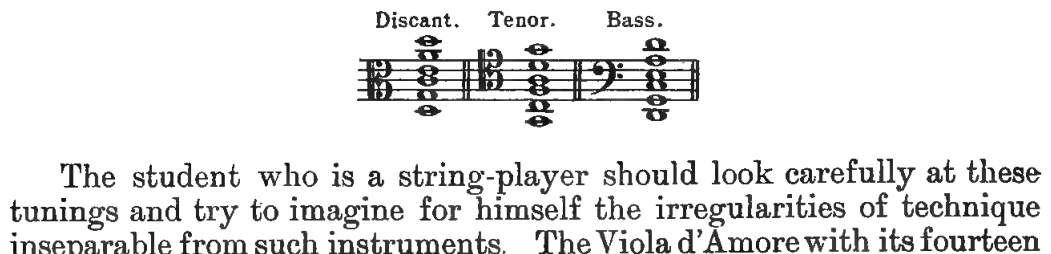
The original Viol-family consists of three members,
(1) The Discant- or Treble-Viol.
(2) The Tenor-Viol or Viola-da-Braccio.'
(3) The Bass-Viol or Viola-da-Gamba."
The tuning of these three instruments was as follows:
strings, of which seven were tuned strictly in the key of D major thus
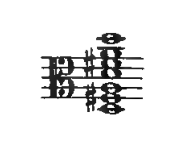
and seven were " sympathetic," is even more impossible from the point of view of the modern String-player.3
The intermediate—one might say the experimental-type between the Viols and the Violins is represented by the Quintons. These two instruments, The Treble Quinton and The Tenor Quinton, were furnished with five strings apiece. They are interesting as showing an approach to our modern system, both in the reduction of the number of strings and in the fact that they are actual "half-way instruments." As the student will see from the following tunings
Treble Quinton. Tenor Quinton.
I ie. arm-viol, because played in violin position. As showing the extraordinary differences that existed between the methods of various Viol-makers the student may be recommended to look at a Viola-da-Braccio in the Donaldson Collection at the Royal College of Music. This instrument, from the general shape of its "bouts" and from the curving of the back and belly, might almost be a modern orchestral Viola. Yet it The "head" is of a very ancient pattern, totally distinct from anything made since the Violin- or even the Viol-settlement. It is provided with
strings, of which five are on the fingerboard and two are strung à vide on the
" i.e. leg-viol, because played in cello-position. Intermediate between the Viola-da- Braccio and the Viola-da-Gamba came a Viol called Viola-da-spalla, ie. shoulder viol. l'his instrument, something like a very small Cello or a large-sized modern Viola, was held in front of the player in a sort of Cello-position. It was used a great deal in Italy for Church processions, and on these occasions was attached to the player's person by a string or ribbon. For Viola-da-Gamba see page 434.
3 For a full description of this instrument, see below, page 405.
the three lower strings of the Treble- and Tenor-Quintons are the same respectively as those of the modern Violin and Viola
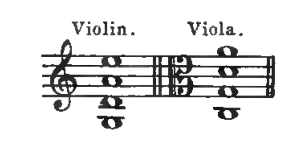
The immediate precursors of our present-day instruments were a set of violins, each of which had much in common with our modern These were-
me The one mera Vostringed inserument which had the
(2) The Bass-Violin, a four-stringed instrument which had the same tuning as the modern Cello,
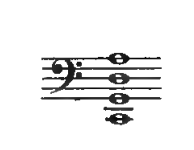
(3) The Double-Bass Violin or Basso-da-Camera,? an unwieldy fourstringed Bass which was tuned thus
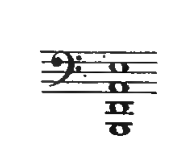
All these are obsolete, as are also (1) The Oktargeige " or Octave- Fiddle, a small four-stringed Bass standing in pitch between the Viola and Cello, and tuned an Octave below the modern Violin. (2) A small four-stringed Cello tuned the same as the modern instrument. This is apparently the instrument called by Leopold Mozart Handbassel, and by Boccherini the Alto Violoncello.
The first instrument of the modern family to make its way into serious Church-music was the Viola. From that instrument all the others measure their stature. The Violin, whose name simply means "small Viola" (Viol-ino), struggled in against much opposition. Objection was taken to its licentious secular character. The name Violone,
1 The true Violins had from the first four strings as opposed to the five or six of the Viols. A well-known Italian chap-book of the middle of the 16th century, La Violina con la sua riposta, etc., contains a picture of La Violina as its title. This, however, is plainly a small Viol of pronounced 15th century type. The Italians from the first used the masculine termination for the Violin, calling it "Il Violino."
2 This instrument was used occasionally by the great Bass-player Dragonetti.
3 Not to be confused with Vuillaume's 19th century invention the three-stringed Octo-Bass. See Berlioz, page 240.
* The early Cello tuning vacillated a good deal between the modern A-D-G-C and a uning one whole tone lower, G-C-F-Bb.
• Similar to this but somewhat smaller was the Fagotgeige or Bassoon-Fiddle mentioned by Leopold Mozart.
i.e. "big Viola," was given to the Double-Bass,' and in accordance with the accurate if somewhat limited principles of the Italian language, the intermediate instrument was christened, Red-Indian-fashion, , " little big Viola, " Violoncello.
Into the many and wonderfully subtle improvements which were made, first in changing the Viol into a Violin, and then in perfecting the new instrument, it is impossible to go here. It is sufficient to say that the work was begun in the 16th century by Gaspar da Salo,? and ended in the 17th by Stradivarius. All the various instruments had now become standardized. It is, however, necessary to mention three instruments whose names the student may possibly meet in 18th century music. These are
(1) The Violetta Marina,
(2) The Viola Pomposa,
(3) The Violino Piccolo (of Bach).
They were all invented after the final Violin-settlement, rapidly became obsolete, and may now be regarded merely as instruments
(1) The Violetta Marina, for which Händel wrote in Orlando, was an eighteenth century atavism. It was an adaptation of the old Viola d'Amore with all its paraphernalia of "sympathetic strings." Begotten in the brain of Castrucci, the leader of Händels Italian
(2) The Viola Pomposa was a small Cello to which a fifth topstring, or chanterelle, had been added. It is probably the "Violoncello Piccolo" of Bach's 6th Solo for the Cello, and is said to have been either invented or suggested by him. There is, however, considerable doubt with regard to both these statements. The instrument was obsolete in Leopold Mozart's day.
(3) The Viulino Piccolo of Bach stood in the same relationship to the Violin as the Eb-Clarinet to the C-Clarinet. It was in fact a three-quarter sized violin tuned a minor third higher than that instrument. The Violino Piccolo had a short and not particularly gay life, and, like the Viola Pomposa, was extinct in Leopold Mozart's
We must now turn from this short historical study to make ourselves more fully acquainted with the four-bowed instruments which constitute the modern orchestral string-quartet. These are, in their order or pitch downwards, the Violin, the Viola, the Violoncello, and the Double-Bass.
' Some authority has been found for the assertion that the Double-Bass was actually the first of the modern instruments to receive Violin form. The matter is, however, somewhat doubtful.
2 Andreas Amati made some very small violins in the 16th century.
" One species of Viola d'Amore mentioned by Leopold Mozart bore the poetical name of «The English Violet."
No. 16. The Violin (or Fiddle)."
Fr. Violon; It. Violino; Ger. Violine (or Geige).
No attempt will be made here to describe accurately the shape of the Violin or the possible relationship of that shape to its exquisite musical qualities. It may suffice to say that the form in which we now have the instrument is apparently beyond improvement. Since. Stradivarius's day only non-essential alterations have been made in the instrument, and these consist chiefly in the strengthening of certain parts, such as the bass-bar and in the thinning and lengthening of the neck to meet the demands of the modern left-hand technique.
The violin is made of about seventy separate pieces of wood. Of this number sixty are built permanently into the structure, while the rest are merely "fittings." The belly is made of some such soft wood as pine, the bridge and back are both of hard wood, the former generally maple, the latter either maple or sycamore. The length of the instrument varies slightly according to make. In the finest "Strad" specimens it is, as nearly as possible, fourteen inches. The four
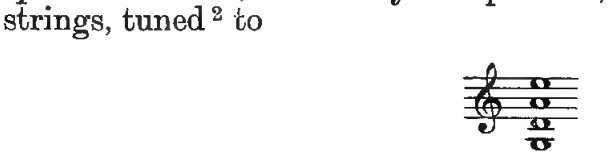
are, as in all other bowed stringed instruments, numbered downwards. The E (or chanterelle) is called the Ist string, the A the 2nd, and so. These four strings are not arranged exactly parallel to each other, but are slightly "splayed" from the nut to the bridge. The nut 3 itself is a raised bar of ebony at the extreme end of the finger-
1 Besides these names various cant words have been used in various languages to designate the fiddle, and incidentally to testify to its popularity. In England the most interesting of these is the so-called Romany word Bosh (=fiddle; Boshomengro=fiddler) which one has heard used as current orchestral jargon. Bosher (=fiddler) is also to be found as a proper-name in the London Directory. A secondary meaning of the word Soak appears to have crept into colloquial English as an equivalent of Nonsense or, as one ring to a turkish Tr Be north of faid a world soil cheng in ofa sing. "fiddlesticks." It is only tair to add that Murray traces the latter meaning to a teenth century novel. of the sloping sides of a blast-furnace or lime-kiln. The essential meaning of this word is the slope as opposed to the straight portion of the walls. It would be interesting to enquire whether the Romany word cannot be traced back to the same root. word would well suggest the characteristic sloping sides of the fiddle before it took its The earliest use of the word "fiddle" appears to be that already given,
2 Ten other tunings have been used at different times by such players as Tartini, Castrucci, Biber, Nardini, Barbella, Campagnoli, Lolli, Ch. de Bériot, Prume, Paganini, and Baillot. None of these has been regularly adopted. Uccasionally in modern works one player or the whole group of players is directed to alter a string for a special purpose. This alteration must, of course, take the form of a lowering not a raising of the pitch, ecause the tension of the strings is already as great as they will stand This alteration f tuning is scarcely ever worth doing on the Violin The results are not sufficient compensation for the tortures of mistuned fiddles which the players and the audience have to sutter during the rest of the programme.
¿ Known in Germany as the Sattel (= saddle).
board nearest the scroll. Four small notches are cut in this nut, and the strings lie in these notches on their way to the four pegs which control their tension The greatest vibrating-length of the four strings, that is to say, the length in which they produce the four open notes E-A-D-G given above, is of course measured by the distance between the nut and the bridge. All four strings are made of very light catgut,' and the lowest string of all—the G- is tightly wound with metal filament, generally silver.
2 The friction of the bow apparently sets up a double vibration in the strings—longitudinal and molecular-and both these series ot vibrations pass through the bridge to the sott belly. Connecting this belly and the hard back is a sott wooden soundpost carefully adjusted on the chanterelle-side of the fiddle. The vibrations are carried through this soundpost to the air space contained by the back, belly, and ribs. If the student will contrast the acoustical process that takes place between the string and the ear with the corresponding processes in the Wood-and Brass- Wind he will see that the former is comparatively complex. The exact action of (1) the hard bridge, (2) the soft belly and soundpost, (3) the hard back, on the air-vibrations initiated by the strings is still a mystery. Apart from this difficult question, the general acoustics of the instrument have never been fully explained It seems obvious that the wooden air-box can be nothing but a resonator reinforcing the already partially damped vibrations set up by the strings. These consist not of a succession of symmetrical oscillations but of a series of controlled and uncontrolled vibrations. The string is thrown into violent motion when it is engaged by the bow, and then has a period of comparatively free movement as the bow releases its grip. Perhaps the best explanation of the fiddle-quality is connected with the material of which the strings are made. These, owing to their extreme lightness, are rich in harmonics which, in their turn, are quickly damped out by the low elasticity of the catgut. Thus "the ultimate quality of the note" is appreciably softened. No confusion exists. The moment the note stops all harmonies cease.
The method by which the bow attacks the strings will be explained later when we deal with the various "bowings" of the violin. Meanwhile a few words may be devoted to the left-hand technique of the instrument. Outside the four open strings, E-A-D.G, every note on the fiddle has to be produced by one of two methods, either
(1) By stopping with one of the four fingers of the left hand, that
1 Made from the entrails of the sheep. The word catgut, however, appears to be not a popular mistake but actually cat-gul, that is to say, entrails of the cat. It seems a pity to deprive the cat of this its only title to usefulness, but there is no record that fiddlestrings were ever so made. Murray suggests an alternative humorous derivation frum the resemblance between caterwauling and fiddle-playing!
2 In this article a certain amount of information common to all the orchestral Strings It will not be necessar is grouped together. to repeat this information under the headings "Viola," " Cello," and " Double-Bass.
3 Known in France as the dme or soul of the instrument. The soundpost is generally so placed that its grain is crossed by the grain of the wood forming the belly.
is to say, by pressing down the string against the fingerboard and so shortening its vibrating length, or
(2) By lightly touching the string at one of the "nodes," and so assisting the string to vibrate in sections. The notes so produced are known as "harmonies." 1
Stopped Notes.
The following is the list of notes produced when the left hand is in the 1st or normal position on the neck of the Violin, and when the Ist, 2nd, 3rd, and 4th fingers successively stop the string. The figures U 1 23 4 placed above the stave have nothing whatever to do with the number of the string. They indicate respectively the open string and the string when stopped by the Ist, 2nd, 3rd, or fourth finger

(1) That three of these notes, viz.,
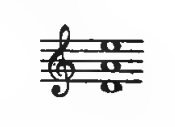
can be played either as open notes or as notes stopped by the fourth finger on the string next below. In practice fiddlers rarely use any open strings except the unavoidable low G
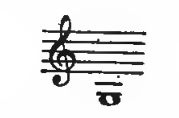
Their tone is too strikingly different from that of the stopped notes.
(2) 'Ihat this scale is not necessarily a scale of O major. It car just as well be played in, say, four flats throughout, though, in that case, the three reduplicated notes mentioned above would all be flat, and could therefore only be played as stopped notes.
This short scale, however, by no means exhausts the possibilities of the Violin. The whole left-hand can be "shifted" into other positions, that is to say, the hand can be slid along the neck into various degrees

1 It must be remembered that, even when the string is vibrating as a whole, it is also With a good covered G-string it is quite possible to coax out one or two of these harmonics so that thev are heard simultaneously with the open note produced by the tull-length string. 'As everyone knows, the quality of the open strings is considerably brighter and harder than that oi the same strings when stopped. This is probably due to the fact that, in the former case, the string, vibrating between two sharply defined points of hard wood, is able to vibrate quite freely, not only in its whole length but also in segments. The harmonics which go to make up the bright openstring quality are thus much more clearly audible. With the stopped notes the slightest uncertainty or movement of the fleshy finger-tips tends to damp out these subsidiary vibrations.
is takemes to the briden lie he, that i dong and atop en poition of nearness to the bridge. new series of notes.
The complete number of these "violin positions" is usually given as seven. It must, however, be stated that for the extreme high notes
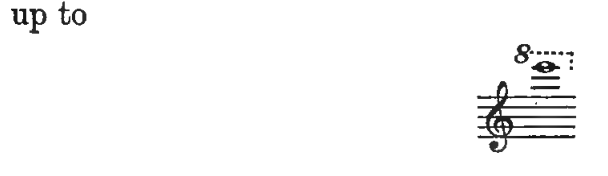
still higher positions are employed. These higher positions, however, and indeed the upper three of the seven ordinary positions, are of little practical use on the D- and G-strings, except in so far as they enable a player (1) to periorm a legato melody with the tone-colour of a single string, (2) to remain in or near one position while executing a diticult passage "across the strings." It is as well to notice the fact that the higher the position taken by the hand the closer the tingers have to b set to each other. Naturally this is of more importance on the Violin than on the larger stringed instruments. The student should bear this in mind with a view to simplifying any passages above top A
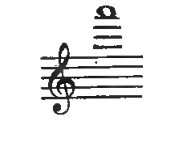
In any of the Seven Positions mentioned above a series of not more than four notes upwards is producible on each string. In addition to this an extension of the fourth finger upwards allows an extra note a semitone or a tone higher, but this is only used for certain limited purposes. Of course in the first position an extra (open) note below the Ist stopped note is always obtainable.
We shall now give a complete list of the Seven Positions on all four strings. 'The semibreve notes are those on which the first finger rests in each position. The crotchet-head notes are those which are played by the 2nd, 3rd, and 4th fingers. The figures above the notes represent, as usual, the fingering.
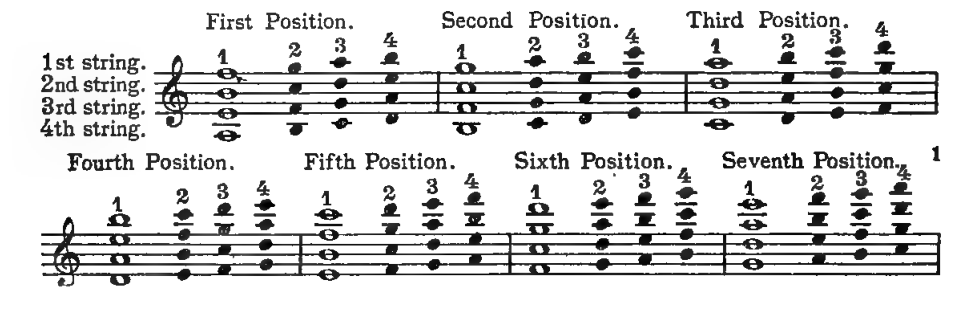
1 The higher positions-8th, 9th, etc.—can be found by the student for himself. They are all formed on the same model.
The student must bear in mind that when the tirst finger is resting on any of the above (semibreve) notes, the player has access without moving his hand not only to that note and the three notes upwards, but to the corresponding notes in the same position on the other three strings. In fact he has practical command not only over his open strings but over the whole series of sixteen notes covered by any one position. These sixteen notes are the four semibreves and the twelve crotchet-heads contained in any one of the above bars. To give a simple instance, it is no more difficult for a good fiddle-player to per-
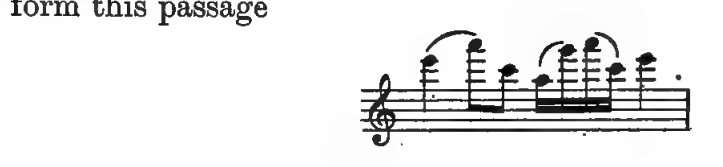
which all lies " directly under the hand" in the 7th position, than the corresponding passage in the Ist position
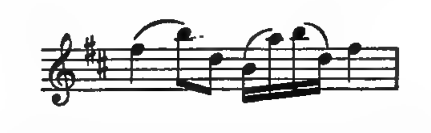
This is a most important point, as it is the foundation of all Violintechnique, and the rock on which all pianists split when they come to write Violin-passages. The only slight element of difficulty in this passage consists in the fact that it is "across the strings," that is to say, that the bow and finger have to make a simultaneous jump to the lower string in order to produce the 3rd and 4th notes, then back to the upper string for the 5th and 6th notes, then back to the lower string for the 7th note, and finally back to the upper string for the 8th note. Naturally it is easier to play a passage in one position on and the ditticulty increases with the number of strings employed This is, however, by no means a serious matter to a competent violinist, and the student must fix clearly in his mind the fact that this small difficulty is inherent in the passage itself at whatever altitude it is played. It is no greater in the 7th than in the Ist position."
It is hoped that the student will by now have seized the fact that the Violin-technique is a technique of position, and not ot notes. Ignorance of this fact is the cause of all the bad fiddle-writing which is too often found in pianists' music. The object, especially in writing fast passage work, should be to keep the player as much as possible in one position, or, at any rate, not to give him passages which involve continual irritating shifts undertaken perhaps merely in order to get single notes. By all means let him shifta violinist is doing so all the time he is playing—but when he has shifted give him something to play in his new position.
1 It may be mentioned in passing that the odd-numbered positions (1, 3, 5, otc.) are on the whole more used by violinists than the even-numbered (2, 4, 6, etc.).
There are of course a certain number of passages which, in fiddle player's language, "need looking at," but, when they have been looked at, the result is either that the player can find a position-technique for them, in which case they are probably good fiddle-music, or else that he cannot, in which case they are sure to sound dull, fussy, and ineffective.
The difficulty of taking skips on the Violin, as indeed on all the String- and Wood-Wind-families, has been somewhat exaggerated by the fact that writers always tend to measure these difficulties by the peculiar mechanical standards of the Pianoforte. The student therefore, if he be a pianist, should try to rid his mind of all a prioni views on this point derived trom his knowledge of pianotortetechnique. On that instrument a melodic skip of two octaves means an acrobatic swoop of thirteen inches or so. On the Fiddle there is no such thing. The utmost that the hand can move is an inch or two, and skips of even two octaves cannot be more than two positions apart.
A very elementary example will make this clear. In the following
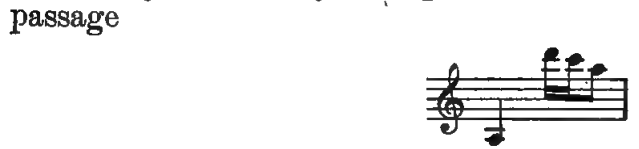
the first note must, of course, be taken in the Ist position with the first finger stopping the note "A" on the G-string. The skip that follows is, to the fiddle-player, not a skip from the note "low-A" to the note "high-D," but a skip from the Ist position on the G-string (with his first finger on low-A) to the 3rd position on the E-string

The wit of the phras of mely a ton to put it in of is trag, To put it in other words, ship aying this passago the first inger merely performs a two-octate
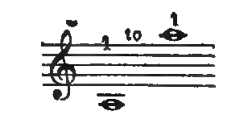
But this is, for the violinist, only a skip from the Ist to the 3rd position, and is in practice no more difficult for the left hand than the
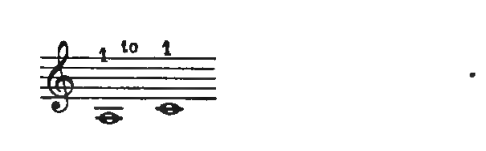
when played, as it can be, in the same two positions, Ist and 3rd. Looked at pianistically, the melodic skip in the above example is wide and difficult. Looked at from the fiddle-player's point of view, it has great, if we shifted the first note up a minor third to C. To the violinist, this alteration would obviate any left-hand skip at all. whole passage would then be in one position—the 3rd—and the difference between the Ist and 2nd notes would be merely a difference of elevation in the bow-arm. All skips, in fact, are to the pianist skips res, to theriole las they artes or chip positiage as follows:
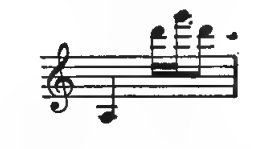
The actual width of the skip between the first two notes remains unaltered, and, to the pianist, the only difference is that he now has to strike the top D with his thumb. To the violinist, however, the skip is now quite different, for the notes which follow are no longer part of a "re-entrant curve" within the limits of the 3rd position. If he were now to take the "top D" with his fourth finger, while his first finger rested on the A below in the 3rd position, he would immediately have to slide his little finger forward in order to get the "top G." In fact, he would be in the wrong position for playing the phrase. What he actually has to do is to play the last three notes in their correct position-the sixth.' This involves his fixing the "high D" with his rst finger, and then playing the last two notes without change of The ditterence then between the two examples given above is that the latter involves a position-skip more than twice the size oi the one necessary for the former.
The student must understand that the second of the two passages printed above is not given as an example of excessive difficulty.? is easy to a good violinist, though not so completely easy as the first passage.
The two examples are given only to entorce the lesson that, when the student is considering the possible difficulties of wide skips, it is
1 The notes could also be taken in the 5th position. In this case the little finge would take the top G as an "extension" in that position. As a matter of theory, th but no player would actually do this, unless so directed by a special indica pog in the last three notes could also be played in the Ist position as harmonics.
"In his Primer on "Instrumentation," Prout gives a passage containing two wide He states that the pertormance of the whole passage would involve such " sudden ohange in the position of the player's hand, that its correct intonation in the orchestra would be almost impossible."
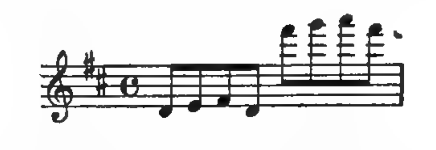
by ole his roose ird to thed, ile page i supposed too diguy, bet This is something of a difficulty, but only the difficulties of position, not of notes, that he need take into account. It may also be added that the construction of string-passages based partly on the low (3rd or 4th string) register, and partly on the high (1st string) register, is an integral and well-understood feature of violin music. Here is a passage which, though it only "ducks down" to the open strings, fully recognizes this special capacity of the instrument. It was written in 1694.
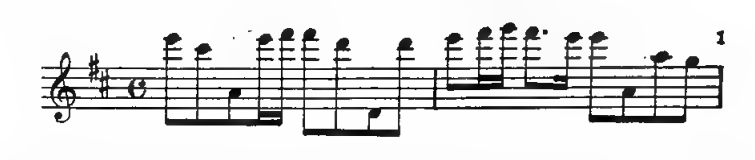
All the writers of the great Italian Violin School of the eighteenth century exhibit this tendency to treat the instrument in two registers at the same time. Bach made it part of his normal musical armament. Twenty examples might be quoted from the Solo Violin Sonatas alone. Here is one taken at random from the Fugue of the 3rd Sonata.
Example 205

A similar and perhaps better example of a tune founded on this method may be seen in the familiar subject in his Double Violin Concerto:
Example 206
Bach. Concerto for two Violins.

the difficulty of getting the bow neatly across the strings is greater than that of dropping the first finger on to the high E in order to take the fifth note with the second finger. The second of his skips
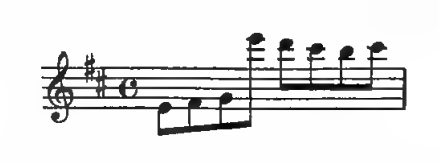
is actually no skip at all on the Violin. It can all be played in the 3rd position with an "extension" for the note E, and even for the bow-arm it only involves a skip of one stringh Tom be ong with on ene thaty blayer who could not perform the passage
" From J. J. Walter's Hortlus Chelicus.
Beethoven, nearer to the days of the contrapuntal school, and therefore less likely to adopt its method, makes less use of the device. Still, some few examples of this sort are to be found in his writings:
Example 207

Naturally this type of music, founded as it is on a legitimate capability of the instrument, plays a part in all Violin Concertos, and its employment when lit by modern ideas opens out a wide vista for effective

unprepared high notes on the violin, that is to say, notes that are may cart that any nan c ma like pean a to about
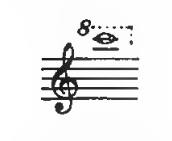
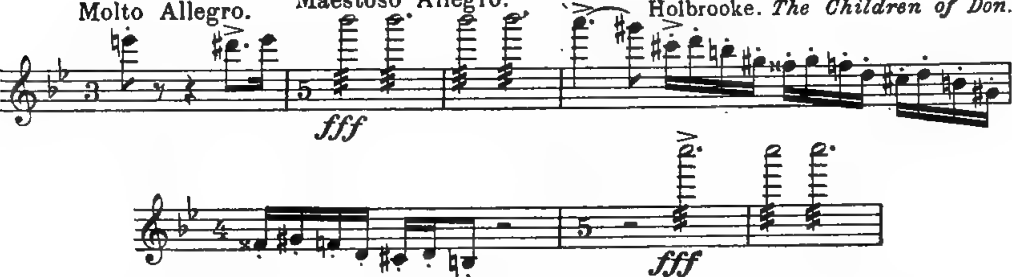
It is, however, as well to give the player a moment's rest—a beat of moderato time will suffice—in which to fix his position with certainty. The following is an example of a high note attacked without preparation. It is quoted from the Ist fiddle part of Holbrooke's Opera The Children of Don:
Example 208
Holbrooke. Ihe Children of Don.
The student should now turn back to the list of notes available in the sister Poison prise in any he oil rise vant such ily see that he has got a diatonic scale of two octaves and a note.!

sharp-keys with the same finger-technique. In the former case his hand merely rests is important because caleil how him the otty in a bictechny a is either an arpeggio-or a chromatic-scale-technique. Passages founded on the latter systems are both possible and effective-in tact almost everything is possible on the violin—but
(1) The instrument is less well adapted than the Pianoforte or
Harp for breaking up wide-spread chords into their component
(2) Chromatie scales havo to be played by mewas of a "false" in
the finger-technique. The result is therefore less sharply semitonic than in the case of the Wood-Wind, where a new key or hole gives individuality to each successive semitone.
In general it will be found that the most effective fiddle-writing is constructed of short scale passages, short arpeggios, combinations in which repeated notes appear, and little figures built round single notes. The last-named are often repeated, with or without joining-passages, on difierent harmony notes of the same or adjacent chords. Thus they may be regarded as having an arpeggio-basis. This type of passage is much more markedly in the character of the instrument than the ordinary type of Pianoforte-arpeggio.
For chromatic notes the player makes no aiteration of position. tovards ly e es one for a viromaticaty taied mole a a draving it back towards the nut for a chromatically-lowered note. When the chromatic notes have time to sound and are of actual' harmonic importance the player distinguishes between the enharmonics, both in the fingering " and in the resultant pitch. The correct notes should theretore be written, especially in the case of the larger stringedinstruments such as Violas and Cellos, where the stopping is wider and the enharmonic differences more easily realized. Quick chromatic passing notes which have no harmonic value are generally best written in the simplest form possible. The inclusion of many double- Hats in flat-keys and of double-sharps in sharp-keys serves no good
purpt is unnecessary to detail the chromatic-technique of the Violin. A single easy example will make the method quite plain:
in what is called a "flat degree of position" and in the latter in a "sharp degree of
Even they are
'The semitone above the open string is, however, of necessity always played with In the same way double-flat and double-sharp notes that are enhar. monic to the open strings are often actually played on the open strings for convenience
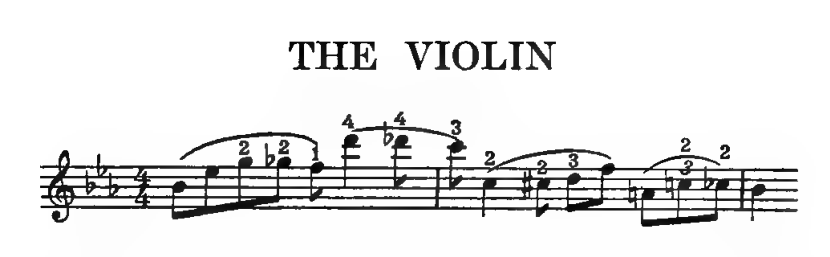
One may draw attention to the fact that, in quick slurred passages, there is necessarily a distinctly audible portamento between the notes which are stopped by the same finger. In practice it comes to this, mentore pairs of notes are alternately "portamentoed" and "unporta except at those places where an open string occurs. whole effect, however, to the ear has certainly a portamento-character which is not at all represented by the written notes. Richard Strauss has drawn attention to this chromatic indistinctness, which is integral to the Fiddle-technique. In cases where the resultant confusion is evidently not intended by the composer, he prescribes a system of fingering in which each semitone is stopped by a different finger. String passage from the Sinfonia Domestica would then be fingered as follows:

This somewhat exotic type of fingering would not be of great use except in passages mechanically and regularly built up from small phrases each of which was within the compass of three or four semitones. In passing one may mention that "bowed"2 chromatic scales and passages are, within reasonable limits of speed, quite playable. When pitched on the two upper strings and well performed by a large mass of Violins in unison they have a hard, icy, glittering sound that is strikingly effective.
and four notes. In the case of two-and three-part chords the notes are practically sounded together. With three-part chords, however, a distinct pressure has to be put on the middle string of the three in order to bring it into one plane with the other two. Consequently the simultaneous attack of all three notes can only be made for mf. In the p the chord has to be slightly arpeggioed. With four-part chords an arpeggio from the bottom string to the top has to be made both in the p and the f3
1 As opposed to such cases as the chromatic scales in the Pastoral Symphony of Beethoven.
& That is to say, in which alternate notes are played with alternate "up" and "down"

Not more than two notes at most can be sustained by the bow. It is usual, therefore, in cases where a full chord is taken tenuto, to write the lower notes in conventional crotchet-heads, and to indicate the exact length of the tenuto in the upper note or notes, thus:
Example 209
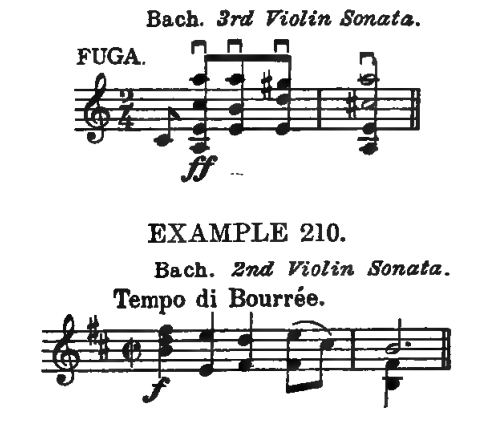
It may be said in passing that the last chord of the first example given above shows an inversion of Bach's usual practice. He generally writes the underneath notes as separate parts, and adds or omits the correct rests at discretion. This may be seen in the last bar of the second example. Such a chord would nowadays always be written so
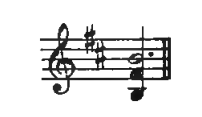
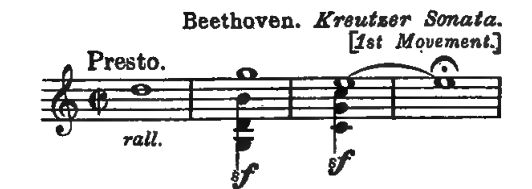
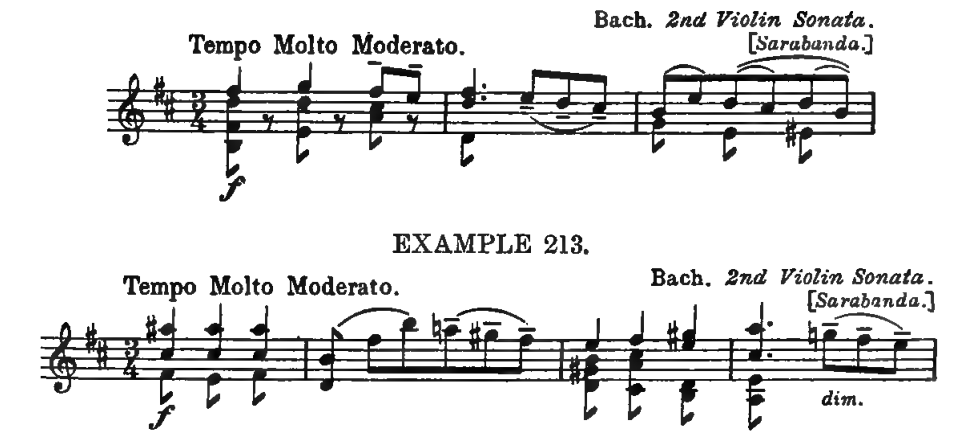
An extra part would only be made of the lower notes in those cases where either (A) the tenuto note has no tail to be joined to the lower notes, or (B) where confusion would result owing to the fact that the tenuto- or melody-note was already represented by a crotchet-head. In the latter case it of course would not do merely to write the lower notes in crotchet-beads, as they would not be properly distinguished from the melody-note at the top. It would be necessary to write the lower notes as a separate part in order to give them the requisite distinction. The latter necessity rarely arises in orchestral writing, though occasionally, with light arpeggio chords, it will happen that crotchet and quaver upper notes need to be detached in appearance from the lower notes. The following examples of (A) and (B) will arm the student against any of these dreadful emergencies:
Example 211
Example 212
All Violin chord playing, whether of 2, 3, or 4 notes, is usually known as double-, triple-, and quadruple-stopping, even in those cases where unstopped-strings are included in the notes of the chord. Double-stopping is of greater general use in the orchestra than triple: triple than quadrupie. The last-named is, except for very special purposes, a little heavy, and not available either in a great variety of hords or kevs. proceed to discuss the available
Double-Stops. These are divisible into
(1) Double-stops in which one note is open,
(2) Double-stops in which no note is open.
In the former case the range of possible chords is almost unlimited.
There is no necessity to keep the hand in one position in order to sound the open note. Any position can therefore be taken on the adjacent string to form the stopped note, and the student should notice that this stopped note can not only be any one of a chromatically ascending series on the upper string but also any one of a chromatically ascending series on the lower string. This sometimes results in the violinist playing on the lower string a stopped note higher in pitch than the open note of the upper string. The only limit to either of these series is set by the fact that, when the stopped note attains a certain degree of nearness to the bridge, the difference in bowing necessary to secure a good quality on the two strings—one very short and the other open in its full length-becomes so great that the resultant chord sounds dull and lifeless.
• The invention of Violin double-stopping is generally credited to Carlo farina, a riolinist who was born at Mantua towards the end of the sixteenth century. He was a early Paganini, and made all sorts of experiments in Fiddle-technique. :Capriccio Stravagante was published at Dresden in 1627 while he was Court-Violinist in Saxony.
(1) Double-stops in which one note is open.!
The following are available for orchestral use: Combinations of the open note
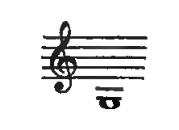
with any semitone on the 3rd-string from
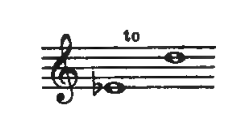
Combinations of the open note
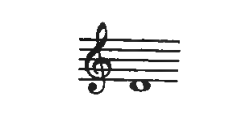
with any semitone on the 4th-string from
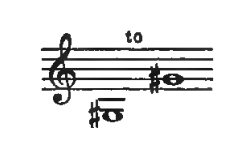
and with any semitone on the 2nd-string from
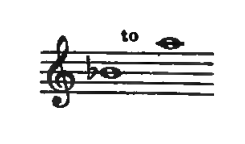
Combinations of the open note
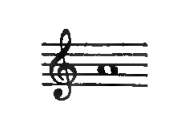
with any semitone on the 3rd-string from
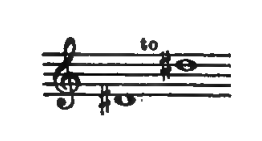
and with any semitone on the Ist-string from
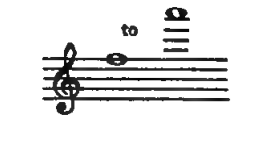
following pate orgy al, open te, al penely in 2, 3, or 4 parts, are mitted in the
Note.—The unison combinations of a stopped and an open E, A, or ) are in common use for purposes of increased force. They mus lways be written either with two notes or with two tails to a singl note, so as to show clearly what is intended, thus
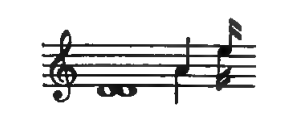
The two. notes can, of course, be alternated with each other. This is generally done under a slur to produce a wavy tremulant effect, thus :
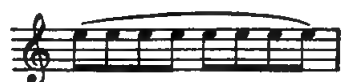
In this case the odd-numbered notes would be played stopped on the A string, while the even-numbered notes would be taken on the open E. The alternate use of an open and a stopped string for the same note is common in cases like the following

where distinction of part-writing is called for.
(2) Double-stops in which no note is open.
The following are all quite easy and playable: (A) All major and minor sixths of which the lower note is any
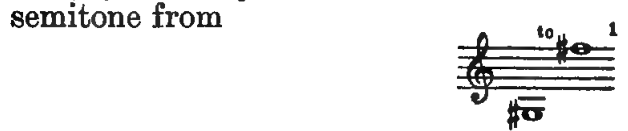
(B) All major and minor thirds of which the lower note is any

The following are not so completely easy but are still quite playable: (C) All perfect and augmented fourths of which the lower note is
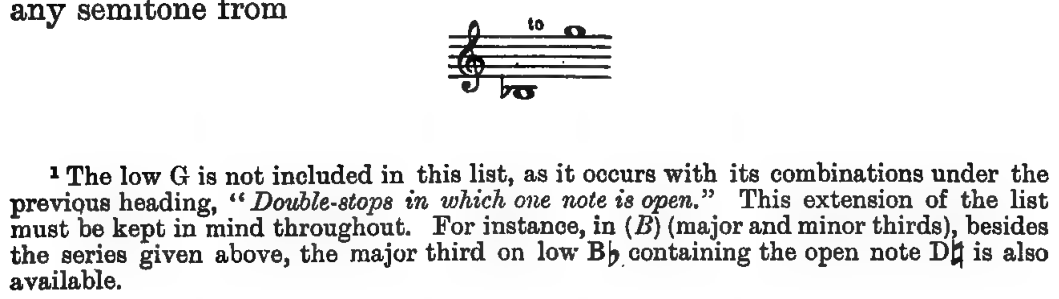
(D) All perfect, augmented, and diminished fifths of which the lower note is any semitone from
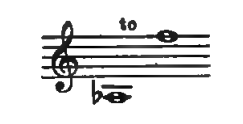
All perfect fifths are difficult. They have, of course, to be stopped ith one finger directly across the strings, and the slightest sharpnes • fatness of either of the strings precludes correct intonatio (E) All octaves of which the lower note is any semitone from
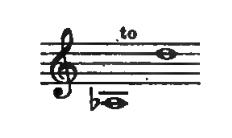
The intonation of octaves is not so difficult as that of fifths. They are stopped with two fingers, the Ist and 4th; some adjustment can therefore be made if the strings are not quite in tune. [The 12 very easy octaves which can be played in any place or at any time are those whose lower notes are as follows:

Of course successions of octaves such as those that occur in Concertos are quite out of the question unless they form part of the above short series.]
(F) The only major seconds worth considering for orchestral purposes are those whose lower notes are any one of the following:
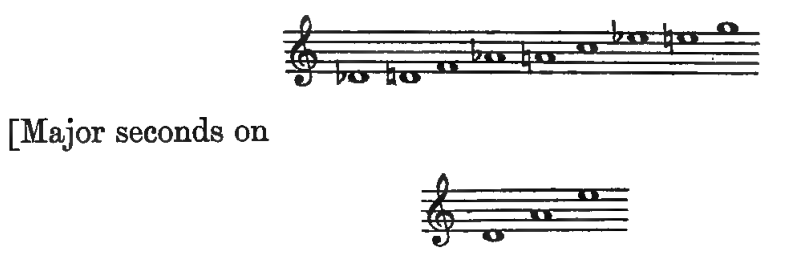
can of course be played with either one note open or both stopped. Lower string case the utter case is played in are prayed in the the position.]
(G) The only minor seconds worth considering are those whose lower notes are any one of the following:
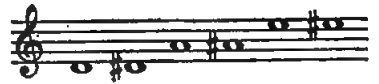
[The remark made above with regard to the performance of major seconds on D, A, and E applies also to the minor seconds on these notes.
Furthermore, the student should observe that, besides the above six minor seconds, there are only three others available, viz. those on
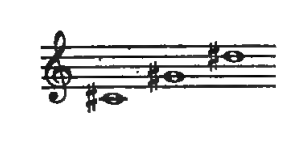
These are omitted from the first list because they are played with the upper note open. The complete list of all the available minor seconds is therefore as follows:
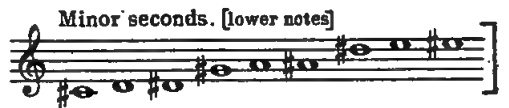
The above is a fairly complete list of all the double-stops which the student may write without fear of the consequences. Quick successions of double-stops are always to be avoided. Une may, however, make an exception in favour of such short successions of sixths, of thirds, or of mixed sixths and thirds as can be played without moving the hand in either the Ist or the 3rd position. If these two positions are mixed it is as well to confine the passage to the same two strings throughout. The student will find this a very safe rule, and, it he contorms to it, he need not hesitate to write thirds and sixths in his Violin-parts. Into such passages he can interpolate any simple double-stops, especially double-stops in which one note is open, provided they do not require violent changes of position. On this point there is rarely any difficulty, for, as the student will doubtless have observed, a good many doublestops can be played in more than one way. The player chooses the easiest one.
It is as well to confine successions of double-stops as far as possible to pairs of adjacent strings, which have one string in common. If the character of the music forbids this, the double-stops should not be written in quicker notes than moderato crotchets.
Everything that was said above with regard to the position-technique of the Fiddle applies equally to wide skips from low to high double-stops. Little dificulty, however, will be encountered on this score, as double-stops above the srd position are practically unknown in the orchestra. The student must use his judgment in all these matters. Even so trustworthy a guide as Gevaert cites the following
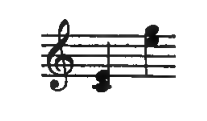
as involving "a sudden and complete displacing of the hand," and as being " extremely difficult, not to say impossible.' As a matter ot tact, it involves no movement of the hand at all, only of the fingers. It is all in the Ist position, and a child could play it.
In this connection it may be mentioned that, as far as the bow-arm is concerned, it is easier to get over from a double-stop on the two lower strings to a double-stop on the two upper strings, or vice versa, than to get over from a single bottom-string note to a single top-string note, or vice versa. In the latter case the bow is compelled to detach the first note in order to obtain the necessary moment-of-silence in which to pass over the intermediate strings: in the former case it pivots on these intermediate strings, and, whether a new stroke of the bow is taken or not, can engage the second chord immediately.
Triple stops.
These are divisible into
(1) Triple-stops in which two notes are open,
(2) Triple-stops in which one note is open,
(3) Triple-stops in which no note is open.
(1) Triple-stops in which two notes are open.'
The following are available: Combinations of the two open notes
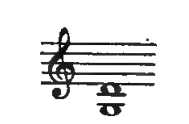
with any semitone on the second string from
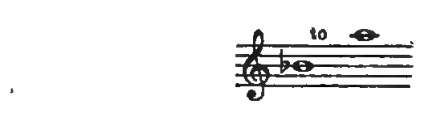
Combinations of the two open notes
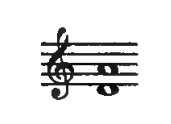
with any semitone on the Ist string from
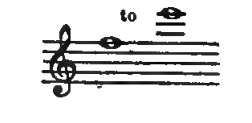
and with any semitone on the 4th string up to
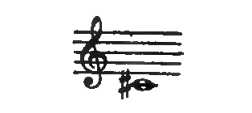
Combinations of the two open strings
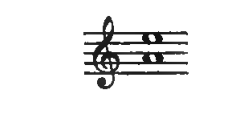
" As already mentioned, combinations of purely open strings do not oceur in this list, with any semitone on the 3rd string up to
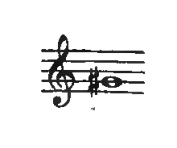
(2) Triple-stops in which one note is open.
Combinations of the open note
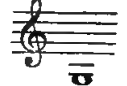
with any perfect or augmented fifth, and with any sixth, seventh, or octave of which the lower note is any one of the following :
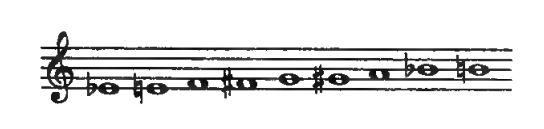
Propo ato ato no to
Combinations of the open note
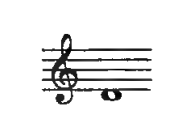
with a of perfect or agented sit and orth alich, seventh, or
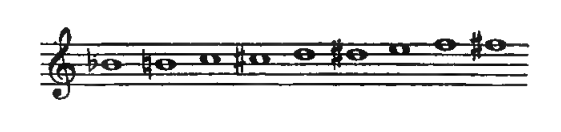
In combinations of the open note
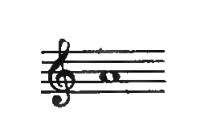
the two stopped notes of the chord are on the 3rd and 4th strings. The only chords which have any orchestral value are the following:
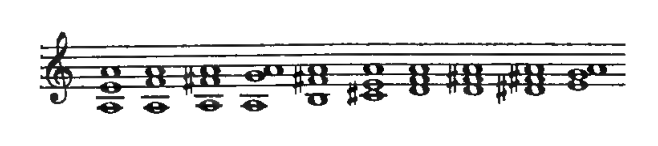
In combinations of the open note
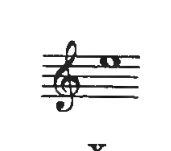
the two stopped notes of the chord are on the 2nd and 3rd strings. The only chords which have any orchestral value are the following:

(3) Triple-stops in which no note is open.
Practically only major and minor triads and a few augmented fifths are available. They must be arranged either (1) with the fifth at the top and the sixth at the bottom, or (2) with the sixth at the top and the fitth at the bottom, or (3) with a sixth both at the top and the bottom. For examples the student should consult the general lists of orchestral chords given below.'

Quadruple-stops in which three notes are open are almost useless. The combination of the three lower open strings practically ties the part down to the tonic and dominant of the keys of G major and minor. It required these three open strings could be written in conjunction with such notes as
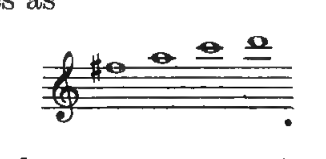
Ine combination of the three open top strings with a stopped note on the lowest string is scarcely worth considering, though the low A might be arpeggioed with them. The other Quadruple-stops are divisible into
(1) Quadruple-stops in which two notes are open,
(2) Quadruple-stops in which one note is open,
(3) Quadruple stops in which no note is open.
(1) Quadruple-stops in which two notes are open.
The following are available: Combinations of the two open notes
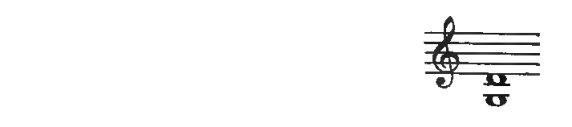
with any simple sixths and fifths on the two top strings, such as
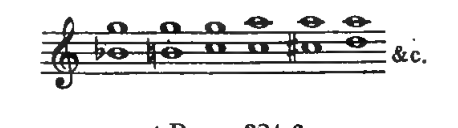
• Pages 324-6.
but the topmost of the four notes should not be allowed to rise above
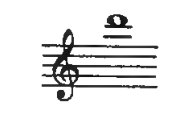
Notice that combinations of the two open top strings with two stopped notes on the bottom strings are little used. The following may be of occasional service in the orchestra:

(2) Quadruple-stops in which one note is open.
Practically only a few major and minor triads and augmented fifths are available, all built on one or other of these two patterns,
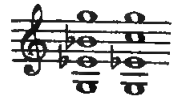
but the topmost of the four notes should not be allowed to rise above
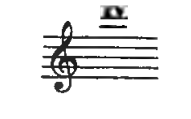
(See the lists of chords given below.)
(3) Quadruple-stops in which no note is open.
Of these chords few are possible and still fewer advisable. Ther ure practically confined to this formula
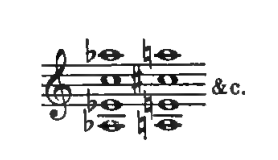
with the same restriction upwards as was imposed in the case of the other quadruple-stops.
We have already said that two-part chords are better on the Violin than three-part, three-part than four-part. Three-part chords, however, when written carefully so as not to be difficult and when played with vigour by a large body of violinists, are slashingly effective In setting-out these chords, especially for tutti Strings, the composer who has an eye for orchestral effect will throw overboard all ideas of writing complete harmonic chords for each instrument. Good keys near C, G, and D (all major or minor), and easy fingering, are the two necessities.
The student will now wish to see the above general rules embodied in the more concrete form of the most serviceable chords for orchestral use. It would be the easiest thing in the world to compile a complete
list of all the chords playable on the Violin at a pinch, or rather at several pinches. Such a list would include nearly 1500 different chords. A very large number of them, however, are absolutely useless in the orchestra. They involve such cranky fingerings 1 that a wise composer would not write them even in a Fiddle Concerto.
The following list contains practically every chord that can be wanted for orchestral composition. It is confined to three-part and fourpart chords for the reason that almost all simple two-part chords are playable on the violin. The student may easily manutacture them tor himselt from the general rules given above. In his choice of threepart and four-part chords the composer is, of course, restricted by the particular pitch at which he wishes to take them. Otherwise he should be guided by the advice (1) that three-part chords are generally preferable to four-part, and (2) that open strings in the middle ot a chord are usually to be avoided. Very few such chords are printed below.
Chords of the Tonic and of the Dominant Seventh.
The following groups of chords are arranged under their keysignatures, thus: The first and second bars give respectively three-part and four-part chords of the dominant seventh, then, after the double bar, the third and fourth bars give respectively three-part and four-.. part chords of the Tonic. Almost all the tonic chords are available in both the major and minor modes. In those tew cases where a choro is only available in one mode an accidental is placed before the chord to show the only form in which it can be used. The student must bear this in mind, as, in this case, the accidental is used with a meaning slightly out of the ordinary. Of course, whenever accidental is used, it refers only to the one note before which it is placed. It does not affect that note in succeeding chords. Thus the 22nd and 24th chords in the following list are available only in the major mode, but the 23rd and 26th are available in both modes.
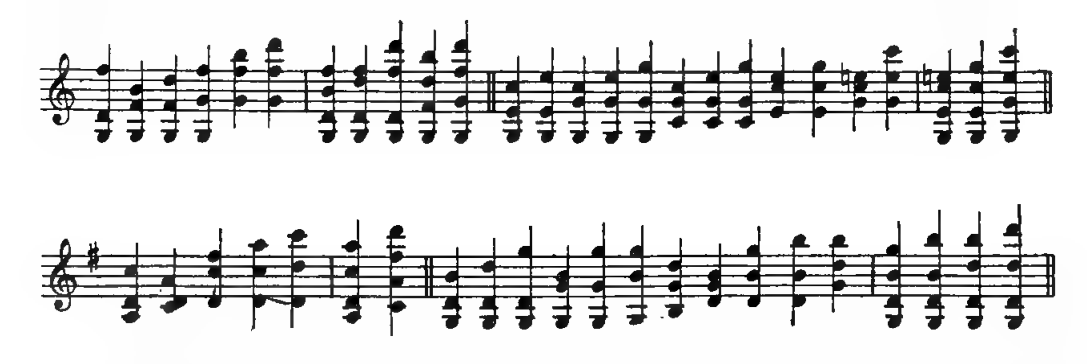
" For the "normal spread " of the fingers in String-chord playing the student should see page 422. The remarks there apply just as much to the Violin and Viola as to the
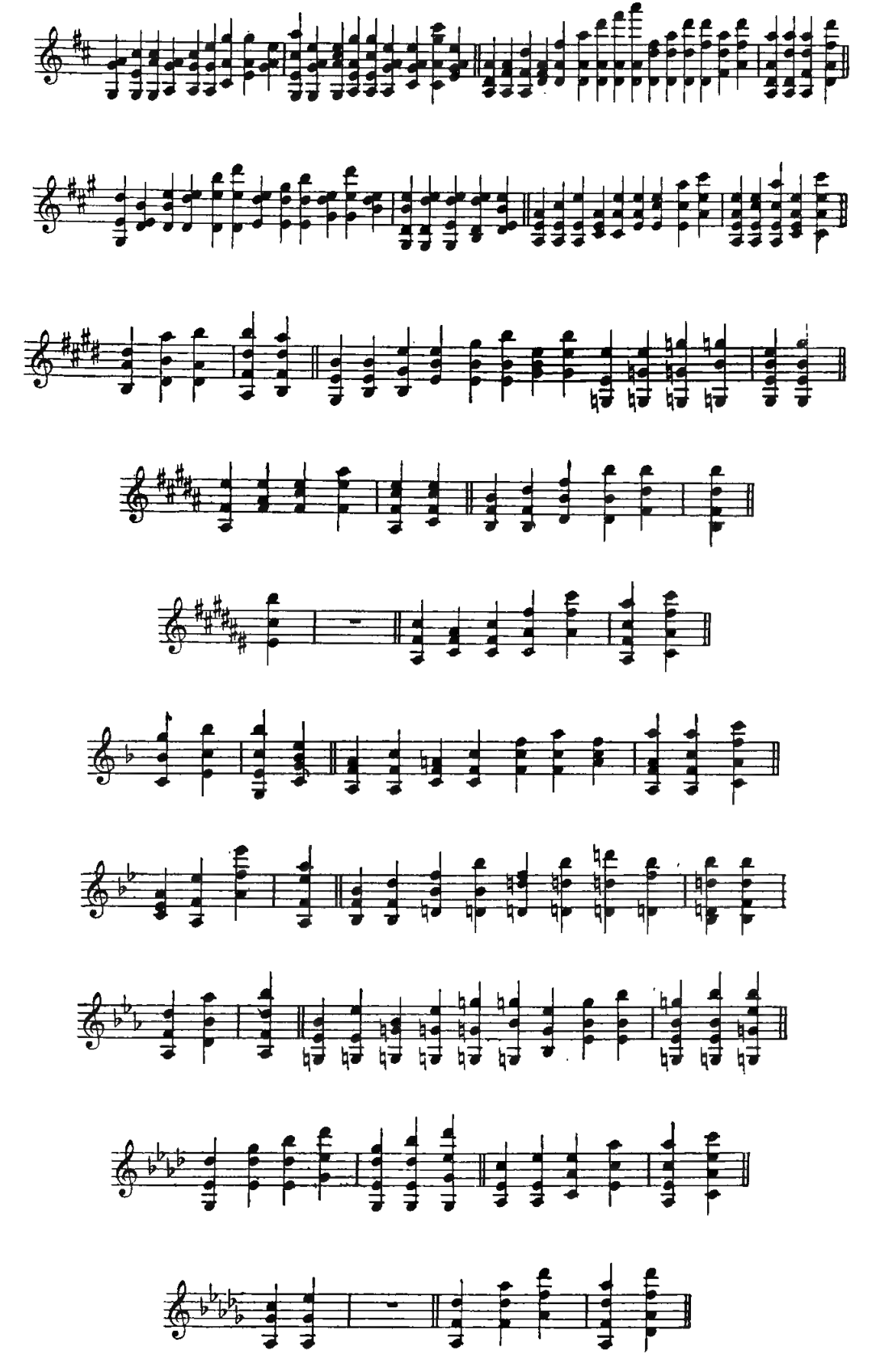
Chords of the "Diminished Seventh"
In the following chords and parts-of-chords of the diminished seventh the easiest notation is adopted. Any enharmonic variations of these chords can, of course, be used.

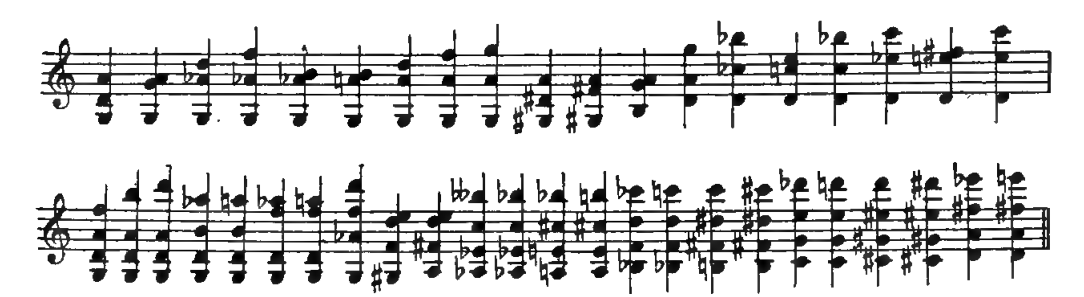
Chords of the Major and Minor Ninth.
The following are the only chords and parts-of-chords of the major and minor ninth that are likely to be of any practical use in the orchestra.
Chords of the Augmented Fifth.
parts the early wore in nose marts: Confined to three
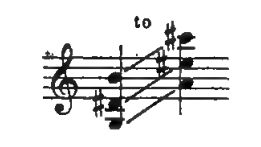
and should all be written on this simple model.
Any of the chords given above may be broken up into arpeggios. In the simpler keys a fair number of spread chords are available in comparatively easy stoppings, and this type of formula is otten used

write an effective and simple arpeggio for the Ist Violins and awkward arpeggios for the 2nd Violins and Violas. At most the outside notes of the arpeggios need be considered, and even that is often unnecessary. In the following passage from Act I. Scene 3 of Die Walküre
Example 214
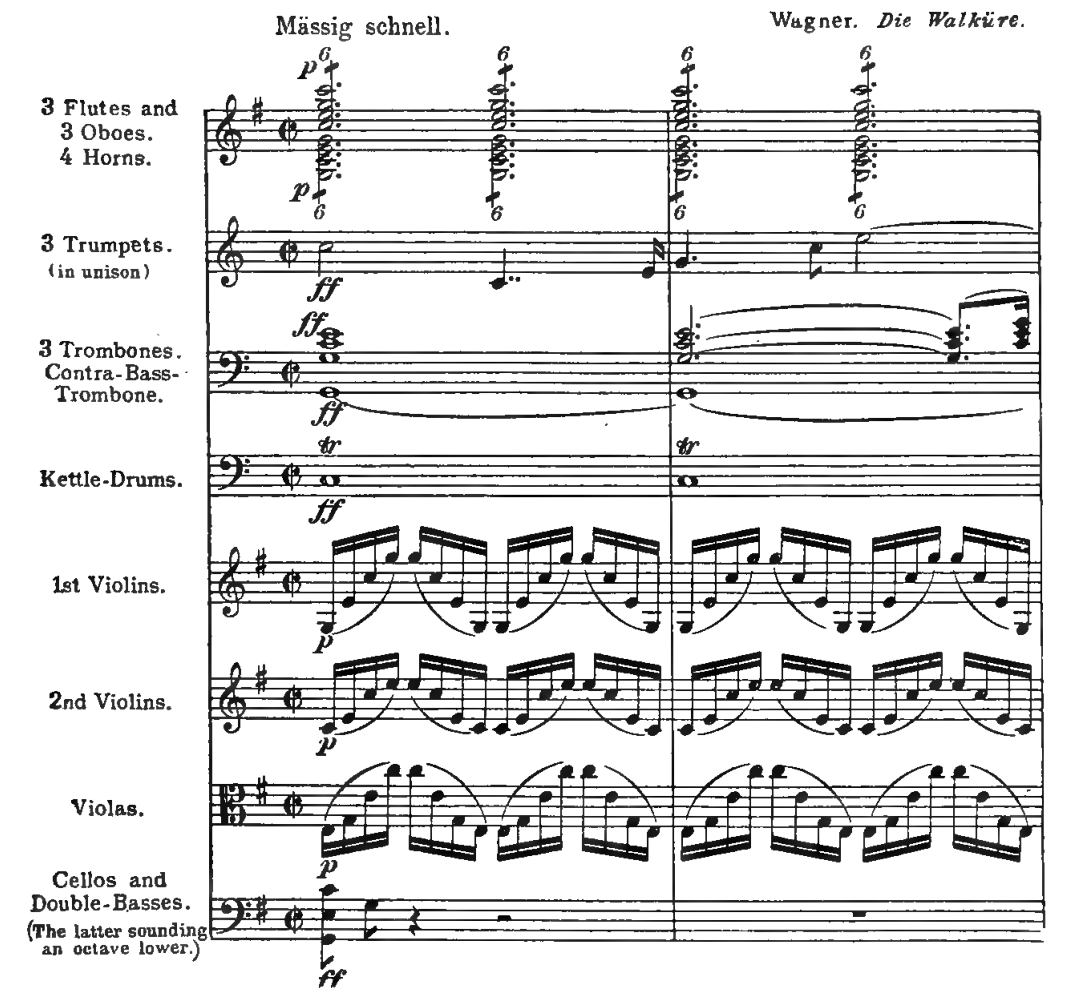
the object is obviousiy to secure the complete three-part chord at each end of the arpeggio. It would, however, make practically no difference to the effect, and would be more in the Violin-way of writing it the 2nd Violin passages were written to be played in the 3rd
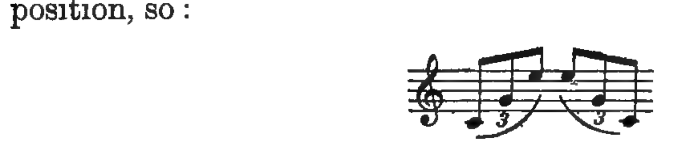
and the Viola passages, so :

It is a fair general rule that the String technique should be the first
This ee Base is much on me last rothet or arrants are outed and and Brase entry of the Bass Trumpet on the last crotchet of Bar 2 In the original score. the 4 Horns are in E, Ist and 2nd Trumpets are in H, 3rd Trumpet in C, Bass Trumpet in D.
consideration in such cases. In the example just given the Brass ff covers up everything, and it is therefore easy to arrange the arpeggios with a single eye to the String technique. Un the other hand, it, in p passages, the harmonie basis of the music is only to be apprehended from the outline of the arpeggios, the Strings may reasonably be asked to bate something of their technical demands.
Before leaving the subject of chords the student's attention may be drawn to an important point. Quick successions of chords are made no easier on the Violin by being broken up. In order to make a Judgment as to their practicability they must be considered as unbroken. So far as the Fiddle-player's left hand goes the following two passages from Mendelssohn's Violin Concerto
Example 215
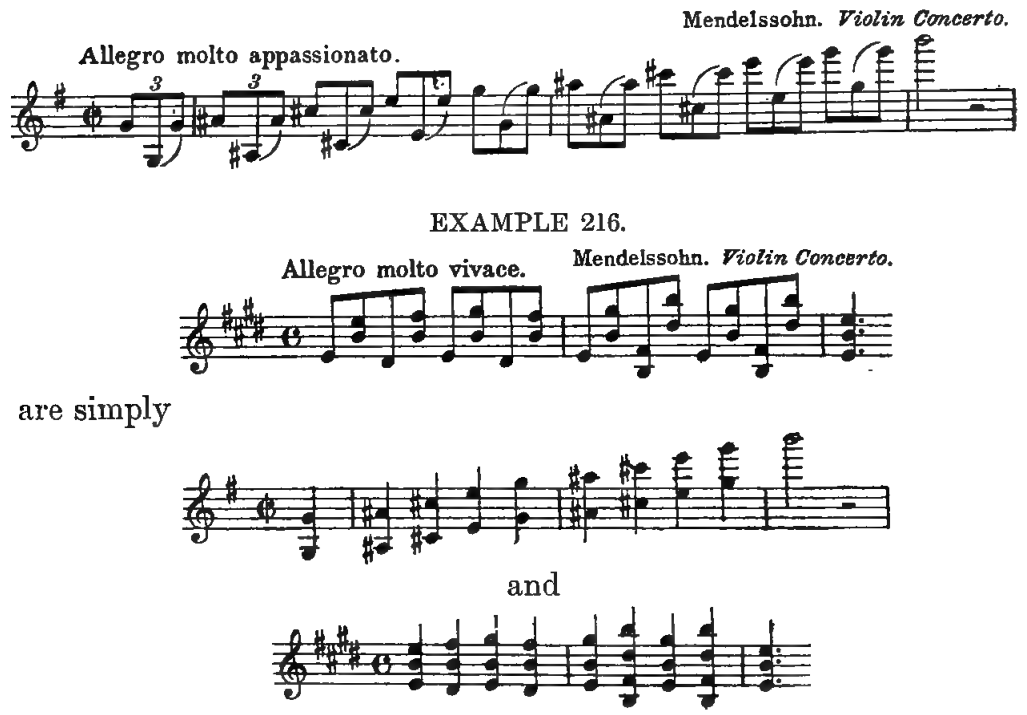
Natural Harmonics.
Hitherto we have only dealt with that series of stopped notes which is produced by pressing the string tightly against the tingerboard. Two other series of notes, however, exist. Of these the first is the Series of Natural Harmonics. They are obtained by lightly touching

moniques, etc. This work was published at Paris in the first half of the eighteenth It appears to have been first used in the orchestra by Philidor in his Opera Tom Jones (1765).
she sriny at aratione of the action o here it nadetry the up tito of the complete string-length and compels the string to vibrate only in segments.
The actual physical process may be illustrated by an example. If we touch the open string E half-way between the nut and the bridge the note E an octave above the pitch of the open string is sounded. The reason is that by touching the string midway we prevent it vibe tiny so these gran prines ibrare ee denot the vibrating as a whole. higher than the original string-length. Theoretically it is of no consequence whether we draw the bow on the nut-side or on the bridgeside of the finger.
The intonation of the Natural Harmonics depends solely on the correct tuning of the open string, and is therefore outside the violinist's control at the moment of playing.
All the Natural Harmonics are of a light " flutey" 2 quality, very different from that of the stopped notes. It follows that, except in quick passage-work where they sometimes materially facilitate the execution, they should never be used by the player unless they are actually indicated in the part. Occasionally such notes can be introduced both into quiet legato melodies and into vigorous passages, but this needs some judgment. They are more often used in groups of all the upper Strings to produce special ethereal effects. Double-, triple-, and quadruple-stopping are all quite out of the question in writing Harmonies.
On each string of the Violin, five Natural Harmonies can be produced. These give a portion of the ascending Harmonic Series ° with which the student 1s already tamilar. He will have no difliculty in remembering the notes of this Series, as they give a regularly diminishing set of intervals from the open string upwards, an octave, a perfect fifth, a perfect fourth, a major third, a minor third.
In the following list of Natural Harmonics the Open String is represented by a semibreve and marked 1, while the 5 Harmonies are represented by crotchets and marked 2, 3, 4, 5, 6, respectively The numbers have, of course, nothing to do with the fingering;

1 See above, page 305.
2 They are commonly known on the Continent as "Flageolet notes," and their use is often prescribed by the words flautato or flautando.
3 See Ex. 18 (Solo Viola-part) and Ex. 247 (last bar of Viola-part).
4 Sec below, page 331, for the only available chords.
5 See page 73.
In each of these four groups of Natural Harmonics,
No. 2 is obtained by lightly touching the string halt-way between the nut and the bridge at the place where the ordinary stopping would produce the same note.
No. 3 can be obtained in two different ways.: (A) By lightly touching the string 3 of its length from the nut and of its length trom the bridge at the place where the ordinary stopping would produce the perfect fifth above the open string, (B) by lightly touching the string of its length from the nut and of its length from the bridge at the place where the ordinary stopping would produce the same note.
No. 4 can be obtained in two different ways: (A) By lightly touching the string I of its length trom the nut and of its length From the bridge at the place where the ordinary stopping woula pro luce the pertect tourth above the open string, (B) by lightly touching the string } of its length from the nut and i of its length from the bridge at the place where the ordinary stopping would produce the same note.
No. 51 can be obtained in four different ways: (A) By lightly touching the string t of its length from the nut and f of its length from the bridge at the place where the ordinary stopping would produce the major third above the open string, (B) by lghtly touching the string i of its length from the nut and of its length from the bridge at the place where the ordinary stopping would produce the major sixth above the open string, (C) by lightly touching the string 3 of its length from the nut and of its length from the bridge at the place where the ordinary stopping would produce the major tenth above the open string, (D) by lightly touching the string * of its length trom the nut and t of its length from the bridge at the place where the ordinary stopping would produce the same note. [Of these four ways only Nos. I and 2 are actuaily employed in the orchestra.
No. 6 can be obtained in two different ways: (A) By lightly touching the string I of its length from the nut and f of its length from the bridge at the place where the ordinary stopping would produce the minor third above the open string, (B) by lightly touching the string & of its length from the nut and s of its length trom the bridge at the place where the ordinary stopping would produce the same note. [This Harmonic, however produced, is of no practical use.]
The student should notice that, in each of the groups of Harmonics on the three lower strings, Nos. 2 and 6 are reduplicated in the series on the next higher string. Theoretically it is necessary to indicate in the part how the harmonic is to be taken. This is done by using the Italian words "Sul II," " Sul III," etc., that is to say, " Played on the Ind string." "Played on the 3rd string," and so on. However, this sort of direction, unless given by a skilled violinist, is not of great use. So much depends upon the technique of any given passage, and upon
1 This Harmonic is, on all stringed-instruments, distinctly out of tune with the similar note in the tempered scale. The note is sharp, about to of a tone above the tempered nute.
the position in which the player's hand happens to be lying. As a rule, then, the choice of method in performing those harmonies which are playable in more than one way may be left to the violinist's discretion.
In practice, as we have already said, Harmonic No. 6 is not used at all It can be produced more easily and with a better tone as No. I in the series on the next higher string. On the top (E) string practically only Nos. 2, 3, and 4 are used. 'These are all excellent notes.
The Notation of the Natural Harmonics is simplicity itself. A little round "o" is placed above each note that is to be taken as a Harmonic. Here is an example of the high Violin-Harmonies.| It forms the connecting link between the Sanctus and the Benedictus in Stanford's Requiem. The Violins are divisi for the first five bars, and then unison for the rest of the passage.
Example 217
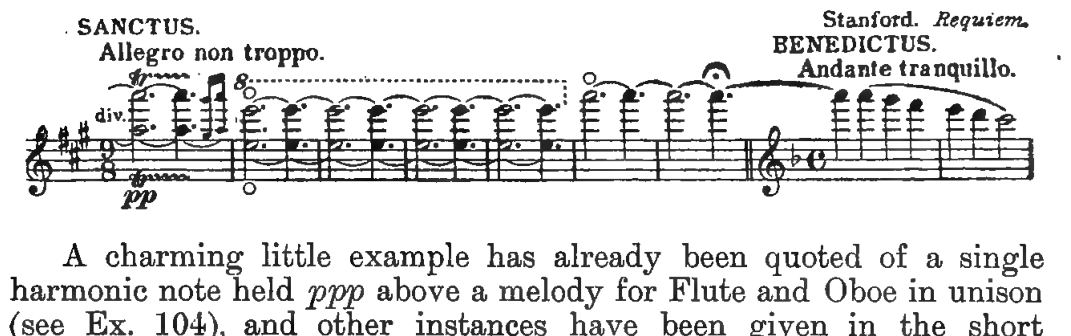
quotation from Strauss's Sinfonia Domestica (Ex. 18). Further examples car be found under the headings "Viola," "Cello," and "Double-Bass."
Chords in Natural Harmonics are only possible in two parts, and then only when both notes can be taken as No. 2 on adjacent strings. In other words, they are limited to these three
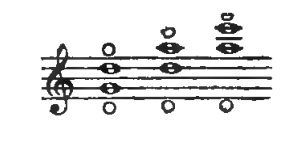
However, unless the number of instrumentalists is very small, it is better even in these cases to write the chords divisi.
Gevaert has pointed out that when a Harmonic cannot be made to sound on the Violin this is usually due to a fault, not in the string, but in the bow. The simple reason is that "a string set in vibration at is a node, point cannot sound any harmonie for which the said print In other words, the bow is "standing in its own light," and if it be shifted a trifle nearer either to the bridge or to the nut the desired harmonic will "come out."

If the student will now turn back and read the description of the two different ways in which No. 4 can be obtained he will see that, by the first method, the string is lightly touched at the place where the ordinary stopping would produce the perfect fourth above the open string. The harmonic obtained by this method sounds two octaves above the open string. It is, however, obvious that when the Ist and fth fingers are laid upon the fingerboard in any position they are normally just a perfect fourth apart. It is, therefore, always possible to use the ist finger as a sort of moveable nut; to stop the string narc with this finger and lightly to touch the perfect fourth above it with the outstretched 4th finger. The resulting note will, of course, be two octaves above the actual note which the first finger is stopping. This Ist finger, however, can stop any note within reason in the lower positions, and can be slid about from position to position while the 4th finger is all the time lightly touching the perfect fourth above. The consequence will be that, whatever series of notes the Ist finger is stopping will be reproduced to the ear two octaves higher.
These notes are known as Artificial Harmonics.
They begin on the lowest semitone Ab (G♯) which can be stopped by the Ist finger on the 4th string. This produces the sound
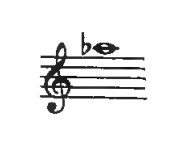
Upwards they may be continued chromatically for about two octaves and a semitone.
Now the whole compass of the violin in Natural Harmonics is
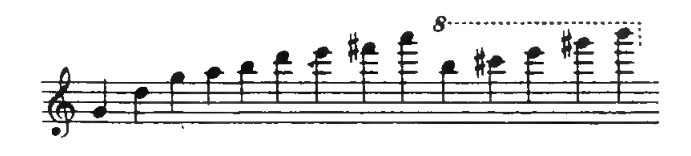
Therefore, if we add to this the compass in Artificial Harmonies we get the following complete compass in both Natural and Artificial Harmonics:

The first three notes of this complete Harmonic-Compass can only be Pared in, warl Hase nice Themest malled played in caiial taken both
The notation of Artificial Harmonics presents no difficulty. The passage is simply written out in notes of the desired time-value two octaves lower than the required sound. This gives the player the To each note is then added a concorrect stopping for his Ist tinger. ventional diamond-shaped note a perfect fourth above the pitch of the stopped note. This gives the player the "light stopping finger. If one wishes the following phrase played in Artificial
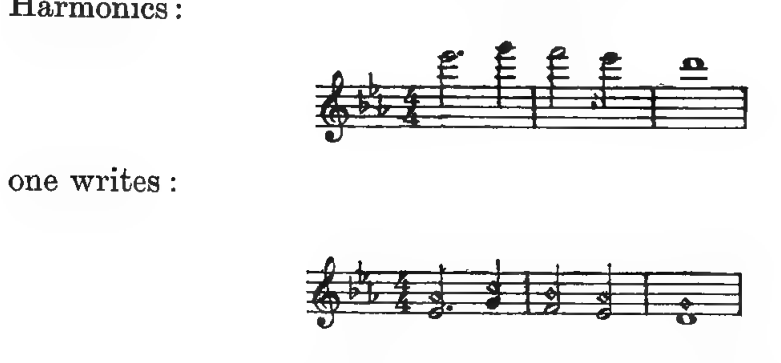
It may be as well to mention that, if in writing a series of artificial harmonies one needs to use Natural Harmonic No. 4, that is to say, to substitute the actual nut for the Ist finger, it is usual to take a certain licence and write the note as an Artificial Harmonic. This applies to all tour strings. Thus, in the example just given, no player in his senses would dream of taking the last note by jumping over to the G string and stopping the note D with his Ist finger and the note G lightly with his 4th. The result would be doubtful. In place of that he simply takes up the Ist finger and remains in position on the D string, using the nut in place of his Ist finger and lightly stopping the pertect fourth above with his 3rd finger.
There is no need, when using artificial harmonics, to write the actual sounds produced. This old-fashioned method involves the composer in the labour of writing three notes for every single sound required. Conductors and players who do not know the meaning and effect of these little diamond-shaped notes are now extinct.
Occasionally, however, composers write out a complete passage at its actual sounding-pitch and mark the part "to be played in harmonics," or simply "harmonics." This is a lazy way which leads to much conversation at rehearsals, and generally results in the separate players doing what the composer should have done in the first instance —writing out the passage in its correct Harmonic Notation. Single Artificial Harmonics can never be interpolated into quick passages. Their accurate stopping needs a little time and caution. In moderato time, however, such single notes might possibly be used for special effects provided they did not necessitate a skip of position. This happy conjunction of circumstances, however, is unlikely to occur, as their use naturally involves an upward skip of two octaves.
On the other hand, single notes in Natural Harmonies can often be interpolated with happy effect into passage-writing. Upportunities for this sort of thing occur more trequently at the ends of phrases. The Harmonies which sound the octave, the double-octave, and the twelfth above the open string, can be used almost anywhere.
It may be necessary to add that, in writing complete Harmonicchords for the Strings, no effort need be made to keep the notes rigidly to one sort of Harmonic, natural or artificial. The two kinds are so nearly alike to the ear that they may be indiscriminately mixed. is, however, as well (1) so to arrange the parts that there may be as many Natural Harmonics as possible. Ihis steadies the intonation and gives greater firmness and clearness to the chords. (2) 10 avoid as far as possible any but the simplest position-skips in writing a series of Artificial Harmonies.
Examples of String-Harmonies are so common in modern orchestral comotion that it i ced necessary to guate ad of the . parts the student may refer to the tenuto "A" in seven octaves at the opening of Mahler's First Symphony. This passage is laid out for Violins and Ist and 2nd Violas, and for Cellos and Basses each in three parts.
As an illustration of the use of the Artificial Harmonies for continuing a subject upwards beyond the range of any other orchestral instruments no happier example could be quoted than the extreme end of the Scherzo in Glazounow's Fourth Symphony. The quotation below is much compressed, but nothing is omitted. The rising fragment of melody is confined to one line. In the lowest octave it is played by the Violas, then in the next octave by four desks of Violins, then in the highest octave by two desks of Violins playing in Artificial Harmonics. At the same time the soft string-chords are carried upwards by the omission first of the Basses and then of the Cellos. A rippling quaver-tigure on the Clarinets and the Flute tollows the upward trend of the music. Finally there is a tiny piano chord for Wood-Wind alone, followed by a String-pizzicato. from its technical interest this passage is well worth quoting as a most charming example of those little roguish Scherzo-endings which are so delightful when scored with the light but certain "touch" of a master.]
Example 218
SCHERZO. Allegro Vivace.
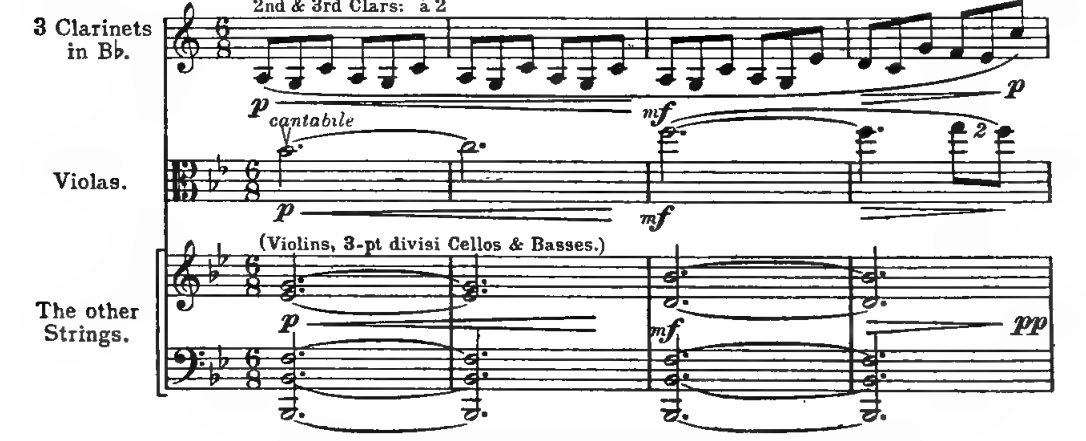
(Violins, 3-pt divisi Cellos & Basses.)
1 For other examples of Harmonics, see Exs. 18, 104, 235, 247.
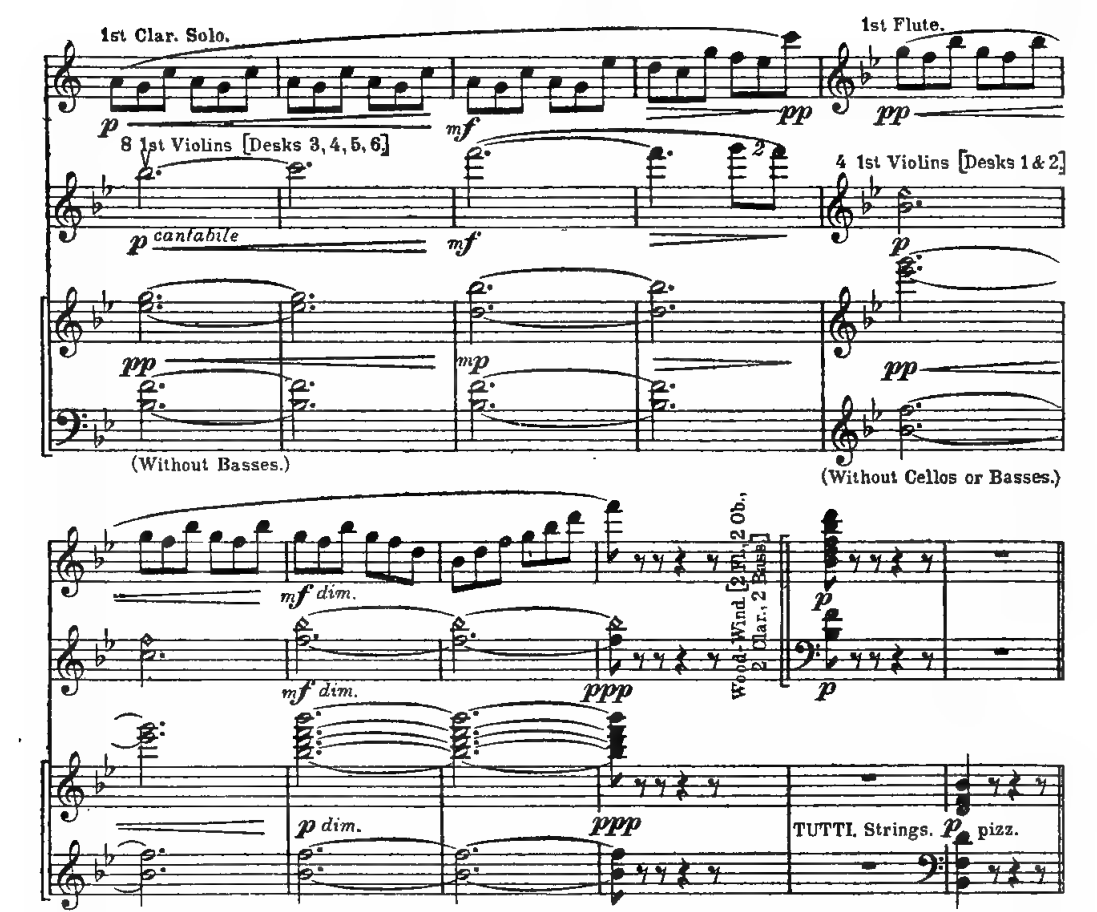
Having dealt with the left-hand technique of the Violin we must now turn to its complement, the bow-arm technique. It is not necessary to describe in detail the evolution of the modern bow, but one nay mention that the Violn technique has always originated trom anc been dependent on the shape of the bow, not of the Violin Furthermore, the bow, as we have it now, was perfected long atter the Violin, and its evolution, though occupying a great space in length of years, has been simple.
The original bow of the mediæval Fiddle consisted of a hank of horsehair uniting the ends of a more or less flexible wooden stick. This stick was arched upwards from the horse-hair, and, if we are to trust the representations that have come down to us, the arching was often so great that its height nearly equalled the length of the horse-hair.
The first long stage in the evolution of the bow consisted merely of a series of attempts to lower this arch and to bring the horse-hair more into line with the bow. Other minor improvements were, of course, introduced from time to time, but if we look at the pictures of even so recent a work as Leopold Mozart's Versuch einer gründlichen Violinschule we cannot fail to see that the violinist is playing with what might be described to-day as a long, light, old-fashioned Double- Bass bow. from the nut to within s of the point of the bow the stick and the hair run nearly parallel. 'Then, in the upper t of the bow the stick gradually and awkwardly curves down till it reaches the place where the hair is attached.
This style of bow was undoubtedly a vast artistic improvement on the mediæval type, whose shape reminds us only of a boy's bird-trap ready set. Still, it any of the older orchestral players were armed with this weapon at the celebrated rehearsal when Schubert's C major Symphony was condemned as impossible, we must offer them our respectful sympathy.
During the second stage of its history the arch of the bow was gradually turned round the other way, so that its natural curve was inwards towards the hair and not outwards away from the hair. With this type of bow almost anything is possible on the Violin. It has been adapted to the use of all the stringed-instruments. Even the Basses have during the past twenty years or so acknowledged its undoubtedly greater technica. powers.
The violin-bow as perfected by Tourte is a shade over 29 inches long. The stick is made of a very light but highly elastic wood called Pernambuco. At the upper end or "point" the original block from which the stick has been cut is brought round in a characteristic curve to receive the horse-hair. At the lower- or "nut"-end the hair is firmly fixed in a holder which is not itself part of the bow-stick. Underneath this holder is a ring through which a screw thread is cut. When the holder is in position this ring lies in a slot cut out of the solid bow-stick. At the extreme lower end of the stick a long screw passes for an inch or so through a hole bored lengthwise in the bowstick. On its way this screw passes through the ring. The two screws are thus engaged, and the player, by turning the ornamental head of the long screw can draw back the holder and so tighten the hair. The curve of the bow-stick is inwards towards the hair, and its nearest approach to the hair should be exactly midway between the nut and the point. The hair itself is simply a bundle made up of between 100 and 150 hairs taken from the tails of white horses. Before use the hair is rubbed on a specially prepared fine rosin' to give it a grip on the strings.
The strings are set in vibration by the bow at a point between the bridge and the end of the fingerboard. This point, however, is varied slightly according to the quality of the tone required. In the centre the tone is clearest and most supple. As the bow approaches nearer to the bridge the difficulty of setting the strings in motion appreciably increases, with a corresponding marked hardness in the quality. Finally, when it is drawn close up to the bridge, a painfully glassy and unpleasant quality is produced. This special tone-colour is occasionally demanded by composers, and is indicated in the score by the Italian words sul ponticello (on the bridge), or simply ponticello.? If, on the uther hand, a very light feathery quality is needed, the bow is drawn somewhat nearer to or actually above the fingerboard. This
1 Called also Colophonium (Fr. Colophane; It. Colofonia). 2 See below, pages 355-6.
effect, though delightful, is less rarely prescribed in orchestral works. It is, as a rule, left to the judgment of the conductor. The indication in the score generally takes the torm of the french or Italian words for "on the fingerboard," viz. sur la touche, or sul tasto. The student may find an example of its employment in the pp repeated demisemiquavers for 2nd Violins and Violas at bar 14 in Act I. of Debussy's Pelléas et Mélisande.
The top of the bridge is convex but not regular in its slope. the E-side it is cut down very low, and rises to its highest point at the D-string: Midway between these two is the A-string. Thus the three strings, E, A, D, all lie in a slope upwards. From the D the bridge slopes slightly down again, but it is not cut to so low a level as that of the E-string side. About * down this slope the G-string lies almost on a level with the A. This peculiar shape makes for ease in the technique. The bow is always strictly in one of four planes, according as the player wishes to set the E, the A, the D, or the G string in vibration. Each of these four planes from the E-plane to the G-plane is reached by means of a simple upward movement of the right elbow. Hence the name " elevations," by which they are known. When the correct elevation has been taken by the back-arm and elbow, the wrist-the real controlling force in the bow-arm techniqueremains unaltered relatively to the bow.!
The method of attacking the strings with the bow is interesting, because it explains in great part the peculiarly soft and swishing effect so characteristic of the string tone. The technique is as follows: The bow is first turned so that, while its whole length remains at right angles to the strings, the stick is slightly nearer than the hair to the player's left hand. Only a portion of the hair engages the string at the first moment of attack. The rest of the hair is gradually brought into play with a soft " cleaving" action. During the progress of the bow-stroke the string is kept vibrating with greater or less amplitude according as (1) the pressure of the fingers on the bow is increased or decreased 1, (2) the bow is moved more quickly or more slowly over the string. The "cleaving" method of attack soon becomes so completely automatic with violin-players that some of them forget its very existence. However, one has only to listen to the hard perpendicular "bite" with which a beginner attacks the string to become aware of its importance.
When the bow is turned, that is to say, when a stroke is to be made in the opposite direction, the pressure of the hingers on the bow-stick is relaxed. In other words, the bow is "lightened." At that instant the bow is turned and a second (reverse) stroke is begun in exactly the same manner as the first. It must be said that, though at the moment of lghtening the bow the pressure is completely removed and no sound can therefore come from the instrument, this moment can be made by the most ordinary fiddler so minute in duration as to be inappreciable to the ear.
1 In setting more than one string in vibration at the same time an eleration midway between those of the two strings is taken.
This is the true bowed legato of the Strings, the most perfect and

It is necessary for the student to grasp the importance of the above remarks. A change of bow does not necessarily mean an absence of legato. Un the other hand, the amount of "lightening" can be extended in duration so that every note is isolated from its fellows. And this can be done not only at either end of the bow—at the "heel" or the "point"—before it is turned, but in the middle of the bow before resuming for a second stroke in the same direction. Furthermore, when the bow is being drawn from point to heel-"up-bow," as it is called-this stoppage may take place any number of times in reason. When drawn from heel to point-" down-bow," that is to say—these stoppages are less easily controlled by the player, and therefore less used by the composer.
Here we must mention a second method of attack, called the storzando. This attack when pertormed—but not overpertormedby large bodies of Strings is highly effective. The technique is as follows: At the commencement of the stroke the player overpresses the bow for an instant, and in doing so first sets the string in motion and then the ediately bite oute not pail the musical sobrations. to the note, and the unmusical sound thus proved ate boy is made to trave on on the formal cataly. motion described above. This gives the actual musical sound required. The sforzando is indicated in the score either by the letters sf or sfa, or by a little accent mark thus ». It is equally effective in the pand the f, and violin-players are quite accustomed to graduate the "bite" on the note according to the dynamic requirements of the music. The following example of the pp sforzando is from the fugato in Weber's Euryanthe Overture. The whole passage is played at a dead pianssimo, the four minims only just bitten into prominence.

Before proceeding to describe the various coups d'archet which are, so to speak, standardized all over Europe, it may be as well to say that, with the exception of the sforzando, they are all performed with the same initial attack, even when the strokes are so minute in point of time as to appear to be merely a dancing of the bow on the strings They differ among themselves only
(1) In the length, force, and pace of bow allotted to each note,
1 For other aforzando see Exs. 74, 99, 112, 137, 156, 230, 241, 245, 248, 278.
(2) In the length of the stoppages between consecutive notes taken either with the same bow-stroke or with alternate bow-strokes,
(3) In the pressure exerted on the bow by the fingers of the right hand during any part of the bow-stroke,
(4) In the part of the bow—upper or lower half, upper, middle, or lower third—used for the stroke.
• Notation. The signs and V are used to indicate "down-bow" and "up-bow" respectively. The Fand V are called in French Tiré and Poussé and in German, Herabstrich and Herunterstrich.
The long curved line drawn over extended phrases as an indication that their component notes are conceived as parts of a whole has no existence in violin music.
Neighbouring it unconnected by a slur, are played with and "up" bows. Successions of these unslurred alternate "down" notes are always spoken of simply as being "bowed." In such passages the length of stoppage between the | land the V is determined by the character of the music. As was explained above, it varies trom an inappreciable traction of time to a fraction which is The "silence" perceptible as a distinct gap between each pair of notes. in the latter case is, of course, robbed trom the end, not from the beginning of the note.
The various bow-strokes or coups d'archet are generally known in England by their French names. The principal of these are:
(1) The Détaché ' (sometimes called the Grand Détaché). This is a "long bow" stroke. The bow is drawn rapidly and with considerable force through as great a part of its length as the duration of the written notes will allow. In this style of bowing, despite its name, the bow is kept well on the string for as long as possible. The individual notes receives pigly colated to the sit burine, passages needing a fair amount of vigour. Anything much quicker than allegro quavers cannot well be played with the true detaché. No

usual to write simple dots (unslurred) over the passage, thus :
Example 220
Beethoven. Choral Symphony.
Allegro, ma non troppo, un poco maestoso.

In English orchestras the words long bows are sometimes written as a direction for Détaché bowing. This seems a sensible plan worthy of general adoption.
2 Sciolto in Italian. 1 German, Bogenstrich.
s Spohr, in his Violin School, says "this bowing is at all times understood when no warks for bowing are given."
(The French also distinguish a Détaché moyen and a Petit Détaché, both used in the more rapid tempos. Both of these are played with the same smooth and even stroke, but the former is restricted to the upper t and the latter to the point.)
If the utmost degree of detachment is required for the successive notes of a f phrase, these can all be played | !.. In this case the player lifts the bow bodily from the strings after each stroke and replaces l at the heel. It is not wise to continue this style of bowing for more than about half a dozen notes, and these must not be too rapid. The student must remember that the player has to make a silent up-bow stroke in the air between each pair of down-bows, and this requires a distinct interval of time. The effect, especially on the bottom string, is ferocious in the extreme. In the following passage from Tschaikowsky's Fifth Symphony the first four String-chords come out added bey are harked, homere parts te are all played pial with the necessity of making a series of silent up-bow strokes which no time is allowed) can only pertorm the passage by means of a series of perpendicular and ineffective scratches on the strings. passage, trom which the Wood Wind and Drums have been omitted, is as follows:
Example 221
Allegro Vivace. Ischaikowsky. Fifth Symphony
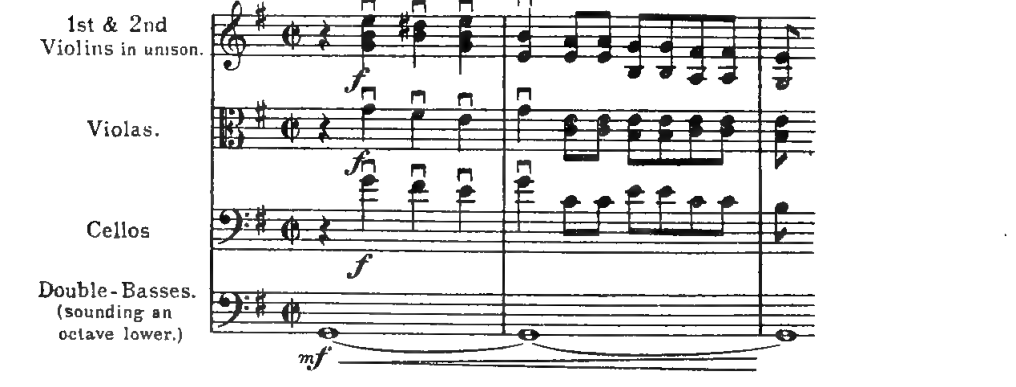
The student will notice that there is an obvious omission of a | | fron the second note of the second bar in each of the four upper Stringparts. The tirst of the quavers must, ot, course, be attacked | !
Another and even better example of consecutive down-bows is to be found in the familiar passage from Ischalkowsky's Pathetic Symphony. (Ex. 222.) Successions of up-bows of a character corresponding to the passages given are wholly unknown to the String-technique.
(2) The Martelé ' or hammer-stroke is done at the point of the bow. The actual stroke is a quick alternate push and pull, not too short, but with an abrupt termination that instantly checks the vibration of the string. In effect it is hard and mechanical, like the strokes of a hammer on an anvil.
'* Italian, Martellato. The French also call this stroke Détaché sec (dry détaché)...
Example 222
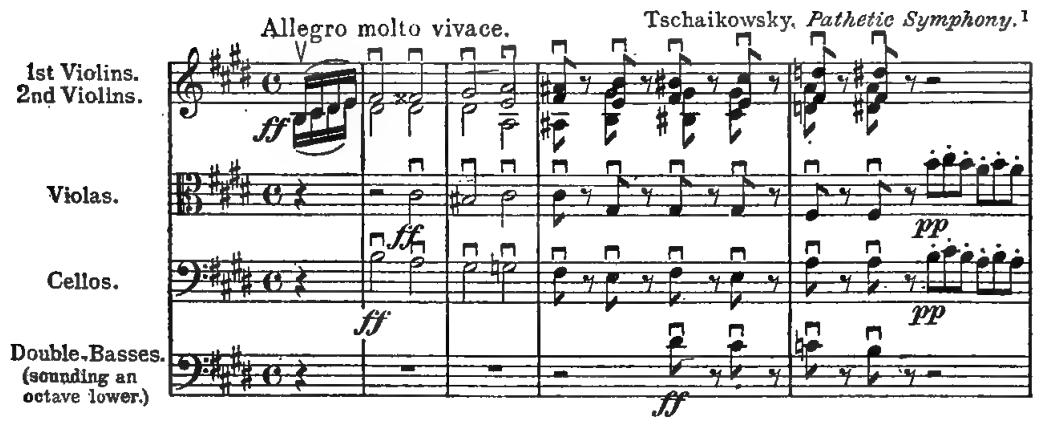
The notation for the ordinary Murtele bowing is generally a series of little upright strokes, like the tops of exclamation marks. To these it is usual to add the word point, or the Italian words a punta d'arco, so that no mistake can arise.
The Martele is equally suited to both the p and the f. Less usually It is done at the heel of the bow. When so played the sound is quite ditferent from the true Martelé " a punta d'arco." A little of it is tremendously effective in the orchestra. It should be indicated by the little upright Martelé dashes, with the addition of the word talon or heel, thus:
Example 223
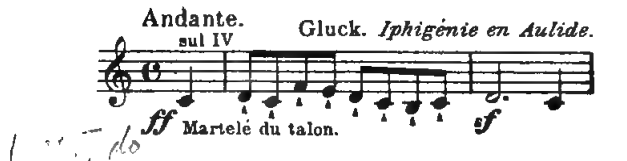
(3) The Sautillé " is a middle-bow stroke. It is done by letting the bow rebound quietly on the strings. At each stroke it just " picks up' the string and sets it in vibration. This style of playing is really the daily bread-and-butter of all orchestral players for light passages. is the style adopted for all those hundred and one phrases usually called by non-string-players " p staccatos." Its notation is merely the staccato dot over each of' the notes. The student has only to open any score which he may possess to find instances of this bowing. Its total lack of strength precludes its use at any dynamic level above mp.
(4) The Jeté is a species of Sautillé in which the bow is thrown on to the strings and at each rebound picks up a little rhythmical group of notes. The effect is light and airy in the extreme. The bow actually
1 The Wood-Wind and 2nd Horn parts are omitted from the above quotation.
Deta pohr uses this sign in a rather confusing manner for both the startle and the
" Italian, Saltato, sometimes Sallando.
* See, for instance, the last six notes of the Viola and Cello parts in Ex. 222.
dances on the strings in what seems to be a series of little perpendicular Jumps that are scarcely either up-bow or down-bow. This stroke is more effective when executed with precision by a large body of The notation for violinists than when employed by a single player. the Jeté is a slur over the whole rhythmical group with a dot over each note of which the group it is often und in spanish and other This style of playing is frequently miscalled Sautillé. national dance-measures where rhythms of this kind predominate:
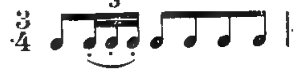
An example may be found in the Moderato Mosso of Tschaikowsky's Pathetic Symphony.
Example 224
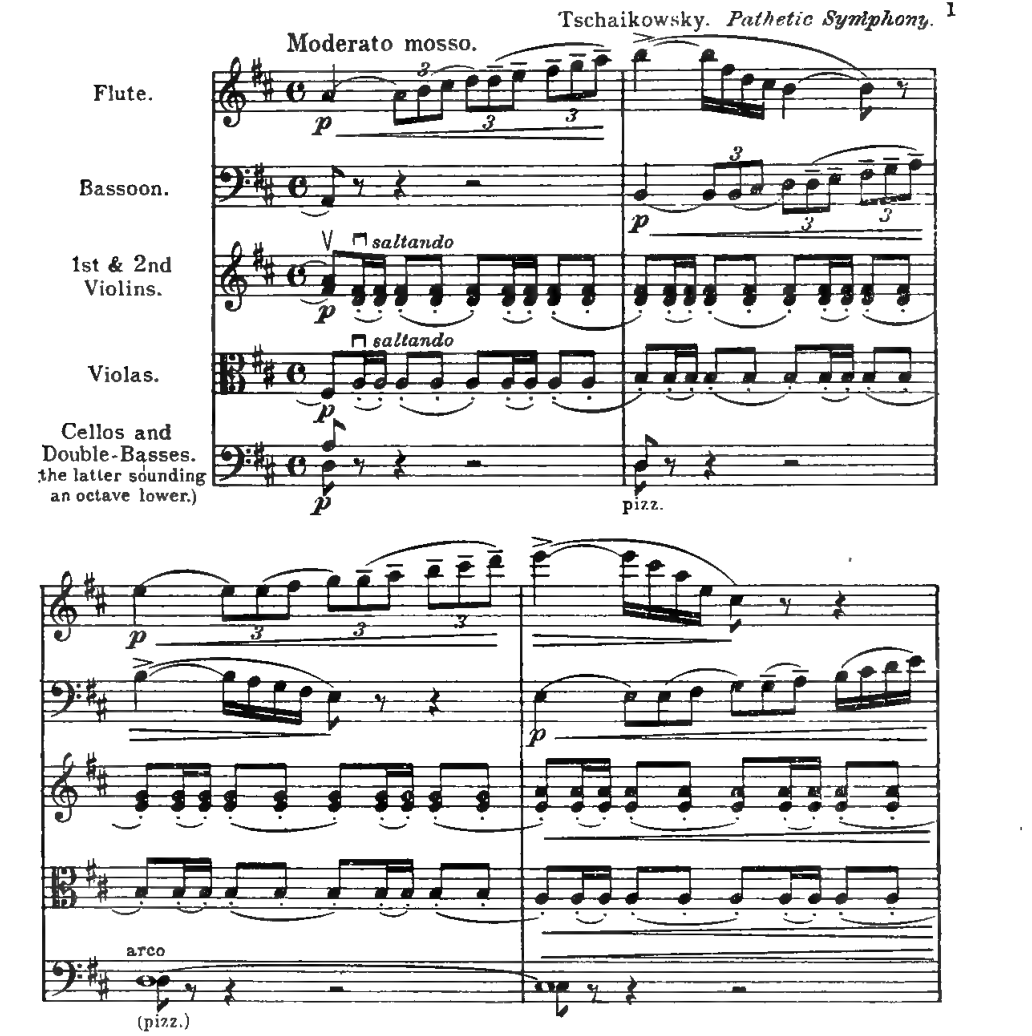
1 In the above example the Ist and 2nd Violins are written with only one set of tails, in order to show the notation of the bowing more clearly. In the Full Score they naturally occupy separate lines.
(5) The Slur, though not strictly a bow-stroke at all, is included here for the sake of convenience. Any number of notes within reason
may be included under a —, and so long as the slur continues the
player will not change the direction of the bow. It should be noted nowever, that (A) only notes on the same string or on adjacent strings can be slurred, (B) the more notes that are included in the slur the slower the bow has to travel, and therefore the weaker becomes the tone. Long f slurs are an absolute impossibility. In any case the eking-out of a long p slur at the end of an V (that is to say, at the extreme heel of the bow-its strongest part) is unsatisfactory. Similarly the eking-out of a long f slur at the end of a! (that is to say, at the extreme point of the bow-its weakest part) is ineffective. Pianissimo held notes or slurs consisting of a few long notes bound together can be pertormea up to a maximum ot about 4 bars ot i moderato time. In this case the string has only just to be kept moving. If, however, the slur includes a large number of notes, such as scales or figures, a certain amount of "way." has to be kept on the bow in order to give each note its requisite impetus. In this case the maximum number of bars mentioned above must be about halved. This is a fairly good general rule.
The next three bow-strokes are mixed strokes, that is to say, they may be regarded as slurs in so far as the bow performs more than one note when proceeding in the same direction. On the other hand, a distinct stoppage of the bow, and therefore ot the sound, is made aiter each note, so that the musical effect is of a series of more or less detached notes.
(6) The Louré is a characteristic V stroke, though it can also on occasion be performed 7. It is used only in the cantabile for the purpose of giving the utmost intensity of teeling to a group of unslurred notes. In making this stroke the player exerts a strong pressure with the fingers of the right hand on each ot the notes composing the group. The stoppage of the bow after each note is reduced to a minimum. "Consequently the effect is that of a series of "pushes." By increasing or decreasing the length of bow used, a very effective crescendo or diminuendo can be secured.
The notation of the Loure is a slur under or above the group, with a little horizontal line thus — under or above each note of which

It need scarcely be pointed out that, as the object of the stroke is to give the maximum cantabile effect combined with a certain amount of detachment to each note, the bow is compelled to travel a considerable distance while "singing" each note. opposite to the Staccato, in which the bow only just engages the string for each note sounded. It is, therefore, impossible to include a large number of notes under one Louré slur. Six, perhaps, would be the maximum: half that number the most effective. The opening of
"Comfort ye" in The Messiah gives an excellent example of the Louré.
Example 225

Notes written this way are commonly called in English orchestras "one-line-crotchets," " one-line-quavers," etc. The student should note that the type of tone which is indicated by the slurs and dashes can also be secured by using separate bows. The essential point is that the Loure is a slightly detached cantabile, in which each note receives a definite pressure from the bow. If a modern Score, such as that of the Pathetic Symphony, is read through it will be seen that a very large number of Louré notes occur either (1) as isolated notes with separate bows, (2) as successions of " one-line-crotchets" and "one-line-quavers," or (3) as single notes bracketed in Louré with other notes. In all these cases the effect is precisely what has been described above—a detached emotional cantable.
A good example of a few Louré strokes cunningly interpolated here and there in order to secure a maximum of effect may be found in the Viola melody quoted below from Bridge's Isubella.! A second excellent example is to be seen in the excerpt from Vaughan Williams's String Fantasia? In this quotation the melody is played con molto espressione by 2nd Violins, Violas, and one division of the Cellos. Almost every note has a Louré stroke. A third example may be found in the section devoted to the Violin pizzicato. In the quotation from the slow movement of Ischaikowsky's Fifth Symphony the Louré is used in the Ist Violin melody to detach the last note of the up-beat triplet from the preceding notes.
(7) The true Violin Staccato is scarcely ever used in the orchestra. It is done by taking a rapid group of notes-generally an upward but sometimes a downward diatonic scale-with the upper half of a single up-bow. After each note a distinct stoppage of the bow is made, but the whole scale is bracketted together, so to speak, into one brilliant whole. Naturally this stroke demands very great skill on the part of the player. The capacity for its execution is, as Spohr says, " in some degree a natural gift." The Violin Schools of Bobemia, Hungary, and the Latin countries, excel in this species of bowing, but in mixed orchestras the dangers in the way of securing a proper ensemble practically forbid its use. However, three or four Staccato notes before a down beat can sately be hazarded anywhere.
The notation of the Staccato is a slur over the whole scale-passage with a dot above each note of which it is composed. Here is an example from Spohr's Ninth Concerto:
3 See Ex. 241. 2 See Ex. 277. 1 See Ex. 248.
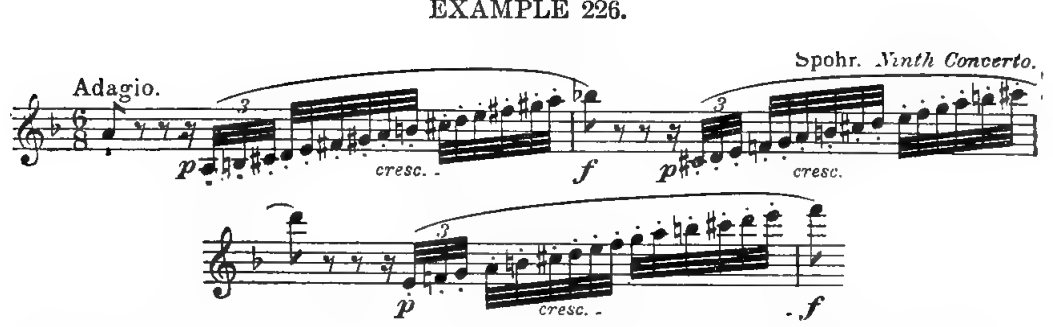
Down-bow Staccatos are very rarely used, even in Solos. In the orchestra they are quite out of the question.
Simple passages across the strings of this sort
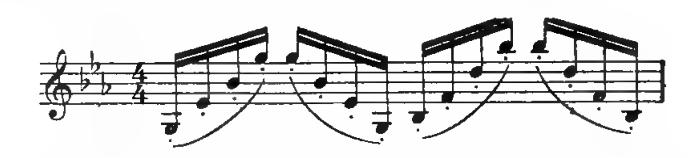
can easily and effectively be played with a light staccato-like effect provided the notes of the arpeggios are arranged so as to be practicable as chords. This type of staccato, however, has nothing technically in common with the true Violin staccato. The latter is done solely with the wrist. The former merely consists of throwing the bow backwards and forwards across the strings with the lightest possible pressure ot the fingers of the right hand... Perhaps it would be truer to say, " with no pressure at all except that which is exerted by the weight of the bow itself." Arpeggios played in this manner have less tone and qualty than they would have it they were merely slurred. In the latter case they can be performed at any dynamic level from pp to J.
Though the true Violn Staccato is little used in the orchestra, a simplified and curtailed variety is continually employed by all string players. It is essentially a system of grouping together little sets of not more than two or three notes for convenience of phrasing. These notes, however, are not grouped together so as to give the effect of slightly detached legatos—as in the case of the Louré-but so as to give the effect of a staccato in the ordinary sense of the word. Though this system of staccato-grouping is in daily use in every orchestra all over Europe, it unfortunately has never received a name. For convenience of reference it may be called
(8) The Group-Staccato. (A) Its notation in the case of notes of equal length is the same as that of the true Staccato, a slur with dots over each note. (B) In the case of notes of unequal length the notation is conventional—a slur over the two notes and a dot over the

The first of these (A) is merely an abbreviation of the true Staccato. It is solely an V stroke, and can be equally well used for repeated

Exe bot when interpol ted i of strepid passage do the usake of " getting the bowing right" The second of these Group-Staccatos (B)

demands a little more attention. The student should notice that the dot under the second note ot each pair is merely a convention. The shortening is a shortening of the first note. The second note is played strictly in time but clearly detached from the first note. In fact, the time robbed trom the tirst note gives the characteristic detachment to the group. The second note is attacked at its strictly correct place in the time-scheme of the bar, and is not shortened. The efiect of the rhythm
when so bowed is o ye o not d.. d
Occasionally the detached character of these string rhythms is emphasized by means of rests, thus:
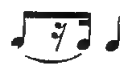

notes. It is somewhat difficult to understand the reason for these dots in an allegro rhythm such as that in the Finale of Beethoven's Fifth
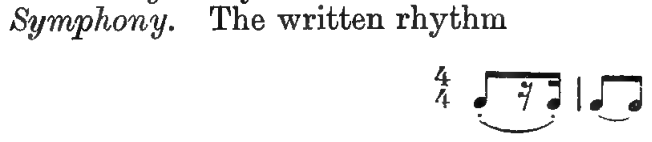
would appear to demand the sound
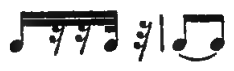
but this is meaningless in so quick a movement.. These dots seem to frame of mint and muly to terrify the player into a staccatisimo
The second species of Group-staccato can be used equally well p or When played I with the 2nd note bitten out hard at the point of the bow it is immensely effective. The V Group-staccato is also continually used, but it is slightly less in the character of the and to into the had the a teles to check an decidi aly that "this bowing is commonly used when not expressly prescribed by the composer, for certain rhythmic combinations, particularly for gron not to notes, of which the second gis shed bad unacenpted." except in those cases where he actually wants the rhythm played with alternate bows. The latter method of playing them-possible either I V at the head of the bow or V Fat the point-secures a great degree of rhythmical detachment and vigour. It is, however, a little fussy and tiring to the player. The reason of this is that, in a series of such groups, the player has to keep to the same portion of his bow, and is therefore compelled to draw very strong and rapid strokes for each of the second (the short) notes, in order to get back again for the first (the long) notes.
To sum up, the composer should remember that the written rhythm
represents, on every stringed-instrument, a perfectly clear detachment of the first two notes, and not a sort of semi-slur. If, in his most "rumbustious" passages, he wants this type of rhythm played •V he should omit both the dots and the slurs. This, however, will probably not happen more than once in a hundred times.
There are a number of other bow-strokes associated with the names of the great Fiddle-masters who first employed them. These are known by such names as the coup d'archet de Viotti, coup d'archet de Kreutzer, and so on. For the most part they consist merely of different combinations or arrangements of the strokes already given. The Viotti-bowing, however-consisting as it does of alternate groups of two Fi and two V staccatos, all played with the upper t of the bow,

deserves to be excepted from this category.
Shakes.
Very little need be said with regard to the Violin shakes. They are playable both whole-tone and half-tone practically throughout the whole compass of the instrument. There are, however, two restrictions to be borne in mind.
(1) Violinists never shake on an open string: The whole-tone and half-tone shakes on low G, therefore, cannot be, or rather are not, used.t The shakes on the three other open strings are pertormed either in the 3rd or the 4th position on the next lower string.
(2) At the extreme upper end of the compass the shortness and high tension of the E-string combine to destroy the "freedom" of the shakes. The limit of top G
should not, as a rule, be exceeded.
These are the only restrictions to be observed in writing Violin

The notation of the Violin shake is the ordinary trill sign tr.n, and the student should be caretul to slur together those notes which he wishes played with the same bow. This is a most important point. The new attack on the same or on a different shake makes a strong appeal both to the ear and to the eye. In very long shakes which exceed the possible limits of a single bow-stroke the players will, 1 the whole shake is slurred, change the bow at discretion. This secures a unitorm quality in the shake.

As early as the time of Monteverde efforts were made to give a dramatic intensity to String-backgrounds by substituting a quick trembling movement of the bow for the ordinary tenuto stroke. Ir the earliest known examples the device adopted was merely to fill up the required space of time by writing repeated notes of a smaller These note-groups were presumably performed with time-unit. rhythmical regularity by the players. The result was a sort of bastard tremolo, new and surprising at the time when it was invented, but still not a true tremolo in our sense of the word. This tremolo, which, in quick tempos, approaches the ettect of a modern tremolo, Is commonly known as The Measured Tremolo. It appears to have beer first used by Claudio Monteverde at the beginning of the seventeenth century. The tollowing excerpt from his Opera Il Combattimento di Tancredi (1624) is quoted from Vol. II. of Reissmann's Geschichte der Musik. The Italian Direction in the 7th bar "to leave the bow and pull the strings with two fingers" is of course equivalent to our modern word pizzicato.
1 The whole-tone and half-tone fingered-tremolos on low G are, in effect, nothing but shakes.
Example 227
Monteverde. Il Combattimento di Tancredi. 1
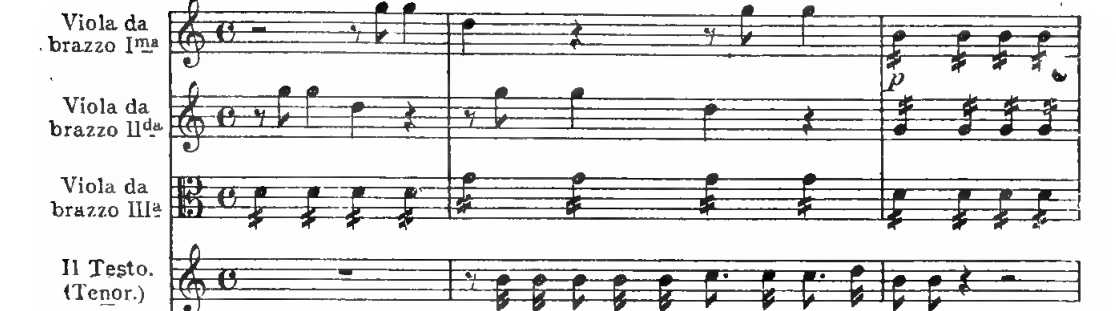
Sti-mol no vo s'aggiunge a pia - ga
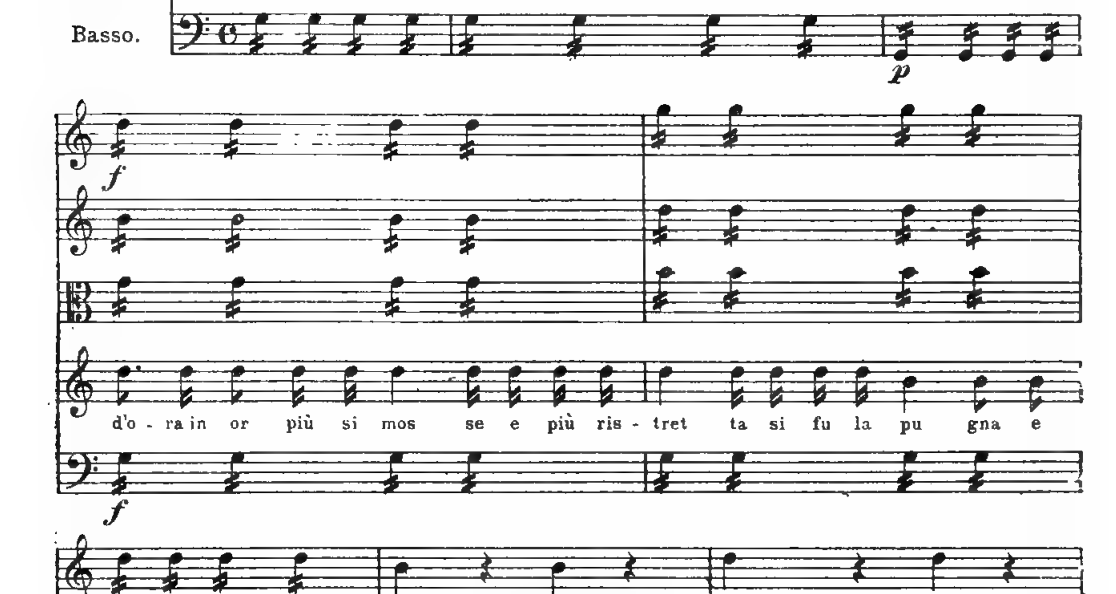
Qui si lascia l'arco, e si strappano le corde con duoi diti.
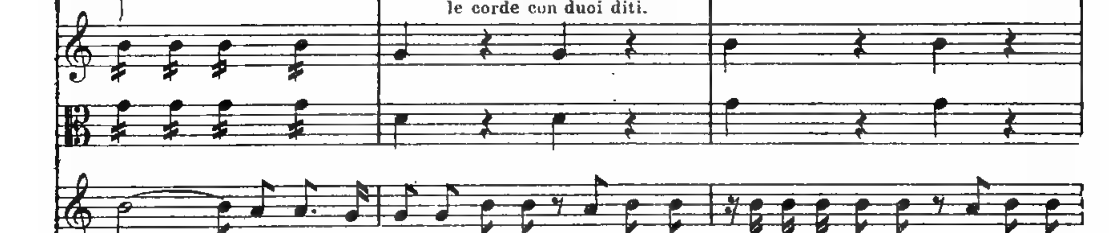
in -fe-lo-ni - ti - di oprar non gio-va

This is the earliest form of the tremolo, —a characteristically awkward repetition of a single String-chord as an accompaniment to a vocalist. Monteverde's experiments in this kind did not, however, meet with any general acceptance, and it was not until Gluck's time that the real tremolo became a recognized method of tone-production for all the Strings.
1 See foot-note, p. 395.
In discussing the various sorts of tremolo we may leave out of account this early Measured Tremolo. It was merely the rapid reiteration of a note or notes in which the strict rhythmical values were observed. Undoubtedly this often has a tremulous effect, but it cannot be properly classed as a tremolo, for the simple reason that no rule can be given as to the pace at which it either becomes or ceases to be a tremolo.
Besides this Measured Tremolo there are four sorts of true tremolo which either have been or are now used in the orchestra. These are
(1) The obsolete Undulating Tremolo.
The Bowed Tremolo.
(3) The Fingered Tremolo.
(4) The Bowed-and-fingered Tremolo.
(1) The Obsolete Undulating Tremolo.
This variety as used by Gluck is traditionally supposed to have been done by means of a series of pressures exerted by the fingers of the right hand on the bow during the progress of a long legato bowstroke. The fingers alternately exert and relax the pressure as the bow proceeds on its course. A certain-or, to be accurate, a very uncertain—undulating effect is thus produced. This is the tradition. But it must be said that, unless violinists have wholly lost the art of this particular stroke, the result is disappointing and futile in the extreme. Perhaps the best proof that the Undulating Iremolo was performed in this way is to be found in the fact that it has been totally abandoned for more than a century.
It is difficult, however, to believe that a composer of Gluck's eminence could really have been satisfied with a tremolo so uncharacteristic of all the string-group. A suggestion has been made that it was not done as a legato bow-stroke at all but as a series of little dancing strokes or jetés. In this case the players would simply throw the bow on the strings continually till the value of the written note was exhausted and, if this were done by a large body of players all making the stroke without rhythmical collusion, the total result would probably be effective. The shape and weight of the bow as used in Gluck' time ver vestainly walted i more egle of playinding the ily are consequently less adapted for this hard rapping method of attack.
The notation of the Undulating Tremolo was not unitorm. Sometimes the note was written at its full value with the addition of a series of quaver dots combined under one slur, thus :
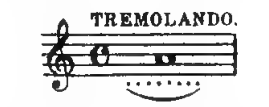
Sometimes the quavers were written out thus:
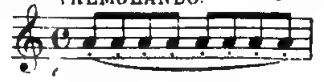
and sometimes a little wavy line was placed under the note, thus :
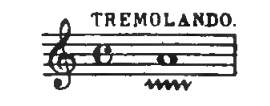
It is not known whether this difference of notation indicated an intentional difference of effect or not.
The following example of the Undulating Iremolo is quoted from the 1776 edition of Gluck's Alceste. It occurs in the air of Alcestis, Arbitres du sort, etc., Act 1, Scene 5.
Example 228
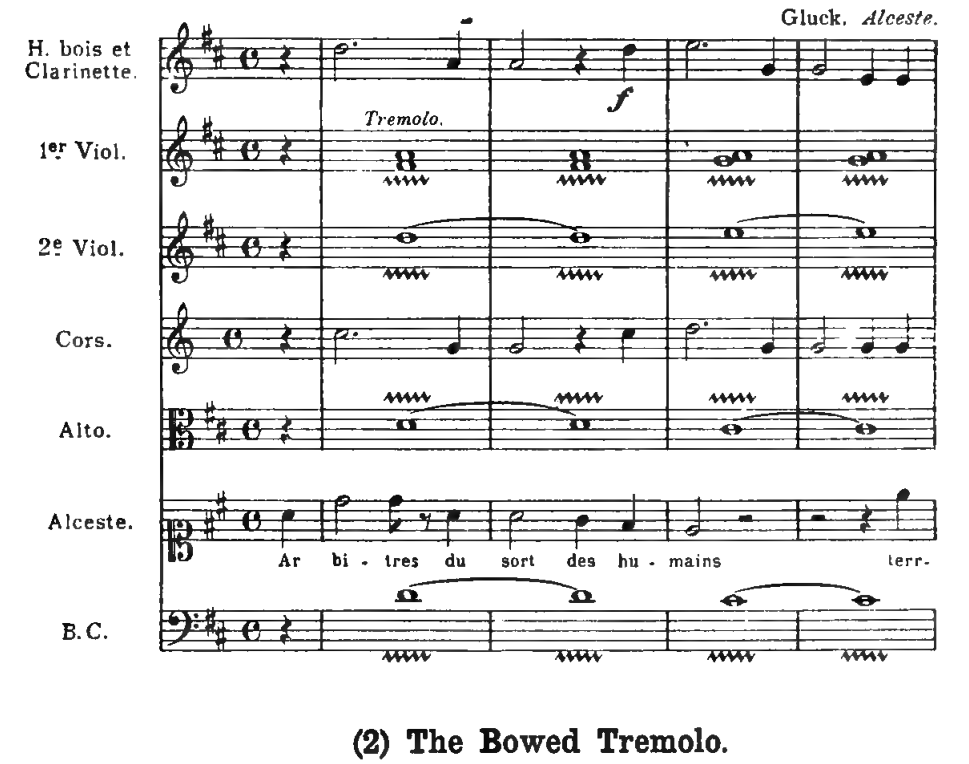
This, the most commonly used orchestral tremolo, is performed by rapidly reiterating a single note or at most a two-part chord tormed of notes on adjacent strings. In the latter case the two notes composing the chord are not alternated but reiterated simultaneously. To be effective this tremolo must be very close, that is to say the individual players must perform as great a number of strokes This is often difficult to achieve in the as possible on each note. orchestra. The player's attention, when confined to so mechanical a task, is liable to wander and his muscles to flag. Still it makes all the difference in the effect. Perhaps the best way to ensure a good close tremolo is not to continue its use in one part beyond a dozen bars or so.
The notation of the Bowed Tremolo is simply a number of slanting strokes drawn through the tail of the note, if it has one, or placed above the note if it has not:
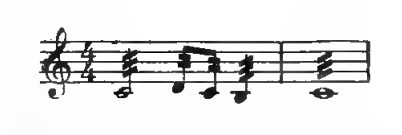
Less than three strokes should not be used and, in very slow tempos where demisemiquavers would clearly be played as rhythmical constituents of the bar, the abbreviation trem. should, for safety's sake, be added above the stave.! The overlooking of this word in a score has on more than one occasion produced absurd results. The converse of this proposition must also be kept in mind. If too many strokes ar added to a rapid series of notes in quick tempo a tremolo will resul when not intended. The Fiddle cadenza towards the end of the Flying Dutchman overture is a case in point. The sound of this passage is always more or less of a fussy tremolo. In this instance it might be just possible, by means of careful rehearsal, to secure an intelligible TV attack on each note. However, it is difficult to recall a performance in which this nicety has received the proper attention.
Example 229
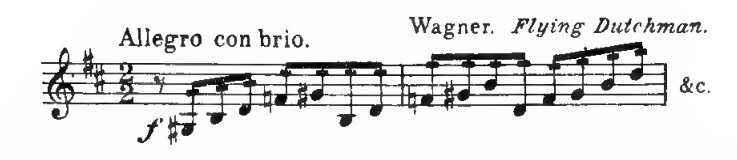
The only nuances possible in the tremolo are the - , the
=, and the extraordinarily effective sforzando written thus:
The latter is performed exactly like the ordinary Violin sforzando, except that immediately atter the bow has taken the preliminary "bite" on the strings it is inoved rapidly to and fro. The sfz can be taken at any dynamie level of p or f. In the f it is usual for players to emphasize the note by taking an extremely rapid bowed note (I) immediately after the "bite" and before beginning the tremolo proper. The effect of the Bowed Tremolo, especially of the full tremolo horne pond inge, varies, middle atly accordiseas if i he dierene instruments. In the lower registers it has a sombre, threatening effect. As it rises upwards to the top string it gradually loses its gloom and becomes more and more ethereal. On the top-string "it seems," in Gevaert's words, "to sparkle." It would be impossible except at great length to give adequate examples of the many p and f tremolo-combinations of Violins, Violas, Cellos, and Basses. They must
1 See below, p. 358, for the ordinary notation of the Bowed T'remolo in notes whose time-valies vary from the semibreve to the semiquaver.
be studied by the composer in the concert-room and the theatre An example of a low tremolo for tutti Strings is given below.! For the sake of contrast we shall give here a medium-register tremolo for Violins only in four parts.
Example 230
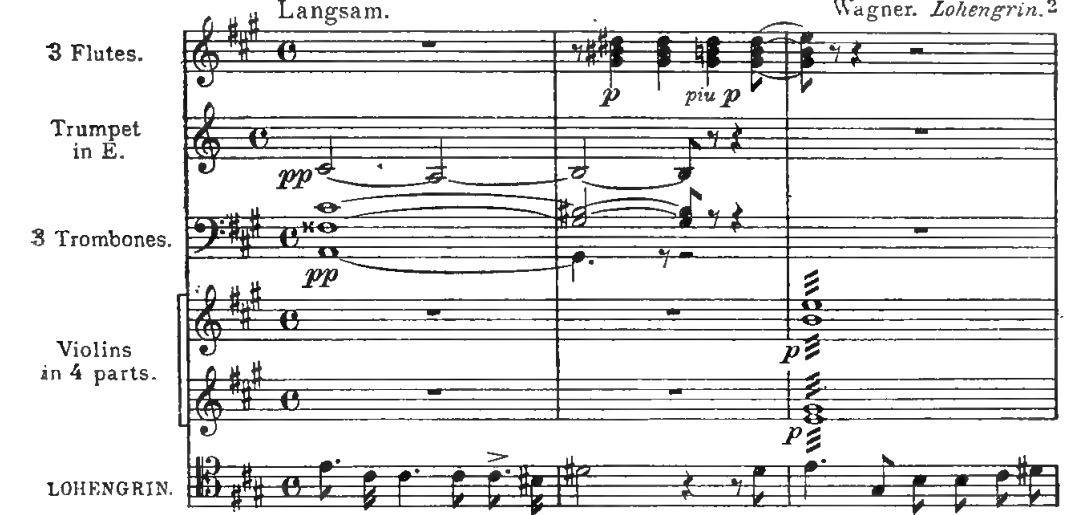
Rit - ter dort
heh
er un - er - kant
ter Art doch ist es
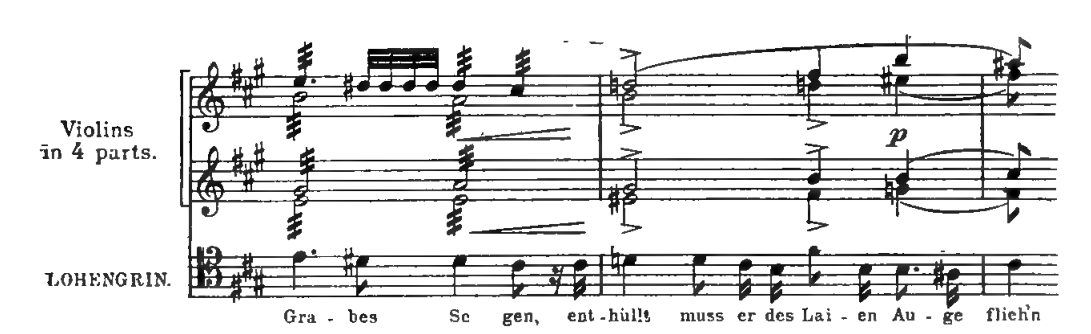
In this passage the magical effect of the E major chord, which is coft as it were telling in thee to chen need by the anil. contrasting tone-colours of the two previous bars. example prompts an observation which is well worth the studenti attention. All Bowed Tremolos, whether p or f, have much less sound in them than the corresponding legatos or Fingered Iremolos (No. 3). This statement, which is directly contradicted in some orchestration books, is undoubtedly true. In the Bowed Tremolo the amplitude of the string-vibrations is very small, and, with every turn of the bow, the sound is damped. Even the greatest crescendo possible, provided it remain a true tremolo, never approaches the dynamic level of an

" The practical application of this can be seen in any big " Trem. cresc. to ff." In such the String-players always tend to increase the length and to diminish the number of the bow-strokes. This is done to make a more perceptible dynamic difference between the two ends of the Crescendo.
ordinary legato or bowed fortissimo. These facts, which are within the knowledge of all conductors and players, can be demonstrated scientifically or they can be judged roughly by listening with the eyes shut, and then contrasting the two types of sound. The mistake on this point has indisputably arisen from the fact that the tremolo is more exciting to the hearer, and this added excitement is mistaken for increased sound.
The Bowed Tremolo need not of course always be employed only with tutti Strings. It is more often written for middle parts, such as 2nd Violins and Violas, Violas and Cellos, or for the lowest parts, such as Cellos and Basses, or Basses alone. When tempted to employ this method of expression in the middle parts, the student should occasionally pause and consider whether it is not a rather too easy "refuge for the destitute."
When not too or ta kai, they are chain dreader. tiny, thin, wandering thread of sound. This type of tremolo can be usefully employed to give colour-contrast to the upper of two contrapuntal phrases where the lower is not too loud, and where it is some distance away.
A few examples of the Bowed Tremolo have already been given under various Brass and Wood-Wind headings. It is therefore unnecessary to give any further extracts here. The student should refer to those already printed. They are as follows:
(1) Exs. 67 and 139. Two high tremolos, one in four parts for Ist and 2nd Violins divisi, the other in three parts for three desks of 2nd Violins. In both cases the melody is placed below the accompaniment. Note that, though both the String-accompaniments look much the same, in the case of the Horn-the stronger and more telling instrument-about thirty-two Violins are employed pp; in the case of the Oboe d'Amore there are only six players in all, and their parts are marked prp. Furthermore, the Oboe d'Amore probably plays at a slightly higher dynamic level than pp. Also notice that the Stringaccompaniment to the Horn solo is really one of those Measured Tremolos to which reference was made above. Each of the quavers enjoys its exact time-value. A similar instance may be found in the open hiths for 2nd Violins and Cellos (semiquaver triplets) at the beginning of the Choral Symphony. See also Ex. 15.
(2) Exs. 43 and 103. Two middle compass tremolos, one ff in three parts forming the background to a thick unison of Clarinet, Cornet, Bassoon, and Cellos, the other pp in two parts torming a very light accompaniment to the Flute and Oboe unison. In the former case the accompaniment is above, in the latter case below the melody. In the Example trom Carmen the three tremolo String parts could of course be laid out differently.
(3) Ex. 74. A lower but still not very low Bowed Tremolo for Violins and Violas supporting sostenuto of the Horns. Note the ettective pp storzando on the minor ninth, the last chord.
(#) Ex. 191. A deep Bowed-Tremolo for Violas, Cellos, and Basses (bars 1 and 5).
The following examples occur later in this book:
by a roll on the Bls Detave tremolo for Doe ble Basses, accompanied (5) Ex. 274.
and the Pedal-Organ.
(6) Ex. 278. A three-part tremolo on the lowest strings of the Violins and Violas. The passage is too familiar to need comment.
(') Ex. 217. A high two-part tremolo for Ist Violins accompanying a melody some distance below it. The accompaniment is comparatively weak: the melody is played by a rich String-unison. type of accompaniment is a favourite one in modern music. It is always effective and interesting, and is capable of considerably varied treatment. As a rule, a high tremolo accompaniment of this sort is best in three parts, neither more nor less.
for the sake of completeness a short example will be given of a low tremolo for tutt Strings. The excerpt is from Act I. Scene III. of Wagner's Die Walküre. Notice the sudden cessation of sound secured, in Bar 3, by the omission of the Cellos and Basses, and by the substitution of the fp in the upper strings for the previous ff. On the word Schwert the Horns, Bassoons, and Drums enter with an octave F omitted in the quotation. Further reference is made below (page 362) to this passage and to the bars that follow it in the score.
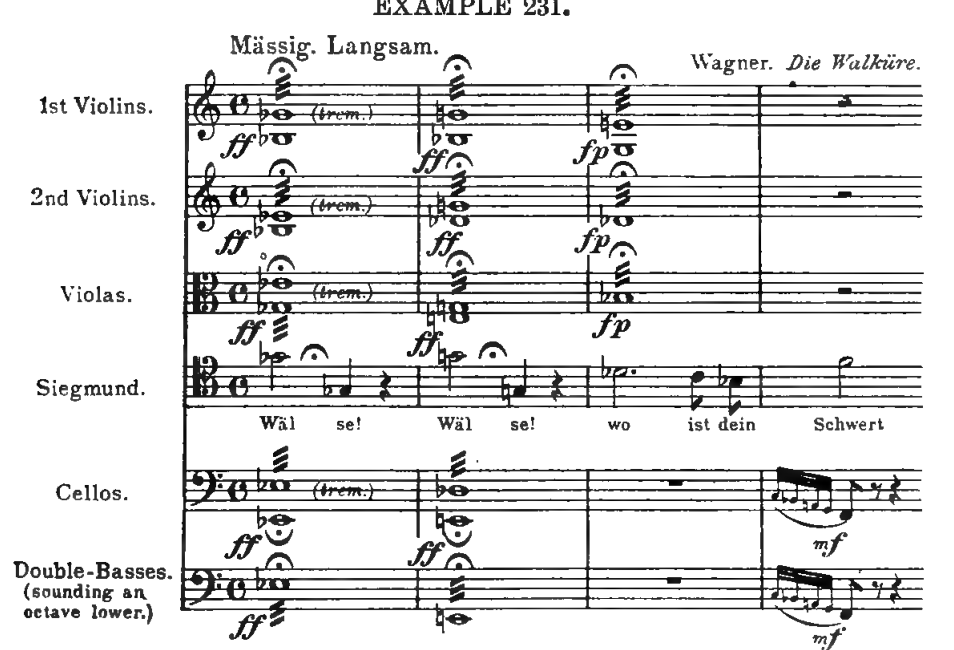
l'or the sake of an occasional, and especially dramatic effect, the composer sometimes writes the word ponticello, above : his Bowed Tremolo. As was explained on page 336, this effect is produced
' Italian for "bridge." The French say au chevalet, and the Germans am steg.
by drawing the bow across the strings close to the bridge. The result—a sort of core of sound covered up by a thick layer of "scrape"— is not very pleasant. It may, however, be used once and again with advantage. In playing the Bowed Tremolo sul ponticeblo the violinist uses exactly the same technique as he would for the ordinary tremolo.
Pressure on the strings, however, is almost out of the question, and he is therefore able to concentrate all his attention on keeping afloat the right side of the bridge. An excellent example of ponticello is to be found near the beginning of the 2nd Act of Tristan (full score, page 139, bar s onwards). It occurs just atter Branganes words "Noch sind sie nah';-deutlich tönts daher," and is laid out for Violins, Violas, and Cellos, against which the ascending Clarinet passage stands out in strong relief.
The ponticello effect is practically confined to the Bowed Tremolo. occasionally been written for the ordinary bowing, with detestable results. In the Scherzo of Beethoven's C♯ minor Quartet

t may have been memt me ly to tere on most tones pan considerations, 1
Another Beethoven ponticello which Gevaert cites with high approval occurs in the choral portion of the Ninth symphony. At the woras Ueber Sternen muss er wohnen the whole of the strings have a pp Measured I'remolo-semiquavers in 3 time-against the crotchet triplets of the Wood-wind.' Gevaert quotes this passage with the addition of the words sul ponticello under each of the String-parts. but there seems to be no authority for this addition, and, in Sir Henry J. Wood's words, "certainly Bülow, Richter, Mahler, Levi, Steinbach, and Nikisch never allowed it to be played in the manner suggested."
(3) The Fingered Tremolo.
This tremolo, sometimes called the slurred I'remolo, consists of the rapıd alternation of one note with another by means of the fingers of the left hand. The player firmly stops the lower of the two notes with his Ist, or 2nd, or 3rd finger, and then quickly stops and unstops the upper note with his 2nd, 3rd, or 4th finger, as the case may be. Each time the upper note is unstopped the lower note "sounds through," and this gives the alternation of the two notes. The bow continues to be drawn in a smooth legato stroke across the string: has no part in producing the tremolo or in increasing its rapidity. The only influence that it brings to bear is a dynamic influence. this point a word will be said later.
For this kind of tremolo the limits of an augmented fourth should not be exceeded. In the case of a fifth the player is compelled either (1) to use an open and a stopped note alternately —a not very satisfactory method-or (2) to use two stopped, notes on adjacent strings. In this case the two fingers merely hold the notes as it they were the notes of a chord, while the bow undulates from one string to another duriny he ingestive arenato troke. This produces a somewhat But for its comparative rarity it might be placed in a class by itsell. For all intervals wider than an augmented fourth this method is the only one that can be adopted but, as was said above, it is much better to restrict the width of the tremolo so that it can be performed on one string.!
The notation of the Fingered Iremolo is as follows: The two notes on which the tremolo is to be made are reckoned as sounding simultaneously. The time-length of only one of them is taken as an integral portion of the bar. In other words, their united written time-length is always twice the actual time-length in sound. If we wish to fill a bar of 3 time with a Fingered Iremolo on the notes B and D, we write as follows:
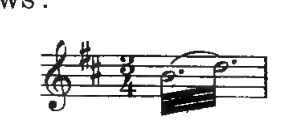
It only two beats of the bar are to be occupied by this tremolo the crotchet rest is put in its proper place, and we write:
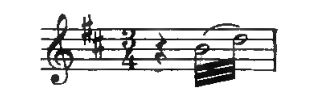
In any case the total written time-value of the two notes must be halved to get the actual time-length in sound.
At least three conventional demisemiquaver strokes are added to the notes in order to indicate the tremolo, and a slur is always drawn above the two notes.
The student however should notice that, in dealing with notes of diterens time values adoped in mini o digue clearly ront tremolos from the non-tremolos.
(1) In the case of semibreves (dotted and undotted) the demisemiquaver strokes are simply drawn above or below, according to convenience, but are not attached to the notes. See Ex. 232, Bar 5.
(2) In the case of minims (dotted and undotted) the tails of the two notes are joined together by the demisemiquaver strokes. See Ex. 232, Bars 1 and 4.
(3) In the case of crotchets (dotted and undotted) the tails of course cannot be joined by the demisemiquaver strokes, otherwise they would make merely a group of two demisemiquavers. The two crotchets are therefore placed next to each other, and the demisemiquaver strokes are drawn between the two tails so as not to touch either of them. See Ex. 232, Bars 2, 3, and 4.
1 It may be mentioned in passing that the utmost stretch possible between the Ist and 4th tingers on the same string is an augmented tourth. When the Ist finger is on ne string and the 4th finger is on the next higher string, the corresponding interval becomes a minor ninth. This latter stretch, however, should be used with caution, and not employed if the chord or tremolo can be obtained by any other arrangement. restrictions with regard to finger-stretches apply only to the lower positions.
(4) In the case of quavers the tails of the two notes are joined by a single quaver stroke, and the two extra strokes are inserted so as When, not to touch either of the tails. See Ex. 232, Bars 2 and 3. however, the quavers are followed or preceded by semiquavers to form a single crochet unit, the whole is usually written out See Ex. 232, Lad beat Of Ex 21, hrst 3 beet of Barers, this plan could not be last beat of Bar 3.
(5) In the case of all units smaller than quavers, the notes of the tremolo are usually written out in full. Thus the following
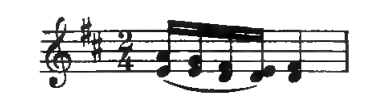
would be represented in Fingered Iremolo by
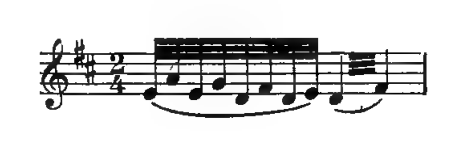
above erhaps the addition, in a very slow tempo, of the word trem.
The logic of these tremolos is very simple, and a single example, including all time-values from semibreves to semiquavers, will make it perfectly clear. Suppose we wish to write the following series of two-part chords as a Fingered-Tremolo,

the correct notation would be:
Example 232

If the same passage had to be written out as a Bowed Tremolo in double stopping, its notation would be:

The extra stroke through the tail of the last semiquaver in"Bar 3, though strietly necessary to conventionalize the time-value, would be omitted nine times out of ten and the player trusted not to break the tremolo.
1 Demisemiquavers must of course be written out in full. Semiquavers might be
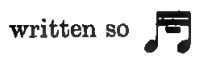
but in practice they are generally written out.
Written for two Violin parts, each in single stopping, the passage
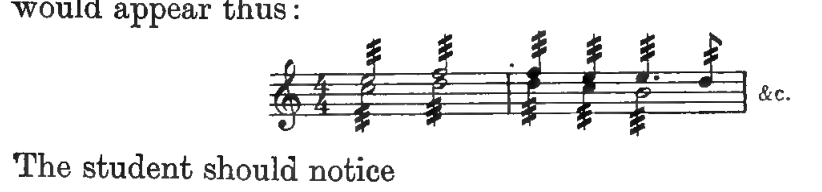
(1) 'That the usual convention of putting in a fresh slur every time the two notes of the Fingered Iremolo change is unnecessary and illogical. So long as the tremolo is on one string or on adjacent strings, the player can go on slurring it exactly as it it were ax ordinary legato phrase. The change of finger does not necessarily call for a change of bow. The composer should therefore slur the passage to suit the phrasing. If the tremolo is, as often happens, piano, fairly long slurs are a good insurance against the ubiquitous and much-dreaded orchestral mezzo-forte. Ii, however, the tremolo ls #, long slurs should be avoided. In the latter case, even when the she than pe inter unity bets it tense i real e, and the first two marked V, they may be made strikingly effective. At the opposite extreme, if a mere p background-tremolo is required, it Is as well to use the longest possible slurs, and to leave the players to change their bows without rhythmical collusion according to their individual styles.
(2) With the Fingered Tremolo the player has just the same powers of — and = as in the ordinary legato bow-strokes; that is to say, anything between pop and fff is both possible and effectiv
3) A Fingered Tremolo is often crossed with itselt. Une part 1s written upwards and one downwards. This can be done either by dividing up any one of the String groups (Ist or 2nd Violins, Violas, vellos, or, more rarely, Basses), and writing the part thus:

or by giving one complete group the upward tremolo and another the
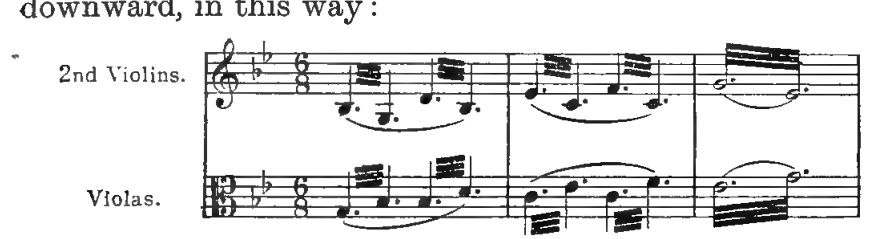
Both these divisions of the tremolo into two parts are merely pretty arrangements for the eye of the score-reader. Violin players make no difference in the performance. They set the lower finger and beat with the upper in any case. Furthermore, no accent—unless specially prescribed-is given by the player to the first written note. The effect of the upward and downward Fingered Tremolo is therefore precisely the same. If of 16 Ist Fiddle-players 8 are directed to make the tremolo one way and 8 the other, the effect is the same as if all 16 were playing it in one direction. The addition, however, of l6 other players performing the same Fingered fremolo on the same notes, whatever the notation, makes a sensible difference in the thickness of the tremolo. It must be said that Fingered Tremolos are often crossed with the object of confining the tremolo within narrow limits. each tremolo necessitates the use of two harmonic notes, the chord is sometimes liable to spread too far unless this plan is adopted.
(4) Fingered Iremolos of a major and minor second are, of course, nothing but shakes, and are often so written in the middle of tremolo passages.
(5) Bowed- and Fingered-Tremolos can be combined in different parts. The elect, which is curiously elusive and tascinating, may be öbtained by arranging the two sorts of tremolo in different parts, so that different notes or parts of chords are played by different methods. In this case it is matter of choice which sort of tremolo should occupy the extrem is or made sipion in th oharmone tremol on the naive in this sort of way
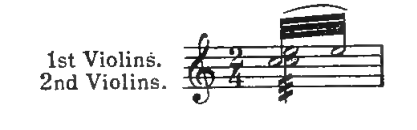
Ut course it is not necessary that the whole of a String-group should be employed on each part. Such a passage can, as a rule, be well done by a single group—Ist Violins, 2nd Violins, Violas, etc.—divisi.
Example 233
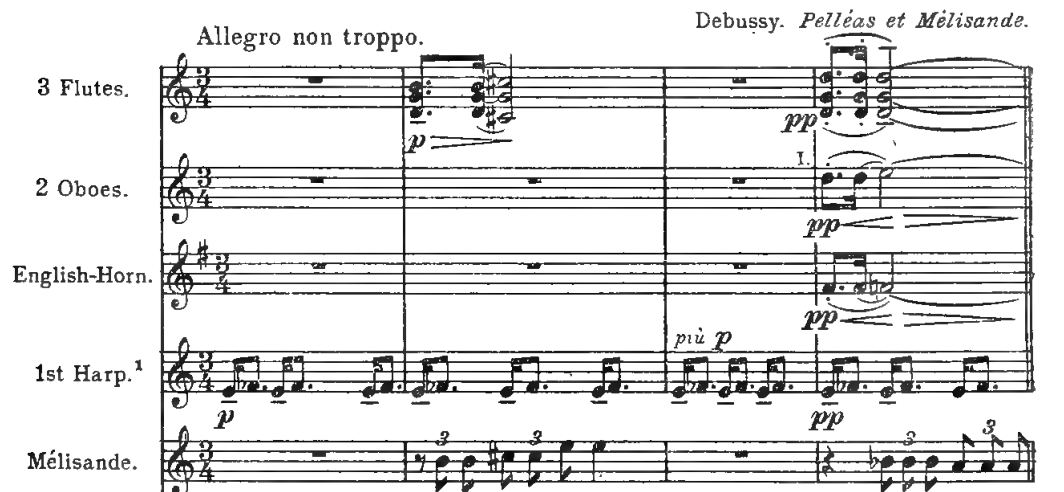
Je ne le vois pas des-
Il est tombe dans leau
Pelléas.
où est-il! Où est - il?
Il est tombe
Ist Violins. 2nd Violins.
niin
1 For an explanation of the Harp-part see below, page 466.
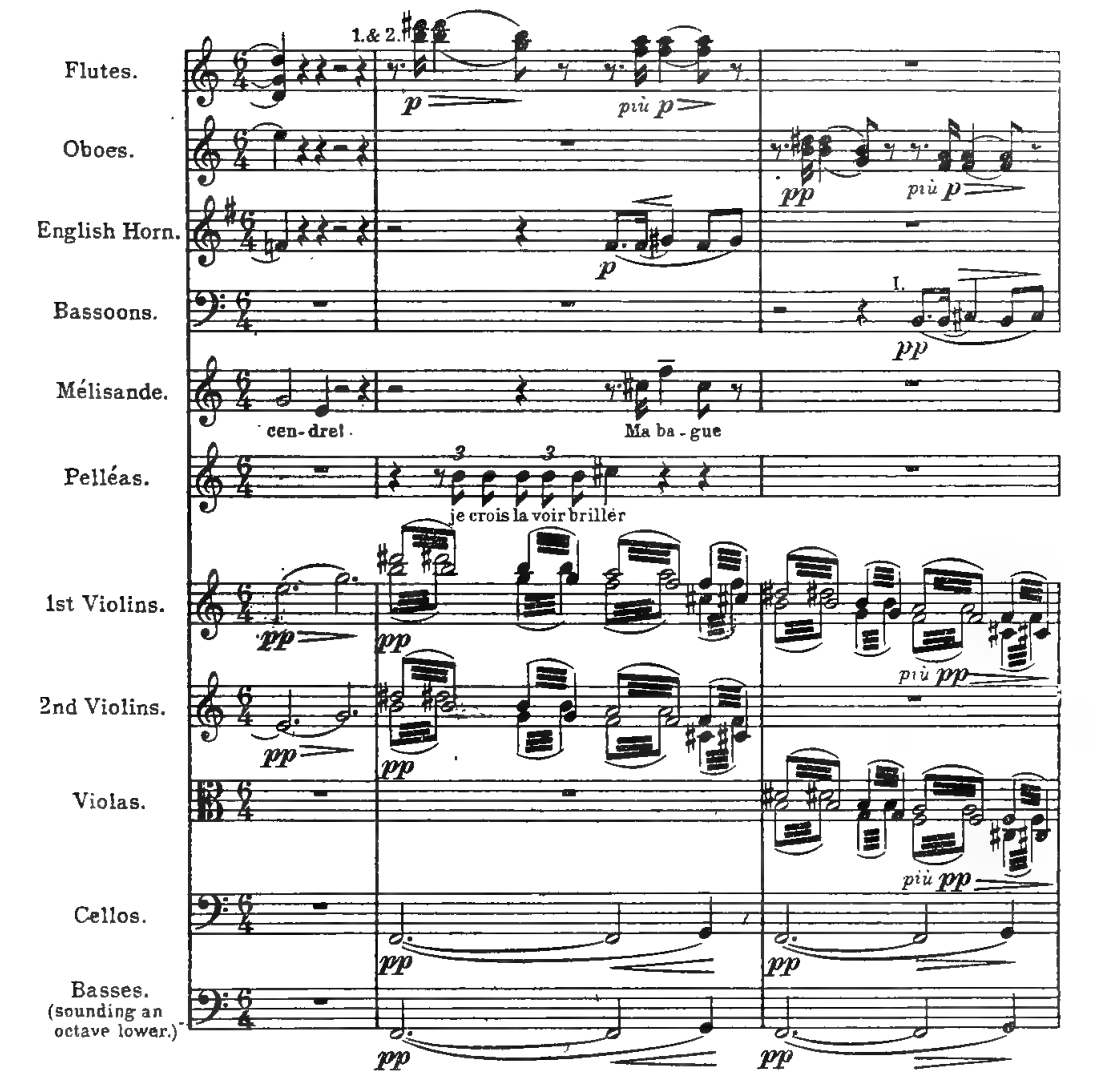
A single example ot the lingered 1'remolo has already been quotea from Lohengrin! The student should notice carefully how it is written, as it is a good type of all such tremolos. Nowhere is the This is a "middleplayer asked to exceed the limits of a major third. register" example. Such tremolos are very rarely used in the lowest octaves, as some confusion is likely to result in the bass. The Measured Fingered Tremolo, however, in which the notes are written out in tull and executed at their proper time-values, is often used by Wagner in the Basses and Cellos. The student can easily find examples of these in The Ring. There are many in Siegfried. Instances of the Fingered tremolo in the upper octaves are so common nowadays that the difficulty of quotation is merely one of selection. A charming example occurs in Pelléas et Mélisande (Act II. Scene 1) at the moment when the ring drops in the water." Fingered Tremolo passing down through two octaves with the descending Wood-Wind and the deep pp of the Cellos and Basses brings to
2 See above, Ex. 233.
1 See Ex. 137, also Ex. 23.
the mind a vivid picture of the gurgling water and the gradual obliteration of the widening circles on its surface.
It is interesting to notice the different mental effects produced by the various sorts of String tremolo. These are not often to be found in close proximity to one another, but there is an instructive example in Act I. Scene 3 of Die Walküre. The passage begins on page 45 of the full score with ff and j Bowed Tremolos all written in the lower register! Six bars later the tremolo changes and we have high Fingered Tremolos for Ist and 2nd Violins, each in two parts. Fourteen bars later, without altering the pitch, the composer changes back to a Bowed Tremolo. Any of these tremolos might have been written precisely the other way round, and the student cannot do better than examine the whole passage in the score and then note, in performance, the important mental differences implied by the differences in technique.
(4) The Bowed-and-Fingered-Tremolo.
Ihis type of tremolo, sometimes called the Broken tremolo, is as old as Gluck? It can be performed by setting the two fingers it position on adjacent strings and then bowing the notes in rapid alternation with a series of tremolo Fand V strokes, thus
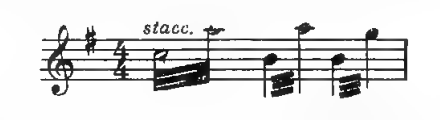
or by making the ordinary fingered I'remolo on a single string and at the same time making a tremolo bow-stroke,
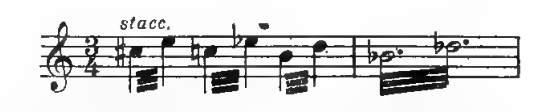
In either case a little more bow and right arm attack is necessary than in the ordinary Bowed Tremolo. This tremolo has not been much used, though it offers great scope for effect. When played f on the upper strings it has a hard brilliant sound, something like a shower of hail-stones. It should be written just like the Fingered Tremolo, but with the omission of the slurs. The word stacc. should be added above the part. The effect may be practically shown by an illustration from Act III. Scene 3 of Wagner's Götterdämmerung. It is true that here the notes are written out at their strict rhythmical values, and, in so far as that goes, the passage may be regarded as a Measured Tremolo. But that does not make a great difference to the sum total of the String-effect. The sound of the Strings here immediately strikes the imagination, and will be recalled by everyone who has heard the passage. It may be mentioned that the String-parts begin two bars earler than the quotation given below, and that they are there marked staccato.
1 These opening bars have already been quoted above. See Ex. 231. 2 Iphigénie en Tauride, Act III. Scene 4.
Example 234
Lebhaft (noch etwas gedrängter.)
Wagner. Götterdämmerung
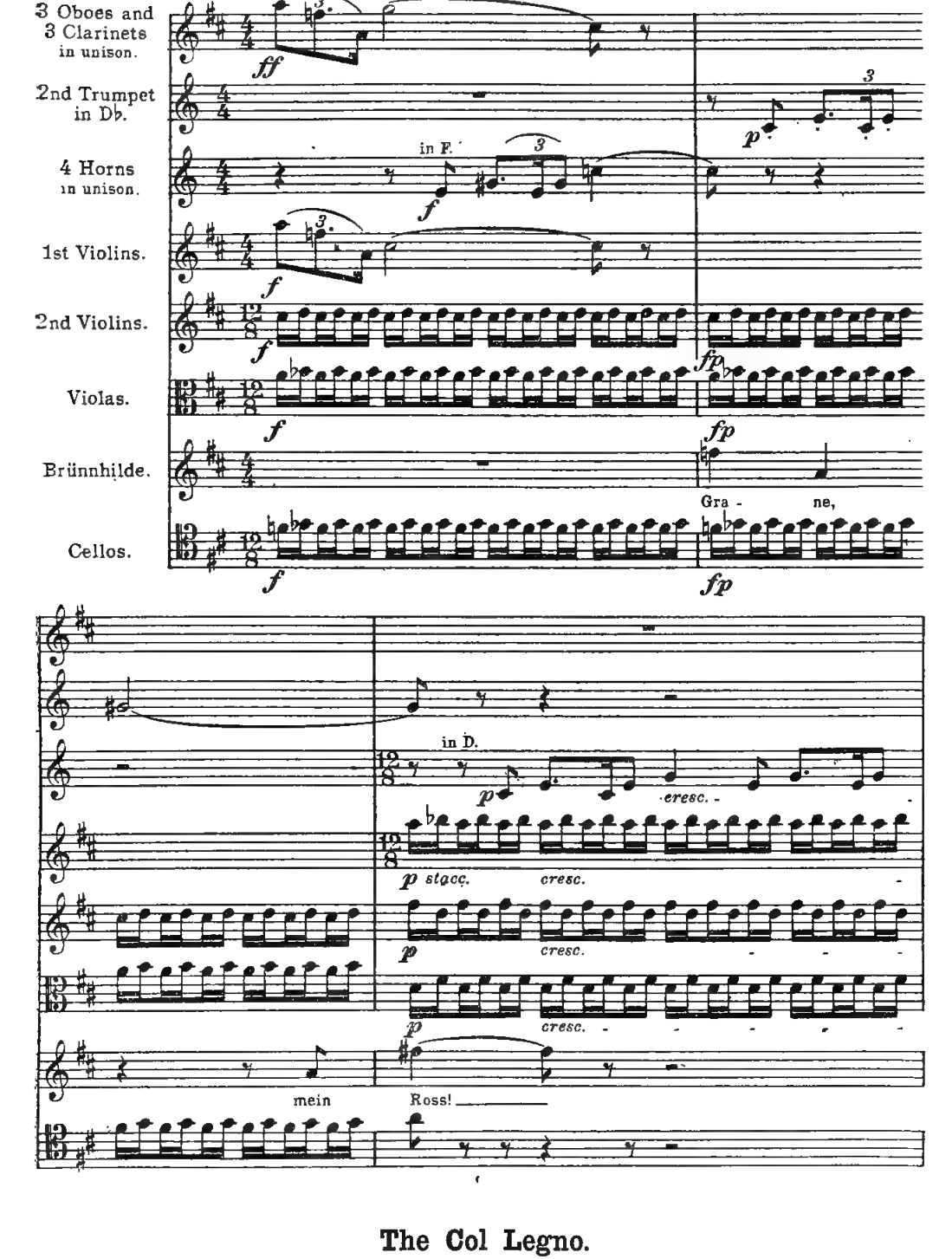
Besides playing : with the hair of the bow, String-players are occasionally directed to strum the strings with the bow-stick itself. This not very legitimate effect is usually indicated by the Italian words col legno (or col ligno), that is to say " with the wood." In executing this stroke the player throws the bow-stick on to the strings with a hard mechanical tap in which there is a good deal more wood than music. The bow is not drawn at all either For V. It follows that no legato is possible. Isolated notes, small staccato phrases, and little rhythmical groups in the style of the jete are all that can be attempted with the legno. As a rule players perform the stroke with a rather the hair on their strings-both where they should be.
The col legno is little used in serious music. Familiar examples, however, are to be found in the Danse Macabre of Saint Saëns, in Liszt's Mazeppa, and in the Second Act of Sregfried (L'ull score, page 451). In more modern times strauss has introduced a Vroln-tremolo Same nic Poem, Also sprach Darathastass see reproduced with the omission of the Wood-Wind-, Harp-, and Trumpet-parts.
Example 235
Strauss. Also sprach Zarathustra. Sehr langsam. Etwas weniger langsam.
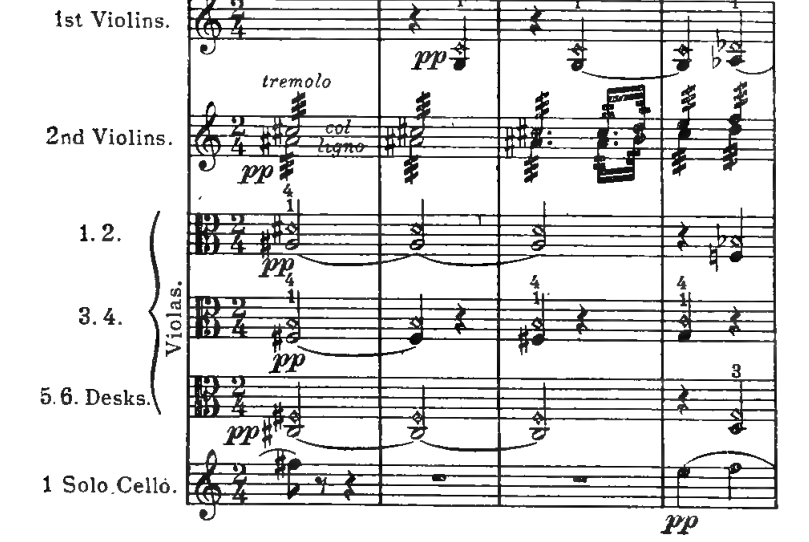
The effect is curious and perhaps unique. In reading the Artificial Harmonies the student should remember what was said above, viz. that if in writing a series of Artificial Harmonics one needs to use Natural Harmonic No. 4-that is to substitute the actual nut for the Ist finger—it is usual to take a certain licence and write the note as an Artificial Harmonic. The above excerpt affords a good example of this licence, for, though the fingering 1 is scattered in a mechanical and somewhat haphazard manner throughout the passage, it would not always be used when written. For instance in the last bar (3rd and 4th desks of Violas) the note might be played according to the directions as an Artificial Harmonic in the 4th position on the bottom string according to the fingering. It would, however, more probably be played as Natural Harmonic No. 4 on the 3rd string merely by touching the note C lightly with the 3rd finger. Again, in the Ist violin part, the first two notes do not exist on the instrument as Artificial Harmonics. They must be played as Natural Harmonic No. 4 in the Ist position on the G string.. The omission ot the fingering in certain cases is probably only accidental. On the other hand, the stopping of the note G with the 3rd finger (last note, 5th and 6th desks of Violas), while the Ist finger is stopping the 4th below, is simply an impossibility.

Before leaving the bow-and finger-technique of the Violin it must be mentioned that String players alone in the orchestra employ the portamento.- Not every legato phrase can be treated in this way. However, it would probably only confuse the student if full details interval is small, and if both its notes can be conveniently played with a single finger, the finger is slid along the string from one note to the other. All the intermediate connecting intervals between the two notes are thus heard in rapid succession.
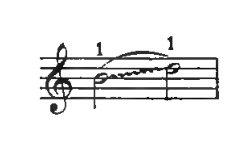
If the interval is larger, and if both its notes are not conveniently playable with one finger, a species of "cheat" is practised on the ear. The tinger that stops the lower note is slid torward in a true portamento until it reaches the position in which the upper note can be stopped by another finger. When it has arrived in that position the to speak, in intan here sly stops the higher not leaven in map, no the portamento from B to G on the 2nd string, the Ist finger slides forward, as explained, from B to D (not G). The Ist finger is then in its place in the 3rd position, and the 4th finger snaps down on to the The actual portamento is from B to D. Between that note and the top G there is no portamento whatever. The process may be
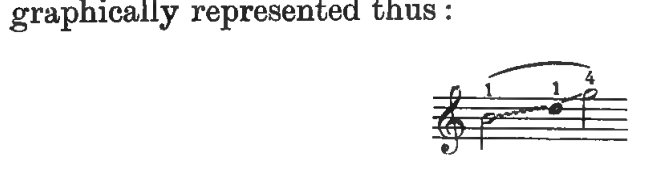
1 The Trombone, of course, has a terrific power of portamento. However, except for humorous military-band pieces and pantomime-effects, it can scarcely be used.
The latter portion of the operation is performed so swiftly that the ear of any but a String-player is quite deceived.
The portamento is not used except between slurred notes on the same string: It could be used on adjacent strings by means of : somewhat similar technique to that described above. 'The moment however, of changing the bow from one string to another makes the gap a little too obvious.
The Pizzicato.
In place of the bow, String-players occasionally pluck the strings with a finger or fingers of the right hand. This mode of execution is indicated by the Italian word for "pinched" or "plucked," pizzicato, or its abbreviation, pizz. When the bow is to be resumed the Italian word arco ("bow") is inserted in the part.
Hor short puzz passages the player retains the bow in his hand, doubling it up against the palm with the Zad, sra, and 4ith tingers. He then rests the thumb against the tingerboard and plucks the strin with the fleshy tip of his first finger. Jecasionally in prolonger pizzicatos he is all e in both an the begik. and at an end of But this can only be the pizz. A single isolated pizz note or chord of this sort

can be interpolated even into a quick arco passage. In such a case the player does not take up the usual puzz position at the tingerboard, but merely thrums the chord with the Ist finger while the bow remains practically in its playing position with regard to the right hand. interpolated puzz note or chord is, ot course, easier it the previous bowstroke is V not | 1. The V brings the tingers of the right hand somewhere near the fingerboard, and the player has to make less of a swoop in order to get the pizz.
Very little time is required in which to pass from arco to pizz, especially it the last note or group of notes in the arco can be arranged to come V. A phrase of this sort is quite easy and playable.

¡ It is interesting to contrast this partial portamento with the ordinary vocal porta- This is theoretically a true portamento, containing all the intervals between the two extreme notes. In practice, however, the majority of singers seem unable to make this extensive portamento with the necessary neatness. Their practice is just the opposite to that of the string-player. The sounds which they omit are those nearest to the "taking-off" note, that is to say they generally jump a portion of the gap at the be ginning, pok up the sound somewhere near the final note, and then perform a true portamento till it is reached.
On the other hand, it is not so easy to get the bow back into its proper position for playing, as it is merely to throw it out of action for the pizz. About half a second by the watch must be allowed. Nothing beyond quavers in allegro time can be attempted at the place where the pizz changes to arco. The following, from the przzicato movement in syla (Delibes) is only just possible. Indeed it the anzmando is done as it should be, either the last przz note has to be scamped or the first arco note has not its proper force and precision.
Example 236

Players, as a rule, give little study to puzzicato playing, and therefore the maximum speed possible is not great. Widor gives semiquavers when d=104 is the limit. This should certainly not be exceeded. It would not be possible beyond one or two bars of i time at most. The better technique of the rapid pizz by means of alternate Ist and 2na tingers certainly deserves the closer attention of orchestral players.
Chords which can be struck with the bow can naturally be arpeggioed pizzicato at any speed. If they are written out they must be spread from the bottom note upwards only, thus :
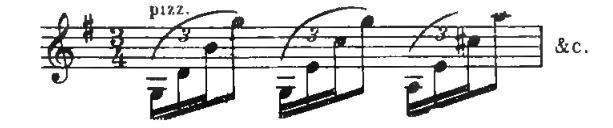
It need scarcely be said that, as no prolongation in the tone of the pizz is practicable, the part is generally written with as few rests as possible. The crotchet pizz sounds the same as the quaver or the

sounds to the ear thus:

On all the Stringed-instruments the pizz is more sonorous and satisfactory for general purposes of accompaniment when used on the two bottom strings. On the upper strings, and especially on the topstring, it is harder and drier, with less of a musical and more of an explosive quality. On the Violin the note
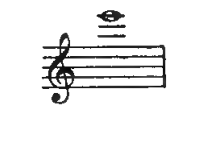
may be kept in mind as being roughly the upward limit for pizzicato. Much higher than this it is not advisable to go. The plucking of a very short and very tense string produces • only poor musical results.
It must not, however, be supposed that the pizz should be kept rigidly to the bottom strings. That register is merely the most useful for ordinary purposes. On the other hand, a f chord written on the top strings will sometimes come out with the force of a pistol-shot. Witness the passage in the finale of Mendelssohn's Violin Concerto, where the Violins and Violas interrupt the running Fiddle-passages with a snap-chord pizz sf:
Example 237
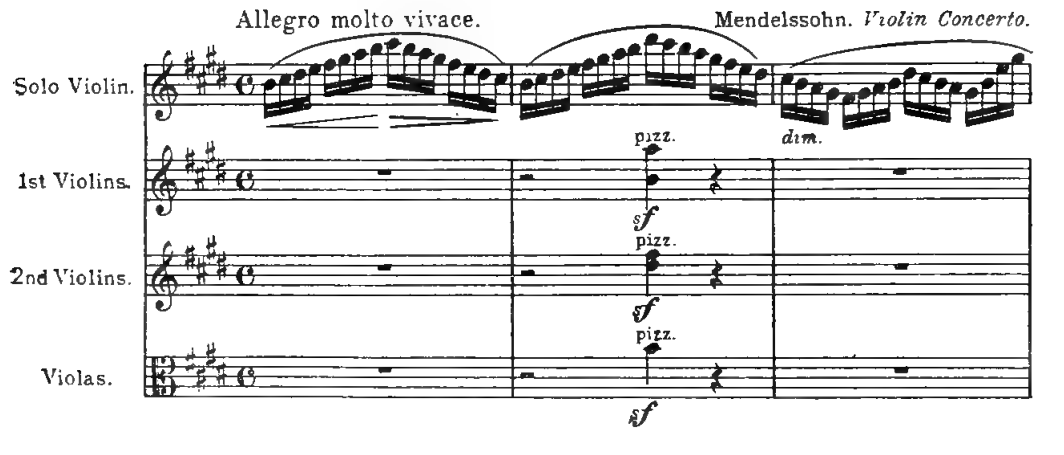
Examples of the pizz are to be found in almost every orchestral Beethoven often makes the happiest use of it. The student should look at the opening bar of his Fourth Symphony, where the pizzicato Bb of the Strings seems to set free the held note for Flute, Clarinets, Bassoons, and Horns. A somewhat similar instance has sirene lalian sted from ten ason chord toe eat opening to n the same way for the reiterated triple notes in the Wood-Wind and Horns. there is an effective pizz Fiddle-part in crotchets, and in the Violin Concerto the student should examine the little bit of pizz accompaniment in the slow movement. (Peters's Score, pp. 54 and 55.) three pp pizz C's with which the Coriolanus Overture ends offers another good example of Beethoven's originality. Ihis, again, maj be compared with the striking ending to Strauss's Also sprac Zarathustra, where the repeated chords of B major in the Violins and higher • Wood-Wind are answered by the pizz C's in the lower Strings.
1 See Example 47.
Strauss. Also sprach Zarathusira.
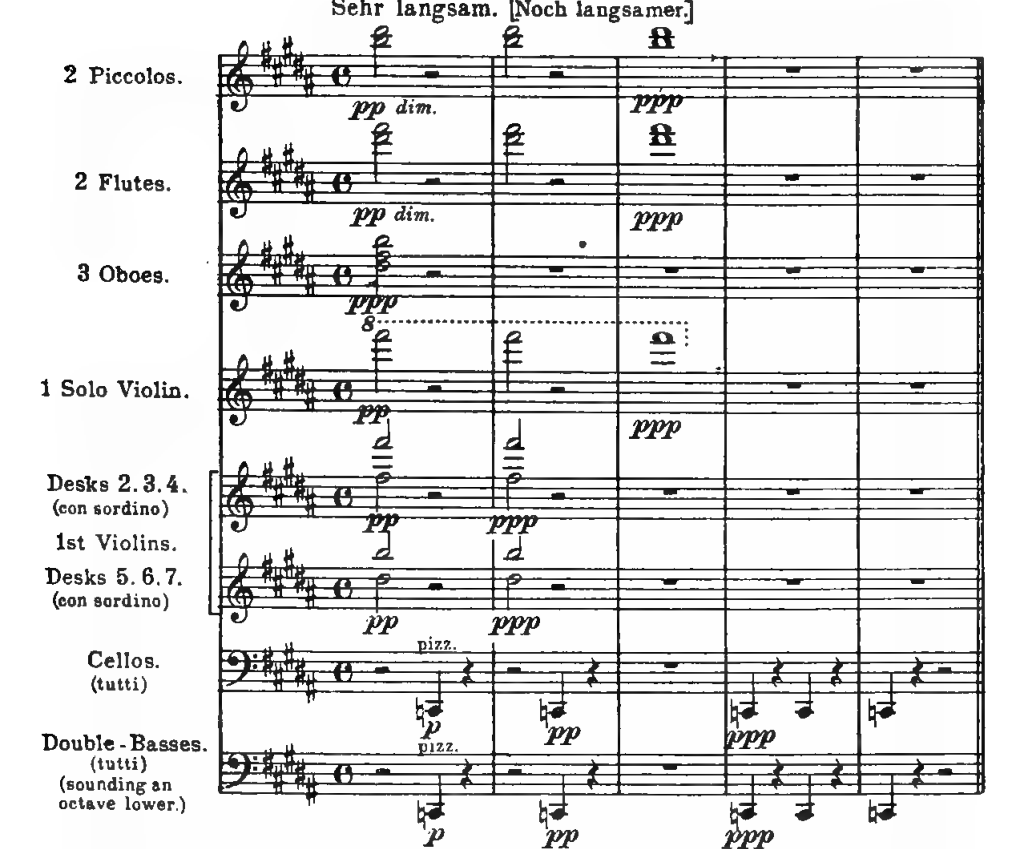
tew examples of the ordinary use of the pizz accompaniment have already been given.' If the student wishes to find an instance of the pizz used in a more heroie way, he should take an opportunity of hearing either one of the complete pizzicato movements which have become popular in Ballet since the production of Sylvra or the extraordinary Scherzo in Ischaikowsky's F minor Symphony. The latter movement may be said to be the high-water mark of the pizzicato. The whole Scherzo is well worth detailed examination.
Before leaving this subject, it must be mentioned that when the pizz is used in conjunction with the whole or a portion of the Wind, it occasionally has a higher function than that of mere support or accompaniment. In such cases, where it is pitted contrapuntally against either the Brass or the Wood-wind, or both, it is almost always bost to mploy the whole of the strings in free octa it may be go of desired. Ihe solemn ending to the first movement of Ischaikowsky's Pathetro symphony, where the strings reiterate the downward scale of B major against the legato phrases of the Wind, is a case in point.? Even when the bass alone is to be made specially prominent, this plan

can be recommended. The mere pizz ot Cellos and Basses, which Will be dealt with later, of course gives "point" to the bass; but if a special eftect of this sort is required, the whole of the Strings can quite well be used. See Beethoven's Overture King Stephen (85th bar of the Second Presto). See also Ex. 133.
The student should familiarize himself with the very marked difference between the pizzicato, in which each group of instrumentalists plays only one note, and that in which each group plays whenever possible in double-and triple-stopping. Contrast any of the p and op single-note pizzicatos given in this book (e.g. Exs. 100, 102) with the Guitar-like thrum of the Violas and Cellos accompanying the Bass-Flute melody in Ex. 114. Furthermore, as the point is sure to crop up in practice, the student should take every opportunity of contrasting in the concert-room the pizz of the Strings with that of the Harp. The two sounds are quite distinct. It would, however, be difficult to put the distinction into words, and perhaps more difficult to give any but a dynamic reason for a preference in any individual passage. duced by the two tone-qualities will soon give the student instinctive appreciation of their differences.
As most of the examples given above have been of quiet pizzicatos, the following three short quotations will illustrate the use of the pizz f. The first, from Act I. of Humperdinck's Hänsel und Gretel, shows a very effective series of loud pizz chords accompanying the Soprano voice. The chords in the 2nd Violin part are marked in the score to be played "together"; that is to say, each player is to play both notes. They are all very simple.
Example 239
Humperdinck. Hänsel und Gretel.
Poco più allegro.
Gretel.
Hänsel, naschen? Schämst du dich nicht? fort mit den Fingern, du naschhafter Wicht
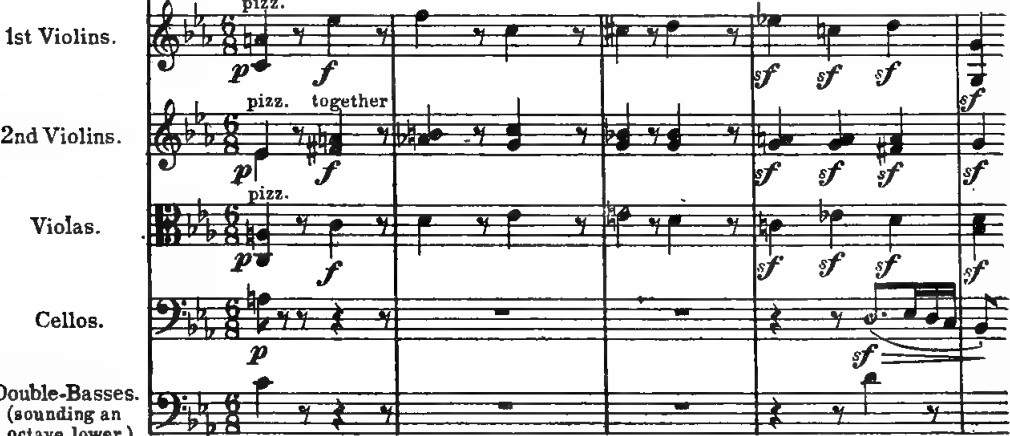
pizz. P
The next example of the use of the pizz for more heroic purposes
1 Two Horns and a Clarinet, omitted above, enter on the note D with the Basses in the fourth bar.
is to be found during the final fortissimo of Berlioz's King Lear Overture. lhe nose and iare oi the full orchestra is suddenl nterrupted by a f pizz for tutt Strings: a moment later there is : second string chord pizz but p. This picturesque piece of orchestration has been cited by Strauss as a stroke of genius in the employment of the przzicato. He says, "This passage gives me at every hearing the impression of a fibre breaking in the heart of Lear-or, in a more realistic sense, ot a blood-vessel bursting in the brain of the mad King" The two pizzicatos are quoted below, but, in order to appreciate their effect, one really needs to see what is on the left and on the right-hand side of these six bars
Example 240
Berlioz. King Lear. Oboes. Flutes.
Allegro disperato ed agitato assal.
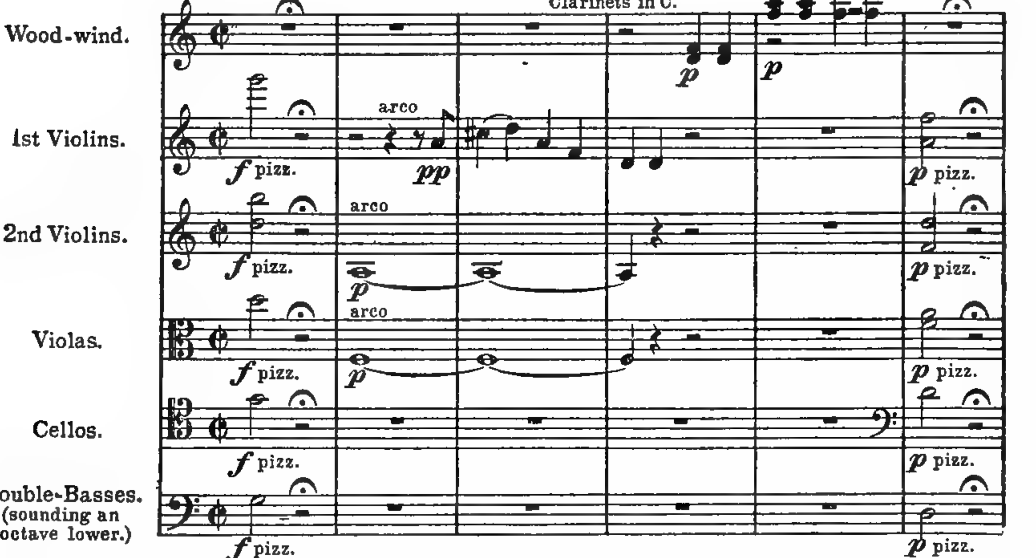
T'he next example is musically perhaps more surprising, and again relies for its full effect on its contrast with what has gone before. occurs most unexpectedly after the big ff climax in the slow movement of Tschaikowsky's Fifth Symphony. The effect of the big thrummed chords is startling and impressive in the extreme. It may be mentioned that these chords are generally taken ff, or at least f—not mf as marked—with a diminuendo in the 3rd and 4th bars to allow the effective entry of the Ist Violin melody. See Ex. 241, page 372.
In the Cadenza Accompagnata of his Vion Concerto Elgar has introduced a new form of pizzicato—the pizzicato tremolando. The effect is obtained, not by means of the quick iteration of a single note, but by thrumming the notes of a spread chord Guitar-fashion. This thrumming is, of course, done without any rhythmical collusion on the part of the players. The result is a curious species ot tenuto. The ear is conscious of the continual movement of the players' fingers, but it does not "dissect out" the individual chords any more than it distinguishes the separate strokes of the hammers in listening to a Dulcimer.
Example 241
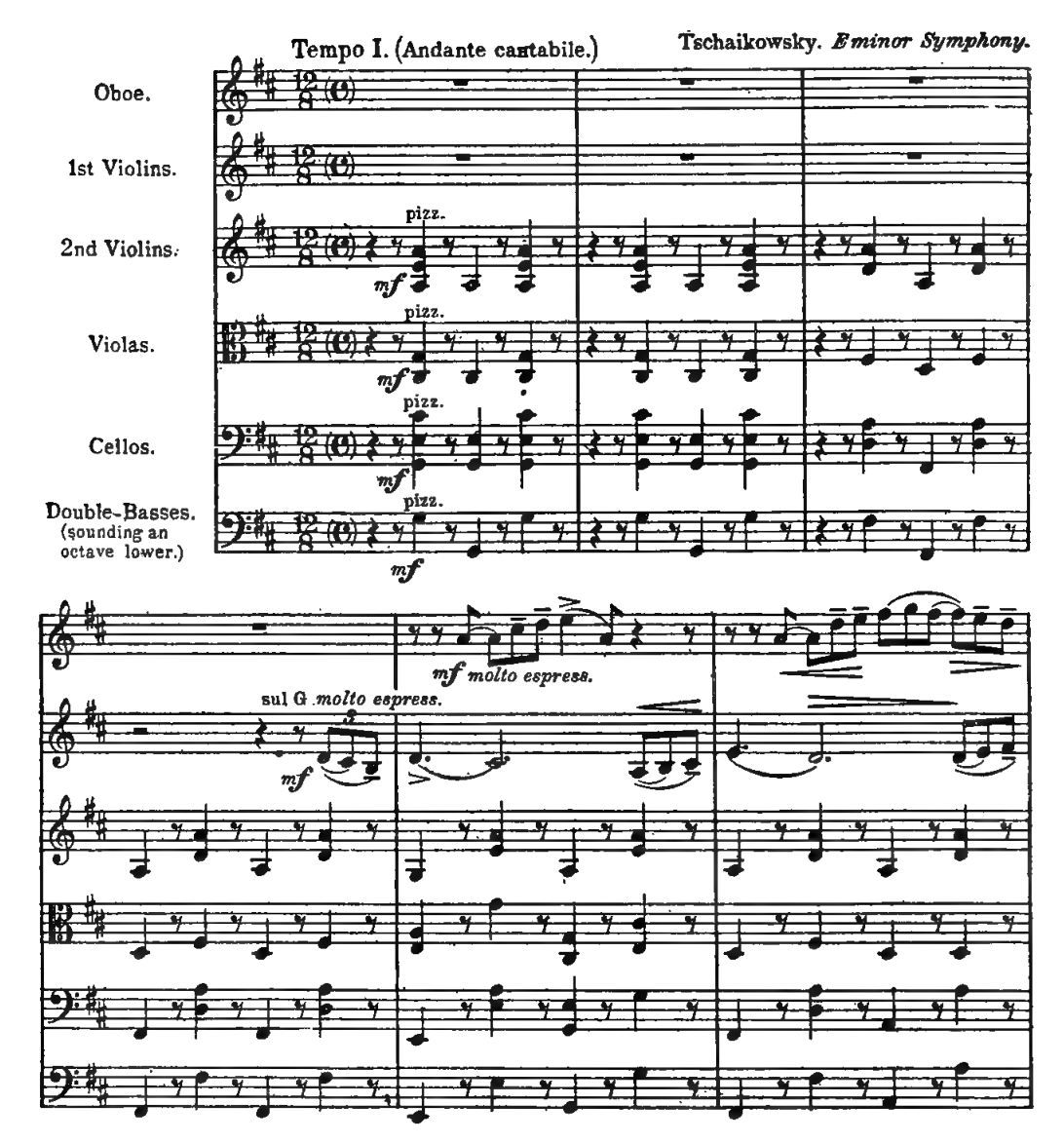
go bored grave playa a far as in of the stinge a th beginning of this bar is omitted in order to save space.

The use of the Mute for deadening the quality of the Violin seems to have been known from very early times. Mersenne, in his Harmonie Universelle, draws attention to the fact that, if a key or some such object be attached to the bridge, the instrument loses its usual tone-quality. Keys are not empioyed nowadays tor this purpose, though pennies and hall-crowns have been pushed in between the strings on the tail-side of the bridge as a poor substitute for the proper mute.
Example 242
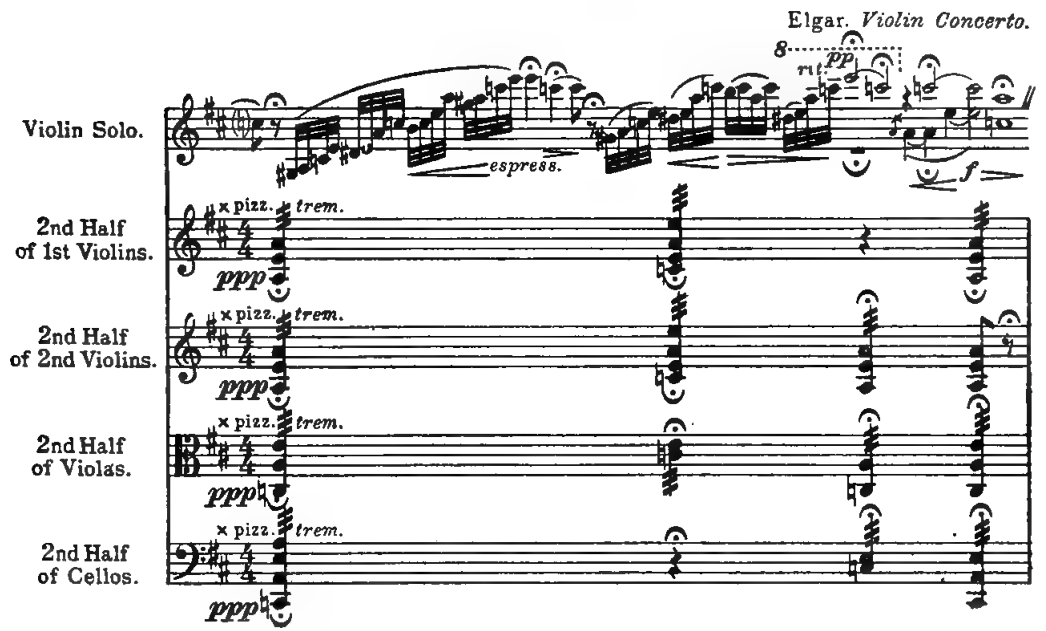
The scientific object of the mute is to damp out a portion of the vibrations as they pass from the strings through the bridge to the sound-chest. This is effected by placing temporarily on the bridge a little three-pronged, comb-shaped apparatus made of wood, ivory, or metal. The prongs are split and are made-or rather should be made —to clutch the bridge firmly. Only in this way can the vibrations be properly damped. Unfortunately a satistactory mute has yet to be evolved by the Fiddle-makers. It should be heavy, and should not merely be cast or cut in a straight piece, but made to fit the contour of each individual bridge with accuracy. The difference in tone-colour produced by a heavy well-titting mute, and one that is light and Illfitting, is simply astonishing. This is more especially the case with the Violas, Cellos, and Basses; but it applies also to the Violins.
Unhappily the mutes remain something oi a problem on the mechanical side oi concert-room organization. When they are re-

rattle their bows down on their desks in order to be free to search their waistcoat-pockets. When the mutes have been dragged out they are fitted to the bridges with a studied and elaborate caution which may be necessary to preserve the bridges from injury, but which gives an impression that the players are taking part in a solemn cabbalistic
"The pizz. tremolando should be "thrummed" with the soft part of three or four fingers across the strings. (Composer's note in the Full Score).
1 Corder gives 2 Ib. as the necessary minimum weight of a Double-Bass mute.
rite. And all this occurs in 1914 when inventors are as thick as bulls in Bashan.
Some conductors have endeavoured to get over these difficulties by adopting little spring-mutes which can be instantly and silently clipped on to the bridge, and, after use, clipped on to the desk. The idea is good, but hitherto these mutes have been made so that only the extreme points of the prongs clutch the bridge. This is not good enough. The result, even when the six points actually touch the bridge as they are meant to, is inetlective. The damping is so slight, especially in the case of the Violas, Cellos, and Basses, as to be almost useless. It is to be hoped that someone will devise a heavy noiseless mute, in which by the action of a spring the whole inside surface of the split prongs will be firmly clasped against the bridge.-
The general effect of the mute is to attenuate the string-tone to a sort of weird thinness, which, in the pp, is about as near to nothing as is orchestrally possible. Of course all the varied bow- and fingertechnique can be put in practice just as readily with as without the A couple of bars at least of moderate i time must be allowed for fixing the mute. A slightly shorter time will suffice for snatching it off. Occasionally it happens that by no ingenuity can the proper rest be given just before? the muted passage. In this case the part is marked some eight or a dozen bars earlier poco a poco con sordino. This means that the players in turn cease playing for a bar or two in order to put on their mutes. When this is properly arranged and carried out the result is a gradual "infusion, so to speak, of the muted tone-quality. More often its actual result is that, at the critical moment, nobody is found to have his mute fixed. The ordinary indications in the score for the use and disuse of the mutes are, in Italian, con sord," or senza sord, or, in English, mutes (on) and mutes off.
Early examples of the effect to be obtained from muting and unmuting the strings have been quoted in instrumentation books Irom such works as Lully's Armide (Act I. Plus j'observe ces leux) and Haydn's Creation (And God sard, Let there be light). One of the earliest and most interesting to Englishmen is the beautiful muted String music in Act Il. of Purcell's Fairy Queen (See, even night) The student will probably prefer to see the opening bars of this
e oral at ton, we been made do radiame sherald beaten to ment ixture on the violin, switchable on and off sort of contraption is that, when out of acten, it slightly alters the tome of the
2 Or after. The converse of course holds true. This method of gradually substituting the muted for the natural tone-colour might well be employed under proper control, not merely as a makeshitt, but as a legitimate orchestral efect.
* Abbreviation of sordino, a mute. In Italian scores one often finds sordini levati or The word is also used in the feminine sordina, plural sordine. See below, Ex. 279. sordini alzati for mutes off, The French either use the Italian words or avec (sans) les sourdines. For "mutes on" the Germans say either Gedämpft, Dämpfer, or Dampfer aulf. For "mutes off" either Dämpfer weg, Dämpfer fort, Dämpfer ab, or Uhne Dämpfer.
passage rather than the more otten quoted examples from Lully and Haydn. It is, of course, printed in the usua. seventeenth century tashion without nuances of any sort. For modern performance it would have to be carefully slurred, as its character is clearly a legato cantabile.
Example 243
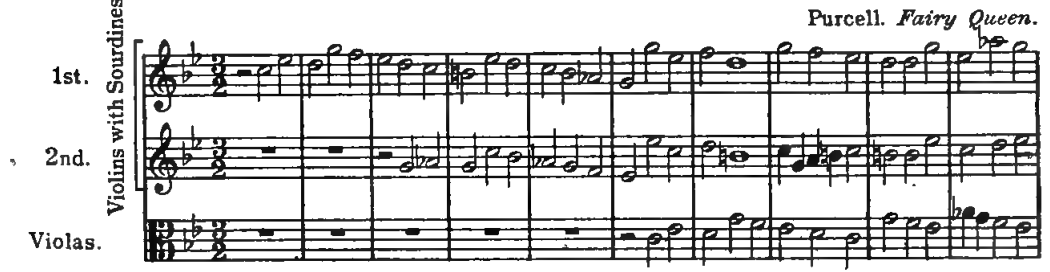
In the above example it will be noticed that the Violins alone are muted. his practice continued to be tairly general down to and including Beethoven's day. The reason was simply that makers would not produce mutes ot sutticient weight to damp the Violas Cellos, and Basses properly. It was therefore said that mutes—it should be inadequate mutes—made little difference to their tone. The converse is true. Nowadays the invariable rule is "mutes for none " or "for all." The possible exception is to be found in the union of the upper Strings arco con sord, with the Cellos and Basses pizz. In this case the pizz stands out more firmly and pointedly if the mutes are omitted from the pizzicato parts.!
A beautiful example of the sudden "hush" produced by the muted Strings is to be found in the Second Act of Tristan. It occurs just before the words O sink' hernieder, etc., on the exquisite rhythm
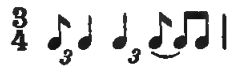
and is well worth attention, as being an instance of the truly artistic as opposed to the merely sensational use of the muted Strings. The passage is too long to quote here.
A number of examples have already been given of the muted Strings as employed in modern music. The student should now reter back to them. They may be conveniently grouped together here in their order of pitch downwards. The student should, in each case, refer to the example already printed.
(1) Ex. 144. A pp series of tour-part chords for Ist and 2nd Violins, each group of which is divided into two parts. The effect is delightful, and the chords just serve with the Cello arpeggios to lock together the Horn- and Wood-Wind-chords.
(2) Ex. 5. An ordinary middle-compass example of muted Strings? Note that, with the mutes on, the two upper melody parts
1 See for instance Ex. 264. 2 See also Ex. 101 (muted Strings, Horn, and Flute).
cannot get anything like the dynamic distinction of the unmuted f. If all the strings were unmuted and the two lower parts marked as they are, an mp or at most an mf would be enough in the Violins.
(3) Ex. 135. For muted Violins in their lowest register (middle orchestral compass) accompanying a Wood-wind melody. The effect i these held chords is particularly charming, when each part is per tormed by one player only. Chords of this sort can be disposed ir any part of the Violin compass. The quality of tone is so thin that a Wood-Wind melody will come through even when the accompanying chords are at a higher or—most doubtful of all—at the same pitch.
1% To nutt, layin in canton le mainly on their
accompaniment for the Horns. (See also Ex. 295.)
(5) Ex. 140. A good example of a ppp muted String background used at the lowest pitch possible, lowest, that is to say, if the Violins and Violas are retained in the score. The 2nd Cellos play the bass most of the time. The effect would be slightly heavier if the Basses took this part. In that case the Cellos would not be divided, but would all play the lowest part but one. If they did that either the characteristic Violin harmony on the 4th string (in bars 5 and 8) would be lost, or, more naturally, the Cellos and Basses would play in unison for these bars. Note the unusual "placing" of the Basses in the 9th bar on the Ab sounding a fifth above the Cello part. In the score the String parts are, of course, engraved on the usual five lines.
(6) Ex. 134. A characteristic example of Strauss's method. The Basses divide into four groups all muted. The soft downy effect of these chords would be a good deal disturbed if the third of the chord were written in at so low a pitch. The Violas and Cellos, also muted, fill in the harmony and play in octaves a portion of another subject against the Oboe tune. The tenuto of the actual bass-note is strengthened by the deep G of the Double-Bassoon. The effect of the passage when properly pertormed is one of great depth, richness, and sottness.
(7) Ex. 186. An example of the muted Strings przzicato accompanyily, a sono dependean pardyi The Basses have, somewhat
The following three examples occur later in the book:
(0) A very light midale-register passage for muted Violins in four parts, with a tonic-and-dominant pedal for divisi muted Violas. Ex. 252.
(9) A four-part rhythmical accompaniment for muted Ist and 2nd Violins playing in double-stopping. Cellos and Basses pizzicato un- Fuzzicato on the second halt oi each bar for divisi muted Violas. muted. Ex. 264.
(10) Three-part pp harmony for Ist and 2nd Violins and Violas (all muted) in their highest and most ethereal register. Muted Solo- Basses beginning in the lowest part of their compass. Ex. 279.
1 For other easily accessible examples of muted Strings the student may refer to Elaydn (Tenor air in Part 2 of The Seasona), Beethoven (Duet in Fidelio and Large of the Vrolin Concerto), Weber (Largo in the Buryanthe Overture, and "Leise In Der I'rerschutz), Berlioz (Yueen Mab Scherzo).
A few words must be said here with regard to the tone-quality of the Violin. To describe adequately the extraordinary beauty of this, the most perfect of all musical colours, would require a volume, not of prose, but of poetry. The peculiar felicity of the instrument lies in the fact that, though each of its strings has a particular character of ite own, and though each seems to possess-for its own regisnto each most exquisite colour conceivable, yet they all "carry over other without the slightest unevenness.
foreed by the "bass-ne, covered as it is with metal flament and reinglued underneath the belly, has a slightly harsh and penetrating tone-quality. Legato melodies executed on this string by the Ist Violins, or by the Ist and 2nd Violins in unison, are always effective. In compass they are quite safe up to
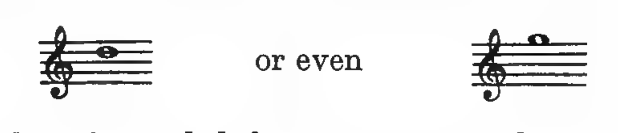
It this tone-colour is needed for any passage, long or short, rising above the low fiddle Do, the part should, of course, be marked sul 1 V or Sul G,? and, unless it is rendered quite unnecessary by the shape of
the phrase, a dotted line thus ........ should indicate how long this
stage-direction is to remain in torce In genera, the natural tendency of String players is to confine legato passages as tar as possible to one This applies all over the whole instrument.
When attacked I with the heel of the bow, the 4th string is harsh and savage in the extreme. Such a phrase as this from the Ist movement of Ischaikowsky's Pathetic Symphony: 3
EXAMPLE 244. Ischaikowsky. Pathetic Symphony.

furnishes a good instance of this ferocious method of expression.*
1 The tone-quality of the Violin, like that of all other instruments, depends, not on ¡he amplitude or frequency oi the wave-lengths set up in the air, but on the shape of the These wave-forms, in the case of the Violin, take the shape of a succession of gables, in which the left half of each gable is considerably longer than the This shape appears to be the nearest instrumental approach to the ideal evenly. indulating line which is the wave-form of the tuning-fork and the human voice
say as a it to tao player so to a to per aris or parentar place, toody, of course, writes Sul I. for a passage in the topmost octave.
& A fragmentary example of a Violin melody Sul G has already been given above, Ex. 241.
• With regard to the bowing of the above passage the student should notice the somewhat illogical way in which the down-bow marks are scattered through the part. down-bow marks only are necessary to secure the proper attack in this passage. They should be placed on the lst, 4th, 5th, and 10th notes.
Nor does it need, for its full effect, the detestable rattle of the G-string against the fingerboard, which is permitted in some orehestras.
The two middle-strings of the Violin may be conveniently classed together. Of the two the D-string is the sweeter. In fact, a fine p cantabile played on this string by a dozen or twenty good tidalers takes one as near heaven as it is possible to go with the aid of music alone. The quality of the 2nd string is somewhat similar. It is, however, a little more placid and flute-like, "well adapted," in Gevaert's words, " for rendering a soft ideal melody."
The E-string or chanterelle is more penetrating than the two middle-strings. The f and mf cantabile on this string are full of passion and earnestness, while the p and pp are capable of expressing the most ethereal ideas. In anything approaching a tutt or even an orchestral mezzo-forte the greater part of the Ist Fiddle music must, of course, lie mainly on the top-string.
Betore leaving this topic the student's attention must be drawn to the fact that the tone-colour of a number of Violins playing in unison -what one may call the 16-Fiddle-quality-is quite different trom that of a Solo-Violin. It is not a mere augmentation of the Solo- Violin tone, but something different, something sweeter and more soitened.1 This can only be due to the slight differences in intonation which must always exist even when the music is performed by a group of first-class executants. In a Violin-concerto it undoubtedly gives the soloist a somewhat greater chance of " standing out" from the Stringensemble, though, on occasion, the repetition of a simple solo phrase by the orchestral Violins has had an almost comic effect, as if they were saying "this is how it ought really to sound."
The Violins are tor orchestral purposes always divided into two main-groups of "Ist" and "2nd" Violins, and their parts occupy two lines in the score. In most of the examples quoted above these two parts have been engraved on one stave merely to save space. This abbreviation is never used either in manuscript or in printed Full-Scores.
The number of Violinists employed in a first-class Symphony Orchestra averages 16 to each part; but it must be remembered that, in many orchestras, the 2nd Violins, sitting on the conductor's right hand, hold their instruments with the sound-holes turned away from the audience. That is to say, they are in a position of maximum inefficiency. The result is that dynamically they are about equal to half the number of Ist Violins, and their part, however skilfully written and performed, makes its chief appeal to the Wind-Players at the back of the orchestra. This question of "placing" the strings on a plattorm is a real dilliculty, and there are many things to be said about it trom several points of view. However, it cannot be dealt with here. The student must merely note the fact that he cannot, as
1 See Sir Charles Villiers Stanford's Musical Composition (in this series), page 114: "It is well known that the sound of a single Violin is far preferable to that of two Violins playing in unison, and that it is not till the number reaches at least four that a rule, rely on the same melodic distinetion from the two Violingroups.
It is scarcely necessary to say that the Ist and 2nd Violins are occasionally united in a unison, and that, in the upper register, this unison gives the composer one of the most powerful and striking melodic effects at his command. In the bottom register the quality of this unison can be augmented by Violas and Cellos, as in the forceful opening to Bizet's Arlesienne Suite (a f unison of Ist and 2nd Violins, Violas, Cellos, English-Horn, two Clarinets, two Bassoons, one Saxophone, and two Horns), in Ischalkowsky's fifth symphony, full Score, page 211, and in the well-known & tune in E major at the beginning of Act Ill., Scene Il., of Humperdinck's Hansel und Gretel (a unison of Ist and 2nd Violins, Violas and Cellos, with a held Basspart and an accompaniment of Bassoons tenuto, with tour Horns and Harp). Naturally this heroic method ot procedure is not for all tunes, as it involves the sacrifice of more than half the players in the orchestra to a single part.
Unaccompanied melodic passages are, of course, to be found in profusion in modern music. Perhaps the finest and most elaborate of all oçcurs at the awakening of Brünnhilde in Wagner's Siegfried (beginning of Act III., Scene III.). The whole passage, which may be seen on page 365 of the Full-Score, is assigned to the Ist Violins alone. It ranges through the whole compass of the instrument three octaves, and an augmented fourth upwards trom the bottom G, and, except for the two interpolated Trombone-chords, is unaccompanied throughout.
Besides these two main divisions, it is often necessary to divide up again the Ist, or the 2nd, or both the Violin parts. If it is merely a case of a few incidental notes a second stave is not usually employed. The parts are written on the one stave, are differentiated by upward and downward tails, and are marked div. Short series of notes, double-stoppings, etc., which cannot possibly be performed by one player, are naturally divided up as they occur. Un the other hand, it they can be pertormed by each player, but, tor reasons of smoothness or softness, are not to be so performed, the composer must mark the divisi clearly in the part. In the more elaborate divisis, where from six to a dozen separate Violin parts are written, it is as well to write not more than two parts on a single stave. An additional cunning is ofet given for do to the i havinay and special to to the eldest. of players- either near the leader (Nos. 1, 2, etc.) or in the body ot the orchestra (Nos. 6, 1, 8, etc.). In the latter case the place trom which the sound is coming is much less apparent to the audience
The elaborate string divisions in which the modern musician delights are much more for the purpose of quiet backgrounds than for aces n, but he student soard a pereil in is maid brat of extime he divides a part he halves the number of players, and therefore the dynamic efficiency of the constituent parts. Furthermore, he
1 See Example 135.
should try to avoid the besetting sin of the amateur orchestrator,- writing for the eye and not for the ear. Some composers will blossom out into five or six Violin-lines on the slightest or no provocation. It makes their pages look so grand and imposing, and the existence of a couple ot divis notes in any bar is, to them, sutlicient justitication for their folly. The best cure would be to make them pay for the engraving of their scores.
There is nothing to be said against the use of a quartet of solo Violins, Violas, or Cellos, or against the use of a mixed Solo Quartet.' The tone-quality is, for a few moments, a delightful relief, and more than one example has been already given of this exquisite method ol accompanying a Wood-Wind solo.? On the other hand, when no special effect of this sort is intended, the continual littering of the String-parts with "2 desks only," " 3 desks only," and so on is merely a confession of orchestral incompetence. The old String-players' rule "one or all" was not so bad after all.
The use of a single Violin playing an independent passage requires a little caution. Une has to consider and provide tor the ditterences between the 1-Fiddle and the 16-Fiddle tone-quality. The Solo- Violin, in fact, needs special treatment, and it can scarcely be pitted with advantage against any thick, spread mass of sound. Almost any scores of Richard Strauss will afford examples of the lightness and thinness which are necessary in order to secure a proper effect from a solo Violin.
The student need not worry much with regard to suitable keys for Except for the most difficult and florid passages the the Violin. technique is sufficiently pliable to meet all demands. Even the extreme keys are less to be avoided than sudden changes of chord and irregularities during the progress of what should be symmetrical

is to say in G major and D major and in those keys that are nearest to them. For the orchestral composer this is scarcely more than a "counsel of perfection." However, it is just as well to remember that the most crooked passages become surprisingly straight when there is the possibility of an occasional open-string or Harmonic
All major keys from Eb to El and all minor keys from C to BL

may be looked upon as easy.
Slightly more awkward are the major keys of Ab and Bl and the minor keys of FL and F$
The most difficult major keys are Do, Go, Cb, F♯, C♯, and the most difficult minor keys, Bb, Eo, Ab, Cf, G♯, D$.
1 This style of accompaniment was common at the end of the seventeenth and the beinning and one go enth rentury inst the are as an he let ole the inning or the eighteenth century. rest of the strings were called the grand choeur. See Geraert, page 44.
2 See, for instance, Example 135.
¿ E major is commonly spoken of as the "Violin-key" by all except those who play the instrument.
The following complete list of keys shows their comparative ditticulty at a glance. The large, middle-sized, and small types are used respectively for the easiest, the less easy, and the most difficult

ob, Gib, Db, Ab, Eb, Bo, E, C, G, D, A, E, B4, I#
Minor.
Ab, Elb, Bb, F, C, G, D, A, E, B, F♯, c, G♯, D♯
The character of the Violin is so varied that it is not possible to give within limits of an instame tati obook al poss of passages which would adequately illustrate knowledge of this technique is an important part of a composer's equipment, but it is only to be gained by a first-hand acquaintance with the instrument, by a diligent perusal of Full-Scores, and by study in the Theatre and Concert-room. These studies it is hoped the student will undertake aided by a knowledge of the rough general principles of Violin playing, which have been given above.
It goes without saying that practice in String-quartet writing is an essential preliminary to the acquisition of ease and suppleness in the treatment of the orchestral Strings. The two things are not identical. In writing for the orchestra a great many facts have to be considered that can 1 be neglected in writing for a quartet of evenly balanced "voices." These questions of contrast, balance, and variety cannot be dealt with here; but it is in their proper solution that the secret of successful orchestration lies.