 Playable Books
Cecil Forsyth · section 56 of 60
No. 52. The Harp
Read and hear this section in the playable edition →

Fr. La Harpe; It. Arpa; Ger. Harfe.
This beautiful instrument should have a special place of honour: Alone of all the ancient "plucked" instruments it survives in daily orchestral use. Furthermore, with the possible exception of the Drum, it was probably the earliest instrument to be elaborated in the service of organized music. Indeed, it would be no stretch of language to say that, It we could awaken a mummied Pharaoh of the thirteenth century B.c. in a modern concert-hall, he would recognize practically nothing but the sound of the harp-parts? What his ears heard in Thebes thirty-two centuries ago we hear to-day in London.
As far as Western Europe is concerned the Harp seems to have first installed itself in England and Scandinavia about the twelfth century. The term Cythara Anglica (ie. English Harp) was in common European use, and was employed to distinguish the Harp

to the position of a national instrument. Introduced into Wales in the fourteenth century the Harp became to all intents and purposes chromatie. Its strings were arranged in three rows, of which the two outer rows were tuned in unison-pairs generally diatonically in the key of G, while the middle row gave the additional chromatic notes.
1 Musical Composition, in this Series, page 108.
2 The thirteenth century (B.c.) of two harpists was discorered by I'he instruments-one bow-shaped anc the other three-cornered —are as tall as A species of Guitar called Nefer appears to have been used in Egypt fron very early times. I'he same may be said of the Nanga, a sort of cross between Harp and Guitar. The ordinary bow-shaped Harp was a familiar Egyptian musical instrument for many centuries. was subtlely perfect for its object-the stretching of a series of strings all differing in length. The Egyptians had also sistra, small cymbals, and small flute-like pipes in common use. They appear to have been much more familiar with the use of small Bells than were the ancient Greeks. In the Egyptian Gallery at the British Museum there are no fewer than fifteen of these ancient diminutive Bells.
Harps of this sort with nearly 100 strings seem to have actually existed, but the elaboration of their manufacture and the awkwardness of their technique practically forbade their general employment even in Wales.
The Harp, then, has existed from very early times, and, in essentials, it is still unchanged. It has always consisted of a series of stretched strings, all differing in length and in pitch. The strings have always been set in vibration by the plucking action of the fingers of both hands, and each separate string has normally been employed to sound only one note—the open note of its full vibrating-
comparatively recent times these musical "essentials" remained unaltered. It is true that, in various parts of Europe, Harps existed which were tuned and strung in various ways. These differences, however, of stringing-that is to say, of pitch and compass— left the musical character of the instrument unchanged. It was a purely diatonic instrument capable of sounding only the series of notes to which its strings were tuned. On the other hand, the character of the framework which supported the strings was considerably altered from time to time. These alterations, however, more particularly engage the student's attention in connection with the first attempts which were made to enlarge the Harp's radius of action. They will therefore be considered later.
It need scarcely be said that an instrument so rigid and inelastic could not hope to secure a firm foothold in the orchestra without improvement. An instrument which could only play one set series of notes was on a par with the old Hunting-Horn before the discovery of crooks. A mechanism had to be invented in order to bring • the instrument into line with musical progress. This mechanism became standardized in an instrument which was, until 1810, in general use all over Europe-the (now) obsolete Single Action Harp in Eb.
This instrument had a diatonic compass in the key of Eb from
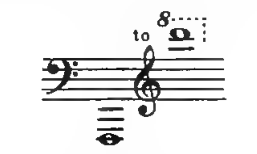
Furthermore, each string was provided with a simple but efficient

each group of mechanisms shortening those strings which had the same name (A, B, etc.) was circuited on to a single rod controlled by a single pedal.I The player, therefore, had seven chromatic pedals at his disposal, and by using these seven pedals he could "naturalize"
I The invention of the Harp-pedal has been credited to various persons. others the name of Hochbrucher, , Galtire, Simon, and Goeptiert have been mentioned. The date of the invention was somewhere in the frst half of the eighteenth century.
THE SINGLE ACTION HARP IN Eb 463
each of the three flat notes in his compass (viz. Eb, Bb, and Ab), and sharpen each of the four natural notes (viz. F, G, C, D).
But observe that it he used any one pedal, say the E-pedal, he mechanically altered all the Eb-strings in his compass to El. could not raise the pitch of one selected string and leave its octavestrings unraised. That would have necessitated forty-one pedals.
The instrument thus became chromatic, but chromatic only in a doubly restricted sense. In the first place, no octave-notes named by the same letter could be chromatic to each other; and, in the second place, when once the strings were " set " by means of the pedals in any desired tuning that series of notes was immovable without further resort to the pedals.
There can be no doubt that this type of Harp was a great advance on anything that had gone betore. Provided its music lay, without much modulationad, one or the simpler keys i dancered it purpose to see what these were the student should go to the Pianoforte keyboard and attempt the formation of various scales and chords from the diatonic notes of Eb major. His only license is that he may raise any note one semitone. But he must remember that, if he does so raise any note, the lower note has vanished and cannot be used in that or in any other octave. He will then begin to find out the restrictions of the Eb-Harp. Such a simple chord as a minor ninth in the key of Eb is impossible. The Bb-string has to be raised a semitone to give the ninth (Co= Ba). But when it is thus raised the Bb itself disappears. The full chord becomes an impossibility.
Furthermore, even for the playing of simple scales the instrument can only be "set"—that is to say, its strings can only be arranged by E, pedal to give real techmique in the eight kege of i th G, D, A, E. If this limit is exceeded in either direction the technical difficulties become insurmountable. Let us suppose that the Harpist wishes to play the first five notes of the scale of Ab major. The first two notes, Ab and Bb, offer no difficulties. For the third note (C) the C-string is plucked. The C-pedal has then to be rapidly depressed in order to raise the string to Uf (=10)., The tinger has then to pluck the same string again in its shortened form to get the Db. This is in itself awkward. The Di-string, however, still remains in its place. The finger has theretore to skip this string and resume on the dominant (Eb). In keys such as Do, Go, and B4, all these difficulties were intensified. The two former keys were, as Berlioz suggests, "nearly inaceessible."
The student must not compare the old Single Action Harp in Eb chromatic than the run: i be Laying as never for a won dese chromatic than the latter. instrument. It always has been and possibly always will be an instrument of harmonic formulae. The deficiency of the old instrument as compared with the new is to be sought in the fact that the former instrument could be less freely set to any required sequence of notes. The modern Harp can be set almost as one chooses. Its radius of action is great. Once set, however, it is nearly as much bound to its formula as was the Eb-Harp. The formula itself is capable of wider variation. It can be executed even in its most grotesque forms. to change it, however, and all the old mechanical difficulties of pedalling begin to reappear.
The Harp as we have it at the present day is due to the inventive genius of Sébastien Erard. In 1810-1811 he produced his Double Action Harp, an instrument whose mechanism still remains the model for manufacturers. Besides minor improvements Erard made two capital innovations. In the first place, he saw the necessity developing the mechanism so that each string and its octaves might be shortened at will by two different lengthe so as the asceived the either a semitone or a whole tone. Furthermore, fact that, if this development was to be musically effective, there was only one key in which the instrument could be tuned. That key was not Eo, but Co. When so tuned the whole series of strings could be raised by the single- or double-action of the pedals respectively to the diatonic scales of C4 and C♯. Whatever the arrangement of the pedals might be, the fingering, the technique, and the actual correspondence between the written note and the string played remained unaltered.
The main features in the framework of Erard's Double Action Harp are the Vertical Pillar, the gracetully curved Neck with the Comb which conceals the mechanical stopping-apparatus, the diagonal semi-conical Soundboard of polished Swiss pine, and the Pedal Box. Of its forty-seven strings the eleven longest are "covered," the rest are of simple catgut. The uncovered C-strings are, as a rule, stained 'ed, and the I-strings blue. In pertormance th Harpist rests the nstrument against his richt shoulder, and. It need scarcely be salc plays from the treble side.
The Modern Harp, then, stands normally in the key of Cb. It has a normal diatonic compass in that key' from
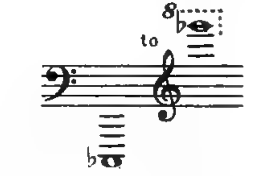
Its music is written, as for the Pianoforte, on two bracketted staves, and the treble and bass clets are used at discretion.
As in the old Do-Harp, seven transposing pedals are provided, each one of which acts simultaneously on all the strings of the same name The seven pedals are arranged three on the left-hand side of the player and tour on the right. Un the leit-hand side the B-, C-, and D-pedals, and on the right the E-, F-, G-, and A-pedals radiate outwards from the player in the order named. The B-, and E-pedals, therefore, are next to the player on his left and right hand respectively. In the centre between these two groups of pedals an eighth pedal is generally provided for dynamic purposes. This is known as the forte pedal. It has
1 The tup note of which can be mechanically raised to Gi or G♯ no connection with the seven mechanical pedals, and does not affect the pitch of the strings.
Each of the seven transposing pedals is provided with a couple of notches cut in the framework of the pedal-box. The depression of any one peda, into the tirst notch raises all the strings of its name by one semitone. A further depression into the second notch raises them another semitone, that is to say, one whole tone above their original pitch. The depression into either notch requires a small but appreciable fraction of time, and is not always free from noise. When released from either notch and also relieved from the pressure of the feet, the pedals are thrown back and held in their original position by the concealed action of spiral springs. The highly ingenious and smoothly-working mechanism for shortening the vibrating length of the strings need not occupy the student's attention. A glance at the neck of a Harp when in action will tell him more than a paragraph of explanation.
An important point now arises which demands some consideration. It is plain that, as the Harp is tuned diatonically to a major scale, no two adjacent strings can differ in pitch by more than a whole tone. The use of the pedal, then, on the lower of these two adjacent strings will bring it into enhurmonic-unison with the upper string.
Thus, in the normal (unpedalled) scale of the instrument, the two notes Bb and Cb lie next to each other. If the B-pedal be fixed in the first notch the Bb string is raised a semitone, and we get B4. The two strings are now in enharmonic-unison B$-Cs. The only other enharmonic unison obtainable on the Harp when one string is unpedalled and its next lower neighbour pedalled in the first notch is the combination Ek-Fb.
Five further enharmonic-unisons, however, are obtainable by means of an unpedalled upper string and a lower string pedalled in the second notch. These are AF-Bb, G7-Ab, F7-Gb, D$-Eb, CF-Db.
Besides the above seven enharmonic-unison, two others can be produced by pedalling the lower string into the second notch and the upper string into the first noteh. These combinations are the E♯-Fl and the B♯-C4. They can, of course, only be taken on those strings which in their normal (unpedalled) condition are one semitone apart.
We can now set out a complete list of the nine available enharmonic-unisons, noting that the small figures ?, I, and?, placed above the names of the notes, represent respectively the open unpedalled string, the string pedalled in the first notch and the string pedalled in the

B$ C4, C♯Do, D♯Eb, Ek-Fb, E♯-F4, F♯-Gb, G♯Ab, A♯-B3, B$-Cb.
These nine enharmonic-unisons are frequently called homophones (= same sounds). They have also been christened synonyms, but a more inaccurate word could scarcely , be tound, for synonyms are essentially "things of the same name," and this is exactly what the strings are not. They are strings of different names tuned to what is practically the same sound. The word homophone is convenient and accurate. The longer expression, enharmonic unison, is perhaps better

adopted the notation of two El's or two Eb's, the harpist would still play the rhythm on two strings. The reason is that quick reiterations of the same string are rather awkward. The string needs to be plucked a lair distance out of the vertical it it is to produce a good tone. Furthermore, its vibrations have a certain amplitude, suticient, in the lower and middle registers, to be quite visible. Quick repetitions, theretore, of the same string are unsatistactory. Lach plucked note damps out its predecessor. Reiterations of the same sound, however, are quite in the character of the Harp, and are produced with ease, as in the example under discussion, on adjacent strings.
If we now recur to the list of enharmonie-unisons given above, we notice that, whereas our octave is made up of twelve chromatie notes,

Cb, the Fo, or the Gb string by three semitones so as to make the necessary unison with the string above. That would require a Triple
A second point calls for our attention. Under this system of "tuning in pairs," the new series of intervals is "set" on the Harp and becomes technically to the player merely a scale. It does not matter how grotesque or unlike a scale the series looks when placed on paper. Its intervals mechanically replace the ordinary intervals of the scale, and can theretore be treated with the same treedom.
For instance, a Harpist can make a rapid glissando over the whole or a portion of his compass. This he does at pleasure upwards or downwards by drawing his finger quickly over the strings. . If the pedals are not used at all, the glissando will be a diatonic glissando in the key of Cb major. If all the pedals are used in the Ist notch, the glissando will be in Ca major. Similarly, by using only a portion of the pedal apparatus, all the other scales can be set.
Suppose, however, that some of the strings are tuned in pairs of enharmonic-unisons. The player's finger still touches each string, but a certain number of the sounds of the scale have been eliminated. Now this elimination can be so arranged as to leave only the notes of definite musical chords.
I'he most commonly used oi these chords are the parts of minor ninth chords usually known as "diminished sevenths, " but dominant sevenths and the upper portions of major ninths and elevenths are also available. In the following list the notes which are taken as enharmonic-unisons are printed as minims. Each of these notes is of 1 See Example 233. See also Example 30.
Cole so to unded in black gric success or data sporate strings.
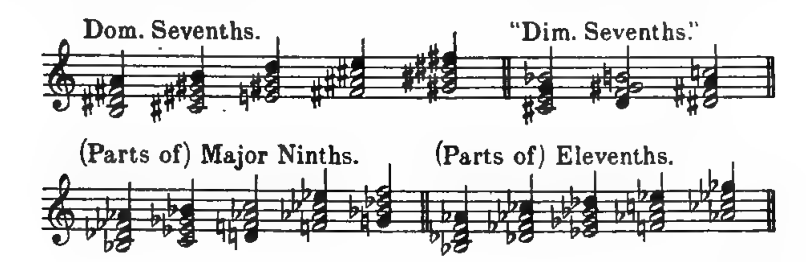
The Harp can be set for any of these chords, so that they become mere scale passages playable at will, glissando or otherwise.
It need scarcely be said that all these chords are used "enharmonically " in the ordinary sense of the word. The dominant sevenths are used as augmented sixths: the sharp and flat nomenclatures are used at discretion to represent each other in sound.
It is important to notice that no glissando can possibly be used unless all seven of the strings in each octave can be associated in the desired chord-setting. , The omission of a single string would involve the necessity of a skip of the finger, and this would totally destroy the glissando-effect If the student will look carefully at the above last example, he will see that in each of the chords there are three minims and one crochet-head. Now, each minim represents an enharmonic-unison of two strings: each crochet-head represents a single string. , The simple sum, 3×2=6+1=7, will show him that in every case all of the seven strings are brought into action.
In order that there may be no mistake whatever with regard to the technique of the glissando, an example will be given which puts the matter in a nutshell. If the first of the three "diminished sevenths" in the above list, viz.,
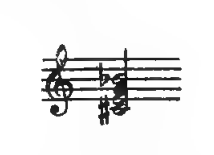
ccurred as a portion of an upward gussando in a Harp-part, th etual strings which would be touched by the player's fingers would b
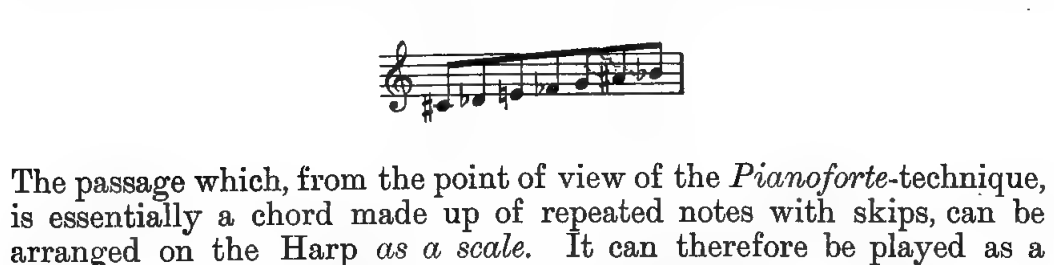
glissando. A tew words on the less technical side ot the question may be interpolated here. There can be no doubt that the scale-glissando with strings paired to form either definite chords. or one of those ingenious combinations! which give so elusive a character to modern Harp-music is an effective weapon in the armoury of the composer. It can be taken for p, upwards or downwards, and its length can be increased by the insertion of "loops." At certain moments its effect in conjunction with almost any orchestral group is brilliant and even exciting. On the other hand, there is equally no doubt that this form of expression has been abused of late years till it has become a nuisance. Some composers, it has been said, demand of their Harpists

is, however, à quite legitimate means of expression, if used with discretion and reserve.
Notation.
Of course no one ever actually writes out the correct nomenclature of all the strings touched by the Harpist's fingers in a glissando. Life is too short. The nearest approach to that logical ideal is the method of writing each pair of enharmonic-unisons as a repeated note of the same name, thus:
Example 289
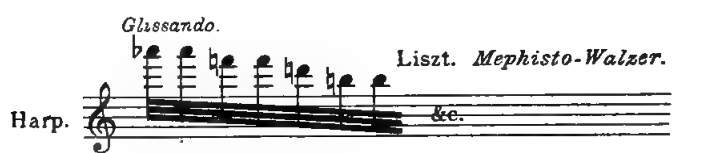
This procedure, showing clearly not only those notes which are taken as enharmonic-unisons on two strings, but also the note which has no homophone, is quite sufficient for all purposes. elaborate for ordinary everyday use. It would be quite enough to indicate the tuning clearly by a series of single notes confined to one octave? If the limit of the glissando upwards or downwards, as the case may be, is then shown by an additional note at the other extremity, the Harpist can have no doubt as to what is wanted. This is really all that is necessary, for there is only one way of "setting" the Harp for any given glissando. The labour of writing out Harpparts is always so great that any form of abbreviation is a blessing.
1 Widor instances the following

‹ The quotation from Liszt's Mephisto-Walzer (Ex. 289) gives only the first seven notes of the glissando. In the Full Score Liszt writes the whole passage out in full for four octaves. Each octave after the first is of course, only a repetition of the notes in the preceding octave.
Here is an ordinary example of an abbreviated glissando from Variation VII. of Strauss's Don Quixote set :
Example 290
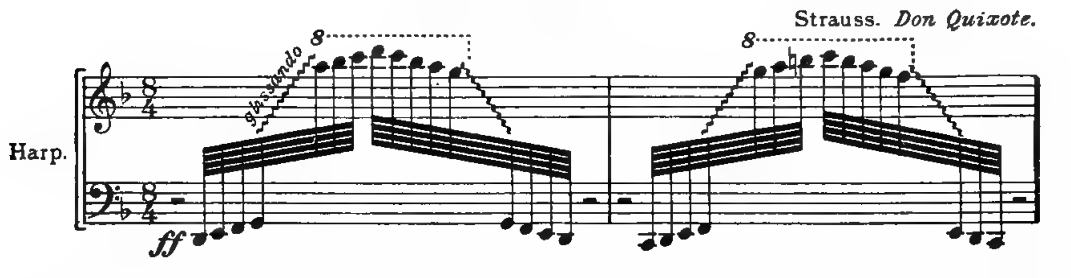
The student will notice that a single complete octave of notes is written in each case, and that they are disposed at each end of the glissando. This ensures accuracy. The notes on the descending side of the glissando are, however, added more for symmetry of appearance than for any other reason. On that side the top and bottom notes would be quite sufficient for all practical purposes. It is more usual to write the single complete octave of notes at the beginning of the passage. Strauss's method, however, is clear and logical. It might well be made a standard for such passages.
With regard to the length of glissandos anything less than about tour or five octaves is hable to sound tame. The player can easily get over the whole of his compass in one second of time, and, if the glissando is written too short, he is forced either to insert a "loop" or to perform it in an ineffectively deliberate manner.
For all glissandos the Harpist must be given a few beats or bars— according to the changes involved—in which to "set " his instrument When the composer has satished his mina as to possibilty of the required setting, he should then see what alterations it necessitates from the preceding setting. In this way he can torm a fairly accurate idea as to the necessary rests.
From the above remarks, it is hoped that both the general subject of the setting of the Harp and the more particular subject of the glissando will be quite clear. Glissandos, however, are only one and a not very important part of the Harp-technique. A point should be mentioned here with regard to the general Harp-notation as opposed to the special notation of the glissando. Some composers write into their parts all the required alterations in tuning. This is generally done by enclosing the directions for pedal-alterations in square brackets wherever required. Thus a change from the key of Bo major to that of G major would be indicated by [B4, E4, F÷].
There is no actual necessity for undertaking a task which the Harpist usually performs at or before rehearsal. On the other hand, it is a perfectly satisfactory and by no means difféult method. Furthermore, it compels the composer to understand the medium in which he is writing, and to foresee the harmonic difficulties which he imposes on the player. If this plan is adopted, its logical outcome is really the abandonment of key-signatures altogether. There 1s OI course a certain redundancy in employing the ordinary key-sıgnatures and at the same time indicating the correct pedalling Strict necessity requires only the correct setting of the strings, and then merely the names of the notes to be plucked. Their pitch—that is to say, their ‡ness, bness, or "ness—-is unalterable at the moment, and is governed by the previously indicated " setting."
Harmonics.'
The only Harmonic used on the Harp is No. 2. This is the harmonic produced by stopping the string lightly at a point equidistant from its two extremities. The resultant note is an octave above the open string. In order to obtain this Harmonic on the Harp,. string is lightly stopped by the lower part of the hand, while it is simultaneously plucked by the fingers of the same hand. This requires some little care and deliberation. Neither the highest nor the lowest portion oi the Harp compass can be used for these harmonic notes. They should be confined to the seventeen strings from
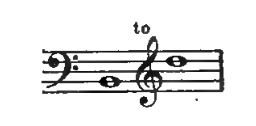
Within these limits Harmonic No. 2 can be taken on any note b, 4, or # ne effect in sound is of course an octave higher The universal nodern notation is to write the note reauire an octave below its sounding-pitch, with the addition of the sign o. Thus the following
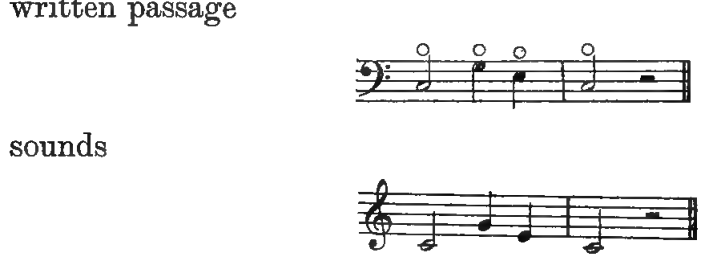
"Double-action Harps allow of sounding two, three, sometimes even four simultaneous harmonics with the left hand, on condition that the right anne smally more thin one extension at a timengers. The
It should be added that, in old Scores, the Harmonic-notes are otten written at their actual sounding-pitch with the addition of the O above each note. The player in this case takes each note on the string an octave below the written note. The practice of the old masters was not, however, invariable on this point, and there is often considerable doubt as to their intentions.
1 Boïeldieu in La Dame Blanche (1826) was the first to make serious orehestral use of these sounds.
2 Widor, The Technique of the Modern Orchestra.
In using the Harmonics the student should remember that (1) any Iorm of elaborate passage writing or arpeggio is quite out of the question. The fewer and the more deliberate the notes employed, the better will be the effect. (2) The tone is so etherial and fairy-like as to be inaudible, unless unaccompanied or accompanied at most by the pr ot some one orchestral group.'
I'wo other methods of plucking the strings may be mentioned here for the sake of completeness. These are
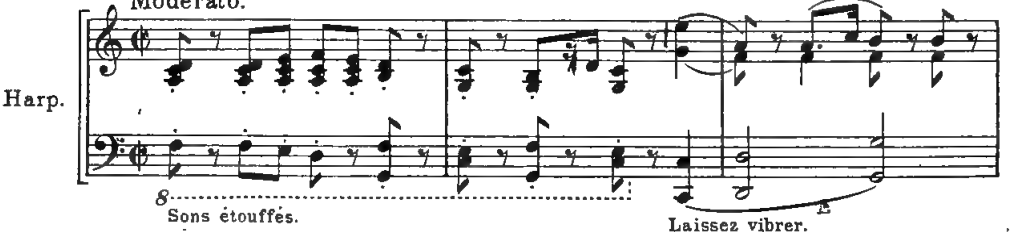
(1) The method of stopping the string as soon as the note is uttered. The sounds so produced are known in france as sons étouffés, and are, in quality, something like a short dry Stringprzzicato. They • difier strikingly in effect from the usual warm vibrant notes of the instrument. In the Score they may be indicated stopped the resumption of the ordinary technique is usually indicated in French Harp music by the words laissez vibrer. dotted line, however, clearly showing the required limits of the stopped passage is quite sufficient for all ordinary purposes. Here is a brief example of this style of tone-production :
Example 291
Th. Dubois. Ronde des Archers (Transcription de Mlle L. Delcourt.)
(2) The method of plucking the strings close to the soundingboard. The sounds so produced are generally known to French Harpists as Sons près de la table. The effect is metallic and somewhat more like a Guitar or Banjo. The following short quotation ' gives an example both of these sounds and of the ordinary Harp-Harmonics. "M.D." and "M.G." of course mean right- and left-hand respectively.
Example 292
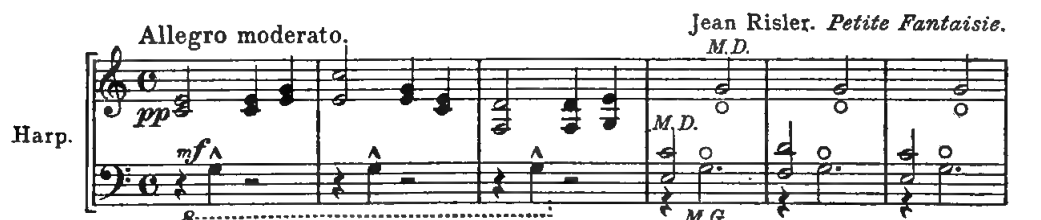
Sons près de la table.
1 For a good example, see the Valse des Sylphes in Berlioz's Faust. 2 From Jean Risler's Petite Fantaisie pour Harpe Chromatique.
Shakes and Tremolos.
Shakes and trennolos, as a rale, sound rather stupid on the Lach They are both played by means of a double-handed technique. group of notes making up the shake or tremolo is performed rapidly and alternately by the right and left hands, thus:
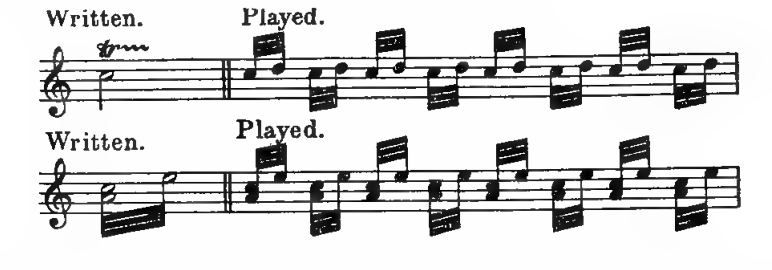
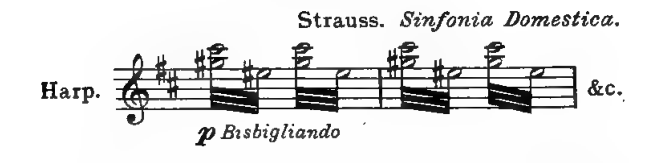
Neither is worth doing in anything but a pranissimo, scarcely even then. The tremolo has only recently been introduced into orchestra. music as a sort of murmuring ("bisbigliando") accompaniment. It is not often met with, but an example may be found on page 67 of Strauss's Sinfonia Domestica,
Example 293
With the old masters, from Händel onwards, the Harp was used more especially to give an appropriate "tang" to those subjects which demanded a flavour of antiquity. This particularly suited the taste of the French under the first Empire. Macpherson and the Classies were then all the vogue, and the Harp became firmly established in Parisian orchestras as an interpreter of the pseudo-classical culture and of the vaporous days of Ossian. From France its orchestral use spread through Germany to the rest of Europe. Nowadays every Symphony and Opera orchestra has at least a couple of Harps. Its fine poetical qualities have become better understood. Its power of characterization- varying according to its music from the fairy-like to the grandly heroic—-is now employed on more general topies. It is still occasionally used to produce the illusion of antiquity, but that side of its musical character tends to become of less importance.
A list of those arpeggios which have been found practical and effective is scarcely worth giving. Owing to the nature of the case it would occupy an enormous amount of space. Furthermore, the type is familiar to all and varies mainly with the momentary necessities of the harmonic progressions. A certain number of quotations have already been made in which the Harp figures in a subsidiary manner. The student should now refer to these. They include examples of
(1) Single repeated-notes: opening of Saint-Saëns's Danse
Macabre. Example 17.
(2) Enharmonie-unisons, where (A) both strings are plucked at
the same time: the "bell-effect" in Wallace's Villon. Example 20. (B) The two strings are used separately as Debussy Pellas et passage a resar pie ere to the already reterred to in former example (A) the
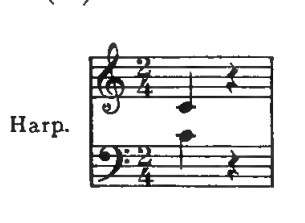
is one of the two enharmonic-unisons produced 1 by pedalling the lower string into the 2nd notch and the upper string into the Ist notch. The unison is actually B$-C* on the Bb and Cb strings.
(3) Melody-notes where the Harp-part is merely added to give
the ictus of the bell: Bizet's Carlon. Example I9.
(4) Simple arpeggio-accompaniments: Tschaikowsky's Romeo
and Juliet, Example 141, and Bizet's Carmen, Example 106.
(5) Simple chord-accompaniments in the lower-middle register:
the two quotations from Strauss's Don Juan and Don Quixote. Examples 134 and 135.
(6) Bass-octaves, occasionally useful in quiet passages,
generally needing either support or thin orchestration: Bizet's Carmen. Example 43.
As it is not possible to give elaborate quotations of Harp-parts here, a few detached observations will be made on the writing of these parts. The student should then take any modern Full Scores to which he has access. and see how these general rules work out in practice.
(1) The Harp is the only instrument whose particular technique has given a generic word-arpeggro-to the rest of the instrumental force. It is unnecessary to dwell on the point that nine-tenths of all orchestral Harp-music must be "in arpeggio."? That does not preclude the occasional use of individual detached notes, short prominent melodic tigures, and so on. These are often found nowadays in the quieter parts of compositions. Their effect is generally in inverse ratio to the number of notes written.
(2) In laying out Harp-chords and arpeggios remember that the
1 See page 465.
2 For a very happy example of the arpeggios suddenly "coming through " the rest of the orchestra, see the 52nd bar from the end of Wagner's Overture to the Flying Dutchman. , The heavy Brass is taken off and the Harp-part has only to contend with the Wood-wind, the Horns, and a light pizzicato.
Harpist uses only the thumb and first three fingers. The little finger remains idle. Five-note chords and arpeggios for either hand are therefore impossible.
(3) The Harp-octave, though controlled by only four fingers, consists merely of seven strings, and these are fairly close together. The Pianoforte-octave controlled by five fingers consists of twelve notes. The advantage in ease of mechanism lies clearly with the Harp. The scale is more "under the hand." Stretches up to and even beyond a tenth are normal for the Harpist. Indeed, that interval -the tenth-—may be said to correspond on the Harp to the pianist's octave-stretch.
(4) In general, the more notes and the closer they are placed in an arpeggio or chord the better the effect.
(5) The Harpist always "spreads" his chords slightly. If the composer wants a short pizzicato effect he must take care to write only notes that lie well under the fingers of the two hands. The chord is then marked with some such expression as short or struck. The French word sec (dry) is often used for this purpose.
(6) Don't let the centre oi your arpeggio figures lie either too higl or too low. Spread them well , and, except for special elects, keep to the most sonorous part of the instrument between
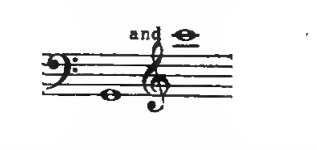
(7) In two-part arpeggios do not ask the fingers of one hand to Plack those so, do ole have jat been gotted pt the other to d. equally important errat the te o eat is jet lie top posite ends of the Keep the hands fairly close, but don't let them overlap. Keep the
(8) Very long arpeggios can only be written in one part. Lac changes position to take up the arpeggio aiter the other hand
(9) You cannot get away trom the non-chromatic nature of the instrument. Ihere is always that restriction. It is by no means necessary that the Harp should stop playing at every slight modulation. The pedals can be employed during performance or in any momentary rest. But of course when they are employed the string or strings on which they are used must be for the moment out-of-action. A little understanding and ingenuity in laying out the Harp-part so as to avoid the chromatic note or notes is amply repaid by ease of performance and enhanced effect. It there are distinct pauses between the chords or arpeggios the instrument can be reset for each new This is, however, somewhat out of the character of the Harp. attack.
(10) If the harmony is of a wildly chromatic character either omit the Harp altogether or write for two. In the latter case divide up the passages so as to give the minimum of pedalling to each of the players. Quite apart from chromatic necessities the Harp-part gains enormously by an increase in the number of players. Reasons of expense, however, otten lead, in the periormance of even the greatest works, to the "boiling down" of the Harp-parts.
(11) When two or more Harps are employed and it is not necessary for chromatic reasons to cut-up the Harp-parts, richness of effect is rather secured by writing additional separate parts than by reduplication of the same part. This must, however, be interpreted with discretion. A 2nd, 3rd, or 4th Harp-part that is merely filling in the notes which the Ist Harp happens not to be playing at the moment Is apt to sound unsatisfactory. With straightforward arpeggios, however, this difficulty will seldom arise.
(12) Repeated notes on different strings are possible at any pace. Repeated strings, however, are less easy. Except in quite slow tempos they are better avoided.
(13) In the very # keys, such as B4, F7, and Of, it is better to write the Harp-part in the corresponding enharmonic flat keys, Cb, Gb, and Do. It gives a greater vibrating length tor the strings.
(14) Be careful where you " place " your Harp-chords in the music It the instrument is merely adding • the mechanical tinkle of its arpeggios to the general orchestral ensemble, the "placing" does not much matter. In any other circumstances it is well to think the matter over carefully, and "plant" the chords wherever they derive the greatest force from the harmonie scheme of the music. In extended arpeggios you must face the necessary toil of writing a great many notes. On the other hand, a few cunningly-placed chords, or even isolated notes, are occasionally strikingly effective.
(15) Some of the great masters have written without much understanding for the Harp. The detailed technique of the instrument can be studied in the works of such specialists as Parish Alvars, Oberthur, Zabel, Dubois, etc. In studying serious modern orchestral composers you cannot do better than make yourselt acquainted with Granville Bantock's Scores. His Harp-parts are models of refinement and happy effect.
(16) In translating trom Pianotorte to Urchestra you will often tind that the music of the original is enclosed and defined by means of a This is the nature of the Pianoforte.

l'he mere transliteration and rearrangement ot these planoiorte pas sages for Harp against an orchestral background is rarely satisfactory The Pianoforte passage is the music: the Harp part merely gives the effect of an addition to the music.