 Playable Books
Cecil Forsyth · section 57 of 60
No. 53. The Chromatic Harp.1
Read and hear this section in the playable edition →The Chromatic-Harp is little seen in English concert-rooms. It is, however, an interesting instrument, whose usefulness is bound to increase with the continued development of chromatic-harmony. A few words with regard to its mechanism and capabilities may therefore not be out of place.
The Chromatic-Harp abandons the Pedal-action altogether, and substitutes a string for each semitone throughout the entire compass. The arrangement of strings adopted is, curiously enough, by no means new. In tact a primitive instrument on this system is to be seen in the South Kensington Museum. It is a Scottish Harp of the fifteenth century.
The main difficulty in producing a Chromatic-Harp, of course, lies in the fact that, as there is a string for each semitone, the total number of strings is nearly doubled. And the ancient system which has been revived to solve this difficulty consists in using a double series of strings.
The first series runs from the right-hand side of the "comb" to the lett-hand side of the sound-board; the second series runs trom the leithand side of the "comb" to the right-hand side of the sound-board. The strings are therefore in two distinct planes which bisect each other at an acute interior angle. Their position may be roughly represented by two hair-combs so locked together that each pair of adjacent teeth forms the capital letter X
With this instrument a completely new finger-technique is demanded from the Harpist, and this undoubtedly militates against its artistic progress. One must therefore be chary of condemning an instrument against whose introduction the interests of a great many living Harpists combine. On the musical side it may be said with music playable on the Pianoforte is also playable on the Chromatic- Harp. If space permitted, this assertion might be supported by endless examples taken from the works of the modern French school. This is naturally the instrument's special title to the musician's respect and sympathy, though, it must be candidly admitted that the general opinion of Harpists and Harp-makers is against the Chromatic-Harp on the score both of its technique and its poor tone. The instrument, however, has some minor advantages, of which two may be mentioned here.
(1) There are no pedals. There is therefore no unmusical noise. The player is tree to devote himselt entirely to what should be his proper task, the control of the strings by his hands.
(2) The strings are not being continually shortened and lengthened.
1 Invented by Lyon, and adopted by the Parisian firm of Pleyel. The instrument is
made by Pape in 1845.
They last longer,—a serious advantage to the player. Their intonation is more stable.
Against these advantages it has been objected:
(1) That it is not in the nature of the Harp to be chromatic. This sort of criticism, which has probably been directed against every advance in instrumental-construction, is sufficiently answered by patin the ate ed in lar to b orrotation, " that it is not in the
(2) That the Chromatic-Harp cannot perform the glissandos which exist everywhere in the modern repertoire of the Pedal-Harp. This may possibly be good news to the frequenters of our concert-halls. It may dispose many of them to look with a friendly eye on the new Chromatic-Harp. It involves, however, an interesting and unique point. Every musical instrument at the successive phases of its evolution has invariably incorporated the resources and the technique of its predecessor, and has added some new facility, some greater scope for musical expression. The Chromatic-Harp alone seems to be an exception to this rule. It is true that its harmonic radius is far greater than that of the Double-Action Pedal-Harp. On the other hand, it has been compelled by its very nature to abandon the system of setting its scales into tixed harmonic patterns. The glissando as a standing dish has to disappear from the Harp menu.
It need scarcely be said that, putting aside its advantages in the way of chromatic passage-work and its disadvantages in the way of glissando-chords, one can treat the instrument orchestrally very much as if it were an ordinary Double-Action Pedal-Harp
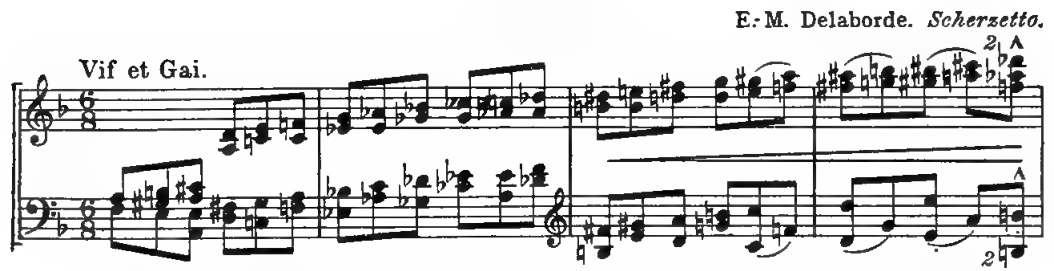
The student will be interested to see a specially written passage embodying chromatic features which could not possibly be played on the ordinary instrument. The following quotation is from a work composed for the Chromatic-Harp. If the student will merely write out the pedalling necessary tor the pertormance of these tour bars on the Double-Action Pedal-Harp he will see how widely ditferent are the mechanical conditions of the two instruments. No one in his wildest moments would write such a passage for the older instrument, and, it he did, it would sound anything but vif et gar when performed
Example 294
It may be said that the special literature for the Chromatic-Harp is at present small. It tends, however, to increase in quantity.