 Playable Books
Cecil Forsyth · section 58 of 60
No. 54. The Mandoline.'
Read and hear this section in the playable edition →
Fr. Mandoline; It. Mandolino; Ger. Mandoline. This is a smail pear-shaped instrument with a fretted neck. It is furnished with eight wire-strings tuned in pairs. The actual tuning is now standardized by the Neapolitan makers is the same as that o the Violin:
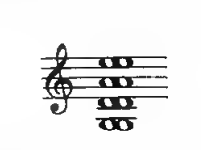
In the best makes a simple "machine-head" with screws and ivory thumb-pieces is used to tighten and loosen the strings.
The peculiarity of the instrument is that, in its method of toneproduction, it employs the ancient and now almost disused plectrum. As miniatul, done the Maydolinist, this ponsie of l. tal last piece merely to produce single staccato notes, but also a sort of tremulous tenuto. This is accomplished by a rapid iteration of the plectrum to and fro on any pair of strings. The resultant sostenuto is the chlet characteristic of the instrument. The fingering is the same as that of the Violin, and it has a working compass trom its low G (fth string) of about two octaves and a major sixth.
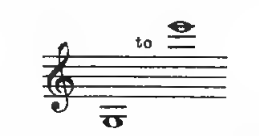
The Mandoline-part is written in the treble-clef at its actual sounding. 'pitch. The poor tinkley tone-quality and the imperfect method of tone-production preclude the instrument from taking a serious place in music.
In the theatre the Mandoline has been used by Mozart in Don Grovanni, by Grétry in L'amant jaloux and by Verdi in Otello. The well-known serenade in Act II. of Don Giovanni-Deh vieni alla finestra-has an obbligato part marked in the Full Score "Mandolin. ‚in view of the specially staccato nature of this obolgato-mostiy semiquavers in a & Allegretto-and of the admitted indefiniteness in the nomenclature of the less commonly used instruments, Mozart's intention has been questioned more than once. It has been suggested that, if he had really wished the ordinary Neapolitan Mandoline, he would have written phrases more characteristic of its special method -the reiterated tenuto. A decision on this point is difficult, though if the Mandoline was not intended it is not easy to see what staccatoinstrument could supply its place in this Number. It must be added that in practice the whole obbligato is played, nine times out of ten, by the Ist Violins pizzicato.
1 Diminutive of Mandora or Mandola. The modern Italian Mandola is a large Tenor-Mandoline. See what has been already said with regard to the early Pandoura, page 291.